


“If you can convince the lowest white man he’s better than the best colored man, he won’t notice you’re picking his pocket. Hell, give him somebody to look down on, and he’ll empty his own pockets for you.”
(BALTIMORE – September 13, 2026) – It is the 800-pound gorilla in the room.
It is standing directly in front of us, staring us in the face, yet nobody seems willing to talk about it.
Black people are being found hanging across America.
We hear the reports sparingly—one from Mississippi, another from Georgia, another from Michigan, and then three in North Carolina. The stories appear briefly, then disappear beneath celebrity gossip, political theater, and the relentless churn of social media.
It is almost as if these deaths are to be expected. Almost as if they are no big deal.
But let me ask a brutally honest question: If 10 white people were pictured together after being found hanging across America, would this country be so quiet?
I do not believe it would.
The cries for justice would be deafening. Cable news would provide around-the-clock coverage. Congressional hearings would be scheduled. Investigative teams would descend on every community involved. We would hear the victims’ names every day.
Yet these are Black lives, so America appears prepared to accept a few official statements and move along.
No. We will not move along.
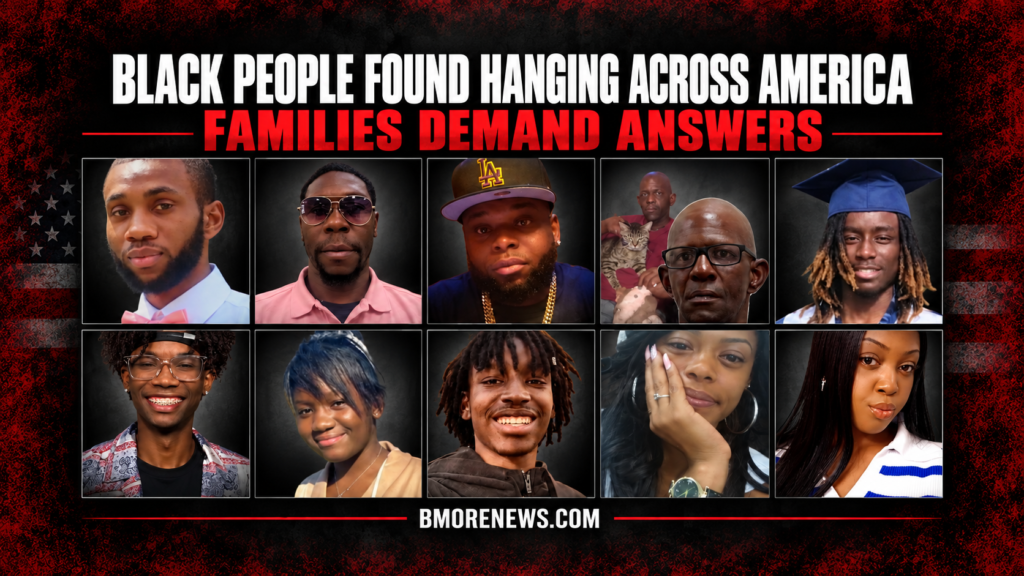
The people pictured here include Tasia Sidea Fortune, Kyle Bassinga, Juliana Nzita, To’Nea Nicole Miller, Jerard “Jay” Jackson, Demetrius Eugene Fleming, Earl Smith, Demartravion “Trey” Reed, Dennoriss Richardson and Javion Magee.
These deaths occurred in different places, under different circumstances, and across multiple years. That does not diminish the obscenity. It is the indictment.
Most of these victims had not reached the prime of their lives. Some were teenagers or young adults. Juliana Nzita was only 16. Several were 21. Tasia Fortune was a 29-year-old mother of four. Demetrius Fleming was a 38-year-old father of nine.
They were human beings. They had families, histories, dreams, and people who loved them.
What happened to them?
Why are Black people still being found hanging?
And why does North Carolina appear to be leading the way?
This should have ended generations ago
Let me make something perfectly clear: I do not care whether these deaths happened during the same month, the same year, or in the same state.
They happened in modern America.
That is the obscenity.
Lynching is supposed to belong to the era of segregation and Jim Crow. America was supposed to have confronted this terror during the Civil Rights Movement. Congress signed the Civil Rights Act in 1964. The Voting Rights Act followed in 1965. The country congratulated itself for beginning to dismantle legalized segregation.
Yet Black people are still being found hanging from trees, bridges, and other structures.
One Black person found hanging should bring this country to a standstill. One should produce national headlines, an independent investigation and an uncompromising demand for answers.
Instead, we have multiple names, multiple bodies, multiple grieving families and a country that keeps scrolling.
Do not distract us by saying the cases are different. Of course they are different. Every human being’s death has its own facts.
The pattern is that Black people are still being found hanging in America at all.
That is egregious.
It is despicable.
It is disgusting.
It is inhumane.
It should be treated as a national emergency.
Why is North Carolina leading the way?
In 2026, Juliana Nzita was reportedly found hanging from a tree on church property in Charlotte.
An unidentified 32-year-old Black man was found hanging from a tree in a downtown Raleigh parking area near the CaribMask Caribbean Festival on August 15.
Six days later and less than 100 miles away, Demetrius Fleming was found hanging at a residence in Roanoke Rapids.
Three Black people. One state. Several months.
That does not establish that the cases are connected. It does establish a concentration serious enough to demand investigation, public scrutiny and sustained national attention.
The absence of a publicly accessible national database makes it difficult to determine exactly how many Black people have been found hanging. That absence is not a minor administrative problem. It prevents journalists, families, researchers and communities from determining whether a broader pattern exists.
Congresswoman Ayanna Pressley led 59 congressional colleagues in sending a letter dated September 8, 2026, to the Department of Justice and FBI. The 60 lawmakers said at least 10 Black people had reportedly been found hanging in the United States during 2026.
They demanded independent autopsies with family consent, audits of local and state investigations, reviews of physical and testimonial evidence, reports to Congress and systematic national data collection.
That is not an unreasonable demand.
It is the minimum.
Read the congressional letter.
The social-media confrontation
Another part of this conversation is one America may not want to touch.
Social media has changed the racial power dynamic in public confrontations. Today, our feeds regularly feature videos of white people using the N-word, provoking Black people and then being met with an immediate physical response.
Black people are not always walking away quietly, lowering their eyes or accepting racial humiliation.
They are clapping back.
In video after video, someone uses the most inflammatory racial slur in the English language and discovers that Black people are no longer willing to absorb it without consequence. These confrontations are recorded, uploaded, and sometimes viewed millions of times.
For generations, white supremacy depended not only on physical violence but also on the expectation of Black submission. The racial order required Black people to know their supposed place and remain there. A Black person who talked back, resisted, or publicly embarrassed a white person could face deadly retaliation.
I believe we must investigate whether the present reports of Black people being found hanging are connected in any way to this changing social climate.
Let me be precise: I am not claiming that evidence has already established a direct connection between a particular social-media confrontation and any particular death.
I am saying the question cannot be dismissed before anyone seriously investigates it.
Could some of these hangings represent retaliation following confrontations involving racial slurs?
Could some be warnings intended to reassert an old racial order?
Could the public display of a Black body carry a message extending beyond the individual victim?
Who is examining these possibilities?
We should not have to apologize for asking. History gives us every reason to ask.
Racial violence grows in a climate
These deaths are not occurring in a vacuum.
America has witnessed the rise of the Proud Boys, the January 6 attack on the United States Capitol, and renewed political efforts to control how the country presents its racial history.
Members of the Proud Boys played documented roles in the Capitol attack. Several leaders were convicted of serious federal offenses related to efforts to prevent the lawful transfer of presidential power.
Donald Trump’s political movement has repeatedly pushed the country into confrontations over race, immigration, diversity initiatives, universities, museums and the teaching of American history.
Trump installed himself as chairman of the Kennedy Center and announced that it would suspend entertainment operations for two years beginning July 4, 2026, for reconstruction. The announcement followed sweeping leadership changes and the withdrawal of artists and major arts organizations. Reuters
The Trump administration has also attempted to reshape how the Smithsonian Institution presents American history. A 2025 executive order directed officials to remove what the administration called “improper ideology” from Smithsonian museums and placed funding for certain programs under scrutiny.
The National Museum of African American History and Culture has been caught in that political crossfire because of how it presents slavery, racism, and the Black experience. PBS NewsHour
How do you tell the history of America without telling the history of racism?
How do you explain the wealth of this country without discussing slavery?
How do you present American democracy without acknowledging the Black people who were excluded from it, fought to enter it, and died demanding that America honor its own Constitution?
You cannot erase Black history and claim to be protecting American history.
Black history is American history.
Project 2025 and the machinery of power
This discussion must also include Project 2025.
The extensive conservative policy blueprint called for expanding presidential control over the executive branch, restructuring the federal workforce, reversing diversity and equity policies, and transforming how numerous federal agencies operate.
Not every recommendation in the document has been adopted, and Project 2025 does not prove who caused any particular death. But it is part of the machinery shaping the political climate in which these deaths are occurring.
Racial violence does not emerge from thin air. It grows in a climate. It grows when political leaders traffic in racial resentment, when white-nationalist organizations are emboldened, when Black history is attacked and when policies seek to dismantle protections Black people fought generations to secure.
I am not claiming that Project 2025 or Donald Trump ordered any of these hangings. I am saying that words, policies and political permission have consequences. When racism is legitimized from the highest levels of government, racial hostility does not remain trapped inside speeches and policy documents. It travels into workplaces, schools, streets and communities.
All of it contributes to the climate in which racial violence grows.
Race has always been used to conceal the class war
There is another deception at work.
Poor and working-class white people have repeatedly been persuaded that Black people are responsible for their economic insecurity. They are told that Black workers took their jobs, Black families received their benefits, Black students took their opportunities and Black political power threatens their future.
That anger is directed downward or sideways—toward Black people enduring many of the same economic struggles—instead of upward toward those controlling the country’s wealth, corporations and political institutions.
President Lyndon B. Johnson understood that racial superiority could be used as compensation for economic exploitation.
Convince a struggling white man that his Black neighbor is the enemy and he may never look toward the billionaire, corporation or political system benefiting from both families’ hardship.
Some poor and working-class white people are led to believe they are defending the white race or preserving white supremacy. But white supremacy has never promised them equality with the super-rich.
Unless they possess enormous wealth and power, they are not inside that circle.
Their whiteness may offer social status or someone to look down upon, but it does not guarantee economic security, affordable health care, decent housing, quality education or a dignified retirement.
Poor white people and poor Black people are encouraged to wage war against each other while the super-rich remain safely removed from the battlefield.
That is the trick.
That is what racism conceals.
That is whom racial division serves.
Economic insecurity does not excuse racial hatred or violence. Every person remains responsible for his or her actions. But we must understand how racial resentment is cultivated, manipulated and directed.
History also shows that lynching was not merely the work of poor, uneducated white people acting alone. Lynch mobs included elected officials, business owners, police officers and prominent citizens. Newspapers promoted the accusations. Prosecutors refused to prosecute. Politicians defended segregation. Respectable institutions created permission for the violence while people farther down the economic ladder frequently carried it out.
The system operated from top to bottom.
It still does.
Laura and L.D. Nelson
History has shown what happens when the deaths of Black people are explained away and the country moves on.
On May 25, 1911, a white mob abducted Laura Nelson and her teenage son, L.D. Nelson, from the Okfuskee County jail near Okemah, Oklahoma.
Neither had received a trial.
The mob overpowered the jailer, carried the Black mother and her son to a bridge over the North Canadian River and hanged them together. Their bodies were left suspended approximately 20 feet beneath the bridge.
Contemporary reporting and the NAACP’s The Crisis said Laura was sexually assaulted before she was murdered, although that allegation does not appear in every historical account.
White spectators gathered at the scene. Photographs were taken. The lynching became a public spectacle and a warning to the surrounding Black community.
No one was prosecuted for abducting and murdering Laura and L.D. Nelson.
That was not simply an attack on two people. Their bodies were used to send a message to every Black person who saw them or heard what happened:
This can happen to you too.
More than a century later, Black people are again being found hanging in public and semi-public places—from trees, near parks, on church property, on a college campus and behind abandoned buildings.
We are told to accept the official explanation. We are warned against raising questions. We are instructed not to recognize the historical terror staring us in the face.
Black America has heard that language before.
Government institutions, coroners, police departments and prosecutors are operated by human beings. They can be competent and honorable. They can also be biased, negligent, politically influenced or wrong.
The official version is part of the story. It is not the only story.
Who receives scrutiny?
The silence surrounding these deaths reminds me of the recent Lindsay Clancy trial.
Clancy admitted killing her three children. Her defense argued that postpartum psychosis made her not criminally responsible. Eleven jurors reportedly were prepared to accept that defense. The lone holdout was reportedly the jury’s only Black member.
The trial ended in a mistrial after an 11–1 deadlock. Attention quickly shifted toward publicly scrutinizing the holdout juror.
The comparison is about where America directs its attention.
Black people are found hanging and the country struggles to maintain focus. One Black juror refuses to join 11 others and the spotlight rapidly turns toward investigating him.
Something is fundamentally wrong with that imbalance.
We demand answers
The people pictured here cannot be reduced to photographs circulating on social media.
Their names must be remembered. Their families must be heard and every question must be pursued without fear or political interference.
We need independent autopsies.
We need federal reviews of local investigations.
We need the preservation and full accounting of physical evidence.
We need a transparent national database documenting every reported hanging death.
We need journalists willing to investigate instead of merely repeating government statements.
We also need the courage to examine whether racial resentment, online confrontations and America’s worsening political climate bear any relationship to what is happening.
Asking that question does not establish the answer. Refusing to ask guarantees that we may never learn the truth.
America must stop treating the sight of Black people hanging as ordinary.
It was never ordinary.
It was never acceptable.
Nothing about hatred makes America stronger.
Nothing about suppressing Black history makes America stronger.
Nothing about government violence makes America stronger.
And nothing about Black people being found hanging should ever be accepted as normal.
It must stop now.