


(BALTIMORE – September 27, 2026) – One of the most-read stories on BMORENews.com is my October 2025 article, “Albert Perry, DNA, and the Reclaiming of Identity.” Readers still find it nearly a year later.
That made me revisit the story. What did the original research establish? What happened after the headlines? And had I given readers the clearest account of the people who made the discovery possible?
The answer to that last question is no.
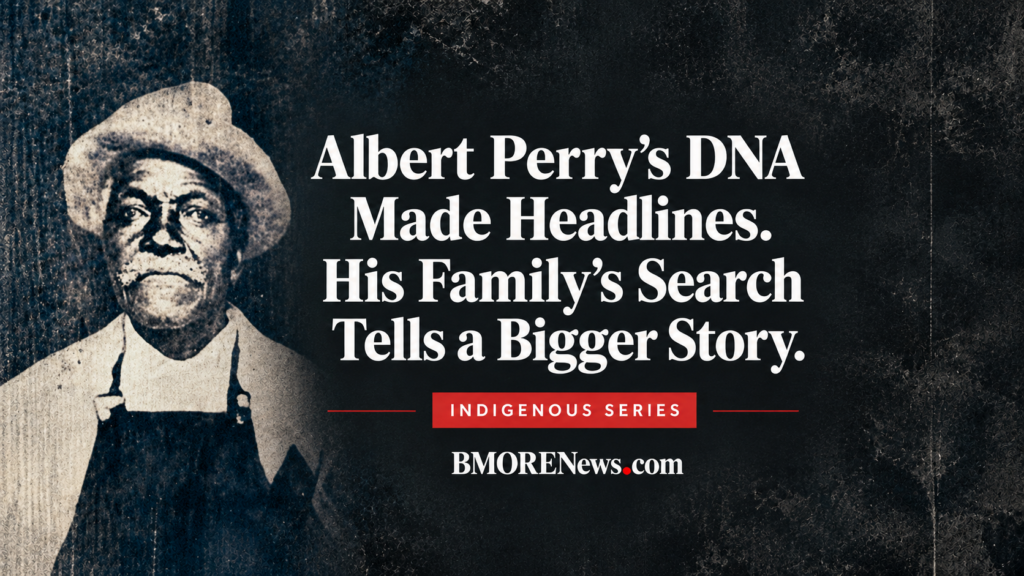
Albert Perry did not take a DNA test. He lived in nineteenth-century South Carolina. His descendants were tested because Jacqueline Johnson, his great-great-granddaughter, looked into her family’s history. That search belongs at the beginning of this story.
Before the laboratory, there was a family question
Johnson traced Albert Perry to the 1870 census, where he appeared by name after emancipation. Researchers and genealogists place his birth sometime between 1819 and 1827 in Chester or York County, South Carolina. His precise birth date, his earlier life, and the generations before him remain difficult to document.
If you have researched your own family, you know, like I do, what it feels like to find a name and then reach a gap in the records. The person on that census page lived a whole life. They had parents, memories, and relationships. But the surviving documents may give you only a few lines.
In a PBS interview, Johnson spoke about her frustration at reaching the 1870 record. Her ancestors did not simply begin to exist when a census recorded their names. She wanted to know where they had been before then. She wanted to know who Albert Perry was.
That question led her to genetic genealogy. A Y chromosome passes through a direct father-to-son line, so Johnson arranged testing with male cousins descended from Albert. The relatives who provided samples actively participated in a family search. Their DNA did not appear in a laboratory by accident. The authors of the 2013 scientific paper thanked Jacqueline Johnson and her male cousins, the descendants of Albert Perry, for their contribution.
I want to be clear about that because a story can lose its people when a scientific result becomes famous. Johnson did the genealogical work. Her cousins agreed to be tested. Researchers then studied the results. We should credit every part of that chain.
What did the DNA reveal?
The tested Y chromosome occupied an exceptionally deep, previously unrecognized branch of the known human paternal family tree. Researchers named that branch haplogroup A00. Fernando Mendez and his colleagues published the discovery in the American Journal of Human Genetics in 2013. They also identified related A00 markers among men sampled from the Mbo population of western Cameroon.
That was a remarkable finding. A Black American family’s pursuit of its history had helped researchers recognize a branch of the Y-chromosome tree they had not previously documented.
But a Y chromosome tells a particular kind of story. It follows one paternal line among the many lines that make up a person’s ancestry. Think of the fathers and mothers in your family tree, and then their fathers and mothers. The number of ancestral paths grows with every generation. A Y-chromosome result follows just one of those paths.
Finding A00 in the Perry descendants and among men sampled in Cameroon is a meaningful genetic connection. It does not supply the names or life stories of every person between those groups. It does not tell us precisely when any one ancestor crossed the Atlantic or identify the individual African community from which Albert Perry’s own forebears came. Those are questions that require more evidence.
The number that traveled around the world
The 2013 team estimated that the most recent common ancestor of the Y-chromosome branches in its analysis lived approximately 338,000 years ago. Its reported 95% confidence interval ranged from 237,000 to 581,000 years ago. The figure made headlines because it placed that proposed branching point much further back than many earlier estimates.
Here is the distinction I should have made more clearly in my original article: Albert Perry was not 338,000 years old. The researchers were estimating the age of an ancient shared paternal ancestor, based on genetic differences and assumptions about how quickly those differences accumulated.
A scientific estimate is an argument supported by evidence and a method. Other researchers can examine both.
That is what happened in 2014. Eran Elhaik, Tatiana V. Tatarinova, Anatole A. Klyosov and Dan Graur published a critique in the European Journal of Human Genetics. They accepted A00 as a newly identified, deeply branching Y-chromosome lineage. They challenged the age estimate, arguing that the original analysis depended on its choice of mutation rate and on comparisons involving unequal DNA sequence lengths. Their reanalysis produced an estimate of approximately 208,300 years ago, with a reported 95% confidence interval of 163,900 to 260,200 years ago.
Those are two substantially different estimates. The later paper did not erase the discovery, and its number should not simply replace the earlier number as an unquestionable fact. Readers deserve to know who calculated each figure and why scientists disagreed.
That disagreement is part of the story of science. Researchers publish a finding. Others inspect the data and the assumptions. The conversation continues.
Another discovery in Cameroon
It did continue. In 2020, a research team led by Mark Lipson reported DNA findings from remains at the Shum Laka archaeological site in Cameroon. One child buried about 8,000 years ago carried haplogroup A00.
That finding places A00 in the region thousands of years before modern DNA testing. It adds to the evidence that this paternal lineage has a deep history in Africa. It does not show that the child was a direct ancestor of Albert Perry or his descendants; the researchers’ analysis does not support that direct-line claim.
To me, that makes the research more interesting, not less. We can follow new evidence as it appears without pretending every discovery answers every question.
What the Perry finding cannot settle
Readers of the INDIGENOUS Series bring serious questions about ancestry, identity and the histories that have been obscured. I share that interest. It is one reason I first wrote about Albert Perry.
But this particular DNA result cannot, by itself, prove that Perry’s ancestors lived in the Americas before European colonization. It cannot determine whether a person or family belongs to an Indigenous people. A paternal marker is not a record of tribal citizenship, community ties, culture, or someone’s full ancestry.
We need these distinctions if we want our research to stand up. DNA can reveal a genetic relationship. Census records can establish where someone was documented at a particular time. Family accounts can preserve knowledge that official paperwork missed. Indigenous communities have their own histories and ways of determining belonging. Each form of evidence has something to tell us; none should be asked to do another’s job.
There is no shame in saying, “We do not know yet.” That is often the sentence that leads to the next good question.
The family kept contributing
The Perry family’s part in this story did not end when the first paper was published. As more detailed testing became available, the original great-grandson’s sample was upgraded to Big Y-700, and two other Albert Perry descendants were tested at that level. The results refined branches within the family’s paternal line.
In a public comment about that later work, Jacqueline Johnson thanked John Clyde Perry, Clifford Anthony Norwood, and Barton LaMont Perry for contributing to the family research. I want their names here. The scientific literature can tell us what the testing found. Their names remind us that family members chose to take part in an inquiry that continued long after the first headlines.
I do not know what each of them felt when the results came back. I will not put words in their mouths. I do know that Jacqueline Johnson’s question—Who was Albert Perry?—gave the discovery a human starting point.
Why I came back to this story
The first article reached thousands of readers. That is a reason to keep reporting, and a reason to correct what needs correcting.
I still believe the thought at its heart: Black history did not begin with slavery. The people whose names we are trying to recover had ancestors, traditions, and full lives before the records we can find. But one Y-chromosome study cannot tell us every detail of that history. Respecting the history means being honest about the evidence.
And perhaps that is why Albert Perry’s story has stayed with readers. A scientific paper can tell us where a lineage sits on a tree. It cannot tell us everything about the man in the 1870 census. Jacqueline Johnson kept looking because she wanted to know the person behind that name.
How many of us have an Albert Perry in our own families—a name we have found, with a life we are still trying to understand? How many have a relative like Johnson, calling cousins, studying records and refusing to let a gap on the page be the end of the story?
The “so what” is not that one number tells us who we are. It is that asking about our people matters—and that we can pursue those answers with both passion and care.
Albert Perry’s descendants helped reveal an extraordinary paternal lineage. Researchers studied it and debated its age. Now it is our responsibility to tell the story accurately, give the family its due, and keep asking the questions the evidence has not yet answered.
Who is the person in your family whose story you are still trying to find? Tell BMORENews. Your question may be where the next story begins.
Sources and further reading
- Fernando L. Mendez and colleagues, “An African American Paternal Lineage Adds an Extremely Ancient Root to the Human Y Chromosome Phylogenetic Tree,” American Journal of Human Genetics (2013).
- Eran Elhaik and colleagues, “The ‘Extremely Ancient’ Chromosome That Isn’t,” European Journal of Human Genetics (2014).
- Mark Lipson and colleagues, “Ancient West African Foragers in the Context of African Population History,” Nature (2020).
- PBS, First Peoples: Africa, featuring Jacqueline Johnson discussing her research.
- FamilyTreeDNA’s Y-Haplogroup A Project, on Johnson and her cousins; and Roberta Estes, “Rare African Y DNA Haplogroup A00 Sprouts New Branches” (2020), on later testing by Perry descendants.