

(BALTIMORE – September 29, 2026) – My journey in media began long before I knew it would become my life’s work.
At Matthew Henson Elementary School #29, I helped produce the morning announcements under the guise of Mr. Kermit Williams. I can still hear that line about a half pint of milk: “Mm-mm-mm, sure sounds delicious.”
My father, Donald E. “Doc” Glover, kept copies of Black Enterprise in his office at the funeral home. We lived above the funeral home until I was nine. I must have been six or seven when I started reading those magazines for fun. There were so many, and I read them all. That was Earl Graves’ early impact on my life. Ebony was there, too. And Jet had the centerfolds.

Doc also had me listen to Carl T. Rowan’s The Rowan Report and Paul Harvey’s “The Rest of the Story.” My father used to say, “There is always something to report.” He was teaching me to pay attention.
I started out selling The Sun and the News American. Eventually, my father helped me build my own AFRO route. Mr. Johnny Smallwood brought me my papers every Tuesday and Friday. His son is Cat Eye Butch. I remember them coming through with those papers, and I remember heading out to sell them. I had the biggest Afro route in West Baltimore.
If you ever meet somebody who was an AFRO paperboy, ask about the bus. Most everybody I have met, including Dr. Al Hathaway, brings up the same thing: We could get on without paying the fare if we were selling our newspapers. What kid wouldn’t get a kick out of that?
I rode the bus on North Avenue selling papers. I would make one trip down, then one trip back, offering the AFRO to people along the way. It was common practice then. The bus was part of my route, and I loved it.
Every Friday, I also went to Penn North to get a copy of Earl Koger’s The Pocket. Years later, I learned that he had helped integrate Easterwood Park, the park where I grew up. Talk about a full-circle moment.
As a child, I appeared on Channel 13 with Bob Turk and the Sunshine Kids, and later on Evening Magazine. Our elementary school study of Indigenous culture even made the newspaper.
I paid attention to the people on television, too. I watched Ted Koppel on Nightline religiously. I loved his presentation. I loved watching Bryant Gumbel on Today. As a kid, seeing a Black man in that position on national television meant something to me. I remember coverage from Cuba, seeing Bryant Gumbel and Barbara Walters, and looking at images of a place I had never seen before. I thought, I’d like to go there.
Charlie Dugger was the one who took me on the radio when I was 15, at WEAA and WEBB. I have to acknowledge him. He gave me an opening when I was just a kid.
In 1993, on my second attempt at undergraduate school, I went to Coppin State to study media arts, broadcast production and technology. I began writing for the Coppin Courier under Donna Clayton. Professor Ronn Nichols encouraged me. Then I became co-editor of the Sandtown newspaper. Everything was falling into place.
By 1999, I was the paper’s editor and co-host of Empower Hour on WOLB 1010 AM. That was the beginning of my long run in radio. For 21 years, I hosted a sponsored show at Radio One. I was not an employee; I was there every week. Ours became the longest-running customized sponsored show at Radio One in the country.
I did not get there alone. Charles Robinson at MPT groomed me. Wiley Hall mentored me, too. Stan Stovall and Marcellus Alexander gave me access early on. Mike Cryor showed me love at WJZ-TV. Jake Oliver, Pluria Marshall, Tony Brown and Clarence Mitchell III encouraged me. Lyle Grandison Muhammad told me more than 30 years ago, “There is always a way to tell a story.” I have carried that with me ever since.
Wanda Draper and Cassandra Vaughn Claxton gave me the access that helped me become a political analyst at WBAL-TV 11, where I spent over a decade. After Freddie Gray’s death, I appeared on CNN with Carol Costello and Sunny Hostin, and my perspective reached other outlets across the country, including McClatchy newspapers.
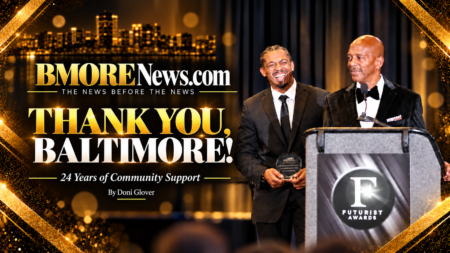
In 2002, I started BMORENews.com. I have never looked back. We have now published our first print edition. In 2027, BMORENews.com will mark 25 years in business. That same year, the Black press will mark 200 years since the first issue of Freedom’s Journal was published in New York City on March 16, 1827.
When I think about those 200 years, I think about the people who made my path possible. David Walker, Marcus Garvey, Frederick Douglass, and W. E. B. Du Bois understood the power of publishing our own words. Ida B. Wells used journalism to confront lynching. Claude Barnett built channels for Black news to travel across the country. Ethel Payne and Harry McAlpin took our questions into the White House. Black journalists also reported from foreign wars, insisting that our perspective belonged wherever history was being made.
That work took courage. Black publishers and reporters faced threats, exclusion, and pressure to be quiet. They persevered anyway. They told stories people in power would have preferred to leave untold.
And this is the part I have not shared before.
My mother, Lillie Glover, got her wings on March 16, 1985. Three years ago, as we approached the 38th anniversary of her passing, I heard again the sermon about the man at the pool of Bethesda. He had waited 38 years for his healing.
Around that time, I realized that the first Black newspaper was born on the same date my mama got her wings: March 16.
That realization stopped me. It felt as if God had kissed me on the forehead and said, “Job well done, my child. You have endured this day well. Now let me give you a reason to celebrate it.”
Oh, hallelujah.
That is why the Black press is so special to me. It runs through my childhood, my father’s office, my AFRO route, those bus rides on North Avenue, my Friday trips to Penn North, the people who opened doors for me, my years in radio and the newspaper we are putting on the streets today. And now March 16 holds my mother’s memory alongside the birth of the Black press.
We need the Black press. As Willie Brown said, we need someone to tell our story correctly and accurately, through our lens and from our perspective. Too often, others ignore us, overlook us, or present a skewed picture without the full facts, the cultural understanding, or the recognition of our history.
I salute the AFRO, The Baltimore Times, WEAA, and every Black outlet in America doing the work of telling our story well. I salute the pioneers who persevered and the people who saw something in me and helped me find my way.
My father was right: there is always something to report. And Lyle was right: there is always a way to tell the story.
Salute. Bravo. And as we approach 2027, happy 200th anniversary to the Black press.