


The Formula on the Board
(COLLEGE PARK, MD – October 2, 2026) – Friday night, in a doctoral classroom at the University of Maryland’s Robert H. Smith School of Business, a formula went up on the screen that looked like hieroglyphics. Upside-down A’s. Backward E’s. Letters with little letters hanging off them.
I had never seen it before. But before I could fear it, Dr. Balaji Padmanabhan had already explained it.
It made perfect sense. Not “I’ll figure it out later” sense. Perfect sense, on the first pass. And sitting there, a member of the DBA Class of ’28, I realized I had felt that exact click once before. It was 1981, and I was a struggling 10th grader at Baltimore Polytechnic Institute.
Poly, 1981
I came to Poly from Lemmel, where I was used to being at the top of the class. Poly’s A course was a different animal. I was not doing well. I was barely making it.
Then I broke my ankle, my fibula, and missed six weeks of school. In the A-course, six weeks is an eternity. I felt weak. I couldn’t hang with the other neighborhood kids anymore. I had to stay home and do homework every single day just to keep my head above water.
So I spent that summer in summer school for Algebra 2, Trig, and Physics. I didn’t work a job that summer. And my teacher was Estella Ingram, known today as Estella Ingram Levy. We were up at Walbrook Sr. High.
Ms. Ingram was a superior educator. Her work would take her to the White House, and she advised the Baltimore City school system. She was also the first woman I ever met on my own, outside my father’s world, who had performed an autopsy. She is still my friend today.
What Poly made complicated, she made simple. I = E/R: current equals voltage divided by resistance. Boom, boom, boom. That’s it. She rebuilt my confidence one equation at a time.
She told me she had seen it before. Poly students kept landing in her summer school, and they were smart kids. We were smart, she said. We just weren’t being taught properly.
Then she told me something I’ll never forget. Poly wasn’t designed to nurture me. Poly was designed to weed me out.
Our story didn’t end that summer. I went on to finish high school at Dunbar, Class of 1983. And who turned out to be my biology teacher there? Estella Ingram.
What the Formula Says
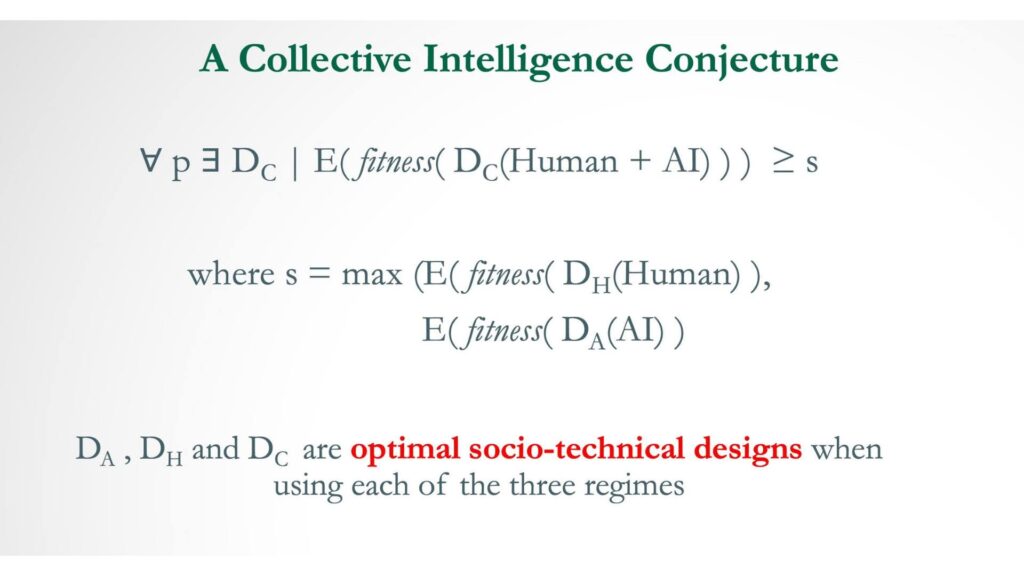
The slide was titled “A Collective Intelligence Conjecture.” Here it is:
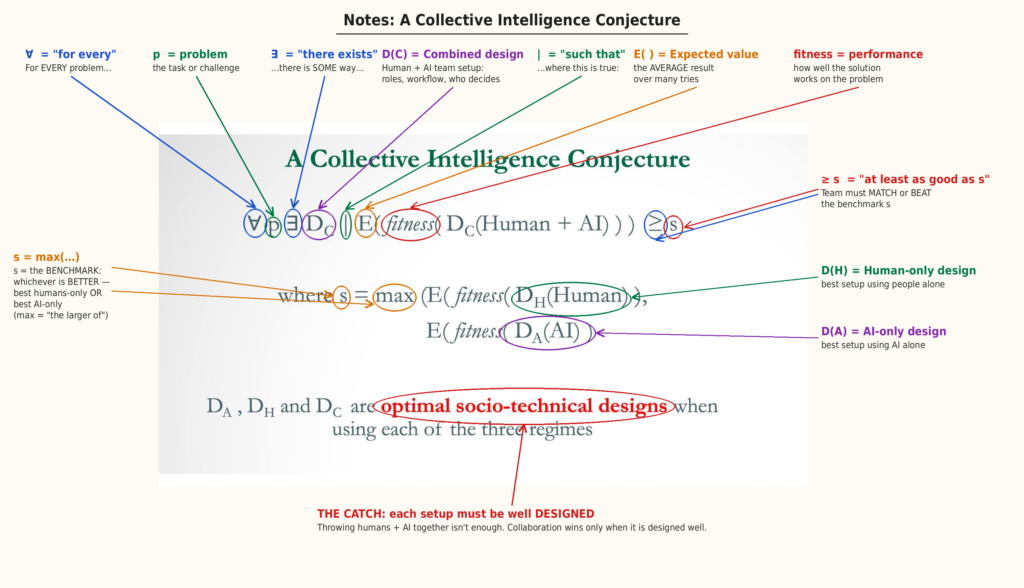
Now in plain English, the way Dr. Padmanabhan made it land:
For every problem, there is some way to design a team of humans and AI that, on average, does at least as well as the best humans alone or the best AI alone.
That’s it. The upside-down A means “for every.” The backward E means “there exists.” The D’s are designs: how the work is set up, who does what, and who makes the final call. The “s” is the bar to clear: whichever is better, humans working alone or AI working alone.
But there is fine print, printed in red on the slide. The promise only holds when each setup is an optimal socio-technical design. In other words, you can’t just throw people and machines in a room together and expect magic. A sloppy partnership can do worse than either side alone.
Collaboration wins only when it’s well designed.
Same Material, Different Design
Here is what hit me. Poly and Ms. Ingram had the same material. Same physics. Same algebra. Same theorems. Same kid sitting in the seat.
The difference was design.
Poly’s system was built to weed out. The symbols went up on the board, and you either kept up, or you didn’t. I can only speak for me. I never shut the door, but I was lost. I was struggling. Ms. Ingram’s system was built to build up. She led with the meaning and let the symbols catch up, and the struggle started to turn into understanding.
Frankly, I got the best of two worlds. Poly gave me discipline. Transferring to Dunbar opened up sports, music, and writing. I needed both to become who I am.
A teacher and a student are a team. Put them together with the wrong design and the student does worse than he would have alone. Put them together with the right design and the student does better than either could imagine. Forty-five years before I saw that formula, Ms. Ingram was already proving it.
What It Means for Us
My doctoral research looks at how AI is reshaping independent media. Most of the conversation out there is fear: AI is coming for the journalist’s job. This formula asks a better question. Not “Will AI replace the reporter?” but “What design lets the reporter plus AI beat both?”
I’ve run BMORENews.com since 2002, and I can tell you where the line falls. AI can transcribe an interview in minutes, organize my notes, and help me check a draft. It cannot tell you who played for Lafayette in the 1970s or which old head at the rec knows the real story. That lives in relationships built over 30 years on these streets. Put those together the right way, and you get journalism neither side could produce alone.
The same goes for our schools. Every Baltimore child sitting in a classroom right now is in a system that was designed, one way or another. Some systems weed out. Some build up. The kids are not the variable. The design is.
Before the Fear Sets In
The great teachers all share one gift. They get you to the meaning before the fear has time to set in. Ms. Ingram had it in a Poly summer school classroom in 1981. Dr. Padmanabhan had it in a doctoral classroom at the Smith School in 2026.
For every problem, there is a way to work it out together. You just have to design it right.
Thank you, Ms. Ingram. I’m still using what you taught me.