


“The ultimate measure of a man is not where he stands in moments of comfort and convenience, but where he stands at times of challenge and controversy.”
— Dr. Martin Luther King Jr.
(BALTIMORE – October 13, 2026)- Now that this week’s game is behind us, there is one matter from last week that cannot go unaddressed. This is about more than a game. This is about honor, sacrifice, and remembrance.
I was embarrassed to hear an otherwise educated Black man say, “I don’t really have any political beliefs.” Marlon Humphrey said those words after appearing with President Donald Trump during his visit to Sparrows Point. Humphrey also said he had never voted, though he explained that he tried in the last election and his absentee ballot didn’t arrive.
I have pondered all week what in God’s creation would make this young man speak as though politics has no bearing on his life—or on the lives of the people who cheer for him.
What planet is Marlon Humphrey living on? Because surely, it cannot be this earth. Specifically, these United States.
Does he not know history?
Never mind Emmett Till, Michael Brown, George Floyd, and a host of others killed by angry white men.
I wonder whether some of our younger athletes understand the sacrifices those who came before them made. If they did, they would never fathom certain comments, let alone utter them.
His comments bring to mind Malcolm X’s criticism of treating Black celebrities as spokespeople for an entire community. Athletic ability, a microphone, or a movie contract does not automatically qualify anyone to lead a people.
Harry Belafonte understood that fame came with responsibility. He helped finance the civil rights movement, supported Dr. Martin Luther King Jr.’s campaigns, and helped organize the March on Washington. He used his money, relationships, and influence to advance freedom. His contribution was substantial because he understood the work and committed himself to it. He would NEVER take a check from Target.
Actors, actresses, athletes—celebrity alone does not make them our leaders. That applies to all of them. Leadership must be demonstrated through service, judgment, courage, and accountability.
Our true leaders do not shuffle for a buck. They stand on principle. They understand the score in America and unapologetically fight for our freedom.
Shout-out to Pete O’Neal in Tanzania — living in exile since the 60s. We love you, Pete!
Stacey Abrams comes to mind. Here in Baltimore, Bea Gaddy comes to mind. To me, she was the epitome of a public servant.
Harriet Tubman comes to mind. So does William Still, known as the Father of the Underground Railroad, who helped freedom seekers and preserved their stories for future generations. And let us not forget John Brown, the white abolitionist who was executed after his attempt to strike against slavery at Harpers Ferry.
These names represent service and sacrifice. Their work demands remembrance.
Black athletes also have an extraordinary history of courage.
Marlon, let us begin with your sport.
Fritz Pollard and Bobby Marshall
In 1920, Fritz Pollard and Bobby Marshall became the league’s first Black players, the league that became the NFL. Pollard also became its first Black head coach.
These men played when racial exclusion shaped who could compete, lead, and earn a living. Their ability did not protect them from racism. They had to confront it while doing their jobs.
This country never simply guaranteed a Black man’s presence in professional football.
The uniform you wear has a history. Learn it.
Jackie Robinson
Jackie Robinson broke Major League Baseball’s modern color barrier in 1947. He endured racist abuse while carrying a burden that no batting average could measure.
Imagine being expected to perform at the highest level while people objected to your very presence.
Robinson continued advocating for civil rights after his playing career ended. He understood that access to a baseball diamond did not settle America’s question of freedom.
He had achieved personal success. He still understood the collective struggle.
Muhammad Ali
Muhammad Ali refused military induction in 1967 during the Vietnam War. His stand rested on his religious convictions and opposition to the war. He was stripped of his championship and lost years of his boxing career. The Supreme Court overturned his conviction in 1971.
Consider what that meant.
A champion in his prime faced losing his livelihood and the possibility of imprisonment. He did not know how the story would end when he took his stand.
We celebrate Ali today. We should also remember what America did to him when his convictions became inconvenient.
His greatness included the courage to accept consequences.
Tommie Smith and John Carlos
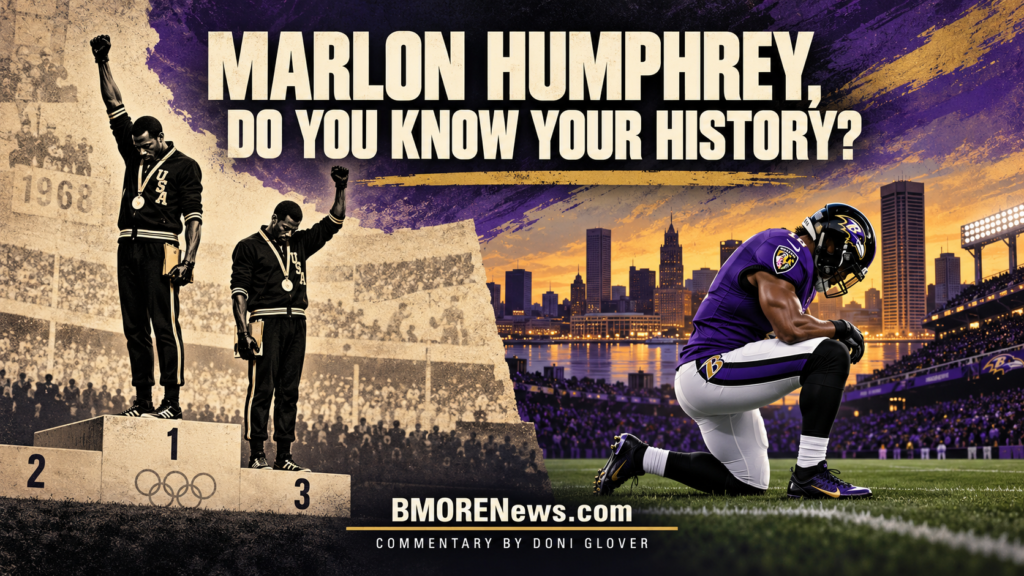
At the 1968 Mexico City Olympics, Tommie Smith won gold, and John Carlos won bronze in the 200 meters.
They had reached the podium. The world was watching. During the national anthem, they raised black-gloved fists to protest racial inequality. They were suspended and expelled from the Olympic Village.
That image has become an enduring symbol of courage. But recognition came after punishment.
They understood that representing America didn’t require pretending America treated all its people equally.
They used the moment they had earned to call attention to people whose suffering could easily have been ignored.
Curt Flood and John Mackey
Curt Flood challenged baseball’s reserve clause, a system that bound a player to one team for as long as that team wanted him.
He took his fight to the Supreme Court in 1972. He lost. His career never recovered. But three years later, the reserve clause fell, and free agency was born.
Curt Flood paid the price. Others collected the reward.
Football had its own version of that fight, and it came out of Baltimore. Colts tight end John Mackey, president of the NFL Players Association, sued the league over the Rozelle Rule, which kept players from freely changing teams. The courts struck it down. Mackey helped crack open the door that led to the free agency today’s NFL players enjoy.
Marlon, every contract you have ever negotiated carries their fingerprints.
Their struggles concerned dignity, labor, and control over one’s own life. Those are political questions, whether an athlete calls them that or not.
The rights people enjoy today often began with someone willing to challenge an arrangement everybody else was expected to accept.
Charlie Sifford
Golf had a racial barrier written into its rules.
The PGA of America’s “Caucasian-only” membership clause excluded nonwhite golfers until it was removed in 1961. Charlie Sifford helped break that barrier and became the first Black golfer to compete on the PGA Tour. He also endured death threats.
Death threats—for playing golf.
Let that settle in.
His talent was never the central problem. The barrier was a system that used his race to exclude him.
Someone had to confront that system before later generations could enjoy the opportunities.
Althea Gibson and Arthur Ashe
Althea Gibson became the first Black player to compete in the U.S. National Championships in 1950. Her presence challenged a tennis establishment that had excluded people who looked like her.
Arthur Ashe won the inaugural U.S. Open in 1968 and Wimbledon in 1975. He also used his stature to challenge apartheid in South Africa.
Their accomplishments were athletic. The barriers they confronted were racial and political.
Understanding their careers requires understanding both.
Colin Kaepernick
In 2016, Colin Kaepernick used his platform to protest racial injustice and police brutality. He explained his concerns publicly rather than leaving people to guess what his protest meant.
Whatever anyone thinks of his method, he took responsibility for his position.
This history is recent. Today’s athletes don’t have to look back a century to find an example of a player confronting questions of race, justice, and public responsibility.
What Have We Taught the Next Generation?
But can we blame him?
After all, society made him want to be a pro football player in the first place, right? We push sports on our children. We want them to compete. You know, stay out of trouble. Give them something to do.
They never miss practice or a game. In fact, it’s a family thing. Everybody shows up. They star in Pop Warner. They star in AAU. They star in high school. Get a scholarship. Win, win, win.
And then, the really special ones get a pro contract.
What I’m saying is that in all of his training, in all of his experiences, and even though he has the money to do what most people cannot afford to do, this Black man stood before reporters and said he has no views on politics.
Is this Soviet Russia? Is this Nazi Germany? Is this Red China? Is the man afraid to speak?
Because he wasn’t quiet before. On September 24, 2017, in London, a rookie named Marlon Humphrey took a knee during the national anthem. He knelt alongside Terrell Suggs, C.J. Mosley, Mike Wallace, and his teammates, two days after President Trump said any player who knelt should be fired. Nine years later, he rode in that same president’s motorcade.
And he hasn’t been quiet online, either. After the assassination attempt in Butler, Pennsylvania, in July 2024, he posted, “Trump took a bullet for America.” When Giants quarterback Jaxson Dart was criticized for introducing Trump at a rally, Humphrey wrote, “The fake Trump hate funny to me.” And in March, posting from Palm Beach, he wrote, “Where my president at.”
That is not a man without political views. So which is it, Marlon?
In the streets, we say, “Pick a side.”
The Bible says it plainer. “A double-minded man is unstable in all his ways.” Even Jesus said He would rather you be cold or hot. But lukewarm? Neither cold nor hot? He said He would spit you out of His mouth.
On your knees in London. In the motorcade at Sparrow’s Point. And in between, “no political beliefs.” Lukewarm. On the fence. Wavering.
Not a good look, young man.
Marlon Humphrey makes his living delivering hits. On this play, he whiffed. He missed the tackle completely. The truth sped past him faster than JuJu Smith-Schuster, and he never laid a hand on it. Worse, he ran in the wrong direction, against his own momentum, fighting his own team.
This is unbelievable.
The athletes named here were different people with different convictions. They did not follow one script. Some broke barriers through their participation. Others directly challenged institutions, policies, or injustice.
Their stories show how closely sports, power, race, and freedom have always been connected.
Marlon, you have the right to meet a president. You have the right to choose your party, your candidates, and your beliefs. A photograph or a ride with the president does not, by itself, tell us everything you believe.
But your own words deserve scrutiny.
“I don’t really have any political beliefs” is a deeply inadequate statement given this history.
Political decisions have determined whether Black people could vote, where we could live, which schools we could attend, and whether we could enter certain professions. Sports existed within those restrictions. The people named here had to navigate and challenge them.
An athlete’s success does not make those questions disappear.
Nor does wealth erase the need to understand how that success became possible.
I cannot claim to know everything you have read or everything you believe privately. I can tell you what your public statement made me wonder: How much of this history have you taken the time to learn?
How many younger athletes know these names beyond a passing reference during Black History Month?
How many understand the price attached to the opportunities they now enjoy?
Those are questions for athletes, families, coaches, schools, leagues, and all of us responsible for passing this history forward.
We cannot celebrate the breakthrough and forget the struggle. We cannot praise the courage of earlier generations while treating their sacrifices as irrelevant to our own lives.
Marlon, learn their names. Study their choices. Understand their consequences.
Then think carefully about what you say from the platform you have.
Your talent earned you a place on the field. Earlier generations fought to make that place available.
That history deserves your attention.
That sacrifice deserves your respect.