
(BALTIMORE – October 12, 2026) – I am a Black man, and I want the Black community to participate in the adoption of artificial intelligence. I want us learning, building, owning businesses, and helping shape how this technology is used.
But first, I wonder how many Baltimoreans—and how many Marylanders—understand the economic strengths surrounding us.
Do we know where Maryland fits nationally? Do we understand our competitive advantage as a region? Do we recognize the opportunities created by the institutions we pass every day?
I am not convinced we do.
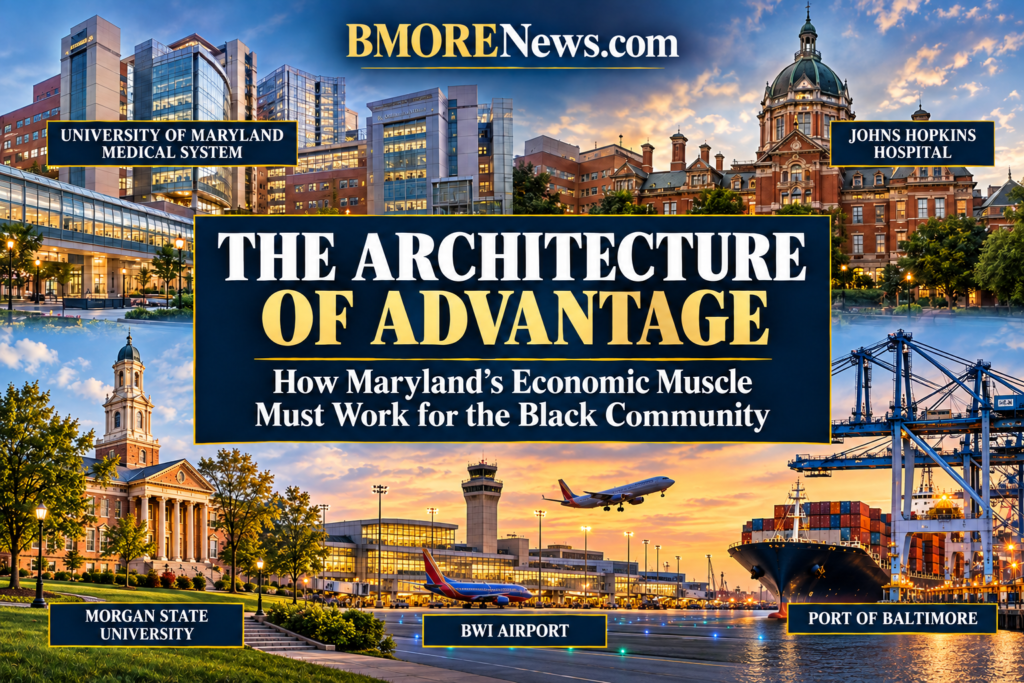
Most people in Baltimore can give you directions to Johns Hopkins Hospital or point toward Morgan State University. We see the buildings, shuttle buses, construction cranes, and people heading to work.
Yet recognizing an institution is different from understanding its economic machinery: the talent it develops, the research it attracts, the services it purchases, and the businesses it can help generate.
That is the landscape I want us to understand.
Because if our community is going to participate meaningfully in the next wave of economic development, we need to know what we are holding—and how to put it to work.
Where Maryland Fits Nationally
Maryland’s competitive strength includes a concentration of healthcare, research, higher education, federal institutions, and specialized talent.
According to the Maryland Department of Commerce, the state ranked fourth nationally in university and college research and development expenditures in fiscal year 2024, totaling $6.57 billion.
Think about the activity behind that number: laboratories, researchers, equipment, technical services, and discoveries that could become products or businesses.
Maryland’s life sciences economy also benefits from institutions such as the National Institutes of Health and the Food and Drug Administration, alongside universities, healthcare systems, and private companies.
These assets help explain why medicine, biotechnology, and research are central to our economic position.
They also help explain why artificial intelligence belongs in this discussion.
Microsoft’s AI Diffusion in the United States report ranked Maryland first among the 50 states in its measure of AI adoption in the first quarter of 2026, at 36.3%. That is a specific benchmark, rather than a claim that we lead every aspect of the AI economy.
Still, it raises a question: if Maryland is already a leading place for AI use, who in our communities is prepared to benefit?
Medicine: More Than the People in Scrubs
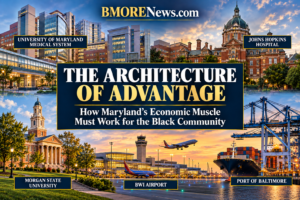
Johns Hopkins Hospital and the University of Maryland Medical System are major parts of Baltimore’s economic foundation.
We know them as places where people receive care. But healthcare institutions also create demand for technology, construction, maintenance, transportation, food services, communications, and professional expertise.
Their economic reach extends beyond the examination room.
For a Black-owned business, that means potential opportunities across many fields. A company does not have to practice medicine to serve a healthcare institution.
But an opportunity becomes accessible only when a business understands how to pursue it.
Who makes purchasing decisions? What qualifications are required? Can the company meet insurance, staffing, and delivery expectations? Does it have the capacity to compete for a prime contract or subcontract?
These are practical questions about connecting institutional spending to neighborhood enterprise.
We should be helping businesses prepare to answer them.
Research: The Brains of the Operation
Our universities are another major source of advantage.
Johns Hopkins, the University of Maryland, Baltimore, the University of Maryland, College Park, Morgan State, and UMBC contribute different strengths to the state’s research landscape.
The University of Maryland, Baltimore reports $636 million in grants and contracts awarded in FY2025. UMBC reports $186 million in annual research expenditures in FY2025. Awards and expenditures are different measures, but both indicate substantial activity in our region.
Morgan belongs firmly in this conversation.
In FY2025, Morgan secured a record $104.4 million in research commitments, an 18% increase over FY2024. It remains a Carnegie R2 institution and is pursuing R1 status.
Morgan’s research enterprise is smaller than those of Hopkins and the University of Maryland. But its growth deserves attention, particularly from a community that should be looking closely at pathways into research, technology, and business ownership.
The next question is commercialization: how can research become useful products, services, and companies? How can students and faculty connect with entrepreneurs? How can more of the resulting opportunity remain in Baltimore?
Our research institutions attract resources and develop expertise. We need intentional pathways that connect those strengths to local participation.
Nonprofits: Economic Power With Unequal Resources
Baltimore’s nonprofit community is essential to the city’s functioning.
These organizations provide services, employ people, purchase supplies, maintain facilities, and contract with businesses. Their work supports families and neighborhoods while contributing to the economy.
Statewide, Maryland Nonprofits reports approximately 280,000 full-time nonprofit workers, representing nearly 13% of Maryland’s nongovernmental workforce. Those figures include healthcare, education, social services, and other activities.
That overlap matters. We cannot add nonprofit hospitals and universities to healthcare and education totals as though they were entirely separate groups.
The Maryland Comptroller’s 2024 Nonprofit Conference Impact Report counted 40,736 active tax-exempt organizations statewide as of October 2024 and reported $83.4 billion in statewide nonprofit revenue as of December 2024. These are Maryland figures, not Baltimore-only totals.
But the size of the sector does not establish the financial health of every organization.
The same report describes a sharp concentration of resources: 2.5% of Maryland nonprofits—those with annual revenue above $5 million—accounted for 93.9% of sector revenue. Meanwhile, 45.2% operated with less than $25,000 in revenue.
A neighborhood organization and a major nonprofit hospital inhabit very different financial worlds.
National evidence also points to strain. In Nonprofit Finance Fund’s 2025 survey, 36% of respondents ended 2024 with an operating deficit, and 52% had three months or less of cash available. Those are national survey findings, not Baltimore-specific rates.
For Baltimore, the question is whether the organizations carrying essential neighborhood responsibilities have dependable funding, adequate staff, and access to useful technology.
AI may help organize information or reduce selected administrative burdens. It cannot replace sustainable funding or the trust these organizations have built.
Black Business: A Staple of Baltimore
Black business in Baltimore is a tradition.
Our entrepreneurs have created livelihoods, delivered services, built institutions, and helped sustain communities through generations of economic change.
I have seen that commitment firsthand through BMORENews.com and the Joe Manns Black Wall Street Awards. The people we document demonstrate what ownership and service look like in everyday life.
Historical data reinforces the scale of that presence.
A Baltimore Integration Partnership analysis of Census data counted 23,600 Black-owned businesses in Baltimore City in 2012, representing 46.5% of all firms. The count had increased from 9,764 in 2002. These are historical figures and should be understood as such.
The same analysis found that only 3.3% of Black-owned firms in the city had paid employees in 2012.
That distinction points to an important economic challenge.
Starting a business and building an enterprise with employees require different levels of resources and capacity. Sole proprietors matter. So do pathways that help owners expand when they are ready.
Capital, customers, contracts, staffing, and professional assistance all belong in that discussion.
So does access to the institutional economy surrounding us.
Our Black-owned businesses should be positioned to compete for work generated by healthcare systems, universities, research projects, and nonprofits. That requires preparation from businesses and serious engagement from institutions.
From Regional Assets to Neighborhood Opportunity
Why does an economy with so much institutional strength still feel disconnected from many neighborhoods in West and East Baltimore?
The answer requires more than pointing to a building or celebrating an investment announcement.
We have to examine how people gain access: to training, employment, procurement, partnerships, and capital. We have to ask who receives information early enough to prepare and who has the support to follow through.
Maryland’s federal connections also deserve attention. Federal institutions and investment contribute to our research and technology strengths. That relationship creates exposure when funding priorities change.
A competitive strategy should build on those strengths while helping businesses and institutions develop durable capabilities and diverse sources of support.
My argument is that the pieces already around us can reinforce one another.
Universities develop knowledge and talent. Healthcare institutions apply expertise and purchase services. Nonprofits understand community needs. Entrepreneurs build businesses that respond to demand.
The Baltimore Tech Hub illustrates one connection: the U.S. Economic Development Administration describes it as building a center of excellence in predictive healthcare technologies through the application of AI to biotechnology.
The opportunity is real. Broad participation will require deliberate effort.
The BMORE AI Challenge: A Place to Begin
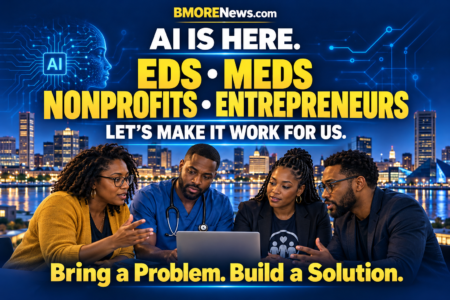
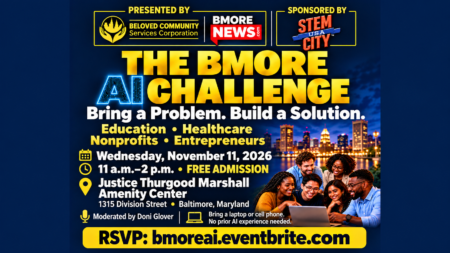
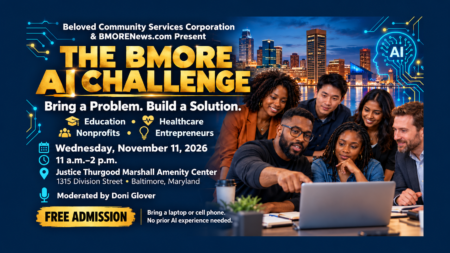
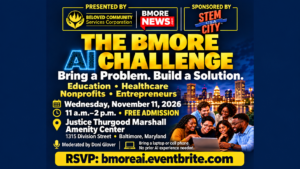
That is why we are bringing together eds, meds, nonprofits, and entrepreneurs for The BMORE AI Challenge.
I want people to understand both the technology and the economic landscape in which they might use it.
An entrepreneur can explore organizing an institutional bid. A nonprofit director can examine a recurring administrative challenge. An educator can investigate a teaching application. A healthcare professional can consider appropriate uses within approved workplace systems.
Each should also learn how to check results, protect sensitive information, and recognize when professional judgment is essential.
Our invitation is simple: Bring a problem. Build a solution.
Join us on Wednesday, November 11, 2026, from 11 a.m. to 2 p.m., at the Justice Thurgood Marshall Amenity Center, 1315 Division Street, Baltimore.
Presented by Beloved Community Services Corporation and BMORENews.com, sponsored by STEM City USA, and moderated by me, Doni Glover, the event is free. No prior AI experience is needed. Bring a laptop or cell phone.
Maryland has considerable economic muscle. Baltimore has institutions, talent, community knowledge, and a deep tradition of Black enterprise.
We need more people to understand how those strengths connect—and how to enter the opportunities they create.
The architecture of advantage is already here. Our assignment is to make it work for our community.
RSVP: bmoreai.eventbrite.com