

People who say it cannot be done should not interrupt those who are doing it.
(BALTIMORE – August 21, 2026) — I saw a comment online that rubbed me the wrong way.
“That ain’t gonna work.”
Maybe it was, “How is that going to work?” Whatever the exact words, the message was clear. It was the familiar voice of doubt—another person standing on the sidelines, criticizing Baltimore and questioning what our people can accomplish.
I did not appreciate it. Doubt is easy from the sidelines. Building something requires vision, work, and courage.
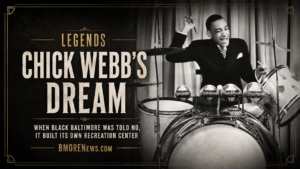
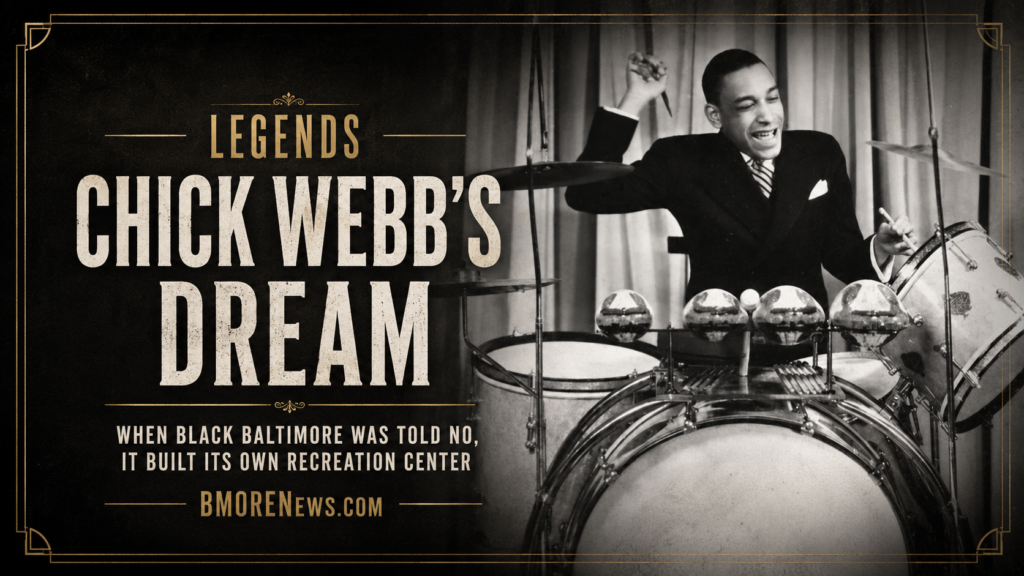
I never met William Henry “Chick” Webb. He was before my time. But I am blown away by this man. I am mesmerized by how he refused to allow his physical condition to stop him from doing anything he set out to do.
Born and raised in East Baltimore, Webb suffered from tuberculosis of the spine, which left him with a severely curved back and short stature. A physician reportedly encouraged him to play an instrument to strengthen and loosen his upper body.
Webb chose the drums.
He earned money selling newspapers and bought his first drum set. Then this physically challenged Black child from East Baltimore went to Harlem and became one of the greatest drummers and bandleaders America had ever seen.
At Harlem’s legendary Savoy Ballroom, Chick Webb was king.
Did you hear me? King!
His orchestra competed against some of the greatest bands in the country. Webb’s band famously defeated Benny Goodman’s orchestra, which featured Gene Krupa on drums. Count Basie, Duke Ellington, and the biggest names in American music knew Chick Webb.
He did not merely enter the Swing Era. He helped define it.
Then he helped introduce Ella Fitzgerald to the world.
Chick Webb and Ella Fitzgerald: Love Returned
After winning Amateur Night at the Apollo Theater in 1934, a teenage Ella Fitzgerald caught the attention of saxophonist and bandleader Benny Carter. Carter recognized her talent and became one of the musicians who urged Chick Webb to give her an opportunity.
Webb was initially reluctant. He had not been looking for a female vocalist, and Ella was an unpolished teenager who did not fit the glamorous image generally expected of a woman singing before a major orchestra.
But Benny Carter and others insisted that Webb listen.
Thank God he did.
Ella joined the Chick Webb Orchestra in 1935. Webb became her mentor, took her under his wing, and gave her a professional platform at the Savoy Ballroom. She began recording with his orchestra and, in 1938, they released “A-Tisket, A-Tasket.”
The record sold approximately one million copies, reached number one, and remained on the charts for 17 weeks.
Chick Webb helped give Ella Fitzgerald to the world. Ella helped give Chick Webb’s orchestra its greatest commercial success.
When Webb died on June 16, 1939, Ella mourned the loss of her mentor. She then assumed leadership of his musicians, and the group became known as Ella Fitzgerald and Her Famous Orchestra.
That history is essential to understanding what happened next.
Shortly before his death, Webb reportedly told his physician and friend, Dr. Ralph Jonathan Young, that he regretted not having done more for the children of East Baltimore. He wanted them to have a safe place—a recreation center that could help lead them away from delinquency and toward productive lives.
Webb died before he could build it.
But Ella Fitzgerald did not forget him.
She lent her name, her voice and her growing celebrity to the campaign to fulfill his dying wish.
For Ella, this was more than another public appearance. It was a labor of love.
Chick Webb had given her a place in the world. Ella Fitzgerald returned that love by using her star power to help give his dream a permanent home in Baltimore.
That is love returned.
The Doctor Who Carried the Dream
Dr. Ralph Jonathan Young cannot be treated as a footnote in this story.
Dr. Young was a pioneering Black physician and civic leader who served East Baltimore for nearly half a century. He was Chick Webb’s doctor, but he was also Webb’s friend.
When Chick shared his dying wish, Dr. Young accepted the responsibility of carrying it forward.
He organized the Chick Webb Memorial Recreation Committee. Historical accounts report that he contributed $5,000 of his own money. He reached out to community leaders, churches, civic organizations, athletes, and entertainers.
The established institutions did not provide what Black East Baltimore needed. Appeals to the city and the YMCA failed to produce the necessary support for a recreation center serving Black children in segregated Baltimore.
Dr. Young and the community did not quit.
They organized.
On February 10, 1940—less than eight months after Chick Webb’s death—thousands of people gathered at Baltimore’s Fifth Regiment Armory for a massive benefit in his honor.
Dr. Young organized the movement, but make no mistake: Chick Webb brought that room together.
Webb was no longer alive, but he was everywhere inside that Armory. He was in Ella Fitzgerald’s voice. He was in the star power of heavyweight boxing champion Joe Louis, who served as the event’s emcee and major attraction. He was in the instruments of the musicians and in the hearts of the approximately 7,500 people who came to help build his dream.
Historical accounts identify roughly 50 Black entertainers associated with the benefit, including Ella Fitzgerald, Duke Ellington, Louis Armstrong, the Ink Spots, Claud Hopkins, the Nicholas Brothers and Jackie “Moms” Mabley.
These were not minor performers trying to get their names on a program. These were among the greatest Black entertainers and athletes in the world.
I can only imagine what that night looked and felt like.
I imagine the Fifth Regiment Armory filled with people dressed to the nines. I imagine tuxedos, evening gowns, and fancy automobiles arriving outside. I imagine laughter, smiles, cigar smoke and anticipation filling the building.
I imagine the musicians greeting one another backstage, trading stories about Chick Webb and remembering the little giant from East Baltimore who could sit behind a drum kit and drive an entire orchestra.
I can imagine Ella Fitzgerald onstage, swinging to the beat and commanding the attention of the room. I can imagine everyone wanting to be there because Black America’s brightest stars were there.
When we watch a major championship fight today, celebrities line the front rows. Imagine the Black heavyweight champion of the world, Joe Louis, leading the effort. Imagine some of the greatest musicians in American history coming together under one roof—not merely to entertain, but to build something for Black children.
That is magnanimously, stupendously beautiful.
It is absolutely phenomenal.
That Is Black Wall Street
The Armory benefit and other community efforts raised the seed money for the project. The AFRO-American Newspaper sponsored a fashion show. The Baltimore Elite Giants, champions of the Negro baseball leagues, participated in an exhibition game. Doctors, churches, women’s organizations, civic associations and ordinary residents contributed.
During World War II, the funds were protected through investments in war bonds. After the war, the campaign resumed. The community purchased property and continued pushing until the first phase of the Chick Webb Memorial Recreation Center opened in 1947.
The swimming pool followed in 1949. It was named for Dr. Ralph Young.
Think about that.
When the established institutions would not build what Black children needed, Black people raised the money themselves. They brought together their entertainers, athletes, physicians, newspapers, churches, civic organizations, and neighbors. They bought property and helped build their own institution.
That is self-empowerment.
That is Black Wall Street.
This is one of the greatest stories of Black self-determination I have ever heard, and it happened right here in Baltimore.
“We Did It Once. We Can Do It Again.”
I called veteran WEAA broadcaster Gary “Prime Time” Ellerbe to discuss Chick Webb and Baltimore’s place in the universe of African American classical music—better known as jazz.
Ellerbe rejects the label “jazz aficionado.” He says he is simply a man who loves the music, knows how to find answers, and understands how much he still does not know.
Many Baltimoreans who learned from him during his 15 years on the radio might respectfully disagree with his modest assessment.
Ellerbe described jazz as “compositions for improvisation.”
That description applies to more than music. It describes the Black experience in Baltimore.
When Black people were denied access, we improvised. When institutions refused to support us, we pivoted. When somebody told us our ideas would not work, we found another way to make the notes fit.
Chick Webb Memorial Recreation Center was one of Baltimore’s earliest and greatest compositions for improvisation.
Ellerbe remembers learning to swim at Chick Webb around 1958 or 1959. He was approximately eight years old. He also remembers swimming at the YMCA on the West Side.
Decades later, he saw young people around Hillen Road and Cold Spring Lane going from car to car, raising money for the Chick Webb Center.
He asked them a simple question.
“Who’s Chick Webb?”
They did not know.
“Well, that means the institution is failing in its obligation, as I see it,” Ellerbe told me.
I asked him what Chick Webb’s story says about the determination of Black people in Baltimore.
“It says you can do it if you try,” he said. “Ain’t nobody holding you back but you. If you stop bending over, can’t nobody rest on your back.”
Then he distilled the entire story into one sentence:
“We did it once. We can do it again.”
Baltimore Is Still Doing It
That spirit did not die with Chick Webb.
Today, Otis Rolley III is the first Black president and CEO of the Baltimore Development Corporation, the city’s principal economic-development agency.
Mark Anthony Thomas is the first Black president and CEO of the Greater Baltimore Committee, one of the region’s most influential business and civic organizations.
P. David Bramble, the Black co-founder and managing partner of MCB Real Estate, is leading the effort to reimagine Harborplace—Baltimore’s beloved waterfront centerpiece.
Shelonda Stokes leads the Downtown Partnership of Baltimore. Robyn Murphy leads Create Baltimore, formerly the Baltimore Office of Promotion & The Arts. Kireem Swinton now leads Visit Baltimore, succeeding another dynamic Black executive, Al Hutchinson.
These accomplishments should not be considered unusual. But because of America’s sordid racial history, they remain unprecedented or historically significant achievements well into the 21st century.
In Annapolis, State Senators Antonio Hayes and Cory McCray represent a dynamic West Baltimore–East Baltimore combination working to direct resources into communities that have been historically starved of investment.
More than $70 million has been invested along the West North Avenue corridor since the creation of the West North Avenue Development Authority, an initiative championed by Senator Hayes and other state and community leaders.
Baltimore has also celebrated the completion of a $118 million transformation of historic Frederick Douglass High School and the Joseph C. Briscoe Academy.
These are investments in communities that went without for far too long.
Dr. Lawrence Brown has famously described Baltimore’s racial geography as the “Black Butterfly” surrounded by the “White L.” The Black Butterfly stretches across East and West Baltimore—communities that have historically endured redlining, segregation, disinvestment, and population loss. The White L follows the city’s disproportionately resourced central and waterfront corridors.
Yet the Black Butterfly continues to move its wings.
Black Baltimore voters—though far too few participate—regularly help determine elections beyond the city limits. When Baltimore aligns with Prince George’s County and Black voters in Baltimore County, particularly its northwestern communities, we can influence the direction of the entire state.
Maryland now has its first Black governor. Baltimore has a Black mayor. Black executives lead institutions that excluded Black leadership for generations. Black developers and civic leaders are directing major projects. Historic West and East Baltimore communities are attracting investments once considered unimaginable.
These developments are not perfect, and neither are the people leading them. They must be scrutinized, questioned, and held accountable.
But do not tell me Black Baltimore cannot get anything done.
Do not interrupt people who are doing the work.
More Than a Name on a Building
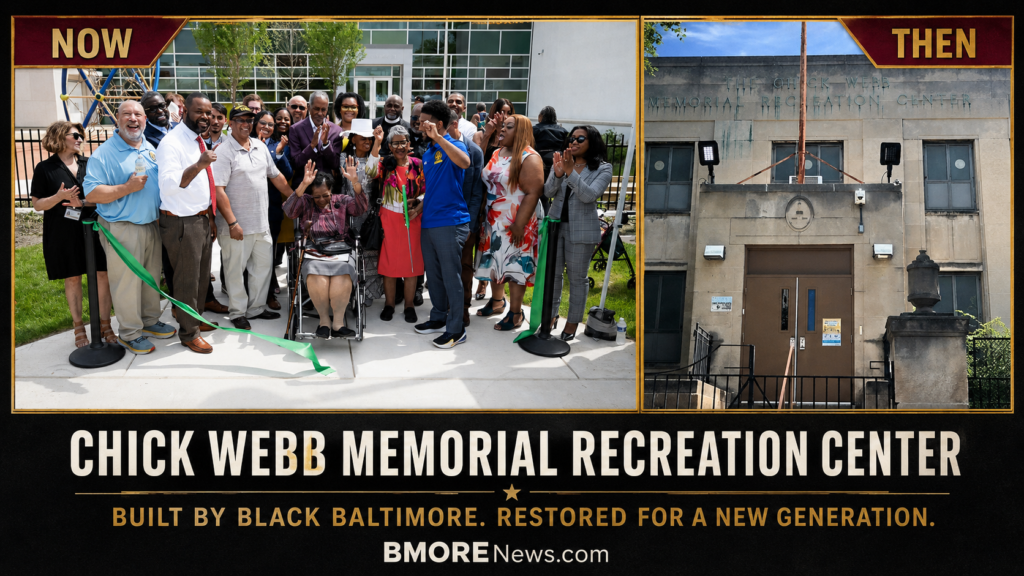
The newly renovated Chick Webb Memorial Recreation Center is beautiful.
Baltimore invested $17.5 million in its restoration and expansion. The facility now includes a regulation-size athletic court, an indoor walking track, fitness facilities, classrooms, a teen lounge, a renovated swimming pool, and a recording studio.
But renovating the building is not enough.
A building can be restored while its history is neglected. A famous name can hang above the entrance while the life behind that name slowly disappears.
The children using Chick Webb Recreation Center must know who Chick Webb was. They must know about Dr. Ralph Jonathan Young. They must know why Ella Fitzgerald came. They must know that Joe Louis, the heavyweight champion of the world, lent his star power to the effort.
They must know that Black people built this.
Gary Ellerbe envisions something even larger for Baltimore: an institution modeled partly on Harlem’s Apollo Theater, but extending beyond entertainment to include public broadcasting and technical training.
He wants young people learning to operate every piece of equipment in the building. He wants them trained to research, write, produce, direct, and broadcast live programming.
That would be a fitting continuation of Chick Webb’s dream: not merely entertaining young people, but preparing them to control the instruments of culture and communication.
I asked Ellerbe who bears responsibility for preserving this history—artists, athletes, businesspeople, churches, elected officials or ordinary citizens?
“All of the above,” he answered. “Everybody’s responsible for preserving history, bro.”
Finally, I asked him what Chick Webb might say if he could walk into the newly renovated center today.
“It’s nice to be remembered,” Ellerbe said.
But what happens when nobody remembers?
He reached for an old musicians’ expression.
“Old musicians don’t die,” Ellerbe said. “They just fade away.”
Chick Webb must never be allowed to fade away—not in Baltimore, not in East Baltimore and certainly not inside the building bearing his name.
Chick Webb helped give Ella Fitzgerald to the world. Ella returned that love by helping to fulfill Chick Webb’s dream for East Baltimore’s children. Dr. Ralph Young turned that dream into an eight-year movement. Black entertainers supplied the star power. Black Baltimore supplied the money, determination, and love.
They were told, in so many words, that it was not going to work.
Then they built it anyway.
We did it once.
We are doing it now.
And we can do it again.