

For 24 years, BMORENews.com’s Six-Point News Agenda has guided its coverage of Black Baltimore. The mission—and the question—remain the same: What solution are you bringing to the table?
(BALTIMORE – August 21, 2026) – For 24 years, BMORENews.com has operated under a Six-Point News Agenda focused on the issues that most directly affect Black Baltimore.
The agenda is not new.
It has guided our journalism since BMORENews.com was founded on August 9, 2002.
What has changed is the urgency.
Baltimore is experiencing investment on a scale we have not seen in generations.
The West North Avenue Development Authority has committed approximately $71 million to projects along the West North Avenue corridor. Another $118 million has been announced for Frederick Douglass High School. Coppin State University has undergone unprecedented expansion. David Bramble and MCB Real Estate are investing in West North Avenue, Northwood and Baltimore’s Inner Harbor, where Harborplace languished for more than 20 years.
The cranes are going up. The money is being allocated. The plans are being announced.
But the question is whether Black Baltimore will own anything, receive contracts, get jobs and participate in the wealth being created—or whether we will once again be pushed to the side, marginalized, further ostracized and told to be grateful for watching somebody else prosper.
Are we moving forward?
Or are we returning to the spirit of 1910?
That is the story.
Baltimore Has Always Been a Freedom City
To understand where Baltimore is going, one must first understand where Baltimore has been.
Black people did not just arrive here yesterday.
Before the Civil War, Baltimore had the largest population of free Black people in the United States. While slavery remained legal in Maryland, free Black Baltimoreans built churches, schools, businesses, mutual-aid societies and networks of resistance.
They created institutions in a country that did not fully recognize their humanity.
Baltimore became a bastion of Black strength and a haven for people escaping enslavement.
That history is not abstract to me.
Minutes from my home stands Orchard Street Church at 512 Orchard Street, now the headquarters of the Greater Baltimore Urban League. I have personally gone into its basement and seen the underground chamber used to hide freedom seekers traveling the Underground Railroad.
Think about that for a moment.
I stood inside a place where Black people may have hidden while risking their lives for freedom.
The precise historical use of the chamber is still being studied, but tunnels beneath Orchard Street Church have long been associated with the Underground Railroad. During the building’s restoration, archaeological excavations uncovered an underground space, which was preserved and made accessible via stairs.
This is one reason Baltimore is known to some as Tubman City.
Harriet Tubman was born on Maryland’s Eastern Shore. After escaping enslavement, she repeatedly returned to Maryland to lead family members and others to freedom.
She was not asking for inclusion.
She was taking people to freedom.
That spirit has always existed in Baltimore.
It lived through the Rev. Dr. Harvey Johnson, a formerly enslaved man who became a pastor, civil rights advocate, and institution builder. In 1885, Johnson helped organize the Mutual United Brotherhood of Liberty, which challenged racial discrimination through the courts decades before the modern Civil Rights Movement.
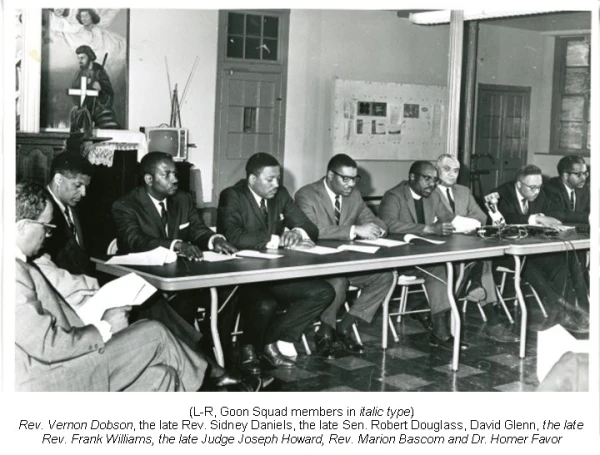
It lived through the Rev. Vernon Dobson, Congressman Parren J. Mitchell, Judge Joseph C. Howard Sr. and the ministers, attorneys, educators and activists who became known as Baltimore’s Goon Squad.
Do not let the name fool you.
These were some of the sharpest Black minds Baltimore ever produced. They understood politics, law, economics, organizing and the necessity of strong Black institutions. They did not wait for permission to defend their people.
Baltimore also lived through the turmoil known as Black October, a dark and complicated chapter that reflected the violence, political tension and street realities gripping parts of Black Baltimore during the 1970s.
Every chapter was not pretty. Not every freedom fighter wore a suit. Not every battle was fought in a courtroom.
Some fought through the church. Some fought through politics. Some organized in the streets. Some built businesses. Some educated children. Some represented people in court. Some operated quietly and never received a plaque, proclamation, or news story.
But the fight has always been here.
Baltimore’s Historic Contradiction
Baltimore contains two powerful and competing traditions.
It was a haven for Black freedom seekers. Yet it became the first American city to legislate residential racial segregation.
But Black Baltimore did not take that attack lying down.
In 1910, George W. F. McMechen, a Yale-educated Black attorney and Morgan College’s first graduate, moved his family into a home at 1834 McCulloh Street. The block was predominantly White, and some of his new neighbors responded with threats, vandalism and organized outrage.
McMechen refused to move.
His presence helped provoke the political backlash that produced Baltimore’s first residential segregation ordinance. Under Mayor J. Barry Mahool, the city attempted to dictate where Black and White people could live.
It was racial zoning—an American form of apartheid and a precursor to the redlining, restrictive covenants and discriminatory housing policies that followed.
But Mahool and the segregationists ran into two formidable Black lawyers: George W. F. McMechen and William Ashbie Hawkins.
McMechen and Hawkins were law partners, relatives and pioneering civil-rights attorneys. Hawkins, working with fellow Black attorney Warner T. McGuinn, successfully challenged Baltimore’s first segregation ordinance in court. The city kept rewriting the law, and they kept fighting.
In other words, Baltimore may have helped write residential segregation into law, but Black Baltimore fought back from the beginning.
McMechen and Hawkins put their legal foot squarely in the segregationists’ behinds.
They did not merely deliver speeches about freedom. They went into court, challenged the city and helped expose its racial ordinance as unconstitutional.
More than a century later, McMechen’s name remains on Baltimore’s map through McMechen Street.
And right off McMechen Street stands the childhood home of Thurgood Marshall at 1632 Division Street.
Again, think about the geography.
All of this history is within blocks of my house.
McMechen challenged legalized residential segregation. Hawkins fought Baltimore’s racist ordinances in court. And Thurgood Marshall grew up nearby before becoming the lawyer who helped dismantle legal segregation across America and the first Black justice of the United States Supreme Court.
Marshall attended Public School 103, also known as the Henry Highland Garnet School, at 1315 Division Street. That building has now been restored as the Justice Thurgood Marshall Amenity Center under the leadership of the Rev. Dr. Alvin C. Hathaway Sr.
BMORENews.com has held programs there.
So, once again, this history is not abstract to me. It is not confined to a textbook or museum exhibit. I walk these streets. I know these buildings. I live minutes from the houses, schools, churches and meeting places where Black Baltimore fought for its freedom.
And Thurgood Marshall did not emerge from a vacuum.
He came out of a West Baltimore ecosystem of Black churches, lawyers, educators, organizers and families committed to justice.
That ecosystem included Lillie May Carroll Jackson, known as the “Mother of Freedom,” who led the Baltimore Branch of the NAACP for decades.
It included her daughter, Juanita Jackson Mitchell, the first Black woman admitted to practice law in Maryland. Before becoming an attorney, Juanita organized young people and helped lead the “Buy Where You Can Work” campaign against businesses that accepted Black dollars but refused to employ Black people.
It included Juanita’s husband, Clarence M. Mitchell Jr., the legendary NAACP lobbyist known as the “101st Senator” because of his role in securing landmark civil-rights legislation.
And it included Clarence’s brother, Congressman Parren J. Mitchell, Maryland’s first Black member of Congress, a founding member of the Congressional Black Caucus and one of America’s strongest advocates for minority business participation.
The Mitchell women fought.
The Mitchell men followed and carried the fight into legislatures, courtrooms and the halls of Congress.
This is the lineage of West Baltimore.
Yet the footprints of Baltimore’s segregationist tradition remain visible in our vacant houses, concentrated poverty, segregated neighborhoods, unequal access to capital and continuing battles over who is permitted to live where.
We saw that same spirit in Hoe’s Heights, a historic Black community forced to fight neighboring Roland Park over access to Roland Avenue.
Imagine that.
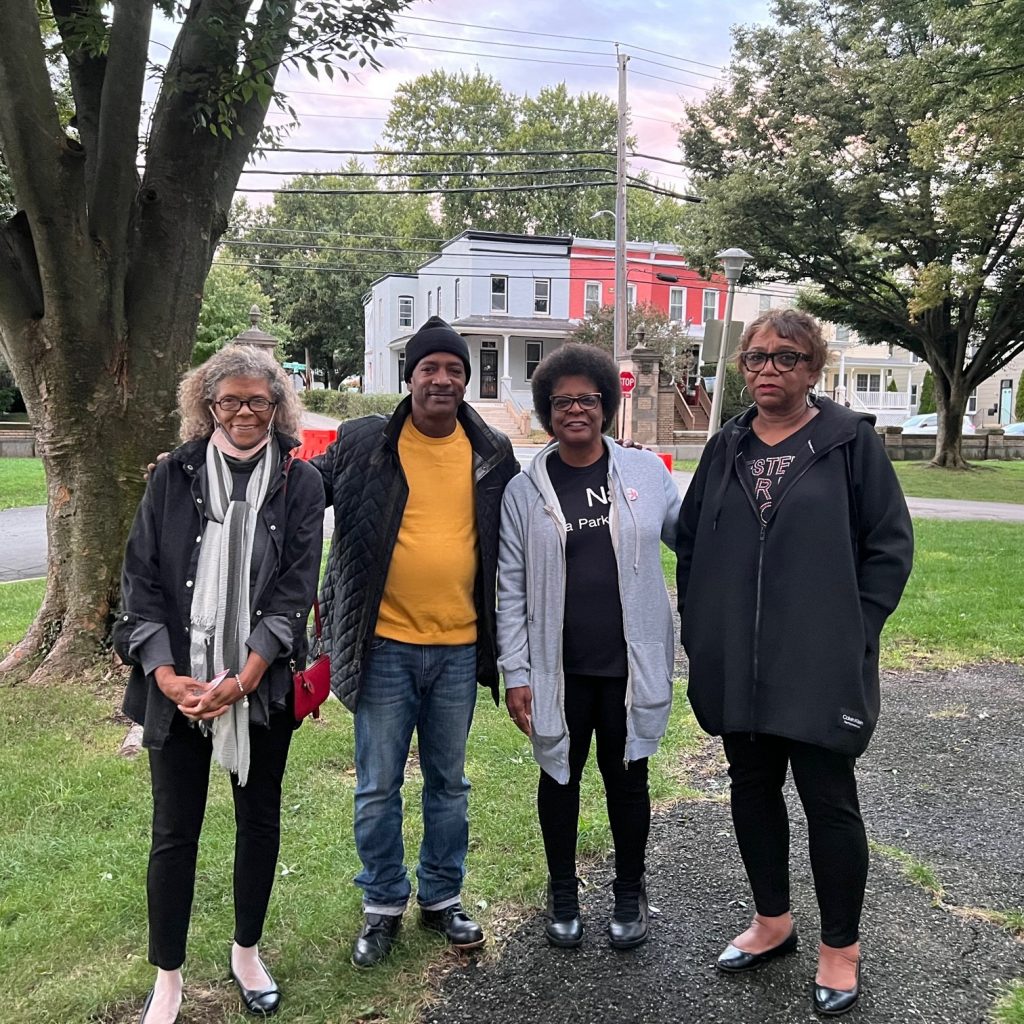
In the 21st century, Black residents had to fight for access to a public street in the very city that pioneered legalized residential segregation.
Access was eventually restored, but the fact that such a fight was necessary should embarrass every decent person in Baltimore.
This is the contradiction we must confront.
Which Baltimore will determine our future?
Will it be Tubman City—the Baltimore of George McMechen, Ashbie Hawkins, Thurgood Marshall, Lillie May Carroll Jackson, Juanita Jackson Mitchell, Clarence Mitchell Jr., Parren Mitchell and generations of freedom fighters?
Or will it be the Baltimore of J. Barry Mahool and 1910, where Black people are pushed behind visible and invisible walls while other people make decisions about our neighborhoods, our schools and our economic future?
That is the choice.
And Black Baltimore has never needed permission to fight for the right answer.
BMORENews.com Was Built for This Work
BMORENews.com was founded on August 9, 2002.
There was no Facebook. There was no YouTube, Instagram or TikTok. Most people were not walking around with television studios in their pockets. Black-owned digital media was still largely uncharted territory.
But the need was already there.
Too many stories about Black Baltimore were being ignored. Others were being told by people who knew the statistics but did not know our communities.
They could report on Sandtown, but they did not know Sandtown.
They could write about West Baltimore, but they did not understand the people who had spent generations building families, businesses, churches and institutions there.
BMORENews.com was created to help fill that void.
For 24 years, we have covered governors, mayors, members of Congress, presidents, entrepreneurs, developers, educators, clergy members, returning citizens, athletes, activists and ordinary people doing extraordinary work.
We have documented elections, business openings, neighborhood battles, community victories, public-policy failures and the arrival of billions of dollars announced in the name of rebuilding Baltimore.
We were there before many of these investments became press releases.
We were there when the cameras came.
And we were still there after they left.
Our theme for this next chapter is:
“Amplifying Our Natural Ecosystem.”
Black Baltimore already has an ecosystem.
It includes our businesses, churches, colleges, neighborhood associations, elected officials, nonprofit organizations, developers, professionals, activists, artists, athletes and media outlets.
The problem is that these pieces too often operate separately.
BMORENews.com can help connect them.
We know the developers. We know the elected officials. We know the clergy. We know the entrepreneurs. We know the educators. We know the neighborhoods.
Most importantly, we know the people.
That knowledge was not developed during a marketing campaign.
It was earned over 24 years of showing up.
The BMORENews.com Six-Point News Agenda
Since 2002, BMORENews.com’s journalism has been guided by a solution-oriented Six-Point News Agenda:
- Black business and economic development
- Black public education
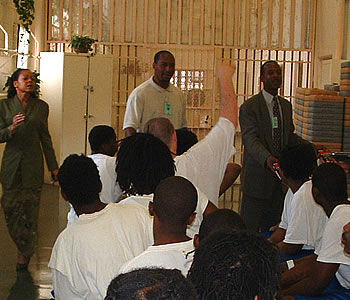
- Advocacy for formerly incarcerated people and reentry
- Affordable housing and anti-displacement
- Universal access to healthcare
- Politics, public policy and accountability
These are not six fashionable topics chosen to fill space.
They are connected.
A child cannot learn effectively while living in unstable housing, suffering from lead poisoning or lacking proper nutrition and healthcare.
A person returning home from prison cannot rebuild a life without employment, housing, mental-health support and a genuine second chance.
A Black business cannot grow if it is routinely locked out of capital, contracts and major development opportunities.
A neighborhood cannot prosper if the people who carried it through decades of disinvestment are displaced the moment the property becomes valuable.
And none of this changes without political leadership that produces results and accepts accountability.
Our central question has remained the same:
What solution are you bringing to the table?
Black Business and Economic Development
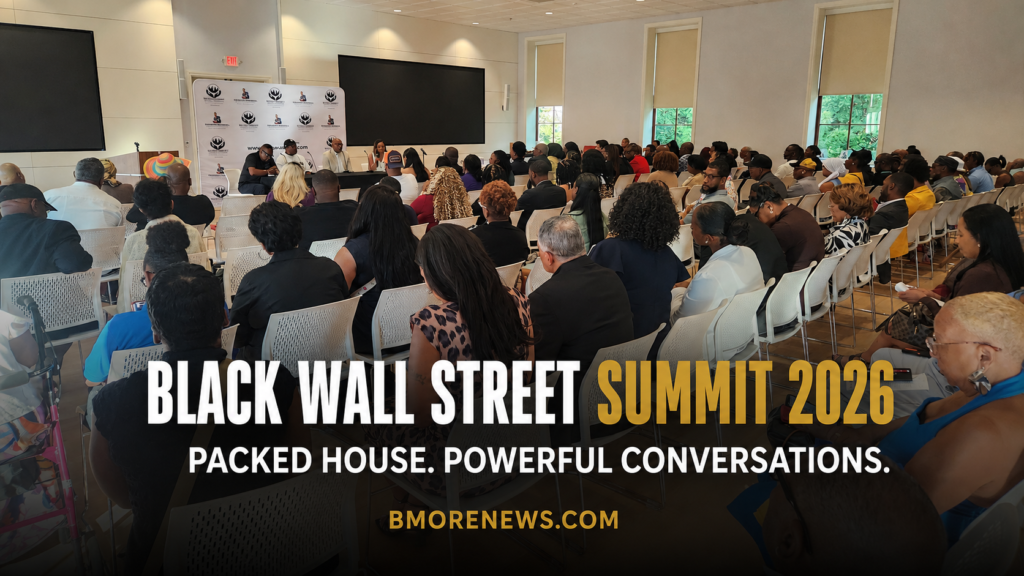
Black people cannot continue being consumers in a city where we are the majority while remaining an afterthought when contracts, ownership, and investment opportunities are distributed.
When millions of dollars are announced for West North Avenue, we want to know how many Black businesses receive contracts.
When Harborplace is redeveloped, we want to know whether Black entrepreneurs will own businesses there.
When financial institutions announce commitments to underserved communities, we want to know how much capital actually reaches Black-owned companies.
When public money supports private development, we want to know what the public receives in return.
How many jobs?
What kind of jobs?
Are they permanent? Do they provide benefits? Is there a path to management and ownership?
A ribbon cutting is not economic development if the same people remain poor after the ribbon falls to the ground.
Black Public Education
Baltimore City spends among the highest amounts per student in the country, yet its children remain near the bottom of Maryland’s 24 public-school jurisdictions on too many critical measures of academic performance.
That contradiction demands more than another press conference.
Where is the money going?
Who is accountable?
Why are children socially promoted and then blamed when they are unprepared?
Why have generations of Black children been labeled, medicated and placed on drugs such as Ritalin without enough attention to trauma, nutrition, home conditions and the environment surrounding them?
Black children do not lack intelligence.
They have too often been failed by adults, institutions and systems that receive money in their names.
Our concern is not limited to Baltimore City. It extends to the education of Black children in Northwest Baltimore County, Prince George’s County, Washington, D.C., and wherever systems receive substantial resources without producing acceptable results.
Formerly Incarcerated People and Reentry
Maryland cannot claim to believe in rehabilitation while continuing to punish people after they have completed their sentences.
A returning citizen needs identification, housing, employment, healthcare, transportation and an opportunity to rebuild family relationships.
Without those things, “reentry” becomes another empty government word.
BMORENews.com has advocated for formerly incarcerated people from the beginning because we understand that people can change.
One bad decision should not become a lifetime sentence after the official sentence has ended.
If a person has paid the debt, open the door.
Affordable Housing and Anti-Displacement
Baltimore’s housing policies cannot be discussed without acknowledging 1910.
This city helped institutionalize residential segregation. It later lived through redlining, restrictive covenants, blockbusting, urban renewal and the destruction or displacement of Black neighborhoods.
Therefore, every modern development plan must answer a basic question:
What happens to the people who already live there?
Can homeowners afford rising property taxes?
Can renters remain as rents increase?
Will vacant properties be returned to productive use for existing residents—or transferred in bulk to outside investors?
Will Black families build equity?
Will Black developers have a meaningful opportunity to participate?
We welcome investment.
But investment without inclusion becomes displacement.
And displacement is not progress.
Universal Access to Healthcare
Healthcare begins long before a person reaches an emergency room.
It begins with prenatal care. It includes nutrition, mental health, environmental safety, addiction treatment, preventive medicine, and access to trustworthy medical professionals.
In Baltimore, healthcare must also include an honest reckoning with lead paint.
How many Black children were poisoned inside their own homes before they ever entered a classroom?
How did that exposure affect their development, behavior and ability to learn?
How many children were subsequently labeled as problems without anyone addressing the environmental conditions that harmed them?
A child’s ZIP code, income or race should not determine whether that child receives competent healthcare.
Universal access to healthcare is not a luxury.
It is a prerequisite for a healthy and productive city.

BMORENews.com, at the Biden White House.
Politics, Public Policy and Accountability
BMORENews.com has been embedded in Maryland politics since 2002—the year of the Republican Revolution that helped elect Robert Ehrlich governor and Michael Steele lieutenant governor.
Since then, the last four winning Maryland governors—Ehrlich, Martin O’Malley, Larry Hogan and Wes Moore—have advertised with BMORENews.com during their respective political journeys.
We know politics.
We understand campaigns, coalitions, relationships and the difference between a promise made before an election and a result produced afterward.
Access, however, does not eliminate accountability.
Our job is not to be a cheerleader for any political party.
Our job is to ask who delivered.
Who received the funding? Who got the contract? Which neighborhood improved? Which school got better? Which law changed people’s lives?
Black voters cannot be remembered in October and ignored by January.
More Than Content
As of March 2026, BMORENews.com’s digital footprint included:
- YouTube: 11.2K subscribers, 2,362,443 views and more than 8,300 videos
- Facebook: 31,000 followers
- Instagram: 4,081 followers
- X: 2,537 followers
- TikTok: 24K followers and 344.8K likes
Our video archive has since grown to more than 8,300 videos covering Maryland politics, business, education, community affairs, culture and the Black experience.
The value of that archive is not merely its size.
It is what we preserved.
We interviewed entrepreneurs before their companies became widely known. We covered communities before developers announced multimillion-dollar plans. We recorded elders, activists and neighborhood leaders whose stories might otherwise have disappeared.
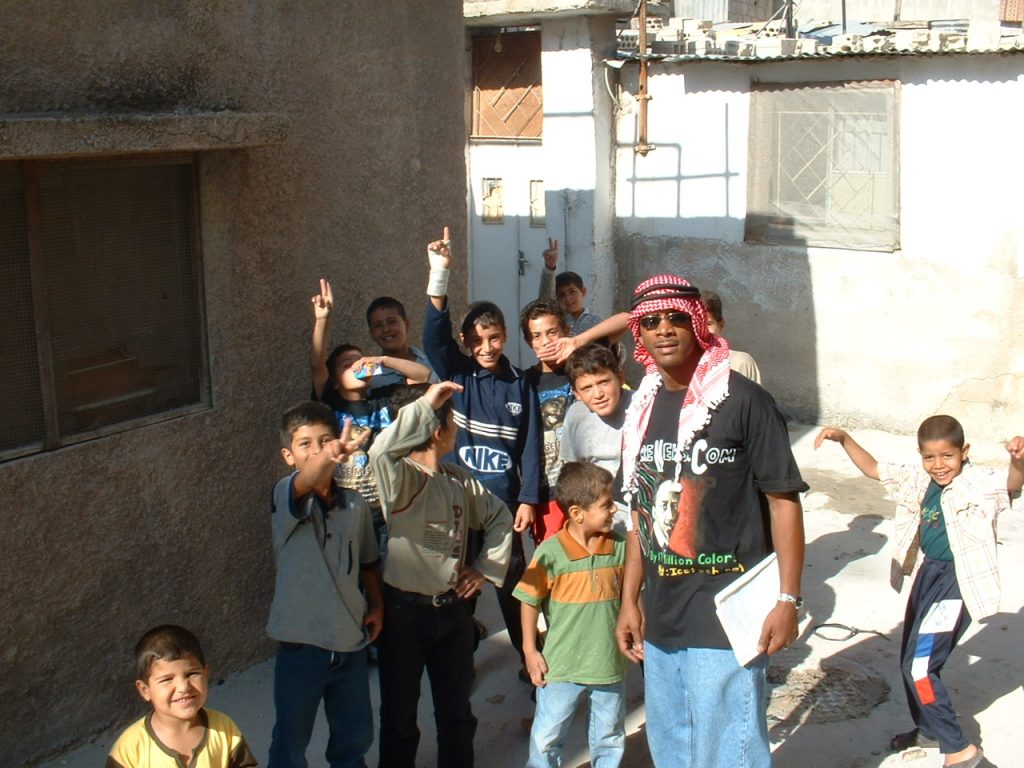
Since 2010, I have undertaken roughly 60 White House coverage assignments. BMORENews.com has also reported from Jordan, Ethiopia, Tanzania, Jamaica and Canada.
Yet no matter where the work has taken me, Baltimore has remained home.
This city is our beat.
Celebrating Our Own
BMORENews.com has never believed that journalism should focus exclusively on everything wrong with Black people.
We already have enough people doing that.
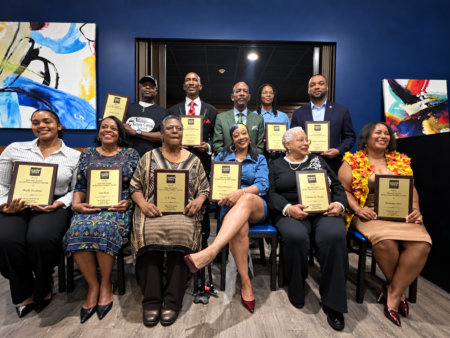
In 2011, we established the Joe Manns Black Wall Street Awards to celebrate Black entrepreneurs, professionals and community servants.
Since then, we have honored more than 2,700 individuals in Baltimore, Washington, D.C., New York, Atlanta and New Orleans.
Why?
Because Black people are not merely the subjects of problems.
We are builders. We are employers. We are educators. We are developers. We are innovators. We are artists. We are freedom fighters. We are problem-solvers.
Our children need to see that.
Our communities need to remember it.
And our media must document it.
The Road to 25
As BMORENews.com moves toward its 25th anniversary on August 9, 2027, I am thinking less about how far we have come and more about the work that remains.
Baltimore is changing.
The money is moving. The land is being assembled. Political and economic alliances are being formed. Decisions are being made today that will determine who owns Baltimore tomorrow.
Black Baltimore cannot afford to watch this transformation from the sidelines.
We must be informed.
We must be organized.
We must be at the table.
And when necessary, we must build our own table.
BMORENews.com will continue telling the stories mainstream media overlooks. We will celebrate Black excellence, challenge institutional failure and hold public officials accountable.
We will ask who owns what.
We will ask who received the contract.
We will ask who got hired.
We will ask whether Black children are learning.
We will ask whether longtime residents can remain in their homes.
We will ask whether the community benefited after the ribbon was cut and the cameras were turned off.
Baltimore has always been a city of Black strength.
From the freedom seekers who passed through Orchard Street Church to Harvey Johnson, Vernon Dobson, the Goon Squad and every unnamed person who fought for this community, the tradition is already here.
This is Tubman City.
We will not willingly return to 1910.
After 24 years, BMORENews.com’s mission remains unchanged:
To tell our stories.
To protect our communities.
To strengthen Black businesses.
To improve the image of Black people worldwide.
And to keep asking every politician, developer, institution, business leader and community organization seeking to shape Baltimore’s future:
What solution are you bringing to the table?
BMORENews.com: THE NEWS BEFORE THE NEWS.