

(BALTIMORE – August 16, 2026) – It was a super-duper, super-busy Saturday in historic West Baltimore.
From Harlem Park to Sandtown-Winchester, Gilmor Street was alive with brotherhood, basketball, poetry, African drumming, community service, filmmaking, and Black cultural expression.
And at the center of it all were Black men.
Black men were up and down Gilmor Street setting the world on fire—in a good way.
They were collecting shoes for people in need. They were organizing basketball games for the next generation. They were beating African drums, celebrating Marcus Garvey, creating opportunities for vendors and restoring a historic Black theater.
These were not disconnected activities. Much of it was happening simultaneously along one historic West Baltimore corridor.
It was Black men giving back, preserving culture and building community—without waiting for somebody else to come and do it for us.
The Wylies Walk This Way
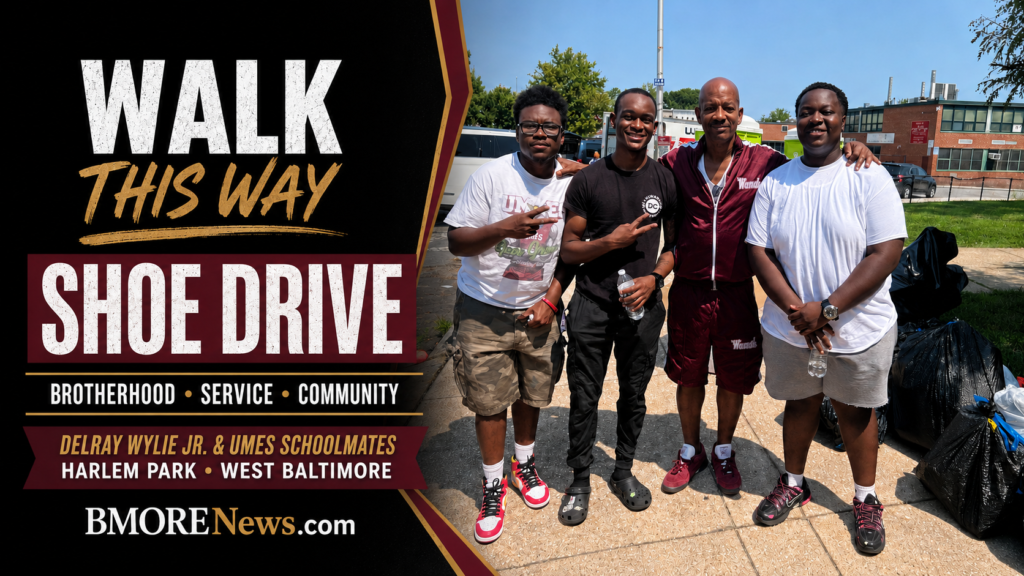
The day began with the Walk This Way Shoe Drive, presented by Delray Wylie Sr. and Delray Wylie Jr. of Wylie Funeral Homes.
Held from 10 a.m. to 1 p.m. along Gilmor Street, the drive was part of the Wylie Foundation’s commitment to giving back to the community.
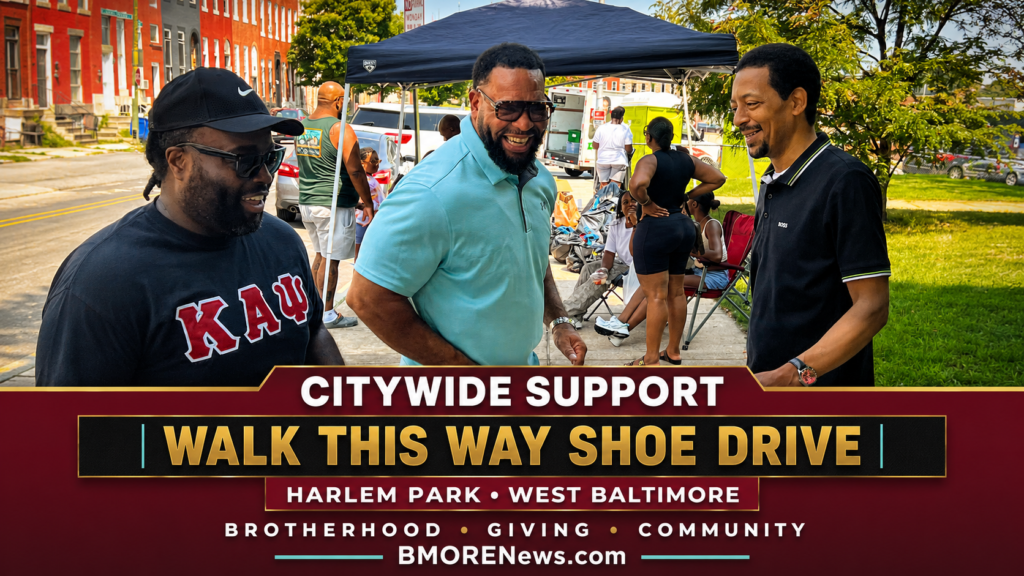
As we interviewed volunteers, people continued pulling up with shoes. Much of the support I witnessed came from men.
Delray Wylie Sr. is both a Kappa man and a Mason. Some of his fraternity and lodge brothers came through, along with his son’s friends. You could see the camaraderie and brotherhood.
They were not there merely to take pictures. They were there to help people who needed shoes.
That was the first example of what would become the day’s prevailing theme: Black men showing up for their community.
Marcus Garvey Day Brings the Village to Harlem Park
As the Wylies conducted their shoe drive along the sidewalk, the 2026 Marcus Garvey Day celebration was beginning inside Harlem Park.
Led by Baba Charlie Dugger and company, the celebration started at noon and continued into the evening.
“Baba” is a title of respect for an elder, and Brother Charlie has earned it. A retired educator and longtime cultural leader, he has dedicated decades to preserving, teaching and celebrating Black American culture and the broader African Diaspora.
Marcus Garvey Day transforms Harlem Park into a village.
Vendors set up throughout the park, offering food, products, artwork, services, and information. Families, elders, cultural workers and community members gather, greet one another and celebrate Black life.
Then come the drums.
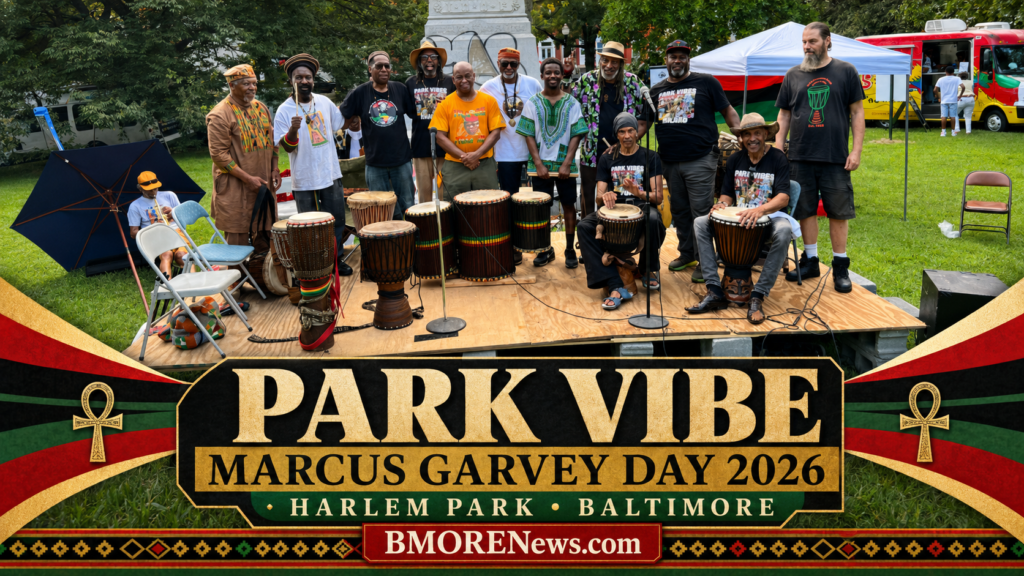
Park Vibe, the group of male drummers whose presence in Druid Hill Park reaches back decades, is always a feature at Brother Charlie’s events. Their rhythm brings an ancestral energy that can be felt throughout the park.
They do not merely perform. They help set the spiritual and cultural atmosphere.
Brother Charlie has been a part of my life since I was 15 years old. He was among the first people to take me onto the radio. Over the years, I have missed several of his invitations, but I was determined not to miss this one.
As he always does, Brother Charlie invited me to speak.
I shared a little about BMORENews.com and performed two poems: “On the Subway” by The Last Poets and “Who’s to Blame” by an anonymous author.
I was grateful for the opportunity. For me, it was more than an appearance or another news assignment. It allowed me to honor an elder who helped introduce me to radio and the power of media, culture and community engagement.
Doni Glover)
The Legends Continue at McAbee Playground
While Marcus Garvey Day filled Harlem Park with vendors, poetry, music and African drums, another expression of Black leadership was taking place farther up Gilmor Street.
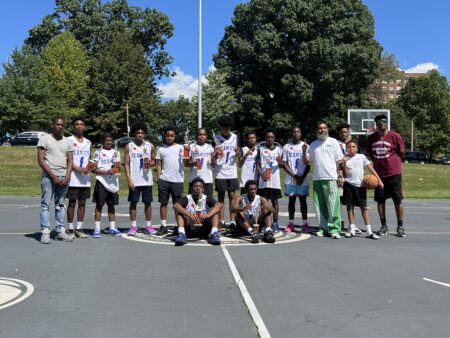
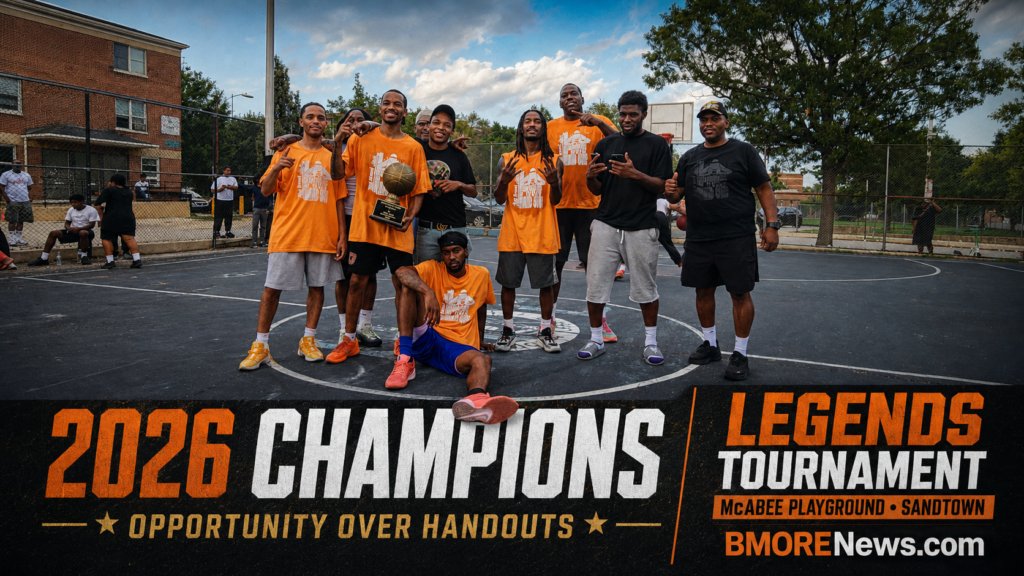
At McAbee Playground, at Gilmor and Laurens streets, Brian Hatcher, Andre Boyd and the other members of the Opportunity Over Handouts Foundation presented their annual Legends Tournament.
Once again, Black men were doing the work.
They organized the basketball games, prepared food and refreshments, and created a positive environment where the community could come together.
Brian Hatcher is not a big talker. He is a doer.
I was not able to get a lengthy interview from him during the tournament. He thanked the people who supported the event, but he did not spend much time talking about himself.
His work spoke for him.
The tournament featured some strong talent, including local high school players. It was refreshing to see the next generation of ballplayers competing. There is nothing quite like watching young people who understand the game and can truly handle the basketball.
The tournament also continues a Sandtown tradition.
Long before Opportunity Over Handouts took the lead, Stacey Fowlkes and Building a Better Sandtown Community—BABSC—organized the Legends Tournament as part of Festival Day weekend.
At that time, Gilmor Homes was still open, and the tournament was built around Sandtown residents. Younger and older men competed, different generations came together, and the winning team earned bragging rights for an entire year.
Stacey’s work grew out of a lesson his mother, Miss Dorothy, taught him:
“When we didn’t have, people gave us.”
He carried that principle into youth sports, after-school programming, community festivals and BABSC.
Acknowledging Stacey and BABSC does not take anything away from Brian, Andre or Opportunity Over Handouts. It establishes the lineage.
One generation created a tradition. Another generation stepped forward to carry it.
That is what legacy looks like.
A Historic Day in Two Historic Communities
The significance of the day was magnified by where it happened.
Sandtown-Winchester and Harlem Park are two historic West Baltimore communities that have given Baltimore and the nation extraordinary people, institutions and cultural contributions.
Sandtown has been home at various times to giants such as Supreme Court Justice Thurgood Marshall, Billie Holiday and Cab Calloway. Harlem Park emerged during the 19th century as a desirable residential community and later became home to a thriving Black middle class.
In 1960, Harlem Park became Baltimore’s first full-scale urban-renewal rehabilitation area. The plan promised improved housing and new green spaces, but it also resulted in extensive demolition and the displacement of residents.
That complicated history made Saturday’s activity especially meaningful.
This time, Black people were not waiting for an outside institution to define what community development should look like. Black men and women were taking to the streets, the playgrounds, the parks, and the theaters for themselves.
Reclaiming the Historic Harlem Theatre
My final stop was at Robert Cotton’s invitation to the historic Harlem Theatre, where a film production was underway.
Although I have spent much of my life in West Baltimore, I do not believe I had ever been inside the Harlem Theatre.
Walking through those doors was powerful.
A group has taken over the space and is working to reclaim an important piece of Black history in Harlem Park. Inside that historic building, Black creatives were not simply remembering the past. They were creating something new.
Once again, a Black man was opening a door, bringing people together and helping restore a culturally significant space in our community.
Black Men Setting the World on Fire
From Delray Wylie Sr. and Delray Wylie Jr. collecting shoes, to Baba Charlie Dugger nurturing the cultural and spiritual life of the community, to Brian Hatcher and Andre Boyd continuing Sandtown’s basketball legacy, to Robert Cotton helping reactivate the historic Harlem Theatre, Black men were visible all along Gilmor Street.
They were visible for the right reasons.
They were serving.
They were organizing.
They were preserving history.
They were teaching the next generation.
They were enriching the culture and spirit of the people.
In every instance, Black men were engaged in some of the most culturally significant activities a community could imagine.
That is the story.
It was a beautiful Saturday spent entirely in historic West Baltimore—my community, my home and the place that continues to shape who I am.
Black men were setting Gilmor Street—and the world—on fire.
In a good way.
And BMORENews.com was there to cover it all.
BMORENews.com — The News Before the News.
It was a super-duper, super-busy Saturday in historic West Baltimore.
From Harlem Park to Sandtown-Winchester, Gilmor Street was alive with brotherhood, basketball, poetry, African drumming, community service, filmmaking and Black cultural expression.
And at the center of it all were Black men.
Black men were up and down Gilmor Street setting the world on fire—in a good way.
They were collecting shoes for people in need. They were organizing basketball games for the next generation. They were beating African drums, celebrating Marcus Garvey, creating opportunities for vendors and restoring a historic Black theater.
These were not disconnected activities. Much of it was happening simultaneously along one historic West Baltimore corridor.
It was Black men giving back, preserving culture and building community—without waiting for somebody else to come and do it for us.
The Wylies Walk This Way
The day began with the Walk This Way Shoe Drive, presented by Delray Wylie Sr. and Delray Wylie Jr. of Wylie Funeral Homes.
Held from 10 a.m. to 1 p.m. along Gilmor Street, the drive was part of the Wylie Foundation’s commitment to giving back to the community.
As we interviewed volunteers, people continued pulling up with shoes. Much of the support I witnessed came from men.
Delray Wylie Sr. is both a Kappa man and a Mason. Some of his fraternity and lodge brothers came through, along with friends of his son. You could see the camaraderie and brotherhood.
They were not there merely to take pictures. They were there to help people who needed shoes.
That was the first example of what would become the prevailing theme of the day: Black men showing up for their community.
Marcus Garvey Day Brings the Village to Harlem Park
As the Wylies conducted their shoe drive along the sidewalk, the 2026 Marcus Garvey Day celebration was beginning inside Harlem Park.
Led by Baba Charlie Dugger and company, the celebration started at noon and continued into the evening.
“Baba” is a title of respect for an elder, and Brother Charlie has earned it. A retired educator and longtime cultural leader, he has dedicated decades to preserving, teaching and celebrating Black American culture and the broader African Diaspora.
Marcus Garvey Day transforms Harlem Park into a village.
Vendors set up throughout the park with food, products, artwork, services and information. Families, elders, cultural workers and community members gather, greet one another and celebrate Black life.
Then come the drums.
Park Vibe, the group of male drummers whose presence in Druid Hill Park reaches back decades, is always a feature at Brother Charlie’s events. Their rhythm brings an ancestral energy that can be felt throughout the park.
They do not merely perform. They help set the spiritual and cultural atmosphere.
Brother Charlie has been a part of my life since I was 15 years old. He was among the first people to take me onto the radio. Over the years, I have missed several of his invitations, but I was determined not to miss this one.
As he always does, Brother Charlie invited me to speak.
I shared a little about BMORENews.com and performed two poems: “On the Subway” by The Last Poets and “Who’s to Blame” by an anonymous author.
I was grateful for the opportunity. For me, it was more than an appearance or another news assignment. It allowed me to honor an elder who helped introduce me to radio and the power of media, culture and community engagement.
The Legends Continue at McAbee Playground
While Marcus Garvey Day filled Harlem Park with vendors, poetry, music and African drums, another expression of Black leadership was taking place farther up Gilmor Street.
At McAbee Playground, at Gilmor and Laurens streets, Brian Hatcher, Andre Boyd and the other members of the Opportunity Over Handouts Foundation presented their annual Legends Tournament.
Once again, Black men were doing the work.
They organized the basketball games, prepared food and refreshments, and created a positive environment where the community could come together.
Brian Hatcher is not a big talker. He is a doer.
I was not able to get a lengthy interview from him during the tournament. He thanked the people who supported the event, but he did not spend much time talking about himself.
His work spoke for him.
The tournament featured some strong talent, including local high school players. It was refreshing to see the next generation of ballplayers competing. There is nothing quite like watching young people who understand the game and can truly handle the basketball.
The tournament also continues a Sandtown tradition.
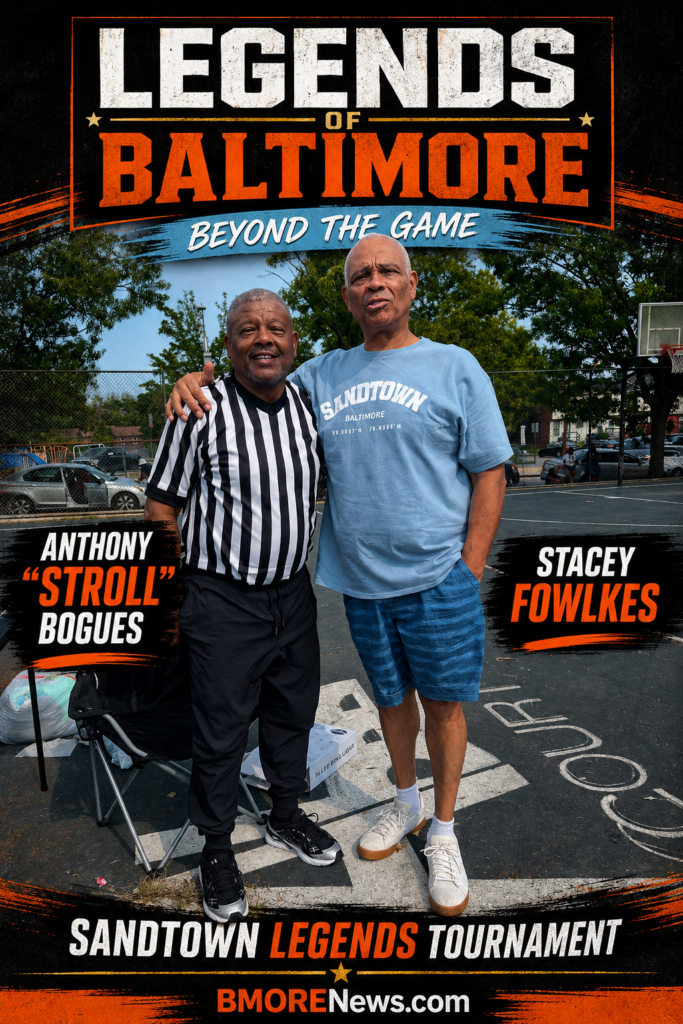
Long before Opportunity Over Handouts took the lead, Stacey Fowlkes and Building a Better Sandtown Community—BABSC—organized the Legends Tournament as part of Festival Day weekend.
At that time, Gilmor Homes was still open, and the tournament was built around Sandtown residents. Younger and older men competed, different generations came together, and the winning team earned bragging rights for an entire year.
Stacey’s work grew out of a lesson his mother, Miss Dorothy, taught him:
“When we didn’t have, people gave us.”
He carried that principle into youth sports, after-school programming, community festivals and BABSC.
Acknowledging Stacey and BABSC does not take anything away from Brian, Andre or Opportunity Over Handouts. It establishes the lineage.
One generation created a tradition. Another generation stepped forward to carry it.
That is what legacy looks like.
A Historic Day in Two Historic Communities
The significance of the day was magnified by where it happened.
Sandtown-Winchester and Harlem Park are two historic West Baltimore communities that have given Baltimore and the nation extraordinary people, institutions and cultural contributions.
Sandtown has been home at various times to giants such as Supreme Court Justice Thurgood Marshall, Billie Holiday and Cab Calloway. Harlem Park emerged during the 19th century as a desirable residential community and later became home to a thriving Black middle class.
In 1960, Harlem Park became Baltimore’s first full-scale urban-renewal rehabilitation area. The plan promised improved housing and new green spaces, but it also resulted in extensive demolition and the displacement of residents.
That complicated history made Saturday’s activity especially meaningful.
This time, Black people were not waiting for an outside institution to define what community development should look like. Black men and women were activating the street, the playground, the park and the theater for themselves.
Reclaiming the Historic Harlem Theatre
My final stop came after Robert Cotton invited me to the historic Harlem Theatre, where a film production was underway.
Although I have spent much of my life in West Baltimore, I do not believe I had ever been inside the Harlem Theatre.
Walking through those doors was powerful.
A group has taken over the space and is working to reclaim an important piece of Black history in Harlem Park. Inside that historic building, Black creatives were not simply remembering the past. They were creating something new.
Once again, a Black man was opening a door, bringing people together and helping restore a culturally significant space in our community.
Black Men Setting the World on Fire
From Delray Wylie Sr. and Delray Wylie Jr. collecting shoes, to Baba Charlie Dugger nurturing the cultural and spiritual life of the community, to Brian Hatcher and Andre Boyd continuing Sandtown’s basketball legacy, to Robert Cotton helping reactivate the historic Harlem Theatre, Black men were visible all along Gilmor Street.
They were visible for the right reasons.
They were serving.
They were organizing.
They were preserving history.
They were teaching the next generation.
They were enriching the culture and spirit of the people.
In every instance, Black men were engaged in some of the most culturally significant activities a community could imagine.
That is the story.
It was a beautiful Saturday spent entirely in historic West Baltimore—my community, my home and the place that continues to shape who I am.
Black men were setting Gilmor Street—and the world—on fire.
In a good way.
And BMORENews.com was there to cover it all.
BMORENews.com — The News Before the News.