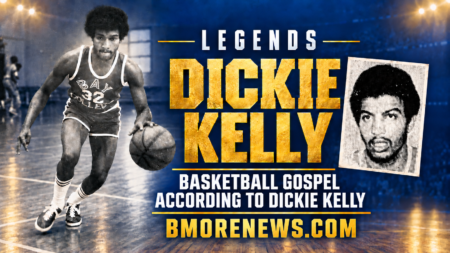


(BALTIMORE – August 10, 2026) – When I hear the word “legend,” I think back to Dunbar.
The basketball players—particularly the starting five—were legends way back then. There was a mystique surrounding them. You could feel it in the hallways, in the gym, and throughout the school.
But Poets know that mystique is earned through hard work.
There are no shortcuts.
You must outwork the competition. You must be mentally fit, and your spirit had better be right. Above all, you must be prepared—especially physically prepared. Your body must be conditioned to execute what your mind demands, even when you are tired, hurting, or under pressure. You cannot wait until the competition begins to get ready. Champions prepare long before anybody is watching. Those are the marks not only of a basketball champion, but of all champions: prepared, smarter, wiser, stronger, more patient, more surgical, more studious and always willing to hustle.
That is the Dunbar tradition.
On the basketball court, it was all choreographed by the maestro, the legendary Coach Bob Wade.
But others had also earned the title of legend at Dunbar—and it wasn’t for hoops.
The Grasshopper Gets Schooled
Anthony Dunaway was our wrestling coach.
On the very first day, he told me to shoot—a wrestling move in which you drop your level, penetrate your opponent’s defense, and attack the opponent’s lower leg, ultimately looking for the takedown.
I shot.
Dunaway simply pointed his knee exactly where I was headed.
The end result? I damn near got the wind knocked out of me by a knee to the chest.
Brutal.
Understand, I thought I could take him. Hell, it wasn’t like he was a big guy. He was my size or smaller.
It was one of those “Grasshopper” scenes from the television series Kung Fu, where the confident young student suddenly realizes how much he still has to learn.
Dunaway was probably only about 10 years older than me, but he had already earned his legendary status. In 1973, he won the Maryland Scholastic Association championship at 98 pounds for Dunbar, defeating Loyola’s Greg Hudak, 7–1.
Nearly a decade later, he was teaching another generation of Poets the craft that had made him a champion.
But while Dunaway was the master teaching the lessons, another legend ruled Dunbar’s wrestling room.
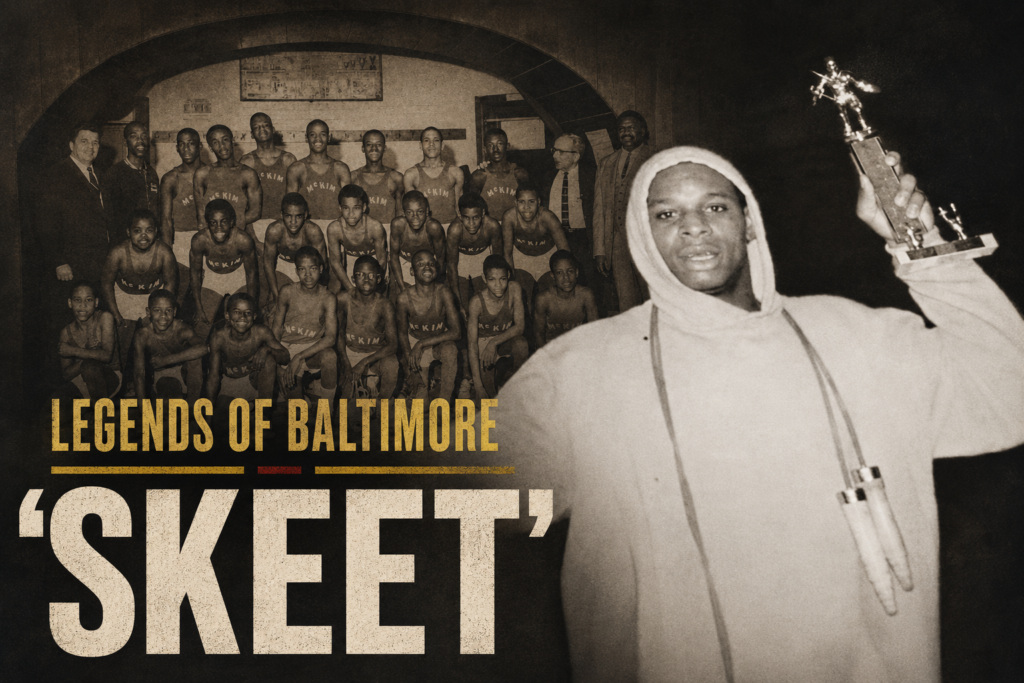
His name was Robert “Skeet” Register.
Like Muggs. Like Reggie.
Skeet was already legendary when I met him.
Let Me Be Precise
I am not declaring Skeet the greatest wrestler in the entire history of Dunbar.
There were phenomenal wrestlers before him—Anthony Dunaway, the Matthews brothers, Damon Lee and other greats who helped establish Dunbar’s wrestling tradition.
I attended Dunbar from 1981 through 1983. In 1982, I wrestled on the same team as Skeet. We had other outstanding wrestlers, including Poo, Rick, Don Ockimey, Big Irby, and Lil Anthony.
But during our era, there was no question who ruled the wrestling room.
In 1982, the year I wrestled with him, Robert “Skeet” Register was unquestionably the baddest wrestler at Dunbar.
McKim Made Champions
Skeet’s wrestling story did not begin at Dunbar. It began when he was five years old at the McKim Center in East Baltimore—known simply as “McKim’s” to generations of Baltimoreans.
McKim was not an ordinary recreation center.
Established in 1821, the McKim Center describes itself as the oldest continuously active community center in the United States. For generations, it has used education and athletics to serve Baltimore’s children and families.
Its wrestling program became one of the city’s great incubators of talent, discipline and character.
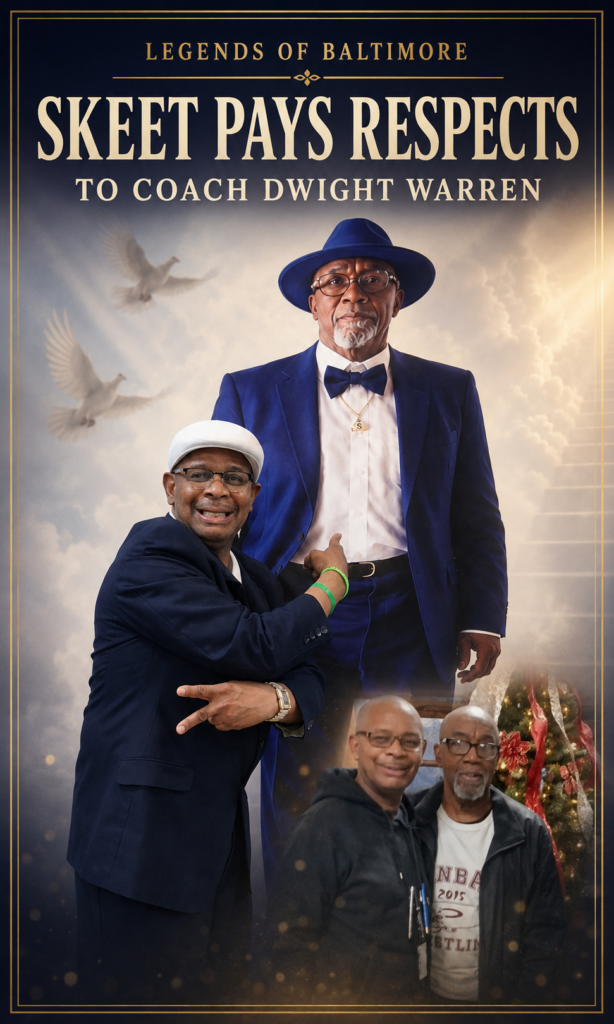
At the center of that tradition was Coach Dwight Warren.
Warren did not establish McKim’s wrestling program. He first entered McKim as a 13-year-old wrestler himself. He became the program’s head wrestling coach in 1967 and coached there until 1989, leading McKim teams to 10 Maryland Junior League championships.
Warren became McKim’s executive director in 1975 and devoted more than five decades to the institution and the young people it served.
“Dwight was the best, man,” Skeet told me. “Dwight was the best.”
Skeet credited Warren with teaching him how to wrestle, but Warren’s influence went far beyond technique. He used wrestling to instill structure, discipline, love and respect—the principles that continue to define McKim’s mission.
Coach Bob Wade also paid considerable homage and respect to Warren and the work he did with Baltimore’s young people.
The historical record supports what Skeet remembered. Warren taught and mentored thousands of young people and continued coaching and officiating wrestling into his 70s. In 2005, he received the National Wrestling Hall of Fame’s Lifetime Service to Wrestling honor. The Maryland State Wrestling Association honored him again in 2020 with the Johnny Eareckson Memorial Award for Lifetime Service.
Warren also coached wrestling at Mervo, Southside Academy, Carver and, eventually, Dunbar. His Dunbar team became the first inner-city school to win a Class 1A/2A regional wrestling championship.
Coach Dwight Steven Warren died on May 1, 2026, at age 77.
By the time Skeet arrived at Dunbar, he was not a beginner learning how to shoot. He had already spent more than a decade studying wrestling under one of Maryland’s most respected coaches.
McKim had prepared him.
Warren had shaped him.
Skeet brought that foundation into Dunbar’s wrestling room, and the rest of us could see the difference.
He was strong, quick and technically sound. He possessed an arsenal of moves, but he also carried the discipline, humility and commitment that Warren taught at McKim.
Before Skeet became Dunbar’s captain and an MSA champion, he was one of Dwight Warren’s McKim wrestlers.
That lineage matters.
Skeet’s championship was not created during a single season at Dunbar. It was the product of a Baltimore institution, a devoted coach and years of disciplined preparation.
That is how champions are made.
Did You Know?
Before becoming an NBA legend, Tyrone “Muggsy” Bogues was also a wrestler at the McKim Center.
And before becoming the publisher of BMORENews.com, yours truly was a co-captain of the Dunbar wrestling team.
Just a couple of Baltimore trivia facts.
They also demonstrate how young Baltimore athletes were not always confined to one sport. Wrestling developed balance, leverage, toughness, discipline and mental focus—qualities that could be carried onto a basketball court, into martial arts and throughout life.
“Strong as a Damn Ox”
Paul Cooper was one of our teammates.
Because Paul wrestled at 147 pounds and Skeet competed around 155, the coaches paired them against each other constantly in practice.
That meant Paul had to wrestle the best man in the room over and over again.
“All the f****ing time,” Cooper recalled. “They matched him and me up all the time.”
Those practice sessions gave Cooper a close view of what made Skeet different.
“Strong as a damn ox,” he said. “Not to mention fast, quick, and had a whole bunch of moves.”
But strength and athletic ability tell only part of the story.
Cooper remembers Skeet as an intense and committed leader—the wrestler who was in the room before everybody else and one of the last to leave.
“He was definitely the best one on our team,” Cooper said. “Skeet was one of the best McKim ever put out.”
Skeet had what Cooper called “that stuff that champions got.”
“They put in the work,” he said.
Train Like a Champion
When Skeet led us through exercises, drills or wrestling moves, everything was done with purpose and precision.
He trained like a champion.
Everything Skeet did—every exercise, every drill and every move—was performed as close to perfection as he could get it.
I carried that lesson with me long after Dunbar. I applied it to working out and practically everything else I attempted.
Even jumping jacks and push-ups had to be performed correctly.
Skeet taught me through his example that you do everything like a professional. Every single thing. There are no meaningless repetitions. Everything must be done with purpose.
Perfect practice makes perfect.
That was Skeet’s leadership. He did not merely tell his teammates what commitment looked like. He demonstrated it repeatedly in the wrestling room.
You can talk it, or you can do it.
Skeet did it.
The Common Touch
Here is something else about Skeet—real talk.
Although he had been wrestling since he was five years old and was far more advanced than many of us, I never—not once—remember Skeet speaking to any of us teammates in a condescending manner.
He never used his experience, his ability, or his status to belittle anybody.
Skeet encouraged you to become your best.
That matters to me because there is a difference between being the best and being a champion.
Talent can make you a star. Accomplishments can make you a celebrity. Being the best can bring you attention and admiration.
But are you a champion?
Character is what answers that question.
I once had a conversation with Coach Bob Wade about Muhammad Ali. Coach Wade told me that Ali visited Dunbar around 1980.
I shared with him my own memory of meeting Ali at Coppin around 1995. Here was “The Greatest,” one of the most famous human beings on the planet, making it his business to shake everybody’s hand.
That was greatness.
Rudyard Kipling wrote of being able to “walk with Kings—nor lose the common touch.”
Muhammad Ali embodied that quality. He showed us that you can be great without becoming so puffed up that you can no longer relate to everyday people—or to people who are not as talented, accomplished, or celebrated as you.
Ali gave people grace.
So did Skeet.
Skeet was the best wrestler in our room, but he never made the rest of us feel small. He encouraged us. He showed us how the work should be done and trusted us to rise toward the standard he established.
Again, he led by example.
That’s Skeet.
One and One With the Chiapparellis
Skeet’s ability becomes even clearer when you consider the competition he faced before becoming an MSA champion.
As a young wrestler in the Maryland Junior League, Skeet defeated Lou Chiapparelli during a triangle match.
Years later, while wrestling for Dunbar, Skeet faced Lou’s younger brother, Rico Chiapparelli, in the MSA tournament.
This time, Skeet lost.
He was 1–1 against the Chiapparelli brothers.
That was no ordinary split.
Lou Chiapparelli became a National Prep champion. Rico became a three-time MSA champion and completed the 1981 season with a perfect 24–0 record. Rico later won a National Prep championship and became the 1987 NCAA Division I champion at the University of Iowa.
These were not simply good high school wrestlers. They were among the elite.
The historical progression is striking.
Rico won the 1981 MSA championship at 155 pounds after defeating Skeet along the way. One year later, Skeet returned and captured the 1982 MSA championship in that same weight class.
He had experienced the level required to become a champion. Then he came back and reached it himself.
Skeet’s victory over Lou Chiapparelli also belongs in his wrestling history. His ability to split two matches against the Chiapparelli brothers demonstrates the level at which he could compete.
He did not merely dominate Dunbar’s wrestling room. He had been tested against some of the finest wrestlers of his generation—and he proved that he belonged among them.
The Championship
The historical record confirms what those of us in the wrestling room already knew.
Skeet wrestled for Dunbar during the 1981 and 1982 seasons. In 1982, he reached the MSA championship final at 155 pounds.
Waiting for him was Scott Flannery of Mount Saint Joseph.
Skeet did not squeak out a narrow victory. He dominated Flannery, winning by a decisive 14–4 score and capturing the MSA individual championship.
Dunbar finished 10th in the 1982 MSA team standings with 61.5 points. Mount Saint Joseph won the team championship with 206 points.
But at 155 pounds, the champion came from Dunbar—and his name was Robert Register.
The victory completed a journey that had begun when Skeet was five years old at McKim. The child taught by Dwight Warren had become Dunbar’s captain and an MSA champion.
Skeet and Dunbar basketball star David Wingate were also selected as Baltimore Sun Athletes of the Week during the same week—an extraordinary moment in Dunbar athletic history.
Basketball may have commanded most of the headlines, but wrestling had a champion of its own.
More Than One Kind of Dunbar Legend
People naturally associate Dunbar with basketball.
How could they not?
Coach Bob Wade’s teams produced a collection of talent and success that may never be duplicated. But the Dunbar tradition was never confined to one sport.
You could find it on the football field, on the track and inside our wrestling room. It lived in coaches such as Anthony Dunaway and Dwight Warren. And please let’s not forget Uncle Loc; he was a father to us all. It lived in athletes who understood that talent without discipline would never be enough.
And it lived in Skeet Register.
Skeet represented the same championship qualities that made Dunbar basketball famous: intelligence, preparation, toughness, patience, confidence, sacrifice and relentless work.
He was already a legend when I met him—not because somebody gave him the title, but because he had earned the respect that came with it.
Paul Cooper saw it every time he had to line up across from Skeet in practice. I saw it in the way Skeet carried himself, led our workouts, and encouraged his teammates.
The MSA saw it when he defeated his championship opponent, 14–4.
But there is an even broader story here.
A Network That Produced Greatness
The more I study, interview, and research the legends of Baltimore, the more I appreciate the network that helped produce them.
I am beginning to understand the interconnectivity of Baltimore’s recreation centers, playgrounds and youth programs—particularly those in East Baltimore.
Lafayette. Madison. McKim. Luzerne. Bocek.
These were not isolated buildings or playgrounds. Together, they formed a network of coaches, mentors and community people who cared about the young people of Baltimore. Like John Murdock.
A child might learn the fundamentals at one recreation center, compete at another and encounter a mentor somewhere else who recognized a gift that needed to be developed.
The coaches knew one another. The young people knew one another. The neighborhoods competed, but they were also connected.
It was an ecosystem.
The more I uncover, the more names emerge: Coach Dwight Warren at McKim. Mr. William Wells at Lafayette. Mr. Cleve Brister and Operation CHAMP. Larry Middleton, the heavyweight boxer who taught boxing at Eutaw Gardens. Tim Conaway—please, let us never forget Tim Conaway. Camp Concern. James Mosher Baseball.
There were many others.
These people made it their business to create opportunities for Baltimore’s young people. They gave children places to go, things to do, and adults to answer to. They created pathways that allowed talent to develop, but their work was never only about producing great athletes.
They were developing human beings.
They taught discipline, responsibility, teamwork, courage and respect. They gave young people a sense of belonging and exposed them to possibilities beyond whatever trouble might have been waiting outside.
There was a unified, collective and proactive effort to save Black children’s lives through sports.
I do not know any other way to put it.
That tradition was particularly strong in East Baltimore. It was also strong in West Baltimore, including the generations of children served through James Mosher Baseball. Similar efforts existed in neighborhoods throughout the city.
The coaches did not simply roll out basketballs, hand us baseball gloves or teach us wrestling moves.
They gave us structure.
They corrected us. They protected us. They created places where young people could belong, learn and grow. They introduced us to standards that many of us carried for the rest of our lives.
They intentionally tried to save Black children’s lives.
And they succeeded.
That is the network that helped produce Baltimore’s legends.
Skeet Register did not become a champion by accident. McKim helped prepare him. Dwight Warren helped shape him. Dunbar gave him another platform, and Anthony Dunaway helped guide the team. Paul Cooper and the rest of us became part of that same wrestling-room brotherhood.
The championship belonged to Skeet, but an entire community helped make the champion.
Baltimore Must Invest in Its Young People
If there is one resounding message I hear from the angels, the heavens and the ancestors, it is this:
Baltimore must invest in youth recreation.
It is mandatory.
Yes, times have changed. Young people have changed. Technology has changed. Neighborhoods have changed.
But children still need structure. They still need safe spaces. They still need something constructive to do. They still need coaches, teachers and mentors who recognize their potential and refuse to give up on them.
Look at what Baltimore once had.
Look at the history.
Look at the greatness that came from it.
We cannot celebrate the legends produced by yesterday’s recreation centers while refusing to make the investments necessary to develop tomorrow’s young people.
You can see the power of those connections today at the Dome during the Legends Tournament. It is bigger than basketball.
People come back to see the men and women they survived with—the people with whom they traveled through life.
We have endured the trials and travails of life, yet we are still here. We are still smiling. We still have good memories and something wholesome to hold on to.
That stands in sharp contrast to much of the negativity portrayed in the media—and to the violence and despair occurring in real time on our streets and in our communities.
Much of that pain is connected to a gross underinvestment in inner-city communities like East and West Baltimore.
Our elders showed us another way.
They organized. They coached. They mentored. They corrected us. They protected us. They gave their time and created environments in which young Black people could see themselves as champions.
Skeet Register was one of the champions produced by that village.
So, kudos and bravo to the coaches and mentors of East Baltimore who did right by their young people and saved countless lives. The same salute goes to those who served West Baltimore and every other community where adults deliberately stood between young people and the dangers waiting for them.
Kudos to you all for a job well done.
May that example be replicated throughout Baltimore and throughout this country.
Baltimore already possesses the blueprint. It can be found in McKim, Lafayette, Madison, Luzerne, Bocek, James Mosher, Operation CHAMP, Camp Concern and every neighborhood program where an adult made a deliberate decision to stand between a young person and the streets.
The model worked.
Invest in the recreation centers. Restore the playgrounds. Support the coaches. Fund the programs. Respect the mentors. Give Baltimore’s children enough positive options that greatness has room to emerge again.
If we do not continue to nurture our young people and provide them with ample recreational opportunities, then we have failed them.
We have failed them in the 21st century.
Our legends are the evidence.
Our young people deserve the same opportunity.
Train like a champion. Lead like a champion. Treat people like a champion.
That was Robert “Skeet” Register.
The baddest wrestler at Dunbar in my era.