

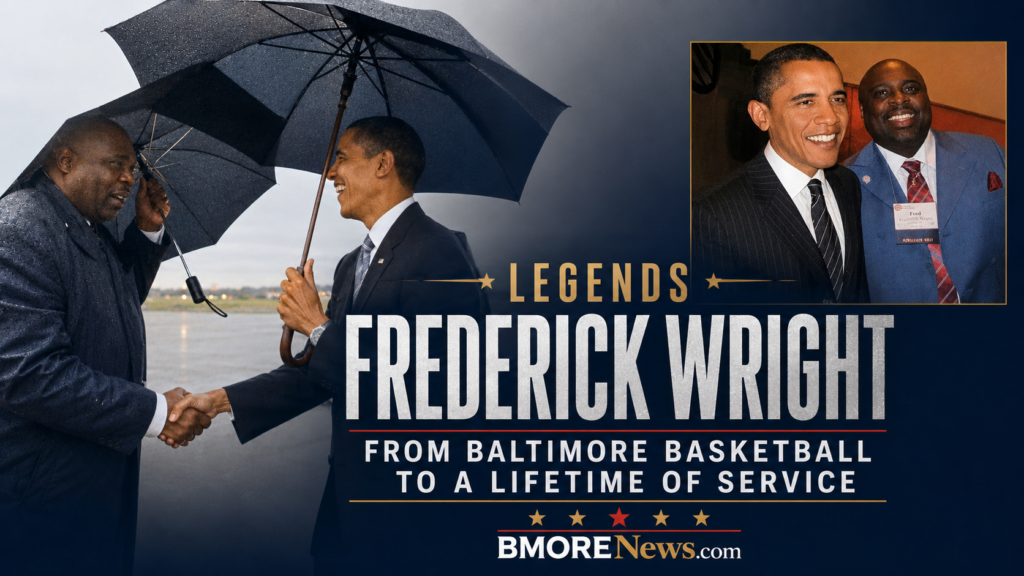
(BALTIMORE – August 23, 2026) – Frederick Wright has spent much of his life getting things done.
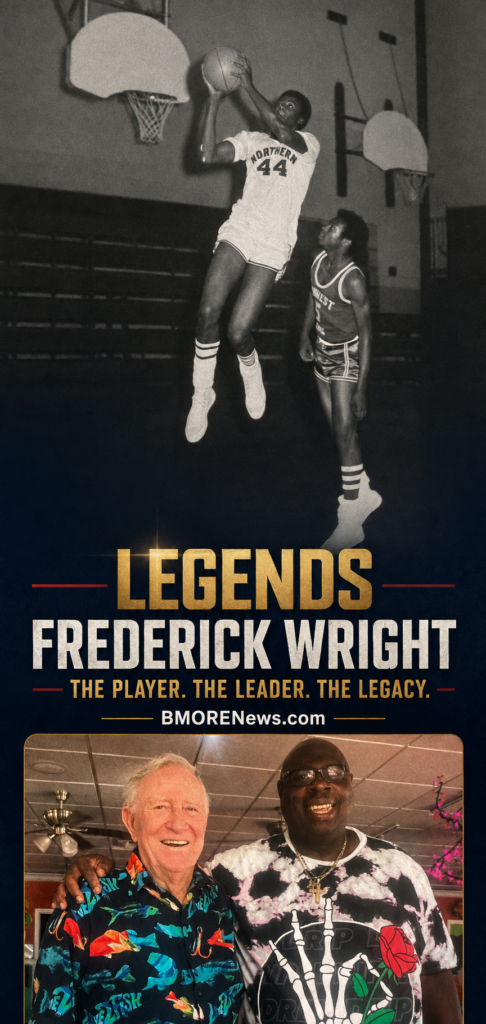
Before he became a veteran Urban League executive, before he developed health and quality-of-life programs across the country, and before he began advising a new generation of nonprofit leaders, Wright was a Baltimore basketball player coming of age during one of the most important periods in the city’s sports history.
He did not hear about that history secondhand.
He lived it.
Born in East Baltimore on September 18, 1954, Wright moved into the Somerset housing projects when he was four years old. His first recreation center was Somerset. He also went to Chick Webb Recreation Center, like generations of Black children on Baltimore’s east side, to learn how to swim.
His formal education began at School No. 116 near Asquith and Orleans streets. He later attended Thomas G. Hayes Elementary School No. 102, across from the old Dunbar High School, before moving on to Clifton Park Junior High School.
At the time, the land surrounding Dunbar looked much different.
Wright remembers a huge recreational lot with multiple baseball diamonds. It was part of a Baltimore in which playgrounds, recreation centers and school gyms served as essential community institutions. They were places where young people learned competition, discipline, teamwork and survival.
When Wright’s family moved from Somerset to the 2500 block near Harford Road, basketball began to take a more prominent place in his life. His cousin, Tyrone “Flick” Johnson, played an instrumental role in introducing him to the game.
At Clifton Park, students competed on class teams. Wright played alongside young men such as Jethro Crum and Billy Snowden. The competition sharpened his game and introduced him to a much larger Baltimore basketball world.
Then came the Baltimore Neighborhood Basketball League.
The Birth of a Baltimore Institution
Before the BNBL became a Baltimore institution, the Baltimore Bullets sponsored a citywide Coca-Cola basketball league. According to Wright, Wes Unseld was closely connected to that league.
When the Bullets eventually left Baltimore for the Washington area, the city faced a basketball void. Wright credits Unseld and then-Mayor William Donald Schaefer with helping establish the BNBL.
For Wright, Schaefer’s role should not be overlooked.
“Best mayor, governor and politician ever in Maryland,” Wright said. “He cared about kids like us.”
He points to Schaefer’s service as Baltimore mayor, Maryland governor and state comptroller as evidence of a public career devoted to Baltimore and Maryland.
The BNBL would become one of Baltimore’s most consequential youth initiatives. It gave generations of young people an organized place to compete and helped develop the city into a nationally recognized basketball hotbed.
Wright played his first BNBL season with Clifton Park. The games were held inside the Madison gym while the outdoor structure, known simply as “the Dome,” was still under construction.
His Clifton Park team included J.T. Shannon and Jethro Crum.
Across the court stood the stars.
William Wells’ team featured some of the city’s best young players, including “Box” Owens, Rodney Floyd, Milton Walker and Larry Witherspoon. Wright’s team did not possess the same collection of celebrated talent, but he held his own against them.
That performance brought him some of his first real recognition.
Wright had played one year of junior varsity basketball at Northern High School but believed he deserved more playing time. After watching his improvement in the summer league, Northern’s coach sent word through Rodney Floyd that Wright would be starting during his junior year.
There was only one catch.
Wright, who was not especially tall for the position, had to play center.
He did it anyway.
Northern Was His Own Road
Wright could have followed other talented players to one of Baltimore’s established basketball powers. Instead, he chose Northern High School.
One of the main reasons was Michael Tillman, an outstanding football and basketball player from Wright’s neighborhood. Tillman was headed to Northern High School, and the younger Wright followed his example.
The decision proved to be one of the best Wright ever made.
Northern was a relatively new and integrated school, with a student body Wright remembers as roughly half Black and half white. Enrollment was so large that students attended in shifts. During Wright’s junior and senior years, his school day ran from 8 a.m. until noon.
His graduating class numbered approximately 1,100 students.
Northern also had something that can get lost when Baltimore basketball history is reduced to Dunbar and City College: strong competition throughout the old Maryland Scholastic Association.
Northern could play. So could Northwestern, Patterson and several other public and private schools.
The city’s basketball talent was spread across Baltimore.
Wright wanted to reach the NBA, just like countless young players before and after him. During his senior season in 1972, he earned second-team All-State honors.
That season placed him in the middle of a pivotal period.
The public and Catholic schools had split following a fight involving Dunbar and Mount Saint Joseph. Dunbar played its games on the road as a penalty. At the same time, the Madison Square Recreation Center Dome was emerging as the center of Baltimore’s summer basketball universe.
And the Madison-Lafayette rivalry was exploding.
Madison vs. Lafayette
Wright played on Madison’s 17-and-under team during the 1970–71 season. The team, which included Jethro Crum, George Pinchback, Gary “Lupe” Lyles and other talented young players, finished 17–0 and won the BNBL city championship.
That same period marked the beginning of basketball beneath the newly completed Madison Square Recreation Center Dome. The first round was held on courts near Madison Elementary School while final construction details were being addressed. By the second round, the players were competing under the Dome.
Then came 1972.
Madison assembled what Wright describes as essentially a 10-man all-star team. Nearly 20 players tried out for the roster.
Lafayette was coming into its own with Skip Wise, Larry Gibson, Timmy Greene, Donnie Joy and Duke Richardson.
The result was one of the greatest neighborhood rivalries in Baltimore basketball history.
“You had to get there early,” Wright recalled. “You wouldn’t be able to get in.”
People climbed fences to see the games. Cars were double-parked along Eden Street. The crowds packed every available space surrounding the court.
Madison and Lafayette played six times that summer. Madison won four; Lafayette won two.
The rivalry was bigger than basketball. It represented neighborhood pride at a time when Baltimore’s playgrounds were producing players capable of competing anywhere in America.
Wright’s success continued well beyond Madison.
In 1979, he captured another BNBL championship while playing for Cecil Recreation in the Double-A Unlimited division.
Between 1975 and 1978, Wright also played on three Project Survival championship teams. Two of those teams were the What Nots, coached by Bob Hampton at Eastwood Recreation Center. He won another championship with Barry Hall and earned league MVP honors during that period.
Wright was later inducted into the BNBL Hall of Fame, an honor he recalls receiving during the early 1980s.
For Wright, these were not simply personal accomplishments. They were evidence of what Baltimore’s neighborhood basketball system could produce.
He believes the BNBL and Project Survival were essential to the development of the city’s players.
Baltimore had once been overlooked by many major college recruiters. They traveled to New York, Philadelphia, Chicago and Washington but frequently passed over Baltimore.
That began to change as the city’s players proved themselves in regional and national competition.
The evidence soon became impossible to ignore.
Morgan State won the 1974 NCAA Division II national championship under Coach Nathaniel “Nat” Frazier. Two years later, Coppin State captured the 1976 NAIA national championship behind tournament MVP Joe Pace and Coach John Bates.
Baltimore was no longer a city college recruiters could afford to skip.
The Point Guard Must See the Whole Floor
Baltimore basketball history includes fierce disagreements—sometimes between people who were both working for the advancement of young Black men.
The conflict between Coach Bob Wade and William Wells is one example.
I am not interested in taking sides. In this case, they were both right.
That is not fence-sitting. It is emotional intelligence.
As the writer, I am the point guard. My job is to see the whole floor.
Coach Wade was responsible for Dunbar. His job was to maintain and strengthen that institution, attract the best players, and compete for championships.
Some people argue that Dunbar was already strong enough. But if you are running Dunbar, you do not build somebody else’s house at the expense of your own.
You do not win national championships by apologizing for wanting to be the best.
Wade’s approach also represented self-empowerment. He created opportunities, hired young people and gave them structure. Sometimes all a 14- or 15-year-old Black boy needs is a job, an assignment and an adult who expects something from him.
I know that would have meant something to me at that age. I might have learned some football if there had been a job connected to it. My path was different, however—and that is what makes each of these Legends stories beautiful.
There is no straight line.
Wells saw another part of the floor.
He believed Dunbar was not the only destination available to a talented Baltimore player. These young men could attend schools throughout the city—and ultimately compete anywhere in the world. His concern was developing the individual child and opening as many doors as possible.
Baltimore needed them both.
Wade strengthened the institution. Wells expanded the possibilities available to the individual.
Out of struggle comes progress. Out of competition comes excellence.
Their philosophies collided because they occupied different positions, carried different assignments, and cared deeply about the same young people.
That tension helped make Baltimore basketball better.
The Tragedy of Tony Brown
Wright also participated in the first Poets All-Star Game, sponsored by the Poets Athletic Club. The game matched senior stars from Baltimore’s public schools against stars from the Catholic and private-school ranks.
The public-school roster included Wright, Tony Brown, Jethro Crum, Tony Carter and Lupe Lyles.
They practiced at what was then the Community College of Baltimore. The night before the game, Brown—the celebrated Dunbar star—was killed.
Brown had been one of Baltimore’s best players, earning All-State and All-America recognition after starring for Dunbar. Wright remembers him as a relentless 6-foot-3 forward and center—a Dennis Rodman-type player before the basketball world knew that name.
The all-star game went forward with a dedication to Brown. The public-school stars won by approximately 30 points, but the victory was overshadowed by the loss of a young man whose future appeared boundless.
Brown’s death left a cloud over Baltimore basketball.
It was also a reminder of how quickly the streets could take away the very young people the playgrounds were trying to save.
From CCB to Bowie and Coppin
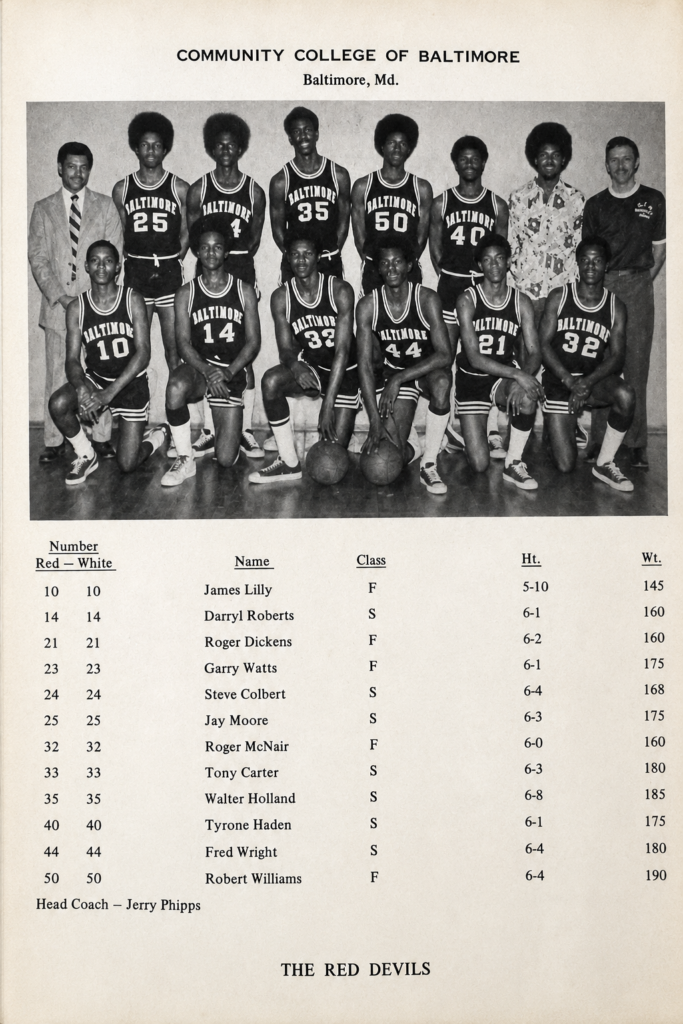
After Northern, Wright played two seasons for Coach Jerry Phipps at the Community College of Baltimore.
During his first season, Wright averaged approximately 14 to 15 points and seven to eight rebounds per game. The team began strongly but lost key players and finished around 18–10.
The following season, Wright and Tony Carter served as co-captains. The Red Devils won the Maryland JUCO state tournament and advanced to the regional semifinals, where they lost by one point to Allegheny.
Wright transferred to Bowie State and played alongside his close friend Steve Cooper. One of their biggest victories came against Coppin State and Joe Pace. Wright and Cooper scored 30 points apiece in the upset.
After sitting out a year, they joined the very Coppin program they had defeated.
Wright played his final college season in 1976–77, one year after Coppin captured the NAIA national championship. He remembers the Eagles compiling a 33–2 record and winning the Metropolitan tournament, only to be denied an opportunity to return to the national championship tournament.
It was a storied basketball journey: Somerset, Clifton Park, Northern, Madison, CCB, Bowie, and Coppin.
But basketball was preparing Wright for something larger.
Leaving Baltimore: Talent Is Not Enough
As Baltimore’s basketball reputation grew, more young Black men began receiving opportunities outside the city.
Some of the earliest players remained close to home, attending institutions such as Morgan State University and the University of Maryland Eastern Shore. Eventually, recruiters from major programs throughout the country began paying closer attention.
But receiving a scholarship and successfully making the transition are two different things.
For a young man leaving Baltimore City and traveling to Delaware, Virginia, North Carolina, Georgia or farther away, college can feel like an entirely new world.
“It’s an eye-opening transition for a young man,” Wright said.
A player may arrive with extraordinary athletic ability but little experience navigating an unfamiliar campus, different social expectations, academic demands and life away from the people who have always supported him.
Wright believes the athlete’s support system can be as important as his talent.
That is where mentors such as Wells, Mr. House and Baltimore’s neighborhood coaches became essential. Their responsibility did not necessarily end when the player received a scholarship.
Young people needed someone to call, someone to provide direction and someone willing to help them adjust when the excitement of recruitment gave way to the realities of college life.
Basketball could open the door. It could not teach a young man everything he needed to know once he walked through it.
Wright and his wife understood the importance of early exposure. They took young people to different parts of the country and on Black college tours, introducing them to places and possibilities beyond their own neighborhoods.
The purpose was to expose them before the college decision arrived.
A child who has traveled, visited campuses and encountered different environments may be less overwhelmed when an opportunity takes him away from home. Exposure builds confidence. It expands the imagination and helps young people understand that they belong in places they may never have seen before.
That remains one of the central lessons of Baltimore basketball history.
It is not enough to produce talented players. We must prepare the whole person for the world that talent may open—and remain part of the support system after he leaves Baltimore.
A New Life in Omaha
In 1989, Wright left Baltimore and moved west after the death of his longtime girlfriend from lupus.
He needed a change.
His brother, Rodney “Pop” Wright, had attended Drake University and was living and working in Omaha. Wright joined him there and began a new chapter.
In Omaha, Wright established the North Omaha Basketball Association, carrying the lessons of Baltimore’s recreation centers and neighborhood leagues into another Black community.
He also connected with the National Urban League.
That connection became a 30-year career.
Wright served as a vice president or president of three Urban League affiliates. His work took him across the country as he developed national health, disability and quality-of-life programs in partnership with other Urban League chapters.
He worked with mayors, governors, corporate executives and community leaders. He received more than 20 local, state and national awards for his service.
But the most valuable lesson was learning how communities and institutions really operate.
“In urban centers, there are always five to 10 individuals who really run everything behind the scenes,” Wright said.
To fulfill a mission, he learned, a leader must know how to build relationships at every level—from the boardroom to the block.
“I’m a person who can get things done,” he said. “I’m a doer. I make things happen.”
Those skills came from playing basketball, growing up in East Baltimore, and learning to get the most out of whatever abilities he possessed.
Judith Changed the Mission
Wright met his wife, Judith, in Omaha.
Her career included substance-abuse treatment, administration and community development. The two were together for 36 years before her death a little more than a year ago.
Wright readily acknowledges that Judith helped straighten him out—not merely personally, but spiritually and professionally.
“She let me know that this work is not about self-accolades,” he said. “You get into this work because you want to help people.”
Judith helped him understand that recognition must never become the mission. When leaders remain focused on service, the awards, relationships and professional opportunities will come in their own time.
First, however, they must seek the mission.
Seek ye first the kingdom of God and His righteousness, and all these things shall be added unto you.
Wright sees a troubling shift in some of today’s nonprofit leadership. Too many people, he said, view prominent community organizations as vehicles for building corporate connections or securing their next position.
“We don’t have the Whitney Young and Vernon Jordan types anymore,” he said.
Those earlier leaders ran civil rights and community organizations from the heart. The work was not a personal branding exercise. It was a commitment to improving the condition of Black people.
A Hand Up
Today, Wright gives back through his knowledge and experience.
He advises new and early-stage nonprofit organizations, helping their leaders build effective boards, maintain their tax-exempt status, establish the proper administrative infrastructure, secure funding and produce meaningful outcomes.
Funding remains one of the sector’s greatest challenges, but money alone will not repair an organization that lacks structure, accountability or a clearly defined mission.
Too many nonprofits, Wright said, operate haphazardly. They leave themselves vulnerable because their leaders have not covered the fundamentals.
His objective is simple: help organizations become strong enough to help people achieve social and economic self-sufficiency.
He calls it giving people “a hand up, not a handout.”
Wright does not pretend that his path was perfect.
He experienced good times and bad. He witnessed the temptations surrounding young Black men in Baltimore and acknowledges that, for a period, he became involved in illegal activity.
But he learned from it.
He turned lemons into lemonade and used his negative experiences as motivation to put his abilities to work for something constructive.
That may be the best way to understand Frederick Wright.
He is a Baltimore basketball player who competed during the birth of a golden era. He is an Urban League leader who spent three decades improving health and opportunity in Black communities. He is a widower who carries Judith’s lessons in his heart. And he is an elder who understands that experience has little value unless it is shared.
The young man from Somerset once dreamed of making it to the NBA.
Instead, basketball taught him how to lead, compete, recover, see the whole floor and serve.
That became his real professional league.
Frederick Wright has been in it ever since.