

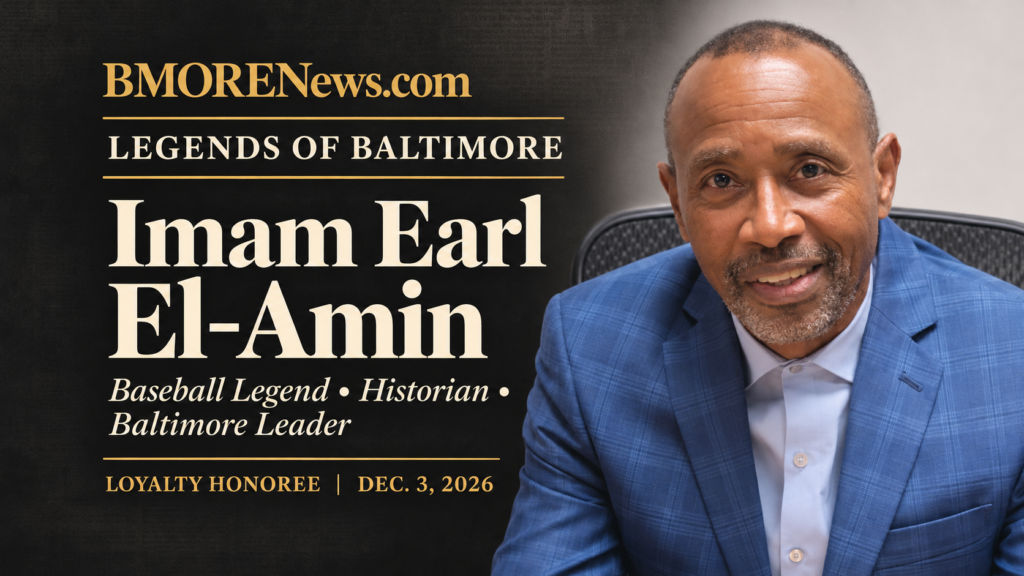
Legends of Baltimore: More Than a Game
(BALTIMORE – November 19, 2026) – Earl El-Amin doesn’t ease into a conversation. He hands you homework.
“My wife and I went to see something I think you would thoroughly enjoy,” he told me. “It’s called Once Upon a Time in Harlem. You got to get it, brother.”
He was still lit up about the film. Historian John Henrik Clarke sat in a living room with people who had lived through the Harlem Renaissance. They remembered some things differently, which made the conversation even better. Earl told me about the librarian at the 135th Street library who used to give Ralph Ellison and other writers a quiet room to work. He called Richard Rowe as soon as he got out of the film. Now he was making sure I heard about it, too.
“Because you are a writer,” he said, “you got to see that.”
I called Earl to talk about his life and the honor he’ll receive on Dec. 3. We got to that. We also got to jazz, baseball, the Pittsburgh Courier, the 1968 uprising and the Baltimore neighborhood where a doctor borrowed his father’s car to make house calls. Earl is a historian in the way he listens, remembers, and tells you who made things possible. He’ll name the ballplayer who stood out there with him, the schoolteacher who managed the team and the pastor who made sure they had a team to play on.
I’ve known this man for more than 20 years. I’m still finding out how much Baltimore history he carries.
An educational Black Wall Street
Earl was born in Long Branch, New Jersey, and came to Baltimore at age 2. Long Branch is where his story starts. Hanlon Park is where he can take you house by house.
Across the street lived Dr. Turgot Jeudy, a Haitian-born physician who didn’t have a car. Earl’s father lent him the family car so he could make house calls. On the corner lived Dr. Socrates Saunders, who taught mathematics at Morgan. Earl remembers 13 teachers from Lemmel living in the neighborhood.
“That makes a difference,” he said.
He calls it an educational Black Wall Street. Within about six blocks, a child could go from elementary school to Lemmel, then to Douglass, and on to Coppin or the community college. Earl knew people who did it. The teachers lived where their students lived. The doctor knew whose door to knock on when he needed a car.
“Isn’t that something, brother?” Earl said. “That’s a story nobody’s telling.”
He remembers what changed after 1968. He had seen the city before the uprising and watched Black families with the means to move begin leaving for the county. When we talked about the unrest of 2015, he went right back to ’68 and what he saw happen afterward.
“So we lost those people that were in the neighborhood,” he said, “that all you could see.”
Think about those words. A child could walk down the block and see somebody who taught mathematics at Morgan. You could see your teachers outside of school. What Earl remembers losing was the everyday presence of people whose lives gave young people a sense of what they could do.
Center field at Memorial Stadium
Here’s something I wish I’d known sooner about my big brother. Earl El-Amin could play some baseball.
At Forest Park, he lettered in football, baseball, basketball, and swimming. He earned All-MSA honors, graduated in 1969, and went into the school’s Athletic Hall of Fame. He played baseball at Baltimore Junior College, which became CCB while he was there, and at Morgan State. He later graduated from Morgan and Sojourner-Douglass College.
In 1971, Earl started in center field at Memorial Stadium in the Hearst All-Star Game. The game preceded an Orioles game, and Earl remembers the local squad as the Oriole Land All-Stars. “I think I was the only fly in the buttermilk,” he said, laughing. Then he remembered Edgar Crawley, another Black player on the team.
I played center field for the James Mosher Mets. Baseball is my sport. Finding out Earl had stood out there, too, made me feel closer to a man I already looked up to. And I could hear in his voice how much those summers still meant to him.
He played for the Union Tigers, a Black team sponsored by the Rev. Vernon Dobson of Union Baptist Church and managed by Ross Nichols, a junior high school teacher. The Tigers played some of the best clubs in the Baltimore area.
“We played top-of-the-line baseball, bro,” he said. “Wasn’t no bluffing.”
Listen to who shows up in that story. A church put its weight behind a baseball team. A schoolteacher ran it. A young man from Hanlon Park got to test himself against the best players around. That’s another part of the Black Wall Street Earl remembers, and it’s why his baseball story belongs in this city’s history.
When we talked about why fewer Black boys play today, Earl traced it back to something that happens long before anybody steps onto a field.
“You play catch with your father,” he said.
From Baltimore to Pittsburgh
When Earl talks about Pittsburgh, he connects jazz, baseball and the Pittsburgh Courier. Hearing him, I thought about how easily we put those things on separate pages. Music goes on one page, sports on another, and the newspaper itself rarely makes the story. Earl hears a city in all three. And he reads Baltimore the same way.
The Union Tigers had a pastor and a teacher behind them. In Harlem, a librarian made space for writers. In Pittsburgh, Earl remembered how the Courier carried the Honorable Elijah Muhammad’s message every week before Muhammad Speaks existed. The brothers sold the Courier on the street because it carried his message. The paper had something they wanted to read, and they helped get it into other people’s hands.
That’s the Black ecosystem Earl kept bringing me back to—from his beginnings in Long Branch to the Baltimore he knew block by block, and the Pittsburgh he brought into our conversation. Black Wall Street was there in who supported the ball team, who opened a room for writers, who put out the newspaper, and who went out and sold it. People built institutions, and those institutions gave people somewhere to go and something to build on.
Earl has spent much of his own life doing that work in Baltimore. He is the resident imam of the Muslim Community Cultural Center of Baltimore. He spent nearly 40 years at NCIA and retired this year after serving as vice president of community and external affairs. His interfaith work has taken him to the Vatican and Saudi Arabia and brought him into dialogue with rabbis in North America.
His favorite detail from giving the invocation with Rev. Todd Yeary at Stephanie Rawlings-Blake’s inauguration was a question. It was raining a little, and former Mayor Tommy D’Alesandro III was sitting beside him. D’Alesandro leaned over and asked him how many mosques there were in Baltimore.
“Yeah, he was a good guy,” Earl said. “He was a really good guy.”
Kicking it with the elders
For 13 years, Earl and Richard Rowe co-hosted Dialogue with the African American Male on WEAA. Earl told me his son was at work one day when a colleague asked whether he knew Earl El-Amin. The man remembered listening to Earl and Richard. Earl’s son told him, “That’s my father.”
“You never know,” Earl said.
Jazz came up when we talked about WEAA and what the station sounds like today. So did a show Earl and Richard would love to do called Kicking It With the Elders. Earl wants younger people to have the kind of conversations with their grandparents that can take you from a ball field to a church to a newspaper office without ever leaving the story of a neighborhood.
“Our young people don’t talk to the older people,” he said. “They don’t have the substantive conversations they should be having with their grandparents.”
“We got to stay connected to the young people, and the young people got to stay connected to us,” he said. “It’s imperative. That’s part of the culture we come out of.”
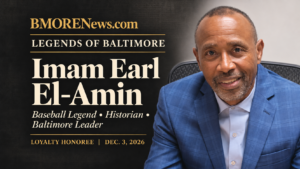
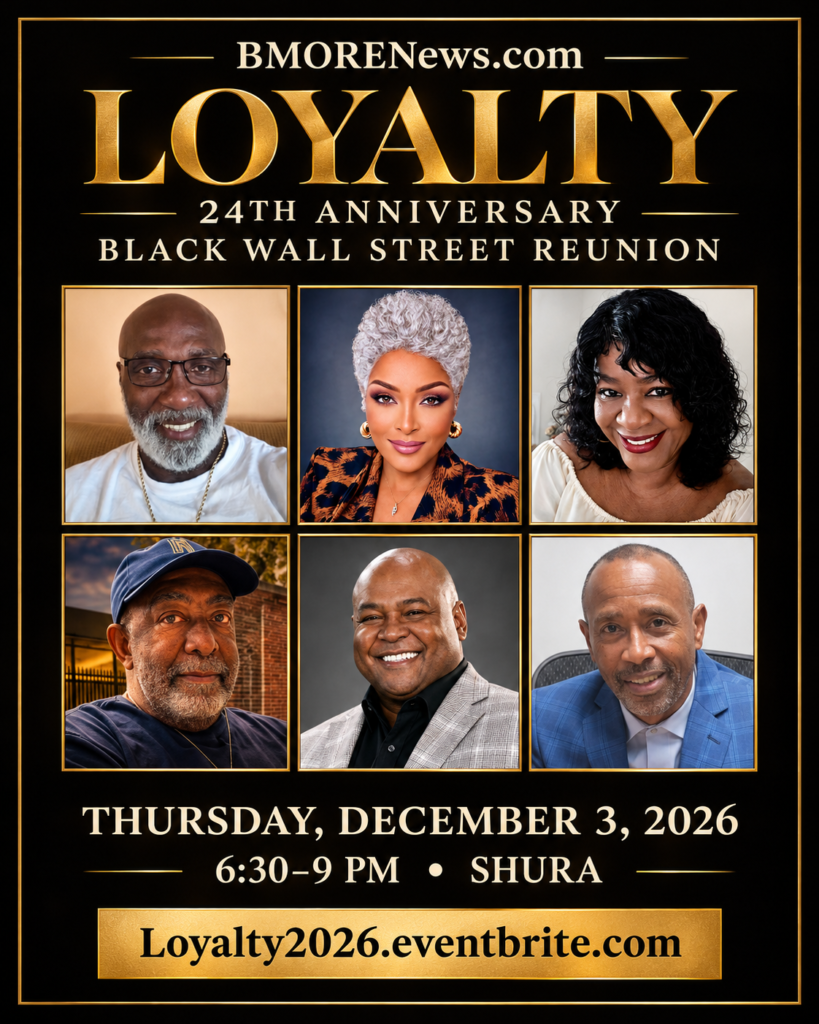
On Dec. 3, we will honor Imam Earl El-Amin at LOYALTY: The Black Wall Street Reunion and BMORENews’s 24th anniversary celebration. We’ll be at Shura, 6665 Security Blvd. in Woodlawn, from 6:30 to 9 p.m. We are honoring a Baltimore baseball legend, an imam, a historian, and a leader whose service reaches across this city. I’m also honoring a brother who still calls to tell me what I ought to be reading and what I need to go see.
The Black Press
As BMORENews heads toward its 25th anniversary and the Black Press marks 200 years on March 16, 2027, I asked Earl what he thought the Black Press needed to do now. He started with how we see the world.
“There has to be a different view of reporting,” he said. “There has to be a different context in how reporting is framed.”
He named the AFRO, the Amsterdam News, the Pittsburgh Courier and the Chicago Defender. In Earl’s telling, you can’t talk about how so many Black families got from Mississippi to Chicago without talking about the Defender. You can’t tell the story of how the Honorable Elijah Muhammad’s message traveled without talking about the brothers who sold the Courier. And when I think about the Baltimore Earl described, I think about how easily the story of the Union Tigers or those 13 teachers in Hanlon Park could disappear if nobody sat down with him and asked.
I asked him about the need for the Black Press. He answered with what those papers had already done.
“All of these papers played such a profound role,” Earl said, “in providing the news that our people needed for upliftment.”