
Legends of Baltimore: More Than a Game
Cut in the 11th grade, the East Baltimore native became a CCB and Towson star, then spent 25 years building a coaching tree that still shades this city.
(BALTIMORE – November 15, 2026) – Roger Dickens likes to tell a story about a watch.
One year, he sent four of his players to Bowie State. They turned the program around, and one of them, Rob Brooks, led the NAIA in scoring. Brooks won a watch for it, and when he came home, he gave it to his old coach.
Dickens never wore it. He kept it for twenty-something years. Then he gave it back.
“I said, now you old enough to appreciate this now,” Dickens recalled.
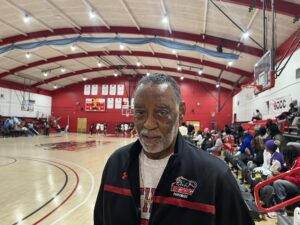
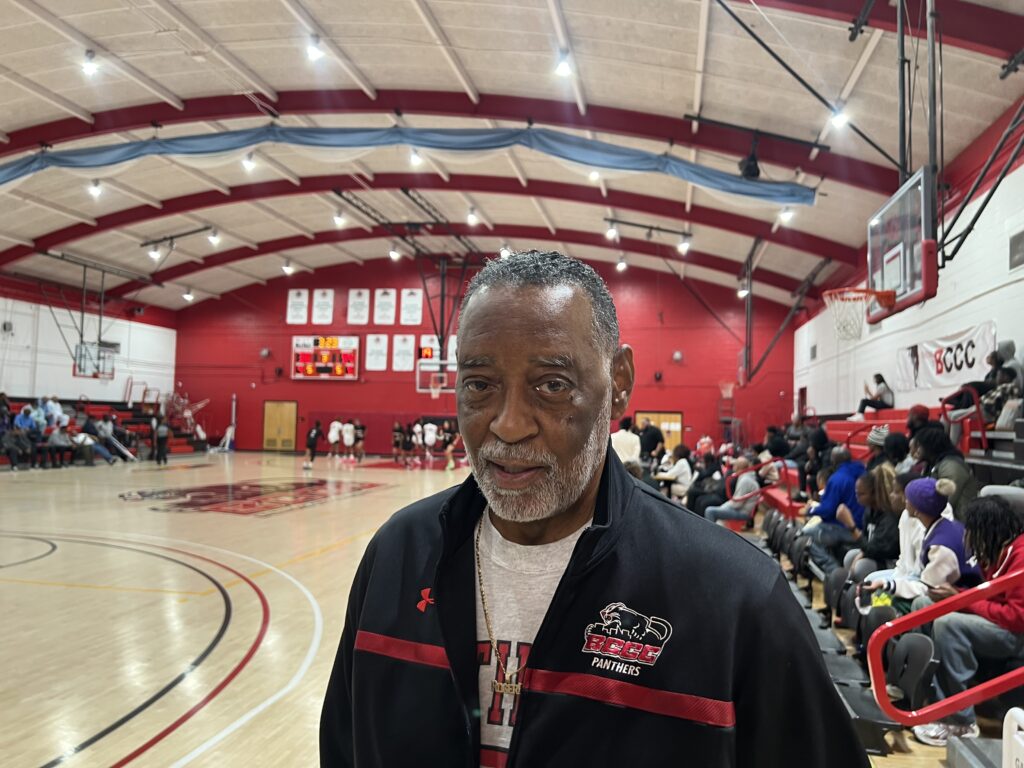
That’s Roger “Dodger” Dickens in one story. He’s a Baltimore basketball legend whose proudest possessions are other people’s accomplishments, and who won’t take a picture by himself because, as he puts it, “it wasn’t really about me.”
The last cut
Dickens was born in 1955 and raised in East Baltimore’s 21218. He was in the first graduating class at Cecil Elementary in 1966, the same year the Cecil rec opened its gym. Before that, he said, neither Greenmount nor Oliver Cromwell had an indoor gym, so when Cecil opened, “everybody from the whole area gravitated to the gym.” The St. Ann’s program, run by Mr. Scott and Ms. Woodland, drew from the same families. “We’re the same people,” he said.
Wilds Buford, a former Dunbar quarterback who had lost an eye, ran the rec. Buford still played ball with the kids. “Him having that handicap and being a rec person,” Dickens said, “it taught us not to look at people a certain kind of way because of their differences.”
Buford’s own story was a hard one. Dickens doesn’t know all of it, but he said Buford had been beaten by police in Philadelphia, “one of them kind of situations back in that time,” and came home to run the Cecil rec with one eye. Sometimes, in the middle of a game, the eye would fall out and roll down the court. Once it came out in the swimming pool and kids dove to the bottom looking for it. Buford later took his own life. “He was my man,” Dickens said. “He is responsible for a whole lot of stuff that happened at Cecil.”
The neighborhood took care of its own. “Not only did you have your own rec, but we also had our own bank. We had our own market,” he said, listing the Pep Boys on Harford Road, the Sears at the top of the hill, Bond’s Bakery and the Apollo. “Everything that you need was in the neighborhood to survive.” Today, he noted, the same area is a food desert.
The neighborhood also turned out talent: Billy Snowden, Brian Matthews, Charlie Thomas, and Ernie Graham and his brothers. Dickens believes Graham should have played in the NBA. At the University of Maryland, Graham played next to Albert King and Buck Williams, and Dickens says the New York native King got all the attention while “Ernie was the glue. Ernie did everything.” Then Dickens accused Lefty Driesell, Graham’s coach at the University of Maryland: “Lefty Driesell blackballed him.” Graham went on to Philadelphia in the Dr. J era, Dickens said, but he never got his NBA chance. “He’s one of the guys who came out of Baltimore that definitely should have gone to the NBA and would have been good in the NBA.”
At 15, Dickens won East Baltimore’s Ghetto Olympics, the one-on-one competition for players 15 and under. He has won plenty since, but he still calls it one of his proudest accomplishments.
What he didn’t do was play high school basketball. At City College, he was the last cut in the 11th grade, and he didn’t try out as a senior.
“I can only say it must not have been my time,” he said. “But that only made me work harder and want to get those guys back that played. So when I ran across them in college, it was like, okay, I think I owe y’all something.”
“I’m in that number”
On the summer circuit, the same thing kept happening. Dickens played all season for John Murdock’s 1500 team, but when the big game came at the Dome, the coach went with the guys who played school ball. In 1973, he passed on Lafayette, where he would have started next to Skip Wise, to play for John Gaines at Cloverdale with his City College friends, including Brian Matthews. Cloverdale met Lafayette for the championship at the Civic Center, and Dickens sat on the bench until the end.
“I was good enough all year long,” he said, “but when it came down to the championship and stuff like that, they went with the guys that played school ball.”
He teased Gaines about it for years, and he never let it turn into bitterness.
“I think all of that is what made me be the way I am today,” he said. “Just being one of the guys, being happy with being one of the guys and not trying to be the guy. When they mention my name with Skip and Dickie Kelly and them guys, man, I’m honored just to hear my name. I ain’t worried about them saying who was the best. I’m named. I’m in that number.”
The Big Payback
His time came at the Community College of Baltimore. Coach Jerry Phipps, a white coach from City College, brought him onto the Red Devils. Chucky Bundy, a standout point guard out of Carver who had also played at CCB, gave him the nickname “Dodger.” His teammates included Tony Carter, Fred Wright, and Steve Colbert. His athletic director was Cyril Byron, a Tuskegee Airman and Morgan State Hall of Famer.
In 1973, the Red Devils faced Baltimore’s Bay College, which had Leon Love, Hansberry, and Dickie “Machine Gun” Kelly, then the nation’s leading scorer. Bay College won the first meeting at UMBC. Afterward, the CCB players sat in the locker room and agreed that the other team wasn’t really that good; the big names had beaten them.
For the rematch, James Brown’s “The Payback” was blasting in a packed CCB gym, and the Red Devils won. They won the next meeting too, at the Jewish community center on Rogers Avenue, a game the papers called the St. Valentine’s Day Massacre.
“From that point on,” Dickens said, “we were whipping their hind parts.”
Dickens played for Phipps from 1973 to 1975. In that stretch, according to BCCC, CCB won two Maryland junior college championships and the 1975 Region XX title, and Dickens was named MVP of the 1975 Region XX Tournament.
He went on to Towson, where he joined his City College friends Pat McKinley and Brian Matthews. Running the point for the Tigers from 1976 to 1978, he was a two-time first-team All-Mason-Dixon Conference pick, the 1978 Mason-Dixon Tournament MVP, a third-team Division II All-American and Towson’s 1978 Male Athlete of the Year. His 152 assists in one season is still a program record. That June, the Washington Bullets, fresh off their NBA title, took him in the fifth round. They waived him before the season started. Towson inducted him into its Athletics Hall of Fame in 2025. Back home, he was, in his words, “one of them household names in basketball.” People even tried to get him to run for city council. “That wasn’t my thing,” he said.
What stayed with him was how Phipps treated his players. When Phipps was in his 90s, Dickens invited him to Timmy Graham’s annual cookout. The men who had played for him at City and CCB all came out to see him.
“He taught us the game,” Dickens said. Some of them had played for Phipps for only a year or two, and they were still talking about him decades later. If you played for the Red Devils for any amount of time, Dickens said, “you automatically all right with them. Because we came out of the same camp. All I did was carry it on.”
The tree
Carrying it on turned into 25 years of coaching at CCB, alongside his old teammate Tony Carter, who went on to Coppin State and helped the Eagles win the 1976 NAIA national championship alongside Joe Pace. Dickens remembers Carter as that team’s leading scorer. Carter is in Coppin’s Hall of Fame, and his 46 points against Bowie State in 1976 is still the school’s all-time single-game record.
The path from CCB to Coppin was well worn. Back then, Dickens explained, Baltimore players didn’t have many college options. Morgan State recruited mostly out-of-state players, so Coppin became the home for Baltimore talent, and CCB fed it. “Coppin always had Baltimore players,” he said. That connection goes back to the 1960s. Cyril Byron, Dickens’ first athletic director at CCB, had coached at Coppin, where his players included Dr. Warren Hayman.
As a head coach from 1982 to 2007, Dickens won the 1985 Metro Conference championship and the 1994 Maryland JUCO title. In 1997-98, his team won both the Maryland JUCO and Region XX tournaments and finished fifth at the NJCAA national tournament. BCCC inducted him into its Athletics Hall of Fame in 2007.
The results are all over Baltimore:
- Ronald Rudacil works for the city and is one of the officials in charge of its parks.
- Marlon Quillens, who used to coach at Douglass, is now a principal and is working on his doctorate. He told Dickens he went into education after working as a substitute teacher and seeing kids who looked like him. When he had to choose between a promotion and coaching, he asked Dickens for advice. “I told him to go do what’s best for him and his family,” Dickens said. “He can give back to the kids whenever he could or however he could.”
- One former player is an oral surgeon with practices in Hagerstown and Frederick. He’s white, and Dickens sent him to Morgan State. “I told him, son, if you can make it at Morgan, you’ll be able to deal with people all over the world anywhere you go.”
- Another is a podiatrist, and another is a police officer who was one of the four players Dickens sent to Bowie.
- Ivan ran track in Wyoming and Idaho and now works land on a farm in Texas.
- At one point, about seven of his former players coached high school basketball in Baltimore, at schools including Edmondson, Poly, Mervo, and Douglass.
Then there’s Herman “Tree” Harried. When Harried came home from Syracuse, he dunked on his old coach, who was in street clothes, just walking through his rec. Then he started laughing.
“I said, what you laughing at?” Dickens remembered. “He said, nah, Rog, I just think about all them years you did all this for me.”
Not all of his players were men. Mackie, another former player, says Dickens and his staff were the men in her life when she didn’t have a father at home, and that what they taught her went beyond basketball to life skills.
JoJo Parker stands up
At CCB, Dickens ran a Youth Day. He brought in 15 to 20 middle school teams by bus, with transportation provided at little or no cost by Joe Miller, a CCB brother who also runs a karate school. One year, the late JoJo Parker was sitting in the stands with the Unseld School group.
At halftime, Dickens took the mic. “I told the kids, y’all got a legend sitting in here amongst you, and you don’t even know it,” he said. He asked Parker to stand, then spent a few minutes telling the children who he was.
“He just, man, cried,” Dickens said. Years later, in his last weeks, Parker called him. “He would say to me, Roger, man, I didn’t know people loved me like that.”
Treat people right
Dickens was baptized at New Metropolitan Baptist Church, at Mosher and McCulloh streets, when he was nine. His brother has been the pastor there for about 38 years. His philosophy is simple: “Treat people the way you want to be treated. When you treat people a certain kind of way, this is what happens.”
He didn’t learn to put himself first at home either. “I wasn’t no star in the house where I grew up at,” he said, laughing. “I better dump that trash and clean that yard up.”
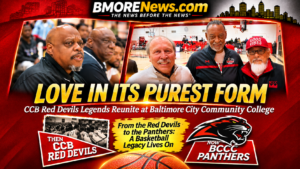
That’s why so many of his former players recently turned out to support Kevin McClain, known around the city as Jim Black, who has taken over the program Dickens and Carter once ran. McClain worked Dickens’ camps for years. Dickens said he didn’t make a single phone call until after November. “And the word got out.” At least seven more players said they couldn’t make it.
“This is the reason I even did what I did today,” he said. “I wanted to bring him the support and love that we shared. And we’re going to support him to try to bring our program back to its glory days.”
“Baltimore been overlooked forever”
People have been telling Dickens to write a book for more than 20 years. “It’s not me,” he said. He would only do one if somebody else did the writing and he did the talking.
That may be because his story keeps turning into everyone else’s. He talks about Dr. Warren Hayman, about Winky Camphor, about men who played against Elgin Baylor, about Billy Snowden, who still texts him a prayer every morning. “It’s a whole bunch of guys walking around or deceased now that were living legends,” he said. “But Baltimore been overlooked forever.”
When he talks to young people, he often brings up James Brown. Kids think of Brown as a performer who did a lot of hollering, Dickens said, but if you really listen, the Godfather of Soul was preaching about Black pride, about the danger of drugs, and about how much education matters.
Asked to join a panel with his former players, Roger Dodger gave the answer you’d expect from him.
“I’ll say less and listen more,” he said. “I’ll let them talk.”