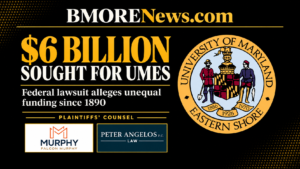


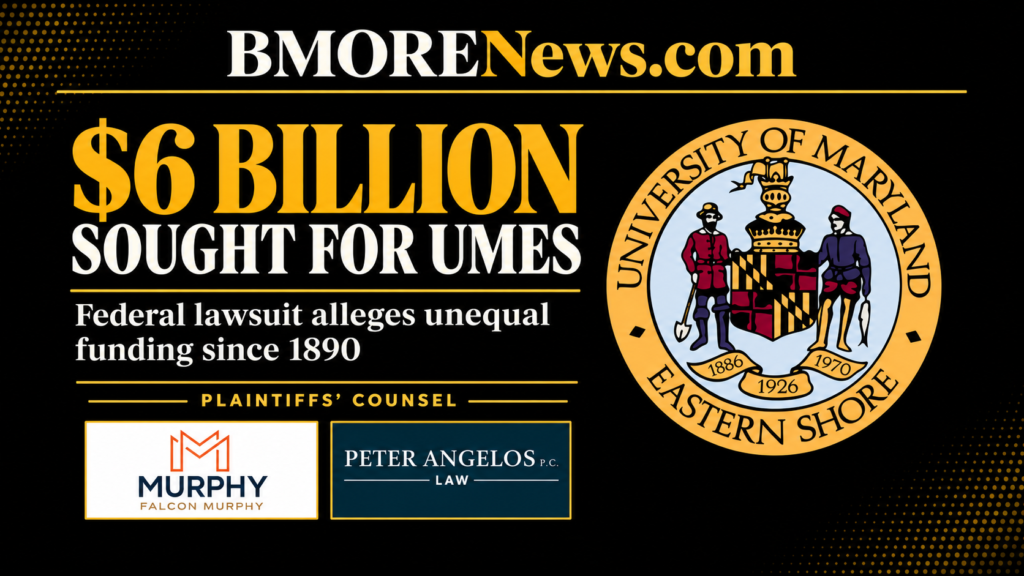
The federal lawsuit alleges Maryland has deliberately underfunded its only historically Black land-grant university since 1890.
(BALTIMORE – November 18, 2026) — Six billion dollars. That’s what attorney William “Billy” Murphy Jr. and his co-counsel are seeking in a federal lawsuit that accuses Maryland of deliberately underfunding the University of Maryland Eastern Shore for more than a century.
“We did the research going back to the 1890s,” Murphy told BMORENews. “Nobody had ever done that.”
The plaintiffs’ announcement calls the $6 billion request one of the largest amounts sought in an HBCU underfunding lawsuit. It is more than 10 times the $577 million Maryland agreed to pay its four public HBCUs over 10 fiscal years. That 2021 settlement ended a separate case over duplicate academic programs.
The plaintiffs are UMES students Chad Lance and Andre Cooper and ForUMES Inc., a group of students, faculty, alumni and prospective applicants. UMES itself is not a party. The plaintiffs filed their amended complaint Oct. 26 in U.S. District Court in Maryland, and their lawyers presented the case at a Baltimore press conference Nov. 17. The suit names Gov. Wes Moore and four higher education officials in their official capacities. Murphy and Jason P. Foster of Murphy, Falcon & Murphy represent the plaintiffs with Jay D. Miller and Ronald E. Richardson of Peter Angelos Law.
A promise dating to 1890
The Second Morrill Act of 1890 let states keep Black students out of their land-grant colleges and still receive federal money. In exchange, they had to provide a separate institution “of like character” and divide the funding fairly. College Park excluded Black students, so the school that became UMES took on Maryland’s land-grant mission for Black students. The plaintiffs say Maryland’s funding decisions violated the 14th Amendment’s Equal Protection Clause and Title VI of the Civil Rights Act of 1964.
The complaint cites Maryland budget books from 2003 to 2023. Over those years, it says, College Park received $9.5 billion in operating funds and $4.7 billion for capital projects. UMES received $747 million for operations and $482 million for capital projects. The plaintiffs’ lawyers also say Maryland paid College Park’s match for federal research and extension dollars directly, while UMES had to cover its match from its own operating budget.
The federal letter that prompted a deeper look
Murphy said his team started with a September 2023 letter to Moore from U.S. Education Secretary Miguel Cardona and U.S. Agriculture Secretary Thomas Vilsack. The amended complaint and the plaintiffs’ press release cite that letter and put the gap at about $312 million. Maryland legislative records, citing the same letter, give the figure as $321,181,312. They describe it as the extra state support UMES would have received from 1987 through 2020 if Maryland had funded it at the same per-student level as College Park.
“And we said, damn, if they’ve been cheated for the past 30 years for that much money, how much have they been cheated since they were supposed to have been recognized as the land-grant college back in the 1890s?” Murphy said. “$6 billion.”
What students described
In recordings played at the press conference, students described flooding and mold on the Princess Anne campus. One student said a gymnasium was closed after it tested positive for mercury. The complaint also says UMES’s laboratories lag behind College Park’s.
“Can you imagine what the University of Maryland Eastern Shore would be like today if they’d gotten the money that they were lawfully supposed to get?” Murphy asked. “That’s why I stand up for Black businesses and Black people, because we have been robbed.”
What the plaintiffs want the court to do
The amended complaint seeks $6 billion in total relief, including damages, court-ordered remedies, interest, costs, and attorney fees. The plaintiffs also want the court to:
- bring UMES’s land-grant facilities and equipment up to College Park’s level
- require fair splits of federal land-grant money and state matching funds from now on
- order prompt funding for campus improvements tied to the land-grant mission
- give UMES an independent governing board with the power to appoint its own leaders
Murphy’s firm shares the case with Peter Angelos Law, but he said his team started the work. “The case originated with us,” he said.
Moore’s office declined to comment on pending litigation and said the administration had invested record funding in UMES. The university said it appreciated efforts to address HBCU underfunding and would keep working with the governor and the General Assembly.
The state’s response to the complaint is due Jan. 19, 2027.