

Special thanks to Fulton Bank, R.E. Harrington, Pleasant Yacht Club’s Lafon Porter, Esquire, Constellation Energy, and Derrick Jones Funeral Home
(SPARROWS POINT, MD – May 11, 2026) – Being from Baltimore — West Baltimore, that is — Dundalk, Essex, Sparrows Point… all of that always felt like another part of the world to me. Not unfamiliar, just different terrain. But anybody who understands Baltimore understands the Eastside’s importance: the water, the port, the ships, the cargo. Commerce moving in and out like a heartbeat. Jobs — real jobs — sustaining families and communities for generations.
And nestled within that industrial landscape is one of the region’s most historic Black communities: Turner Station.
My father, a funeral director whose work took him across Baltimore’s Black communities, often mentioned Turner Station. It was always spoken of with a certain reverence. You cannot tell the story of Black Baltimore without it. It is home to giants like Kweisi Mfume and the legacy of Henrietta Lacks — two names forever connected to Black history, advocacy, resilience, and global impact.
Historian Louis Diggs reminds us that Turner Station did not simply emerge by accident. It was built.
What began as farmland owned by J.M. Turner in the late 1800s transformed as the steel industry rose at Sparrows Point. When World War I created an enormous demand for steel ships, African Americans migrated to the area in search of opportunity and work. Out of necessity and determination, they built a self-sustaining Black community near the rail stop that eventually became known as Turner Station.
They built everything.
Schools. Churches. Grocery stores. Restaurants. Barber shops. Beauty salons. Doctors’ offices. Gas stations. Social clubs. Businesses with names like Balnew Cab Company, Allmond’s Confectionery, and Fanny Major’s Community Laundry became pillars of the neighborhood.
And then there was the legendary Adams Cocktail Lounge.
According to Diggs’ research in From the Meadows to the Point, The Adams became one of the most popular Black lounges in Baltimore, hosting entertainment greats like Pearl Bailey, Billy Eckstine, and Chick Webb. Turner Station was more than a neighborhood. It was a Black economic and cultural ecosystem long before such language became fashionable.
And just next door, that legacy continues along the waterfront at Pleasant Yacht Club — Greater Baltimore’s only Black boating organization. While Bethlehem Steel built a yacht club for its white employees, it simply gave its Black employees the materials to build their own. These men, like honoree Johnny Mathis, built their own yacht club with their own hands. Ironically, Pleasant Yacht Club’s advocacy against Tradepoint Atlantic helped preserve the white boating organization.
Leaders like Derrick Jones and Lafon Porter are not simply preserving a clubhouse. They are protecting history.
When development pressures connected to Tradepoint Atlantic threatened the future of the yacht club and neighboring spaces, community advocacy pushed back. Leaders, including State Senators Carl Jackson and Charles Sydnor, helped force a more equitable conversation about preservation, access, and redevelopment. That fight was about more than property lines. It was about dignity, legacy, and ensuring that Black institutions are not erased in the name of progress.
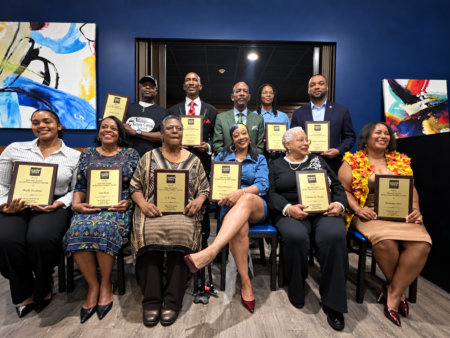
All of that made the May 9 Black Wall Street SPARROWS POINT gathering feel deeper than a typical awards event.
Held at Pleasant Yacht Club, the program brought together a powerful cross-section of leadership rooted in that same spirit of resilience and self-determination. Congressman Mfume and Baltimore County Councilman Julian Jones were in attendance, along with the people who truly define community — the families, the elders, the next generation.
Folks from Turner Station showed up with warmth, pride, faith, and fellowship.
And honestly, that was the beauty of the afternoon.
This was not simply a program. It was continuity.
Legends like Courtney Speed and Gloria Nelson were recognized for decades of service and sacrifice. Emerging leaders like Arkia Wade and Jade Johnson represented the future. Betty Watkins attended surrounded by family, reminding everybody in the room that legacy is not abstract — it is lived, shared, and passed down generation by generation.
The honorees reflected the full spectrum of Black excellence, spanning Baltimore and beyond: public service, entrepreneurship, advocacy, faith, culture, and community building.
Diggs wrote about Turner Station as a place shaped by migration, labor, faith, and enterprise — a community built by people determined to create opportunity for themselves when doors elsewhere remained closed.
Sitting in that room at Sparrows Point, you could still feel that spirit.
Not as history alone.
But as continuity.
I left feeling less like an observer from West Baltimore and more like a participant in a much larger story — one stretching from the steel mills and railroad tracks of the past to the leaders, entrepreneurs, and changemakers still shaping the future today.
And if May 9 proved anything, it is this: the story of Turner Station is still being written — and Black Wall Street SPARROWS POINT is now part of that living history.
CONGRATULATIONS TO OUR HONOREES:
Arkia Wade
Jade Johnson
Servant Courtney Speed
Betty Watkins
Ronnie Lacks
Chief Louis Winston
Gloria Nelson
Johnny Mathis
Dr. William Porter
Michael Hancock
Congressman Kweisi Mfume
Dr. Freddie Oliver
____________________
RELATED STORIES