

How Black Baltimore Helped Shape a Nation
(BALTIMORE – July 11, 2026) – Few American cities have contributed more to the nation’s development while receiving less recognition for doing so than Baltimore.
Mention the city today, and many people immediately think of crime, vacant houses, political dysfunction, or television dramas like The Wire. Those images have become so deeply embedded in the national consciousness that they often obscure a far more important truth.
Long before Baltimore became the subject of troubling headlines, it was helping build the United States.
This city pioneered transportation, transformed higher education, revolutionized medicine, advanced communications, expanded public education, shaped organized religion, strengthened organized labor, and helped define the nation’s ongoing struggle for civil rights and equal opportunity.
Baltimore is not simply a city with an interesting past.
It is one of the principal architects of modern America.
Yet there is another story—one often overlooked even in histories that celebrate Baltimore’s many accomplishments.
While Baltimore was helping build America, Black Baltimore was building the institutions that helped sustain Black America.
Churches.
Schools.
Labor unions.
Mutual aid societies.
Funeral homes.
Newspapers.
Businesses.
Professional associations.
Civil rights organizations.
These institutions did more than serve the Black community.
They created leadership.
They created opportunity.
They created hope.
They produced generations of men and women who transformed Baltimore, Maryland, and the nation.
To understand America, you must understand Baltimore.
And to understand Baltimore, you must understand Black Baltimore.
The City They Think They Know
Recently, I had the opportunity to spend time with Baltimore historian Marco Merrick.
Like so many students of this city’s past, Marco is fascinated not simply by what Baltimore was, but by what it gave the nation.
During our conversation, he made a simple observation that has stayed with me ever since.
“People don’t know what Baltimore is,” he said. “They don’t know what we built.”
The more I thought about his words, the more I realized he was right.
Baltimore’s remarkable history has too often been buried beneath the weight of its contemporary challenges.
Lost beneath the headlines is a city whose fingerprints can be found on nearly every chapter of American progress.
Transportation.
Communications.
Medicine.
Higher education.
Religion.
Journalism.
Labor.
Business.
Finance.
Music.
Civil rights.
Innovation.
Again and again, Baltimore became the place where new ideas took root before spreading across the nation.
This is not simply local history.
It is American history.
Before Freedom Had a Name
Long before the Civil War, Baltimore occupied a unique place in the American story.
By 1860, the city was home to approximately 25,680 free Black residents—the largest free Black population of any city in the United States.
That distinction shaped everything that followed.
It created a critical mass of Black educators, ministers, entrepreneurs, artisans, journalists, labor leaders, and institution builders unlike anywhere else in the nation.
Denied equal access to many white institutions, Black Baltimoreans created their own.
They established churches that nourished both faith and freedom.
They founded schools that educated children whom others refused to teach.
They organized mutual aid societies that cared for widows, orphans, the sick, and the elderly.
They built businesses that created jobs and wealth.
They published newspapers that told stories ignored elsewhere.
They organized workers.
They preserved dignity through funeral homes.
They built institutions that would prepare future generations for opportunities that had not yet arrived.
This is one of the central truths of Baltimore’s history.
The city did not become influential simply because it produced remarkable individuals.
It became influential because it produced remarkable institutions.
And nowhere was that more evident than in Black Baltimore.
Baltimore Built America
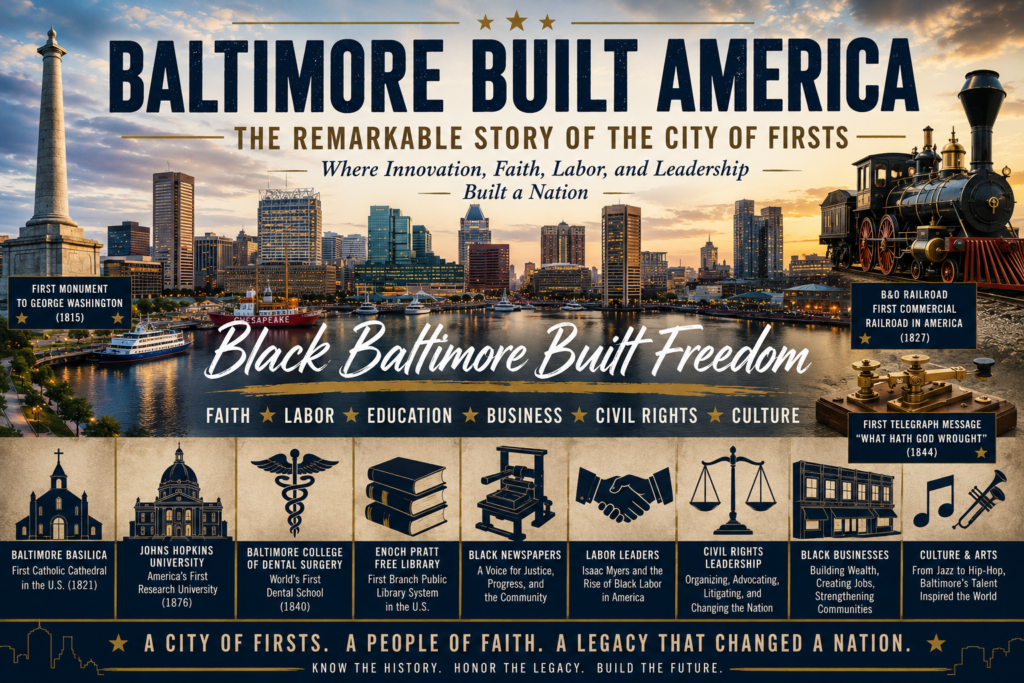
Baltimore’s reputation as the “City of Firsts” is more than civic pride.
It is supported by history.
The Baltimore & Ohio Railroad, chartered in 1827, became America’s first commercial common-carrier railroad, forever changing the movement of people and commerce across a rapidly expanding nation.
In 1844, Samuel F. B. Morse sent the now-famous message, “What hath God wrought,” from Washington to Baltimore, demonstrating the first successful long-distance telegraph line in the United States and ushering in a communications revolution.
In 1840, the Baltimore College of Dental Surgery became the world’s first dental school, transforming dentistry from an apprenticeship into a recognized profession.
In 1876, Johns Hopkins University established the model for America’s first modern research university, forever changing higher education through its emphasis on scientific inquiry, graduate education, and original research.
The Enoch Pratt Free Library pioneered America’s first municipally funded branch public library system, making books and knowledge available to entire neighborhoods rather than only to those with wealth or privilege.
Baltimore’s Washington Monument became the nation’s first major monument dedicated to George Washington, completed decades before the towering monument that now stands in the nation’s capital.
The Basilica of the National Shrine of the Assumption of the Blessed Virgin Mary became the first Roman Catholic cathedral built in the United States, establishing Baltimore as the birthplace of organized Catholicism in America.
Even the nation’s anthem was born here.
Following the British bombardment of Fort McHenry in September 1814, Francis Scott Key wrote the poem that became “The Star-Spangled Banner.”
Yet even this celebrated chapter reminds us that Baltimore’s history, like America’s, is filled with contradictions.
Key enslaved African Americans. Historians continue to debate the meaning of the anthem’s rarely sung third verse, with many interpreting its language as referring to enslaved people who sought freedom by joining British forces during the War of 1812.
History is rarely simple.
Neither is Baltimore.
It is a city that has repeatedly produced innovation while wrestling with inequality.
A city that helped expand freedom while also reflecting the nation’s deepest injustices.
Understanding Baltimore requires embracing both truths.
Because if Baltimore helped build America, Black Baltimore helped define what America could become.
That story begins with faith.