


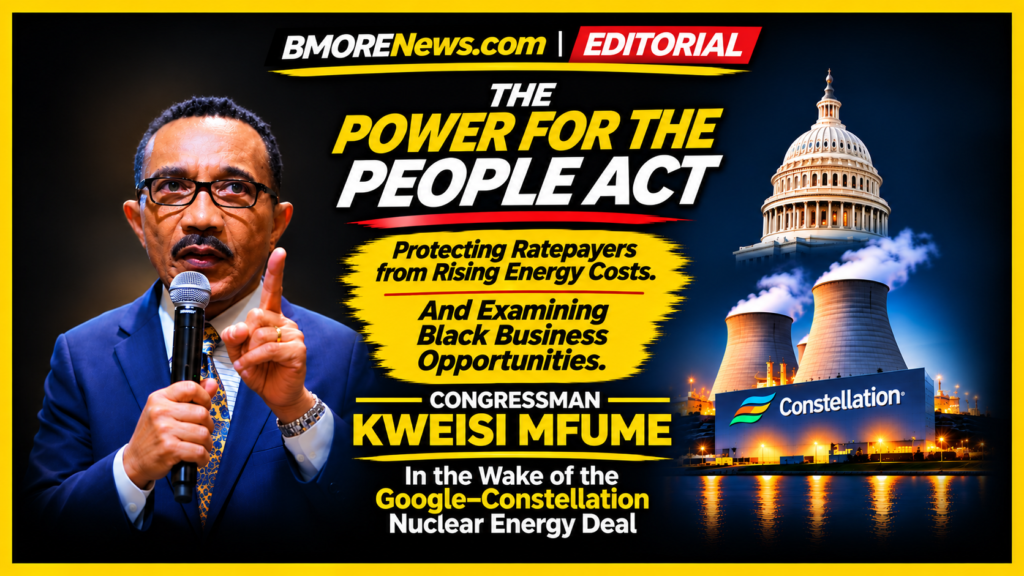
(BALTIMORE, MD – November 21, 2026) — In business and politics, one rule never changes: You don’t get what you deserve. You get what you negotiate.
On October 6, Baltimore-headquartered Constellation Energy and Google announced a massive 3,590-megawatt electricity agreement that underscores just how quickly artificial intelligence is reshaping the American economy.
The arrangement includes a 15-year agreement for 2,700 megawatts of electricity supply and a separate 20-year commitment supporting 890 megawatts of additional nuclear generating capacity. Constellation plans to invest more than $4.3 billion to increase electricity production at 11 nuclear units across Illinois, Pennsylvania, and New Jersey.
Google’s long-term commitment to purchase electricity helps provide the financial certainty Constellation needs to undertake those upgrades. The $4.3 billion represents planned investment by Constellation, not a direct investment by Google.
The first additional nuclear capacity is expected in 2028, with the full 890 megawatts projected by the end of 2032.
Then came another major development.
On October 27, the U.S. Department of Energy announced a separate conditional loan commitment of up to $5 billion to help finance nuclear upgrades and modernization across Constellation’s fleet in Illinois, Maryland, and Pennsylvania.
The financing includes projects under consideration at eight nuclear facilities, among them Maryland’s Calvert Cliffs nuclear power plant.
A federal loan is not a grant. Constellation would be required to repay funds borrowed under the loan’s terms. Nevertheless, the federal government is making public credit available to support investments in America’s nuclear energy infrastructure.
The commitment remains conditional. It does not constitute a final investment decision for every proposed upgrade or guarantee that work will proceed at every facility being considered.
Combined with Constellation’s separate agreement involving Amazon and Calvert Cliffs, the company has announced more than $7 billion in planned nuclear investments.
The Amazon agreement is especially important to Maryland. It supports more than $3 billion in planned investment at Calvert Cliffs, creating a more direct connection between the nation’s expanding artificial intelligence infrastructure and economic opportunities in our state.
And the relationship between Google and Constellation extends beyond electricity. The companies have also announced a technology alliance involving Google Cloud and artificial intelligence tools intended to improve nuclear plant operations.
Consider what is happening.
Technology companies need enormous amounts of electricity to power artificial intelligence. Energy companies need long-term customers to justify multibillion-dollar infrastructure investments. Federal financing may help make those investments possible.
Big Tech and Big Power are becoming increasingly interconnected.
Yet amid these announcements, one question deserves far more attention in Baltimore, Prince George’s County, and Black communities throughout the Mid-Atlantic:
Where is Black business’s piece of the pie?
Billions in Investment. Where Are the Contracts?
Constellation projects that the Google agreement will create approximately 7,200 construction jobs and sustain 4,400 existing jobs.
Those are significant projections. Supporting union labor, protecting existing employment, and expanding skilled-trades opportunities are important economic objectives.
But employment and business ownership are not the same thing.
A construction paycheck helps support a family. Ownership of a construction company can create jobs, build assets, generate recurring revenue, and establish wealth that can be transferred from one generation to the next.
Black communities need both.
The publicly announced Google–Constellation agreement does not identify a dedicated Minority Business Enterprise procurement percentage, a mandatory prime contractor–subcontractor joint venture structure, or a project-specific, enforceable Community Benefits Agreement guaranteeing participation by Black-owned businesses.
That does not mean Black businesses have been excluded.
Constellation already maintains a Supplier Development and Engagement program designed to connect qualified businesses, including small and diverse suppliers, with procurement opportunities.
The company provides supplier registration information through its website.
That is a starting point.
The larger question is whether that existing program will translate into measurable contracting opportunities under these extraordinary new investments.
Will Black-owned electrical contractors receive meaningful work?
What about Black-owned engineering firms, cybersecurity companies, environmental consultants, transportation businesses, logistics providers, and construction management companies?
Will these businesses have opportunities to compete for substantial contracts, or will most of the work flow through established national and multinational contractors?
And will Constellation publish enough information for the public to know the difference?
These are not unreasonable questions. They are fundamental questions about economic development.
Giving Credit Where Credit Is Due: Towanda Livingston
To be fair, Constellation’s commitment to supplier development isn’t just something I have read about in a corporate report.
I have witnessed it firsthand.
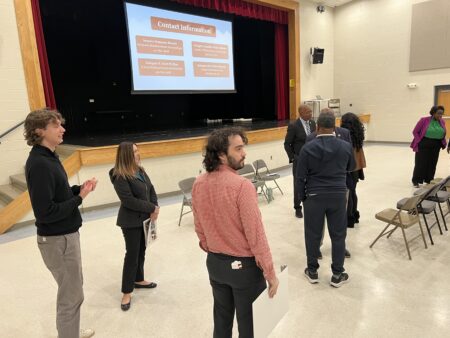
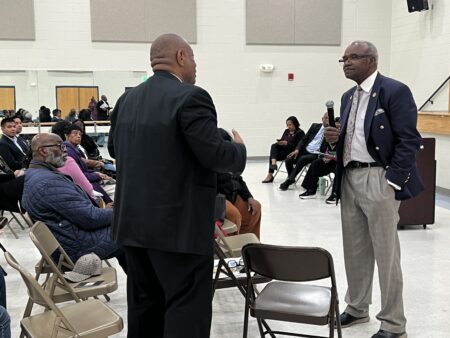
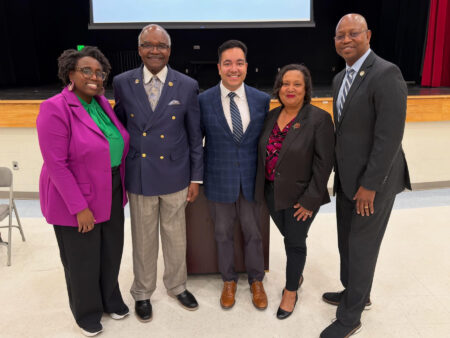
Towanda R. Livingston, Constellation Energy’s Director of Supplier Development & Engagement, has been a consistent presence in the business community, connecting entrepreneurs with opportunities and encouraging greater participation in the company’s supply chain.
Since meeting Livingston, I have seen her go above and beyond to support BMORENews.com and inform businesses about opportunities with Constellation.
And her work is not limited to Baltimore.
With nearly three decades of experience in economic inclusion, Livingston has extended invitations to business events and networking opportunities beyond Maryland, including Philadelphia.
She understands that economic inclusion requires more than a corporate policy. It requires relationships, access, information, and people willing to do the work.
Her philosophy is particularly relevant to this discussion.
“Leveling the ‘Playing Field’ for marginalized groups is not the answer and not enough, because the playing field we have inherited was not designed for minorities, women, or other marginalized folks to play on and, more importantly, to win on,” Livingston has stated.
That is a powerful observation.
Opening the door is one thing. Making sure qualified businesses have a genuine opportunity to compete is another.
I want to acknowledge Livingston because I have personally witnessed her commitment. As a Black woman working in corporate America, she has demonstrated leadership that extends beyond her job title.
Her support of BMORENews.com and her consistent engagement with the business community deserve recognition.
That acknowledgment does not eliminate the larger questions raised in this editorial.
In fact, it reinforces why those questions matter.
The challenge is determining how the work of dedicated professionals like Livingston translates into measurable contracting opportunities as Constellation undertakes billions of dollars in new investments.
We should recognize the people doing the work while continuing to examine the results.
Both are important.
Federal Financing Comes With Public Accountability
The Department of Energy’s conditional loan commitment of up to $5 billion adds another dimension.
Federal loans are not grants. Borrowers must repay the money according to their financing agreements.
But when the federal government makes billions of dollars in credit available to support major infrastructure projects, the public has a legitimate interest in understanding the economic benefits associated with those investments.
In May 2026, the Department of Energy eliminated the program-wide Community Benefits Plan requirement from its Title 17 energy financing guidance.
Previously, applicants were required to submit plans addressing community and workforce considerations. Those requirements did not automatically guarantee minority-business contracts, but they provided a formal mechanism for applicants to explain anticipated community benefits.
Their elimination makes voluntary corporate commitments and other accountability mechanisms even more important.
Constellation’s existing supplier-development efforts provide an opportunity to demonstrate how major infrastructure investments can support broader business participation.
There is also an important precedent worth examining.
Constellation previously published information about its spending with diverse suppliers in its 2024 DEI Annual Report, which included a section titled “Diverse Spend.”
The company’s supplier initiative now operates under the name Supplier Development and Engagement.
An important question is whether Constellation continues to track and publicly disclose those expenditures, particularly as it undertakes billions of dollars in new infrastructure investments.
Historical supplier spending provides a useful benchmark. Current figures would help the public understand whether business participation is expanding alongside the company’s investment commitments.
The existence of a supplier-development program is meaningful. Documented contracting results would provide an even clearer picture of its impact.
How will smaller contractors qualify?
Will procurement packages be structured to allow competitive participation by smaller firms?
Will contractors have access to technical assistance, bonding support, and timely payment arrangements?
And will the company publicly report participation by small and diverse suppliers?
These questions matter because access to capital, bonding requirements, contract size, and payment schedules can determine whether a small business can compete for a major infrastructure project.
A company may be qualified to perform the work and still be unable to meet a contract’s financial requirements.
That is an economic barrier worth examining.
The Maryland Connection: Calvert Cliffs
Constellation is headquartered in Baltimore.
Its Google-related nuclear upgrades are planned for facilities in Illinois, Pennsylvania, and New Jersey, not Maryland.
That distinction is important.
We cannot claim that all 7,200 projected construction jobs are coming to Maryland. Those jobs are associated with the Google agreement and projects across multiple states.
However, Constellation’s separate agreement with Amazon provides a direct connection to Maryland.
The company plans to invest more than $3 billion at Calvert Cliffs, one of Maryland’s most important electricity-generating facilities.
Calvert Cliffs is also among the facilities included in the Department of Energy’s conditional loan financing announcement.
For Maryland’s Black business community, that raises immediate questions about engineering, construction, equipment, technology, environmental services, and professional contracting opportunities.
The state’s Black business community includes contractors, engineers, technology professionals, construction companies, transportation firms, and professional-service providers that can compete for sophisticated work.
The challenge is ensuring that qualified companies understand the opportunities and the requirements for competing before procurement decisions are finalized.
Baltimore’s position as Constellation’s corporate headquarters also deserves attention.
Corporate headquarters generate opportunities in management, technology, consulting, legal services, communications, and other professional fields.
The presence of a major energy company in Baltimore creates a reason to examine whether local businesses are participating in its broader supply chain.
That is where Maryland’s congressional delegation, state leadership, business organizations, and corporate executives have important roles.
Congressman Kweisi Mfume, Senator Angela Alsobrooks, and Senator Chris Van Hollen represent constituencies with a direct interest in the economic consequences of energy development.
Maryland’s Legislative Black Caucus, Black business chambers, and economic development organizations also have an interest in understanding how major infrastructure investments translate into business opportunities.
A meaningful economic development strategy would identify upcoming contracts, responsible procurement officials, qualification standards, anticipated timelines, and opportunities for smaller businesses to participate.
It would also establish a way to measure results.
The Power for the People Act and the Cost of AI
In January 2026, Senator Chris Van Hollen introduced the Senate version of the Power for the People Act.
On April 9, 2026, Congressman Kweisi Mfume and Congressman Paul Tonko introduced the House version of the legislation to address concerns about rising electricity costs associated with large data centers.
The legislation reflects growing concern about protecting residential electricity customers as artificial intelligence companies increase power demand.
Those concerns deserve attention.
Major technology companies have also made voluntary commitments through the Ratepayer Protection Pledge to cover costs associated with their growing electricity demands, including necessary infrastructure upgrades.
These voluntary commitments are important and represent a positive step toward protecting consumers.
In addition to those commitments, we must also consider the value of enforceable utility tariffs and regulatory safeguards that provide lasting protections for residential customers.
Consumers deserve to know that the costs of new data centers are being appropriately allocated and that residential customers are protected from expenses attributable to those developments.
At the same time, another economic question deserves consideration.
If the expansion of artificial intelligence requires billions of dollars in electricity infrastructure, how will the resulting business opportunities be distributed?
Electricity affordability and access to infrastructure contracting are distinct policy questions. Both deserve scrutiny.
Federal lawmakers have opportunities to examine energy financing, infrastructure policy, utility regulation, procurement transparency, and small-business participation.
Any proposed contracting requirements must be designed within applicable procurement and civil-rights laws.
The broader objective should be transparent, competitive access to publicly supported economic opportunities, including meaningful participation by historically underrepresented businesses.
Black Business Must Be Prepared, Too
Accountability cannot rest exclusively with government and corporations.
Black business organizations must also identify companies capable of competing for these opportunities.
Which firms have the appropriate licenses, certifications, insurance, bonding capacity, technical expertise, and workforce?
Which companies can compete as prime contractors?
Which would benefit from joint ventures or subcontracting partnerships?
What technical assistance is needed to help smaller businesses become qualified suppliers?
Those questions should be answered before awarding major contracts.
A serious supplier-development initiative would bring procurement executives together with qualified contractors, financial institutions, bonding specialists, workforce-development organizations, and business chambers.
It would also provide a clear path for companies that are not yet ready to compete for the largest contracts.
There is an enormous difference between inviting Black businesses to an informational meeting and creating a sustained pathway into a multibillion-dollar supply chain.
The latter requires preparation, transparency, accountability, and measurable results.
For business owners interested in pursuing opportunities, Constellation maintains a public Supplier Development and Engagement webpage:
https://www.constellationenergy.com/suppliers/supplier-development-and-engagement.html
Registration does not guarantee a contract, but it provides a place to begin understanding the company’s procurement process.
Black entrepreneurs should also examine opportunities associated with Calvert Cliffs, including construction, engineering, technical services, equipment supply, transportation, and professional support.
The opportunity is not limited to companies that work directly on nuclear reactors.
Large infrastructure investments require extensive networks of suppliers and service providers.
Understanding those networks is part of understanding where business opportunities exist.
The Clock Is Ticking
Constellation expects the first additional nuclear capacity under the Google agreement to begin coming online in 2028, with the full expansion projected through 2032.
That does not mean every procurement opportunity remains available. Some engineering, equipment, and construction decisions may already be underway.
It does mean that qualified businesses have reason to examine the remaining opportunities and the processes for competing.
This is a pivotal moment for American energy development.
Artificial intelligence is driving new demand for electricity. Nuclear power is attracting renewed investment. Technology companies are entering long-term agreements that could influence energy infrastructure for decades.
Baltimore is home to one of the companies at the center of that transformation.
Maryland is also home to Calvert Cliffs, where Constellation’s separate agreement with Amazon supports billions in planned investment.
For Black entrepreneurs, the question is not whether these investments are impressive.
They are.
The question is whether Black-owned businesses will have a meaningful opportunity to participate in the economic activity those investments generate.
We should not confuse corporate headquarters with community prosperity. We should not confuse job announcements with business ownership. And we should not confuse supplier-diversity statements with documented contracting results.
The opportunity is too significant for assumptions.
Constellation’s supplier-development program offers a starting point. Its previous reporting on diverse-supplier spending provides a useful historical reference. Its multibillion-dollar investments provide an opportunity to demonstrate what meaningful business participation can look like.
Maryland’s Black business community must be prepared to compete.
That means understanding procurement requirements, building relationships, strengthening financial capacity, pursuing certifications where appropriate, and developing partnerships capable of handling substantial contracts.
In business and politics, you don’t get what you deserve. You get what you negotiate.
And if Black business intends to participate in the next generation of America’s energy economy, the time to understand the contracts, build the relationships, and compete for the opportunities is now.
Because nobody is going to hand us our piece of the pie.
Doni Glover is the publisher of BMORENews.com and founder of DMGlobal Marketing & PR, LLC. BMORENews.com has covered Black business, entrepreneurship, economic development, and public policy since 2002.