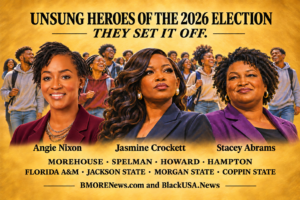

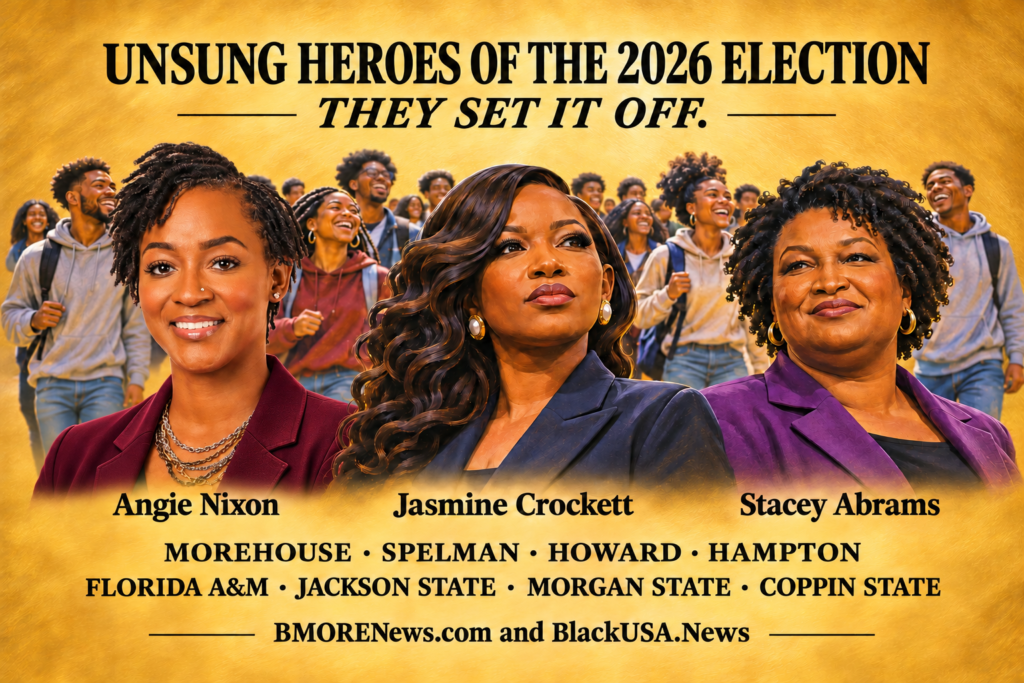
(BALTIMORE – November 22, 2026) – Angie Nixon lost the Florida Senate race. Jasmine Crockett lost the Texas Senate primary. Stacey Abrams lost two races for governor of Georgia. Those are the three women I want on the lead graphic. They set it off.
Abrams kept organizing after her own races and went to Florida to campaign with Nixon. Nixon made people look again at a state that national Democrats had largely written off. Crockett brought young people into a Texas Senate race Democrats would go on to win. Black college students registered voters, organized marches, and got people to the polls. Those are our unsung heroes of the 2026 election.
Democrats won back the Senate. Five Black candidates won races for governor. Georgia elected the first Black woman to govern a U.S. state. Mississippi elected its first Black U.S. senator since Reconstruction. Give the winners their flowers, too. Then ask the people who won with our help a question they ought to be able to answer. What do we get for our vote?
Give Georgia its flowers
There is no way on God’s green earth I can write about Keisha Lance Bottoms winning the governorship and leave out Stacey Abrams. Stacey Abrams is Georgia’s unsung hero. She came within about 55,000 votes of winning in 2018. After that race, she founded Fair Fight and kept pressing on who gets access to the ballot. She ran again in 2022 and lost. And she kept that fire going. Bottoms earned her victory. Abrams deserves her flowers for the work she kept doing when the results didn’t go her way.
And if we’re going to talk about a former Atlanta mayor becoming governor, let’s talk about Maynard Jackson and Andrew Young. Let’s talk about Shirley Franklin, too. Jackson became Atlanta’s first Black mayor and used the office to open up city contracting to minority-owned firms. People could point to the contracts. They could see what changed when the people they sent to City Hall had a say in where the money went. That’s what we get for our vote.
Georgia also elected Tanya Miller attorney general and Penny Brown Reynolds secretary of state, the first Black women elected to those offices. Maryland reelected Wes Moore. Wisconsin elected David Crowley, Nevada elected Aaron Ford, and Florida elected Byron Donalds, the first Black Republican elected governor of a U.S. state. With Bottoms, that makes five Black governors set to serve at once for the first time in American history. In the U.S. Virgin Islands, voters elected Stacey Plaskett, the territory’s first woman governor.
Illinois elected Juliana Stratton to the Senate. She’ll join Maryland’s Angela Alsobrooks and Delaware’s Lisa Blunt Rochester, making them the first three Black women to serve together in the Senate. Janeese Lewis George won in Washington, D.C., Barbara Lee won a full term in Oakland, and Daniele Monroe-Moreno won in North Las Vegas.
In the House, the Joint Center for Political and Economic Studies’ Nov. 13 tally put Black representation among voting members at 59, down from 61. It counted a net gain of two seats for Black Democrats and the departure of all four Black House Republicans. That tally was provisional. In Louisiana’s 6th District, Democrat Chauna Banks faces Republican Blake Miguez in a Dec. 12 runoff. If Banks wins, she’ll become the first Black woman to represent Louisiana in the U.S. House.
Florida came close
Stacey Abrams did more than endorse Angie Nixon. In a Vanity Fair interview, she told Ta-Nehisi Coates that she contributed to Nixon’s campaign, traveled with her, and did events at Florida A&M University and Café Resistance. She got to know Nixon’s mother. A woman who ran twice for governor of Georgia went to Florida and put her time and name behind another Black woman running statewide.
Barack Obama carried Florida twice. By 2024, Donald Trump carried it by about 13 points. This November, Nixon came within 2.9 points of Republican Sen. Ashley Moody. In the governor’s race, Democrat David Jolly publicly asked national Democrats to spend money in Florida before losing to Donalds by just over a point. Two candidates were telling Washington there was a race to be had. Look how close both came.
The Democratic Senatorial Campaign Committee helped set up a joint fundraising committee with Nixon. Reporting found the DSCC made no direct contribution to her campaign. On Oct. 18, Nixon said on Face the Nation that Chuck Schumer and Kirsten Gillibrand had agreed to host fundraisers for her. Schumer also contributed through his own PAC, and outside groups spent money supporting her. Nixon welcomed the help. After the election, she was still asking what earlier investment could have bought. Who could she have hired in September? Where could she have organized while there was still time?
The DSCC can answer for the Senate race. The Democratic Governors Association can answer for the governor’s race. National Democrats say they had to put limited money where they thought it could do the most good. I want to know how much weight they gave the people who were telling them, while there was still time, that Florida was in play.
Mississippi told Washington it had a race
Jimmy Carter was the last Democratic presidential nominee to carry Mississippi, in 1976. Go further back, and you find the state’s 1890 constitution, with poll taxes and literacy tests that disenfranchised Black voters. In 2026, Mississippi elected Scott Colom to the U.S. Senate. He defeated Republican incumbent Cindy Hyde-Smith and became the state’s first Black senator since Reconstruction.
In September, Mississippi Congressman Bennie Thompson said, “I think the DSCC is missing a golden opportunity.” Mississippi had been left out of an earlier $40 million investment across 10 battleground states. On Oct. 20, Senate Majority PAC, the super PAC aligned with Schumer, announced a $1.2 million ad campaign for Colom. On Oct. 28, less than a week before Election Day, the DSCC announced a separate $500,000 coordinated ad buy with Colom. By then, Thompson had been telling Washington for weeks that Mississippi had a race.
One state over, Louisiana Democrat Jamie Davis lost an open Senate seat by less than two points. I don’t know what more money would have bought in Louisiana or Florida. I do know the people knocking on doors were telling Washington something the last presidential map couldn’t. How much does the party listen to those people before it commits the money?
What Jasmine Crockett set in motion in Texas
Texas, like Mississippi, last backed a Democratic presidential nominee in 1976. This year, James Talarico defeated Ken Paxton and gave Texas Democrats their first Senate win since 1988. Before that victory, Texas Republicans redrew the congressional map. They carved Fort Worth out of Marc Veasey’s 33rd District and confined it to Dallas County. They reconfigured Crockett’s heavily Democratic 30th District, and Crockett said the new lines drew her home outside it. She later ran statewide for the Senate and lost the Democratic primary to Talarico.
In a Vanity Fair interview, Beto O’Rourke credited Jasmine Crockett with bringing young people into the electorate, drawing on what he saw on college campuses. “They stayed in even after Jasmine was defeated in the primary,” he said. That’s part of why I commend Jasmine Crockett. She gave young people a reason to get into the fight, and O’Rourke saw them stay in it after her race was over.
Black voters overwhelmingly backed Crockett in the primary. In August, a Texas Southern University poll found that Black Texas voters favored Talarico over Paxton, 79% to 12%. In the same poll, 77% said the Texas Democratic Party takes Black voters for granted. Read those numbers again. People knew who they wanted to win in November. They also knew how they felt about the party asking for their votes.
Talarico pledged $25 million for Black voter outreach. Give him credit for the commitment, and ask what the campaign actually spent and where. By late September, Senate Majority PAC was preparing to advertise for him. When somebody tells us what “the party” did in Texas, Mississippi or Florida, give us the name of the group, the amount and the date.
That redistricting fight came straight to Maryland. I commend Wes Moore for pushing back even when people in his own party thought he shouldn’t. My sense is he felt he had to do something as the Trump White House pressed Republican states to redraw their maps. The Maryland House passed a new map, the Senate never voted on it, and Maryland used its existing lines in November. According to unofficial statewide results from the Maryland State Board of Elections, about 62% of Maryland voters backed Question 3, opening the way for lawmakers to consider new congressional lines. When they do, I want to know what those lines mean for the power Black voters have already built.
The students set it off, too
According to UNCF’s report on HBCU organizing, Vote HBCU registered more than 800 students across 10 campuses in under a month. In Atlanta, students from Clark Atlanta, Morehouse and Spelman marched to the polls. A Fulton County election official told Capital B Atlanta that about 430 people voted on the first day of the early-voting event. UNCF documented voting marches on or near Florida A&M, Jackson State, Morgan State and Bowie State, among other campuses. Here in Maryland, we ought to know that Morgan and Bowie were part of this story.
Tufts University’s CIRCLE analysis found that 75% of Black voters ages 18 to 29 who were enrolled in an educational institution backed Democrats for the U.S. House. That tells us how those young people voted once they cast a ballot. Look at the work it took to get people there in the first place. Students registered voters, organized marches, and brought people with them. Give those young people their flowers, too.
Give women of color their due
Give Ilhan Omar and Alexandria Ocasio-Cortez their props. They were already in the House speaking up and taking heat for it years before Maryland sent Angela Alsobrooks to the Senate. In January 2026, a man sprayed Omar with liquid from a syringe at a Minneapolis town hall. In public. On camera. It was disgusting. In that moment, she had no way of knowing what the hell he’d sprayed on her. She kept speaking for nearly half an hour. The man pleaded guilty to assault and was sentenced in September to 14 months in federal prison. That woman walked through fire and finished her town hall.
Give Black women their due
In Tustin, California, Mayor-elect Dr. Letitia Clark challenged a proposal that would have let the outgoing council approve dozens of regional board and commission appointments before she took office. The proposal was withdrawn after residents pushed back. A woman speaking in support of Clark put into words what it can take for a Black woman to exercise the authority voters gave her.
Because see Black women, you guys use us when it is time to move and mobilize during elections to get the elected officials in office that you want. You tell us that we’re good enough for our labor. You exploit our labor, our free labor, but then when it is time to put us into positions of power, you do not want to support us. You do not want to give us money for our campaigns. You do not want to stand behind us. And then if we somehow rally the people and take the seat, you then do everything in your power to try to remove the authority that we have.
Angie Nixon said something in her post-election interview with Don Lemon that belongs right beside that testimony. “I think people want our labor. They don’t want our leadership.”
I work in marketing. The best people in the business understand the power of the Black woman. They know how often Black women decide where household money gets spent, what gets bought, and which businesses earn repeat customers. They put real money into finding out what Black women think when they want those dollars. I expect political parties to pay at least that much attention when Black women tell them what their communities need, whom they want to lead and what they expect from the people they help elect.
I hear all this talk about the Democratic Party’s “big tent.” Fine. Who decides where the money goes under that tent? Black women deserve to be valued in the room where candidates are recruited, campaigns are funded, and budgets are written. When America fails to value Black women, it fails to value Black people. And when America fails to value Black people, America fails to value itself.
Now use the power
Democrats have to press forward. We’ve watched protections Black people fought for get rolled back. We’ve watched diversity, equity, and inclusion get treated like dirty words. Some of the same white men who insist they ought to be the only ones in the room will tear up the engine and tell everybody else they’re unqualified to touch the car. You ought to be glad somebody else knows what you missed. Racism is childish, destructive and exhausting. Think of the time and talent this country has wasted keeping people out of rooms where they could have helped solve the damn problem.
Seven Black senators are set to serve at once, a record. A Democratic Senate majority brings the power to lead committees, conduct oversight, and act on judicial nominations. At the state level, governors can shape who runs agencies and how they spend public money. Put a Black agenda on the record. What are you prepared to defend in the budget? Who will you appoint? What will you do to make sure qualified Black-owned businesses get a fair shot at public contracts?
Democrats have to hold their own accountable. That includes Gaza. I want to know how you voted on military aid and what you’re doing to protect Palestinian civilians and get humanitarian aid to families who need it.
It includes Google and Constellation. Big Tech needs power. Big Energy has power to sell. They found each other. Constellation is headquartered right here in Baltimore. The company says its agreement with Google supports more than $4.3 billion in planned nuclear upgrades in Illinois, Pennsylvania and New Jersey. Separately, the Department of Energy announced a conditional loan commitment of up to $5 billion for upgrades, including Calvert Cliffs here in Maryland.
Reps. Kweisi Mfume and Paul Tonko introduced the Power for the People Act in the House, and Maryland Sen. Chris Van Hollen sponsors the Senate version. Who’s working to pass it? Who’s looking out for the family trying to pay its electric bill? And when a Baltimore company is involved in deals of this size, where is Black business’s piece?
I want a Black agenda that’s loud, proud and public. A year from now, I want to put that agenda next to the votes, the budgets, the appointments, and the contracts and point to what changed. That’s part of building an American agenda that serves the whole country. The oligarchs already know what they’re getting.
And I want us to remember who set it off. Angie Nixon. Jasmine Crockett. Stacey Abrams. And the Black college students who put in the work to get people registered and get them to the polls. Give them their flowers.
To the Democratic Party, the Republican Party, independents, and everybody else who comes knocking on our doors, do not take the Black vote for granted.