


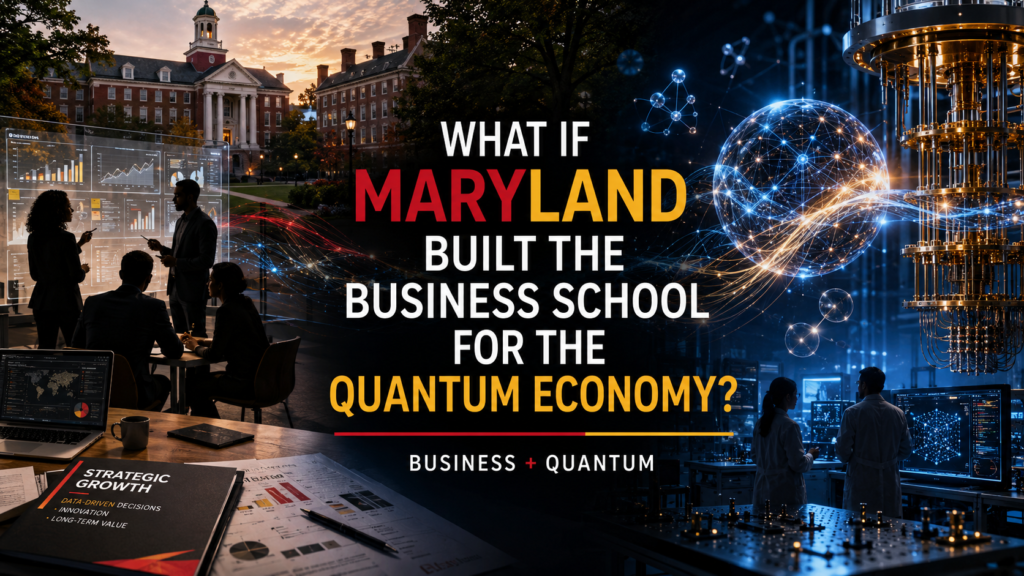
UMD already possesses a world-class quantum ecosystem and a nationally competitive business school. Bringing those strengths together could establish a new gold standard in quantum technology management and commercialization.
(COLLEGE PARK, MD – September 2, 2026) – Rod Carroll, my Morehouse brother and University of Maryland classmate, introduced me to the emerging world of quantum computing last school year.
I had certainly heard of quantum physics before. Like many people, however, I could not have explained what it meant—or why it mattered.
Rod helped me begin to understand it.
In plain language, quantum science examines how matter and energy behave at the atomic and subatomic levels. Quantum technology attempts to harness some of that unusual behavior to develop radically different approaches to computing, communications, sensing, security, materials, medicine, and other fields.
Rod explained that quantum computing represents a possible next frontier in digital technology. He also emphasized its potentially profound implications for money and financial systems—an aspect of our conversation I am still exploring and hope to discuss with him further.
Any university in America would be proud to have a Rod Carroll. He is witty, he understands systems, and he has a gift for recognizing when something within a system is not working—or when an important opportunity is being overlooked.
That conversation returned to me when I read University of Maryland President Darryll J. Pines’s recent op-ed, “Quantum Is Here. Now We Have to Keep Building the Ecosystem Around It.”
President Pines’s message reinforced much of what Rod had explained to me last school year: quantum technology is no longer merely a distant scientific possibility. It is developing now, and the institutions that assemble the necessary talent, infrastructure, partnerships, investment, and workforce will help determine how profoundly it shapes society.
Quantum Is Here—What Does It Mean?
President Pines makes a powerful case for the significance of quantum technology and the University of Maryland’s leadership in the field. He writes that UMD is home to one of the world’s largest concentrations of quantum scientists and engineers, with expertise spanning physics, computer science, engineering, materials science, information science, and related disciplines.
The president also emphasizes that scientific excellence alone will not be enough.
“We need talent pipelines,” he writes. “We need infrastructure. We need startups and industry partners. We need trusted testbeds. We need public investment and private capital.”
It is a compelling list—one that identifies what will be required to translate quantum discoveries into meaningful, real-world impact.
For readers who are still becoming familiar with the field—as I am—it may be helpful to pause and consider quantum technology in plain language.
Quantum science examines the unusual behavior of matter and energy at atomic and subatomic scales. At that level, nature does not always operate according to the rules we experience in our everyday lives. Quantum technology seeks to harness those properties to create new approaches to computing, communications, sensing, security, materials, medicine, and other fields.
Quantum computers, for example, process certain types of information differently from conventional computers. This does not mean that every laptop, cellphone, or traditional computer will suddenly become obsolete. Instead, quantum systems may eventually help solve particular problems that are extremely difficult—or practically impossible—for today’s computers to solve efficiently.
Potential applications include developing new materials and medicines, improving complex financial modeling, strengthening communication, solving optimization problems, advancing sensing technology, and transforming national security and cybersecurity.
The field remains young, and many commercial applications are still developing. Nevertheless, governments, universities, investors, startups, and major technology companies are already preparing for what may come next.
Maryland Has Already Built Much of the Foundation
Through its Capital of Quantum initiative, the University of Maryland has declared its intention to make this region a global center for quantum information science and technology.
President Pines compares the opportunity to the emergence of Silicon Valley:
Quantum will be for Maryland and this region what silicon was for Silicon Valley.
That is an ambitious statement. But UMD has significant assets behind it.
The university’s quantum ecosystem includes the Joint Quantum Institute, the Quantum Technology Center, the National Quantum Laboratory at Maryland, the Quantum Startup Foundry, and the Capital Quantum Benchmarking Hub at UMD’s Applied Research Laboratory for Intelligence and Security.
The university also offers an undergraduate Quantum Science and Engineering minor and a graduate Master of Science in Quantum Computing.
Students and researchers can study quantum computing architecture, algorithms, devices, machine learning, networks, hardware, information theory, thermodynamics, and other specialized subjects.
IonQ, a company born from foundational research at UMD, is headquartered in College Park’s Discovery District. Microsoft has announced plans for a quantum research facility in the area. UMD’s Quantum Startup Foundry helps entrepreneurs and emerging companies bring quantum technologies to market.
In other words, Maryland is not starting from scratch.
It has scientists. It has engineers. It has laboratories. It has intellectual property. It has startups. It has commercial partners. It has government relationships. It has students. It has research infrastructure and a president publicly committed to building the ecosystem.
But something important may still be missing.
Where Is the Business Curriculum?
During a recent meeting with Robert H. Smith School of Business Dean Prabhudev Konana, I gained a deeper appreciation for the intellectual strength of the Smith School and its potential to establish distinctive areas of leadership.
Our conversation included Professor Balaji Padmanabhan, whose expertise spans artificial intelligence, machine learning, data science, business analytics, and the design of complex computational systems.
Padmanabhan directs Smith’s Center for Artificial Intelligence in Business. The center examines AI research, education, business applications, responsible design, and governance.
That conversation, combined with President Pines’s op-ed and my earlier discussion with Rod Carroll, led me to a simple question:
What if the University of Maryland intentionally brought its strengths in quantum and business together?
President Pines says Maryland’s quantum ecosystem needs startups, investors, companies, partnerships, commercialization, workforce development, and sustained public and private investment.
Those are not exclusively scientific questions.
They are also business questions.
Who will determine whether a quantum discovery has a viable market?
Who will identify the customers?
Who will develop the business model?
Who will finance these companies?
Who will manage the risks?
Who will secure the supply chains?
Who will develop and protect the intellectual property?
Who will communicate the technology to investors, policymakers, customers, and the public?
Who will build the workforce and organizational culture required to lead companies filled with scientists and engineers?
Who will decide which quantum applications create genuine value and which are merely expensive promises?
These are questions for engineers, scientists, entrepreneurs, investors, policymakers, and business leaders to answer together.
What If Maryland Created the Program?
What if UMD established a major, graduate specialization, or interdisciplinary degree in Quantum Technology Management and Commercialization?
The program would not attempt to turn business students into quantum physicists. It would provide future business leaders with sufficient scientific understanding to make informed decisions about quantum technologies, markets, investments, organizations, and applications.
Likewise, it could give scientists and engineers the business knowledge needed to translate their discoveries from the laboratory into real-world organizations and markets.
The curriculum could bring together the Robert H. Smith School of Business, the A. James Clark School of Engineering, the College of Computer, Mathematical, and Natural Sciences, the School of Public Policy, the Quantum Startup Foundry, and UMD’s other quantum institutions.
Potential courses could include:
- Quantum Technology for Business Leaders;
- The Business of Quantum;
- Quantum Commercialization and Entrepreneurship;
- Financing Quantum and Deep-Technology Ventures;
- Quantum Markets and Competitive Strategy;
- Quantum Applications in Finance;
- Quantum Cybersecurity, Risk, and Governance;
- Intellectual Property and Technology Transfer;
- Quantum Supply Chains and Advanced Manufacturing;
- Leading Scientific and Technical Organizations;
- Global Competition and Public Policy in Quantum Technology, and;
- Communicating Quantum to Investors, Customers, Policymakers, and the Public.
But the program should be more than a collection of existing business and engineering classes.
The courses should be jointly designed and jointly taught.
Imagine Professor Padmanabhan or another Smith expert in the classroom with one of Maryland’s leading quantum scientists. The scientist could explain what the technology can and cannot do. The business professor could help students determine where it creates value, what market it serves, how it should be financed, and what organization would be required to scale it.
Put business students in teams with physicists, engineers, computer scientists, and public-policy students.
Give them actual problems from IonQ, Microsoft, the National Quantum Laboratory, the Quantum Startup Foundry, federal agencies, investors, and emerging quantum companies.
Ask one team to develop a commercialization strategy for a quantum sensor.
Ask another to examine the business and security implications of quantum communications.
Ask another to evaluate how quantum computing could affect financial modeling.
Ask another to determine the workforce and supply-chain requirements of a growing quantum company.
That would move the concept from theory to application.
Play to Your Strengths, Maryland
The Smith School operates in one of the most competitive higher-education markets in the country.
Within approximately 50 miles of College Park are Georgetown University’s McDonough School of Business, the George Washington University School of Business, Johns Hopkins University’s Carey Business School, American University’s Kogod School of Business, Howard University’s School of Business, George Mason University’s Costello College of Business, and several other business programs.
Each institution has strengths.
Georgetown has a powerful global business and policy identity. George Washington benefits from its location in the heart of the nation’s capital. Johns Hopkins possesses an internationally respected institutional name and significant strengths in healthcare, science, engineering, and applied research. Howard brings extraordinary history, culture, corporate relationships, and influence within the Black business community.
The Smith School should not attempt to become a copy of any of them.
It should play to Maryland’s strengths.
Among these leading regional institutions, UMD may possess the strongest combination of a nationally competitive business school and a world-class quantum science and engineering ecosystem.
That combination is difficult to reproduce.
Georgetown may have the strongest conventional business school reputation in the region, but it lacks Maryland’s quantum infrastructure.
Johns Hopkins has substantial quantum capabilities, but its business school does not occupy the same competitive position as Smith.
George Washington has respected business and engineering programs, but it does not lead the region in either category.
Maryland has the opportunity to combine strength with strength.
Creating a Quantum Technology Management and Commercialization program would convert two powerful institutional assets into one clear competitive advantage.
It could attract business students interested in the next generation of technology.
It could give quantum scientists and engineers a structured path toward entrepreneurship and commercialization.
It could attract investors, companies, government partners, and research funding.
It could produce executives prepared to lead businesses that do not yet exist.
Most importantly, it could allow the Smith School to define a category rather than compete only within an established one.
Establishing the Gold Standard
If Maryland waits until every leading university has developed a quantum-business program, it will become another participant in an established market.
If it moves now, it can help define the discipline.
UMD already understands interdisciplinary education. The QUEST Honors Program brings together students from business, engineering, and science to solve real-world problems through multidisciplinary teams.
The university does not need to invent collaboration from the ground up. It needs to direct that collaborative capacity toward one of its greatest existing strengths.
President Pines is correct that quantum leadership cannot be measured by research excellence alone. The university must also consider whether the discoveries produced by its researchers can become useful products, viable companies, sound investments, responsible public policies, and solutions to real human problems.
Scientists and engineers will build quantum technologies.
But business leaders will also be needed to manage, finance, commercialize, market, regulate, and scale them.
Maryland has both communities on the same campus.
Bring them together.
President Pines says quantum is here.
Now the University of Maryland has an opportunity to build the business school for what comes next.
Doni Glover is a Doctor of Business Administration student at the University of Maryland’s Robert H. Smith School of Business. He is the publisher of BMORENews.com and CEO of DMGlobal Marketing & Public Relations. The views expressed are his own.