

(COLLEGE PARK, MD — September 1, 2026) — I literally grew up in a family business.
Wherever we moved, my peers’ parents worked somewhere. Mine worked at home—or close enough to it. My mother trained me to answer the business phone from the time I was knee-high to a fiddle.
“Good evening, how may I help you?”
Etiquette. How to act when guests came around. How to treat the families we served. My father took me everywhere with him.
Long story short, in retrospect, the three of us were the business.
It was a simple structure, but it was functional. Everyone had an assignment. Everyone had a task. In essence, we had a system. As long as everyone did their part, the result was another successful service.
The lights stayed on. There was food, gas, and oil. You were cool. We worked hard, and we enjoyed ourselves.
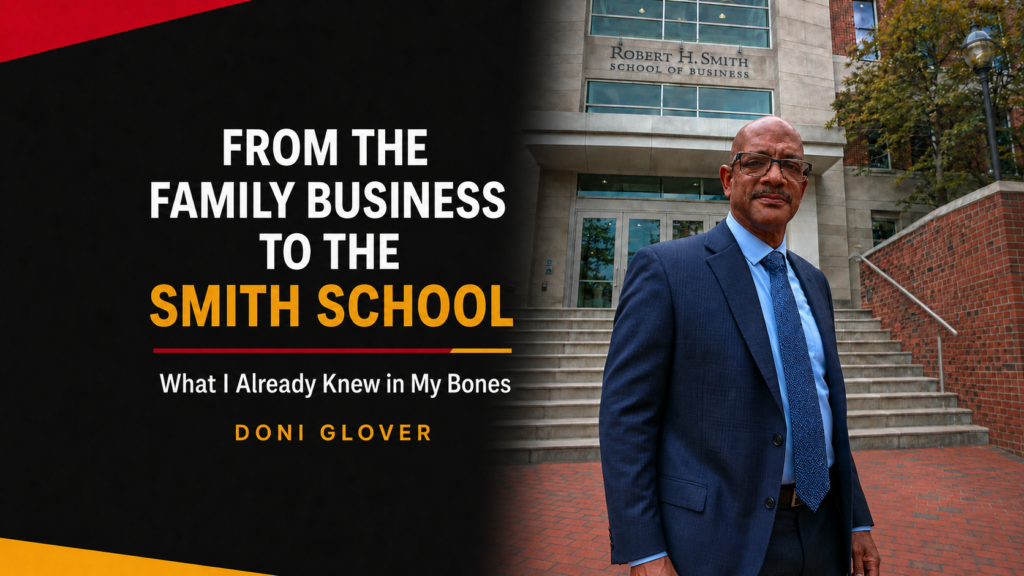
Having turned 61 three months ago, I do more reflecting by the day. Attending the Robert H. Smith School of Business at the University of Maryland, College Park, provides the perfect platform for that reflection—not just on the business I grew up inside, but on the many, many businesses I have witnessed since, across every industry, as a journalist.
Black, white, Asian, Southeast Asian, Middle Eastern, African, Russian, Ukrainian, and Albanian. If you travel—and I have been to a few places—you encounter people, observe how they conduct business, and learn things.
What I am really getting at is language.
The Smith School is giving me the language to better describe what I already know in my bones.
Take competitive advantage.
From the strip to Wall Street, and everywhere in between, everybody is looking for an edge. That edge might be a better product, faster service, a trusted name, stronger relationships, or the ability to deliver while everybody else is still talking.
Everybody wants an advantage. The question is whether you understand yours.
When I think about competitive advantage, I do not have to look far. I think about Dunbar and how Coach Bob Wade built national championship basketball teams. I think about the athletic pipelines—from Lafayette to Dunbar, or from Madison to Cardinal Gibbons—and how everybody wanted the best talent.
We discussed some of that history in our Legends of Baltimore series without necessarily calling it strategy, product leadership, or competitive advantage. Now, the business school is giving me another lens through which to examine it.
These lessons are applicable to almost everything.
Then there is strategy.
One of my current courses is Leading with a Strategic Mindset. The title alone gives me plenty to chew on. You can have a strategy all day long, but if you do not have someone who can implement it, the strategy means nothing.
That is where the magic either happens—or it does not.
Strategy and implementation are two different working parts, but they must work together. One establishes where the organization is headed. The other actually gets it there.
A brilliant strategy without implementation is just talk.
In class, we also discussed the classic razor-and-blades business model. The razor could last for years, but the customer had to keep purchasing blades. The larger lesson was not simply about razors. It was about understanding where the business’s continuing value truly lies.
I will leave that right there.
Some of my favorite topics are product leadership, operational excellence, and customer intimacy—the three paths to market leadership. I could chew on those for days.
Does a company distinguish itself by producing something superior? Does it win because it operates more efficiently than its competitors? Or does it succeed because it knows its customers, understands their needs, and builds relationships they do not want to leave?
Those questions immediately make me think about BMORENews.com.
We have never had the largest staff or the deepest pockets. But we know Baltimore. We know our audience. We show up. We move quickly. We use video, we build relationships, and we cover people and communities that larger organizations routinely overlook.
I am not going to give away the entire class. If you want the full lesson, you may have to enroll.
The point is that the Smith School is helping me identify, examine, and strengthen things I have experienced for most of my life. It is giving me new ways to think about the businesses I have observed, the organizations I have worked with, and the decisions I have made as an entrepreneur.
Most importantly, the program reinforces a lesson I have always believed: Knowledge means nothing without application.
Whatever I learn, can I apply it to my business?
That is the end game for me.
So, here is what I am really trying to say: If you have a knack for business, if you are looking to sharpen your skills, or if you want to better understand the language that describes what you deal with every day—especially if you are an executive—I highly recommend the Robert H. Smith School of Business at the University of Maryland, College Park.
The professors are A1. You are learning from some of the best in the world, alongside accomplished people who bring years of experience into the classroom.
I came to the Smith School with a lifetime of business lessons.
Now, I am learning how to name them, examine them, challenge them, and apply them more strategically.
I do not know what more you could ask for.
|
|
|
|