
(RANDALLSTOWN – November 20, 2026) – I am a doctoral student at the University of Maryland. I started in 2025—75 years after Parren Mitchell sued his way into College Park’s graduate sociology program in 1950 with Thurgood Marshall as his lawyer, becoming the first Black graduate student on that campus. Nobody handed us that seat. We had to fight for it. Parren Mitchell and his brother Clarence Mitchell Jr., “the 101st Senator,” kicked open those doors so people like me could walk through them.
Out in Randallstown, giants like Ella White Campbell fought so we could have a Ken Oliver, the first Black member of the Baltimore County Council. Ella White Campbell stood up for Black people. She represented us. She was unapologetically Black.
What we have today, I am afraid to say, is apologetically Black leadership.
“I speak on behalf of…”
Liberty Road has been my beat ever since I started BMORENews.com. Additionally, I did some editing for the Northwest Voice under Mr. Kenny Brown. I’ve covered Ken Oliver, Julian Jones, Jim Smith, Delores Kelley, and Johnny Olszewski. And I covered Ella White Campbell, the Queen.
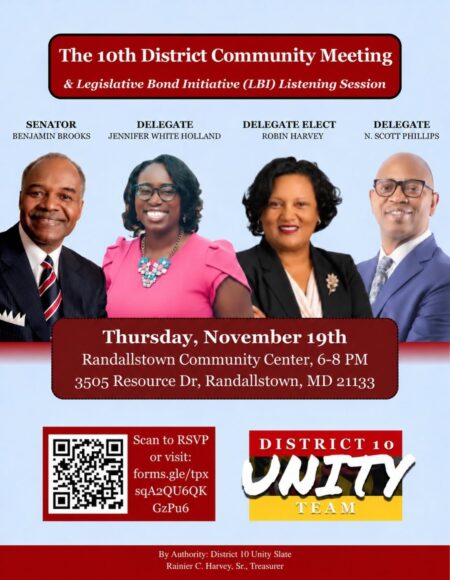
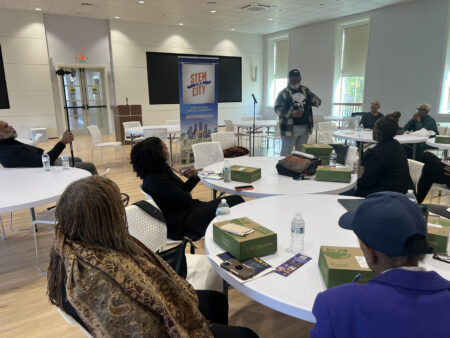
I bet Ella White Campbell rolled over in her grave Thursday night as the meeting unfolded at the Randallstown Community Center.
During the 10th District’s Community Meeting and Legislative Bond Initiative Listening Session, Senator Ben Brooks’ chief of staff, Kimberly Shiloh, took the microphone and said: “I speak on behalf of the state senator and the three delegates.”
I nearly fell out of my chair. Excuse me, ma’am, but who are you? Hardly anyone in that room even knew her name.
The worst part? One of those three delegates sitting right there is N. Scott Phillips—chair of the Legislative Black Caucus of Maryland, the largest state legislative Black caucus in the nation. He sat a few feet away and said nothing.
So here is my question, in print: Delegate Phillips, does she speak for you too?
Abandoning the mission
The Black Caucus was born in 1970. Three University of Maryland educators—Roosevelt Duncan, Howard “Pete” Rawlings, and Norman Reeves—proposed it, and Delegate Lena King Lee issued the call. Seventeen Black lawmakers answered. Today, that caucus has 67 members.
Years after leaving the legislature, Senator Clarence Mitchell III, one of those founders, told me something I have never forgotten: in his view, that small original group accomplished far more than the massive caucus that followed.
That first crew fought its way onto redistricting committees, redrew the maps, and doubled their numbers in about a decade. They fought to put more Black people in office.
The Caucus was founded for one reason: to speak up for Black people. That was the mission. Today, too many of our Black elected officials have abandoned their posts and walked away from it. Watching the chair of the Black Caucus sit silent while a staffer claims to speak for him isn’t just troubling—it is disturbing.
The 600-pound gorilla in the room
The biggest question of the night never got asked: How did the 10th District team endorse Ruben Amaya for County Council District 2—a majority-Black district—after telling two Black candidates, retired educator Lawrence Williams and Dr. Danita Tolson, that they would stay out of the race?
Amaya beat Williams in the primary by 27 votes. In a race that tight, a delegation endorsement decides the winner.
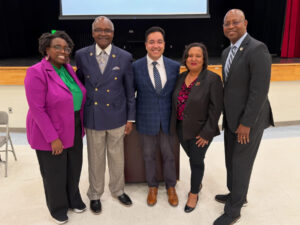
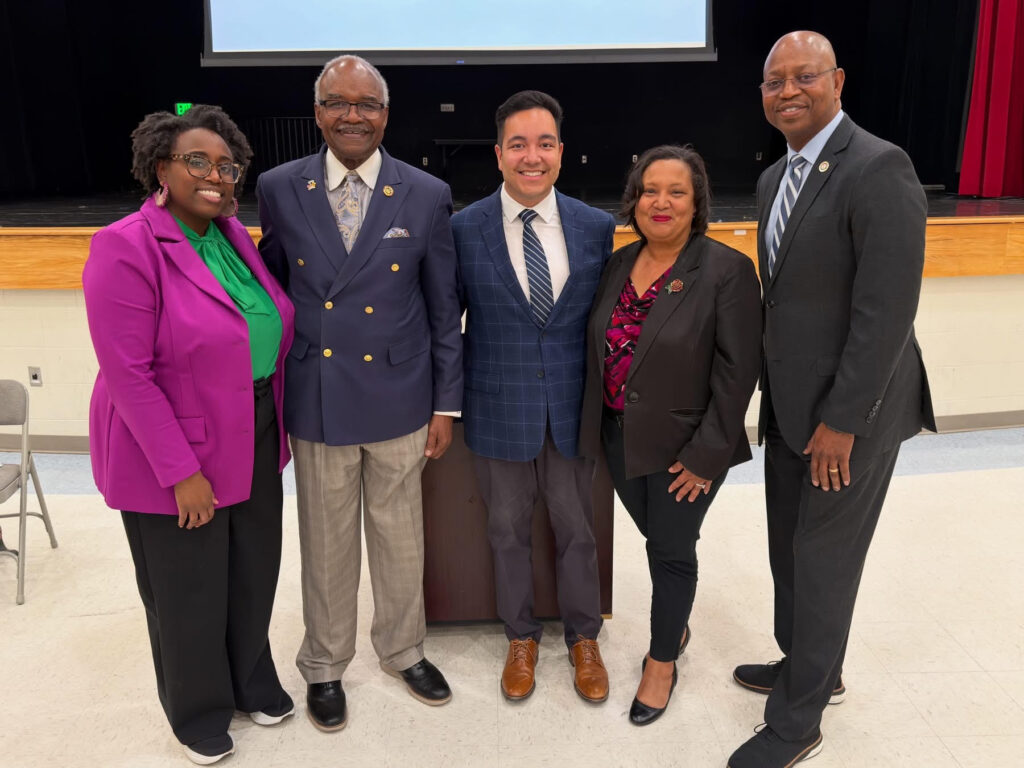
And how did Thursday night end? With a group photo—Amaya surrounded by the very officials who put him there. Within hours, that picture was plastered online. That photo tells the whole story.
What didn’t get said
For the first community meeting after a general election, that room should have been packed. Instead, residents got only a few days’ notice.
Once the meeting started, the delegation seemed more eager to wrap up and talk about Toys for Tots than dig into the real work. They glossed over the future of Liberty Road. They glossed over Security Square Mall. They glossed over whether data centers are coming to the area. Nobody breathed a word about mass incarceration.
And when group homes came up, one official didn’t even seem to know that Randallstown and western Baltimore County have long had the highest concentration of group homes in Maryland, according to county officials quoted by The Baltimore Sun. District 10 lawmakers were fighting that battle in Annapolis back in 2004, when Emmett Burns, Shirley Nathan-Pulliam, and Bobby Zirkin sponsored legislation to stop new group homes in the area. How can you represent us if you don’t even know the lay of the land?
The fight didn’t stop at the county line
After the 1968 riots, plenty of Black families left West Baltimore for Randallstown chasing better schools and a better life. Moving to the suburbs didn’t end the struggle. You still have to fight for those schools. The squeaky wheel gets the oil.
When I read the history of Lena King Lee and Verda Welcome, I am reminded of what real courage looks like in Annapolis.
Lena King Lee was a Baltimore school principal who earned her law degree in her mid-40s, went to Annapolis at 60, and put out the call in 1970 to unite Maryland’s Black lawmakers into a single bloc. When she retired, she handpicked her successor: a young attorney named Elijah Cummings.
Verda Welcome beat Jack Pollack’s political machine to become the first Black woman in the Maryland Senate. In 1964, she survived an assassination attempt outside her home—and went straight back to the Senate floor. She fought to wipe Maryland’s Jim Crow laws off the books and served as the Black Caucus’s first vice chair.
I think about Clarence Mitchell Jr. and the Mitchells who carried that torch—Clarence III and Clarence IV. I think about Parren Mitchell, the Goon Squad, and Rev. Vernon Dobson. Those people weren’t afraid of the streets, and they weren’t afraid of Black people. They loved Black people, and they spoke up for us. I think about Thurgood Marshall, traveling through the South to find folks brave enough to sue before taking his seat on the Supreme Court. I think about the bullets that took Martin Luther King Jr. and Malcolm X. I think about Nat Turner, Frederick Douglass, and Harriet Tubman.
Not a single one of them was apologetically Black.
That is what I saw Thursday night, and it bothers me to my core. Who speaks for Black people on Liberty Road? After that display, I honestly don’t know.