
(BALTIMORE – October 12, 2026) – Curious about artificial intelligence? Wondering how it could help with a challenge you face at work?
Those are the questions I want us to explore. But first, we need to make something clear: the debate over data centers and the conversation about learning to use AI are distinct, although connected.
Data centers raise questions about electricity demand, water use, land, infrastructure, and who pays for expansion. Communities have every right to question proposed developments and demand accountability. AI’s growth is contributing to the demand for that infrastructure. Those concerns deserve attention.
At the same time, our workers, entrepreneurs, educators, and nonprofit leaders need to understand the technology itself.
We can question a data center proposal while learning how AI might help a small business. We can demand responsible development while preparing our community to participate in a changing economy.
Both conversations matter. One should not crowd out the other.
AI Is Already Part of Our World
Artificial intelligence is a major technological and scientific advancement of this era. Its influence is expanding, and choosing not to use an AI tool does not mean we will avoid its effects.
An employer, institution, service provider, or competitor may use AI in ways that affect us. We need enough understanding to ask informed questions about those uses and make decisions of our own.
Technology will continue developing. Quantum computing may become a larger part of the conversation. Other advances will follow, and some will develop alongside AI.
There will always be something next.
But this is the moment we are living in, and artificial intelligence demands our attention.
My position is straightforward: let’s explore it and learn all we can about it.
We do not have to understand everything on the first day. We can start with questions, experiment with a useful task, and build our knowledge from there.
Maryland Leads. Is Our Community Participating?
Microsoft’s AI Diffusion in the United States report, covering the first quarter of 2026, ranked Maryland first among the 50 states, with an estimated AI adoption rate of 36.3%. That ranking reflects the report’s measure of AI use; it does not mean Maryland leads every measure of AI investment, business adoption, or workforce readiness.
Still, it is a finding worth our attention.
If Maryland leads in this measure of adoption, what does that mean for our community?
Are neighborhood business owners getting practical instruction? Are nonprofit teams learning how these tools might support their work? Are educators, older adults, and people who have never considered themselves technical being included?
A statewide ranking cannot answer every neighborhood question.
We have to ask who has access, who has support, and who can turn experimentation into something useful.
I have always been an advocate for our community. Like Dr. Tyrone Taborn and Dr. Alvin Hathaway, I believe in creating opportunities for people to learn, participate, and build.
It is incumbent upon me to do my part to help our community better understand AI and explore how to make it work for them.
Start With the Work in Front of You
Much of the public discussion swings between excitement and fear. But someone running a small business or managing a community organization often has a more immediate question:
Can this help me get something done?
That is a sensible place to begin.
An entrepreneur might explore using AI to organize a marketing plan, draft a customer email, or compare information in vendor proposals.
A nonprofit might use it to create a first draft of volunteer instructions, organize program notes, or outline a funding proposal using information the organization supplies.
An educator might explore different ways to explain a concept or prepare practice materials for review.
A contractor might use it to organize an RFP into a checklist of requirements and questions that still need answers.
These are tasks to test carefully. The value depends on whether the result is accurate, useful, and appropriate for the work.
A draft still needs review. A summary must be checked against the original document. Legal, financial, healthcare, and regulatory questions still require the appropriate expertise.
But helping someone begin, organize, or prepare can itself be valuable—particularly when time and staff are limited.
The starting point should be a challenge you understand firsthand.
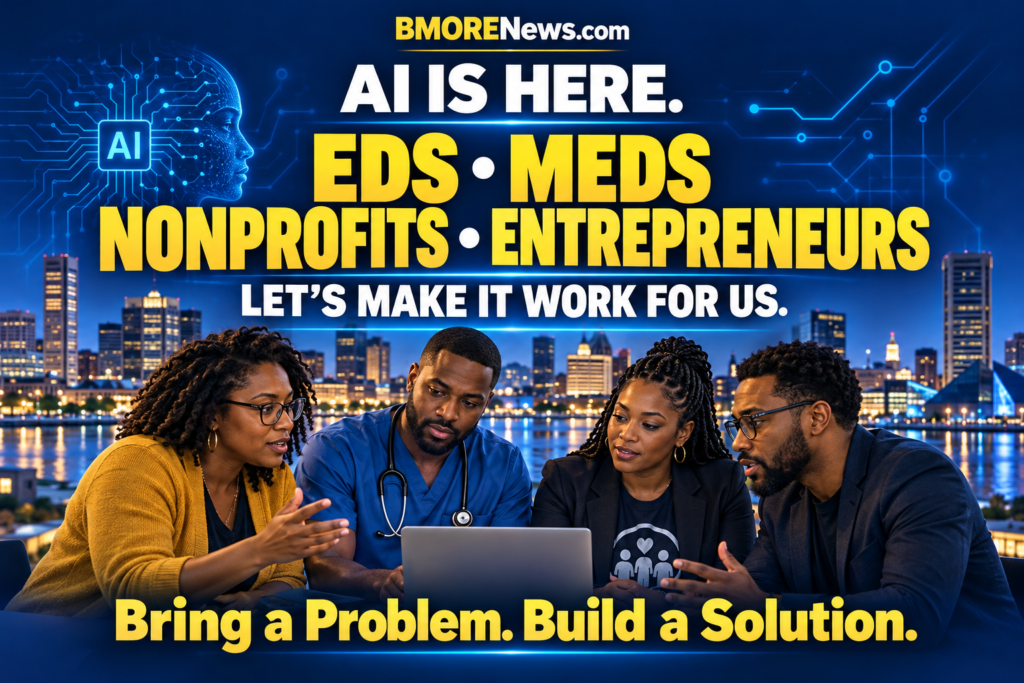
Bring a problem. Build a solution.
Participation Should Create Value for Us
Adoption alone is not the finish line.
I want more for our community than becoming regular customers of somebody else’s technology.
I want people to develop skills they can apply, services they can offer, and businesses they can strengthen. I want our institutions to understand enough to choose useful tools, question vendors, and evaluate results.
Learning to write a prompt can be a beginning. Learning to design a dependable process, check its output, and measure whether it helps takes us further.
For an entrepreneur, that might mean serving customers more effectively. For a nonprofit, it might mean spending less time organizing paperwork and more time delivering a program. For a worker, it might mean building a skill that expands career options.
Ownership deserves a place in this conversation, too.
Who builds the products? Who owns the businesses providing AI services? Who earns revenue? Who determines how community information is used?
Our community should have the knowledge and opportunity to pursue those questions.
Understanding AI Includes Questioning It
AI can produce an answer that sounds convincing and is wrong. It can overlook context, reproduce bias, or generate information that should never be accepted without verification.
That matters to me as a journalist and publisher.
Our stories, identities, and experiences require care. We cannot assume a system understands Baltimore, Black communities, or the circumstances behind a person’s life simply because it produces fluent sentences.
We must check the work.
We must also think carefully about what information we enter into a tool. Confidential business records, personal information, student records, and patient information require appropriate protections.
These responsibilities belong in AI education from the beginning.
Learning should help people recognize when a tool is useful, when it needs closer scrutiny, and when a task calls for human expertise.
The more we understand, the better equipped we become to demand accountability.
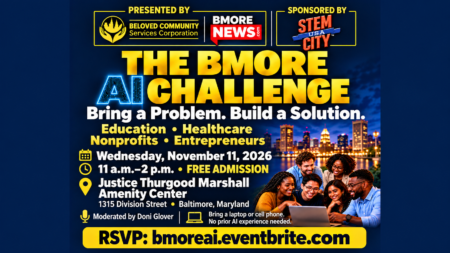
Join The BMORE AI Challenge
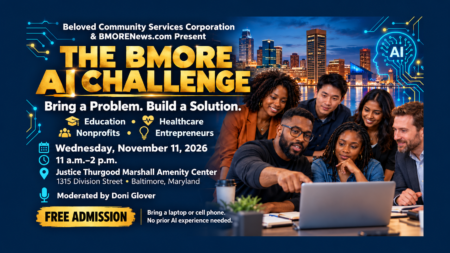
We are putting this call to participation into action through The BMORE AI Challenge.
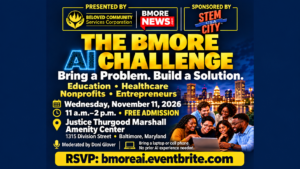
On Wednesday, November 11, 2026, from 11 a.m. to 2 p.m., join us at the Justice Thurgood Marshall Amenity Center, 1315 Division Street, Baltimore.
The event is presented by Beloved Community Services Corporation and BMORENews.com, sponsored by STEM City USA, and moderated by me, Doni Glover.
We welcome educators, healthcare professionals, nonprofit teams, and entrepreneurs who want to better understand AI and explore practical uses.
Admission is free. No prior AI experience is needed. Bring a laptop or cell phone.
Bring a question, too.
What task takes too much time? What could your organization do better? What have you heard about AI that you want explained? What would you need to know before trusting it with part of your work?
You can arrive curious. You can arrive skeptical. Either way, you have a place in the conversation.
Our community deserves access to learning that connects technology to the work and challenges we already know.
We can scrutinize the infrastructure and study the tools. We can demand accountability and develop our own capabilities.
AI is already here. Let’s learn all we can—and put that knowledge to work for our community.
RSVP: bmoreai.eventbrite.com