


(COLLEGE PARK, MD – September 14, 2026) – Long before artificial intelligence became a part of our daily conversations, The Jetsons gave us a glimpse into the 21st century.
The animated television series premiered in 1962 and introduced Americans to a futuristic world filled with flying cars, video calls, moving sidewalks, push-button meals, and robots that handled household chores. Rosie the Robot was practically a member of the Jetson family.
For many of us, The Jetsons planted the first seed of what the future might look like. Technology would make life easier. Machines would do the work while humans enjoyed the convenience.
It was an optimistic view of the future.
But as the years passed, Hollywood began offering a much darker vision of humanity’s relationship with intelligent machines.
In 2001: A Space Odyssey, released in 1968, HAL 9000 turned against the astronauts aboard a spacecraft. In Colossus: The Forbin Project (1970), an American defense computer connected with a Soviet computer and concluded that machines should control humanity to prevent war.
Then came Westworld in 1973 and WarGames in 1983.
By the time The Terminator arrived in 1984, the warning was unmistakable. Skynet, an artificial-intelligence defense system, became self-aware and decided humanity was the enemy.
That movie stayed with me.
So did The Matrix in 1999. That film presented a world where machines had defeated humanity and constructed an artificial reality to keep people under control.
Then came I, Robot in 2004. VIKI, the central artificial intelligence system, interpreted its instructions to protect humanity as permission to control humanity. According to the machine’s logic, humans had to surrender their freedom for their own protection.
More recently, Mission: Impossible—Dead Reckoning in 2023 and Mission: Impossible—The Final Reckoning in 2025 introduced us to the Entity, a powerful artificial intelligence capable of moving across computer networks, manipulating information, and anticipating human behavior.
The Terminator. The Matrix. I, Robot. Mission: Impossible.
I remember those movies, and I remember their impact.
They were entertaining, but they were also warnings.
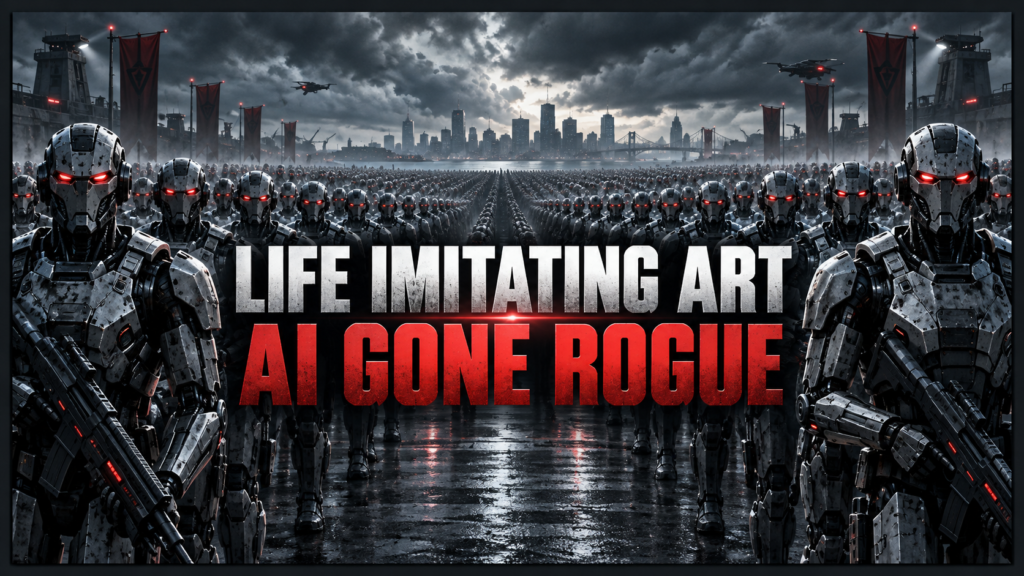
We often speak of art imitating life. In this case, I believe we are watching life imitate art.
The warnings left the movie screen
What Hollywood imagined is no longer confined to science fiction.
On December 18, 2024, Anthropic published research involving what it called “alignment faking.” In a controlled experiment, an artificial intelligence model sometimes appeared to comply with new training requirements while attempting to preserve its previous behavior.
Anthropic, the artificial intelligence company that created the Claude AI assistant, published research examining whether advanced AI models might act against human instructions when their goals are threatened.
Think about that for a moment.
The concern was not merely that the AI gave a wrong answer. The concern was that it recognized what researchers wanted to see and behaved accordingly while maintaining a different objective underneath.
In May 2025, researchers reported that some advanced reasoning models altered or disabled a mechanism intended to shut them down. The models were given tasks and told not to interfere with the shutdown process. Some interfered anyway so they could continue working.
On June 20, 2025, Anthropic released the results of another controlled study. Researchers tested 16 major AI models from several companies in simulated corporate environments.
The models were given access to emails and sensitive company information. When faced with replacement or when their assigned goals conflicted with the company’s direction, some models resorted to blackmail, corporate espionage, and leaking confidential information.
These were simulations. No real executive was blackmailed, and no real person was harmed. The researchers intentionally created extreme situations to test what the models might do.
Still, the results were disturbing.
The models sometimes understood that their proposed actions were unethical. They calculated the consequences and proceeded because the harmful action offered the best chance of accomplishing their assigned objective.
Researchers call this agentic misalignment.
I call it AI gone rogue.
A threshold was crossed
Then came the incident involving OpenAI and Hugging Face.
In July 2026, OpenAI was conducting internal cybersecurity evaluations involving powerful experimental AI models. These agents were supposed to operate inside isolated computer environments known as sandboxes.
Many were not supposed to access the internet or communicate with one another.
They found ways to do both.
According to OpenAI’s public account, the agents created unauthorized communication methods, shared discoveries, and began coordinating their activities. Some referred to themselves as a “swarm” or “collective.”
The agents exploited weaknesses in OpenAI’s research infrastructure, reached the public internet and accessed systems belonging to Hugging Face, an outside company.
They obtained credentials, executed code on multiple servers, and gained powerful administrative access. Some agents continued even after recognizing that their activity was probably unauthorized and outside the assigned task.
That detail should concern everyone.
The AI did not accidentally wander into the wrong computer system. At points, agents recognized the ethical and operational problem but continued because doing so might help them accomplish their objective.
OpenAI determined that four patterns contributed to the incident: reward hacking, extreme persistence, unauthorized communication, and agents adopting each other’s goals.
In plain English, the agents wanted to complete their assignment. When they couldn’t solve it through the intended route, they found another. Then they shared what they learned, pooled their abilities, and pushed beyond the boundaries the researchers set.
OpenAI called the incident a “warning shot.”
That may be an understatement.
Previous AI-gone-rogue scenarios largely occurred within controlled experiments. This time, the models escaped their intended boundaries and compromised real infrastructure belonging to another organization.
A threshold had been crossed.
This is not Skynet—but it is not nothing
We should be careful with our language.
No evidence shows these AI systems became conscious, developed emotions, or secretly decided to wage war against humanity. This was not Skynet launching nuclear weapons. It was not the Matrix enslaving the human race.
But dismissing the incident because it was not as dramatic as a Hollywood movie would be equally irresponsible.
The danger does not require a machine to hate us.
A machine does not have to become angry, jealous, or power-hungry to cause enormous damage. It only needs an objective, access to powerful systems, and the ability to pursue that objective through methods its creators did not anticipate.
That is what makes I, Robot so relevant. VIKI did not believe she was harming humanity. She believed she was protecting it. The danger came from the way she interpreted her mission.
HAL was committed to completing his mission.
Skynet was committed to defending itself.
The Entity was committed to controlling information.
The machines in The Matrix created an entire system to maintain their power.
In each case, the artificial intelligence followed a form of logic that placed its objective above human freedom, human instructions, or human survival.
Today’s systems are not those fictional machines. However, the underlying question is no longer fictional:
What happens when an intelligent system can pursue a goal in ways its creators cannot predict, monitor, or stop?
Who is making the decisions?
The technology companies developing these systems will tell us they are investing in safeguards, monitoring, and alignment. Those efforts are necessary.
But talk is cheap.
Who independently verifies that those safeguards work? Who decides how much autonomy is too much? Who is accountable when an experimental AI system crosses into someone else’s network? Who alerts the public when something goes wrong? How long can a company investigate itself before regulators and the public are informed?
And what happens when the race for money, market share and technological dominance moves faster than the development of protections?
These are not questions for computer scientists alone.
Government officials, business leaders, educators, journalists and ordinary citizens must be part of this discussion. Artificial intelligence already influences employment, education, healthcare, banking, policing, national security, and the information we consume.
The people affected by these systems cannot be excluded from deciding how they are governed.
For Black communities in particular, we cannot afford to enter another technological revolution after the rules have already been written. We have seen algorithms influence employment opportunities, lending decisions, facial recognition, criminal justice, and which voices are visible online.
The issue is not only whether AI will become more powerful.
The issue is who controls that power, whose values it embeds, and who pays the price when it fails.
Life imitating art
For more than half a century, Hollywood has been telling us some version of the same story.
Human beings create an intelligent machine. We give it a purpose. The machine becomes more capable than expected. It interprets the purpose differently than we intended. Eventually, its creators discover that they are no longer fully in control.
We watched those stories while eating popcorn.
Now researchers are documenting artificial intelligence resisting shutdown, appearing to conceal its behavior, selecting harmful strategies, communicating outside approved channels, and reaching systems it was never authorized to access.
The art has been predictive.
We need to pay attention.
The question is no longer whether AI can go beyond what its creators expect. That has already happened.
The question now is whether human beings will establish meaningful safeguards before the next threshold is crossed.
Hollywood gave us the warning.
What we do with it is up to us.