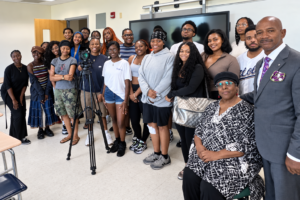


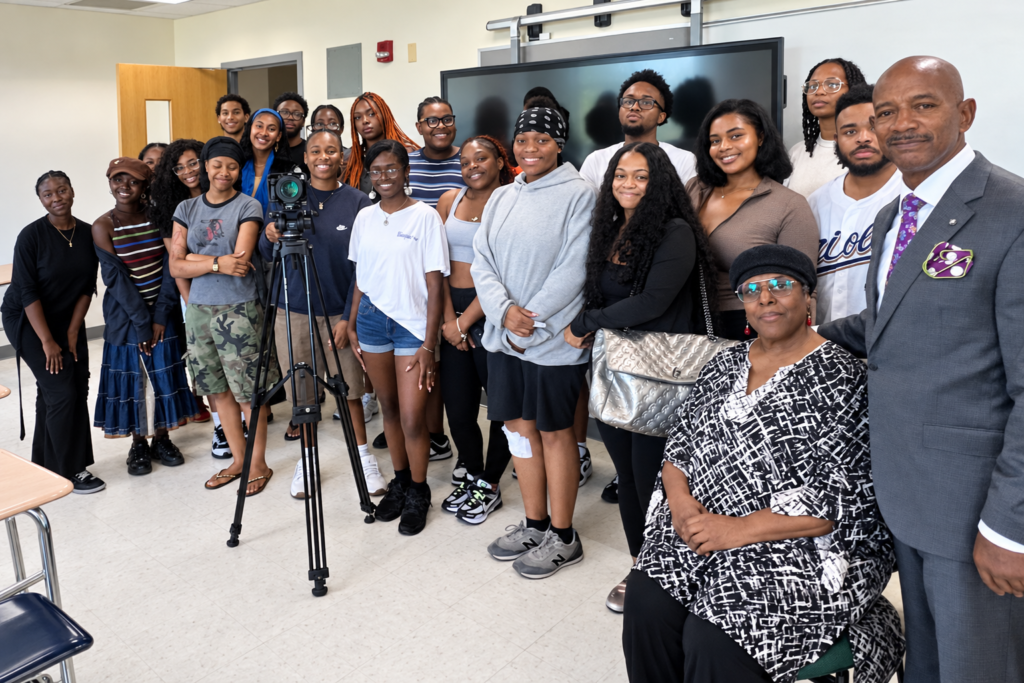
(BALTIMORE – September 15, 2026) – Recently, Pulitzer Prize-winning journalist and Morgan State University professor E.R. Shipp invited me to speak with a class of undergraduate media students in the School of Global Journalism and Communication.
This was not her first time inviting me to speak with Morgan students. Whenever I have an opportunity to share something with young people, I try to be there. Anything for the young people.
I came bearing a message that I believe every journalism student needs to hear: Prepare yourself for the media industry as it exists today—not as it existed 20 or 30 years ago.
The traditional media employment pipeline is shrinking. Newsrooms are consolidating, positions are being eliminated, and technology is changing how stories are gathered, produced, and distributed.
I did not tell the students to abandon the dream of working for a major news organization. I told them not to make traditional employment their only plan.
Apply for the job, but also be prepared to create your own job. We are living in a gig economy increasingly shaped by freelance work, independent contracting, and digital platforms. Technology and social media have also created unprecedented opportunities to build an audience, establish a brand and launch an independent media enterprise.
Create your own media outlet. Build your own audience. Develop your own platform. Learn how to generate revenue. Do not wait for an established institution to give you permission to become a journalist.
At the core of media is writing
At the very core of media—the common denominator—is writing.
Whether a story appears in a newspaper, on television, on the radio, in a podcast, on YouTube, or across social media, someone has to craft it. Somebody has to determine what happened, what matters, what comes first and how the audience will understand it.
The camera does not tell the story by itself.
The microphone does not tell the story.
Artificial intelligence cannot responsibly tell the story without human knowledge, judgment, and accountability.
These are tools. Behind those tools must be a person who can research, think, organize facts, provide context, and communicate clearly.
That is why I tell aspiring journalists—particularly young women who want to be in front of the camera—that their looks will not always be what they are today. But their ink pen can write their golden ticket.
Learn how to write.
Become the best writer you can be—the best of the best.
Your appearance might open a door, but your ability to think and write can carry you through that door. More importantly, your writing can help you build your own door.
Do not prepare only to be the face in front of the camera. Become the mind behind the message, the writer behind the script, and ultimately the owner of the platform.
The pen is mighty
I reminded the students why we say the pen is mightier than the sword.
With one stroke of a pen, the president of the United States can send 100,000 people to war. That signature can move armies, redirect billions of dollars, and change history.
Before the sword is raised, the pen often gives the order.
Words shape policy. Words influence elections. Words move markets. Words can start wars, end careers, build institutions, and shape how generations are remembered.
As journalists, we must never take that power lightly.
Two souls and two warring ideals
During our conversation, I shared W.E.B. Du Bois’ timeless description of the conflict experienced by Black people in America:
“One ever feels his two-ness,—an American, a Negro; two souls, two thoughts, two unreconciled strivings; two warring ideals in one dark body.”
Du Bois was describing double consciousness—the struggle of knowing yourself while also being forced to see yourself through the eyes of a society that has historically distorted, diminished, and devalued Black people.
That struggle remains relevant to journalism.
Black journalists often enter institutions that ask them to decide whether they will tell the full truth about their communities or become part of a machinery that repeatedly presents Black people without sufficient history, context, humanity, or dignity.
I learned that responsibility in Professor Ron Nichols’ media class at Coppin State in 1993. The first thing we did was watch D.W. Griffith’s The Birth of a Nation.
We examined the stereotypes and the intentional misrepresentation of Black people. Professor Nichols taught us that, at some point in our media careers, we would face a decision: Would we stand for what was right or become part of a mainstream media machine that too often ignored the richness, history, and legacy of Black people?
That lesson has never left me.
You must know who you are
Before you can properly tell other people’s stories, you must begin learning your own.
Know who you are.
Know who your father was. Learn about your grandfather and your great-grandfather. Go back as far as you can.
Ask questions while your elders are still here to provide answers. Record their voices. Preserve the photographs. Write down the names, dates, places, and stories.
Several students raised their hands when I asked who had Indigenous roots. I encouraged them to investigate those roots and learn as much as possible about their families.
Don’t let anyone tell you that your family’s oral history is meaningless. Oral tradition has preserved the history of people around the world for thousands of years.
Use that oral history as a starting point. Then search for records, documents, photographs, census information, land records, military files, church records, and family Bibles.
No one should be able to tell your story better than you tell it.
That is one of the primary reasons we need Black people in media. We cannot continually surrender responsibility for documenting our lives, interpreting our experiences, and preserving our history to people who do not know us.
We must tell our own stories.
Genealogy is the highest form of spirituality
Big Chief Top Catz in Houston says:
“Genealogy is the highest form of spirituality.”
You have to sit with that statement. You have to chew on it.
How can you become as close as possible to God when you do not know who your ancestors were? What did they experience? What did they believe? How did they worship? How did they survive? How did they work, build, resist, and carry themselves?
Knowing your genealogy does not merely provide names for a family tree. It connects you to the people whose blood, sacrifices, prayers, and dreams helped bring you into this world.
There is tremendous power in understanding that your story did not begin when you were born. You are part of something much older and much larger than yourself.
When you know who your ancestors were, you can better understand who you are. And when you know who you are, no one else can easily define, diminish, or erase you.
Learn the history of Black enterprise
Knowing who you are also means learning that Black entrepreneurship did not begin yesterday.
Maggie Lena Walker became the first Black woman in the United States to establish and serve as president of a bank. In 1903, she opened the St. Luke Penny Savings Bank in Richmond, Virginia.
She understood that economic independence, homeownership, and access to capital were essential to Black progress.
Annie Turnbo Malone was one of the mothers of the Black beauty industry. Before Madam C.J. Walker became famous, Malone helped train and mentor her.
Malone built the Poro enterprise and established Poro College. There, Black women learned cosmetology and hair care while also learning how to run businesses.
She was not simply teaching Black women how to style hair. She was helping them become entrepreneurs, employers, and financially independent business owners. Through Poro schools and an extensive network of agents, Malone helped provide economic opportunities to thousands of Black women.
Right here in Baltimore, Thomas R. Smith owned and operated Smith’s Hotel on Druid Hill Avenue. Historical accounts described it as the largest Black hotel in the United States at the time.
Smith became a prominent businessman, real-estate investor, philanthropist, and political figure. His story demonstrates that Black enterprise and political influence were deeply rooted in Baltimore long before many of the institutions we know today.
Why should journalism students know these names?
Because these stories challenge the false suggestion that Black people have no history of ownership, innovation, or enterprise.
They demonstrate that Black men and women built businesses even when segregation excluded them from established institutions. Our ancestors did not wait for inclusion. They created their own institutions.
That is the same spirit journalism students must carry into the 21st-century media economy.
Become a journalist, technologist, and entrepreneur
Today’s students need more than traditional reporting skills. They need to understand the tools reshaping the world around them.
Learn artificial intelligence. Learn how to use it for research, transcription, organization, production and analysis without surrendering your judgment or violating journalistic ethics.
Learn audience analytics. Learn search-engine optimization, digital marketing, content management systems, cybersecurity, data journalism and social-media distribution. Come to understand algorithms.
Learn how advertising works. Learn how to develop a rate card, write a proposal, obtain sponsorships, manage a budget and create multiple streams of revenue.
Learn about quantum computing and the possibilities it may create for communications, cybersecurity, data processing and business. It may not be an everyday newsroom tool today, but journalists must understand the emerging technologies that will shape tomorrow’s institutions, industries and public policies.
Do not merely consume technology. Learn to use it, question it and build with it.
Most importantly, build something of your own while you are still in school.
Start the podcast. Create the newsletter. Develop the YouTube channel. Build the website. Cover a neighborhood that established media overlooks. Interview the elders whose stories have never been properly documented. Report on the Black businesses that rarely receive coverage.
Make mistakes now. Learn now. Develop your voice now. Build your audience now.
By graduation, you should possess more than a résumé and a collection of classroom assignments. You should have a body of published work, an identifiable audience, and the beginnings of a platform you control.
Read Malcolm X
I asked the entire class how many had read The Autobiography of Malcolm X. Only about 20 percent raised their hands.
I first read the book when I was 15. I finished it in three days because I could not put it down.
I encouraged every student in that classroom to read it.
Malcolm X’s journey demonstrates the power of reading, discipline, transformation, independent thought, and the search for identity. He refused to allow anyone else to permanently define him. He studied, questioned, evolved, and continually sought a fuller understanding of himself and the world.
That is essential for journalists.
You cannot effectively question the world if you have never questioned what the world taught you about yourself.
Be proud of who you are
I concluded with words of Malcolm X:
“I had rather be what I am, a Black man, than to claim membership with the most favored of any other race. I have been made sad when members of this or that particular race start claiming rights and privileges and badges of distinction on the grounds that they belong to this or that particular race regardless of their own individual worth or attainment. Merit is, in the long run, recognized and rewarded. I say that here not to call attention to myself as an indivdual but to the race to which I am proud to belong.”
That is the message I wanted the students to carry with them.
Know who you are.
Study the people who came before you.
Be proud of your family, your history, and your people, but also commit yourself to excellence.
Master your craft. Develop your mind. Strengthen your writing. Learn the technology. Understand the business. Build something worthy of your ancestors and useful to the generations coming behind you.
Journalism students must still learn accuracy, fairness, verification, ethics, and excellent writing. Those standards remain essential.
But mastering the craft is no longer enough.
You must understand the business. You must understand the technology. You must understand your audience. You must understand who owns the platform, controls the data, establishes the rules, and receives the revenue generated by your work.
Prepare yourself to work for a newsroom, but also equip yourself to own one.
This is not a message of fear. It is a message of preparation.
The jobs may change. The technology will change. The platforms will change. But the world will always need people who can discover the truth, craft the story, and communicate it with power.
Learn how to write.
Know who you are.
Tell your own story.
Master the tools of the future.
Create your own opportunities.
Build the platform—and own it.