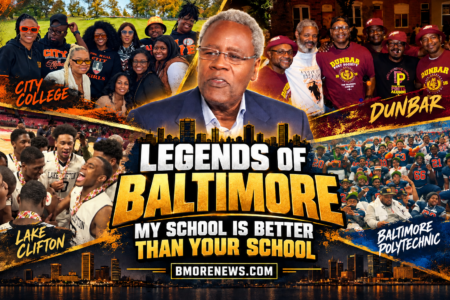


Introducing Legends of Baltimore: More Than a Game, a BMORENews series preserving the athletes, mentors, institutions, and hidden histories that shaped our city.
(BALTIMORE – August 2, 2026) – Let’s get one thing straight from the start: I am not presenting myself as Baltimore’s leading sports statistician. I don’t claim to be a standard sports reporter.
If you want somebody who has Baltimore sports on lock today, I refer you to Troy Hackley, the man behind Urban Sports Beat. Troy has spent years covering our athletes—from Little League and youth programs to high school, college and beyond.
Back in the day, the standard was the legendary Sam Lacy of the AFRO-American Newspapers. Beginning in 1944, Lacy spent nearly 60 years at the AFRO documenting Black athletes, confronting segregation and advocating for the integration of professional sports.
Sam Lacy did not merely report history. He helped change it.
I respect that tradition, and I know the difference between what those men did and what I bring.
I am a storyteller.
And while I may not be Baltimore’s foremost sports authority, in this city, I have never been merely a spectator.
I grew up inside Baltimore’s athletic bloodstream. I know what it feels like to stand on the line, taste the dust of the diamond and feel the weight of a city that expects you to hold your own.
I was blessed to play center field for the 1976 James Mosher Mets during the championship game—an opportunity that opened primarily because the regular center fielder’s family went on vacation.
Thank God they took that vacation. LOL.
I took the opportunity and ran with it, eventually becoming a James Mosher All-Star in my fourth and fifth years.
At Dunbar, I wrestled, clawing my way from a record of approximately 2–5 during my junior year to a respectable 5–2 as a senior. I went out for Dunbar’s junior varsity football team having never worn pads in my life. I ran cross-country, swam, and cycled across the city.
I boxed at Eutaw Gardens through Operation CHAMP, where former heavyweight boxer Larry Middleton stood as a towering, guiding presence. Years later, as a journalist, I found myself covering boxing at Mr. Jimmy McAllister’s legendary gym on McKean Avenue.
By the time I was 13, I realized basketball was not going to make me a star. No matter how popular the game was in my community, the truth had become crystal clear:
The NBA was not going to be calling my house.
I had other gifts.
I took the same vigor, grit, discipline, and competitive spirit I learned on Baltimore’s courts and fields and poured them into my true calling: telling our stories.
Sometimes sports reveal that you have the ability to become a champion. Sometimes they reveal that your greatest gifts belong somewhere else.
Either way, you learn.
Greg Branch Reopened the Door
Years after my playing days ended, Greg Branch’s Legends Tournament at the Dome became my reintroduction to Dunbar sports and Baltimore basketball history.
I had attended Dunbar. I played junior varsity football, varsity baseball, and wrestled there. But I have to admit that I did not fully understand the depth of Dunbar’s basketball legacy while I was a student.
I had transferred from Poly, where the demanding A-Course had occupied much of my attention. At Dunbar, I was trying to find my way academically and personally. Much of the school’s extraordinary basketball history simply was not on my radar.
Then I walked into Greg Branch’s Legends Tournament.
The names arrived before the people did.
Men I had heard about—or should have heard about—were standing directly in front of me. The Dome was not merely hosting basketball games. And please don’t forget “the Great Gert Scott”, as she is often introduced.
It was holding Baltimore history.
That was where I first saw Al Leslie approximately seven years ago.
Somebody pointed him out and said, “That’s Al Leslie.”
I knew Lisa Leslie from television. I had no idea about Al Leslie or the Baltimore basketball history connected to his name.
That moment stayed with me.
Greg Branch’s Legends Tournament did more than bring former players together. It reopened a door for me. It made me recognize how much history had unfolded around me—and how much of it could disappear if nobody stopped to ask the questions.
In many ways, Legends of Baltimore: More Than a Game traces back to that reintroduction.
From Hasim Rahman to Chrisean Rock
My sports journalism journey stretches across two very different media eras.
One of my first national sports opportunities came in 2001, when Hasim Rahman knocked out Lennox Lewis and became heavyweight champion of the world.
The next day, Rahman appeared at Radio One Baltimore at 100 St. Paul Street.
I remember the excitement.
The city was electric.
Baltimore had a heavyweight champion of the world, and he was standing directly in front of me.
Rahman was not some distant celebrity. He was relatable. He was connected to Baltimore people, neighborhoods, and institutions I already knew. He is the first cousin of Saafir Rabb, one of the smartest people to emerge from Baltimore.
This was before Facebook, Instagram, TikTok and YouTube transformed how information traveled. I had my digital camera, as always, but there was no phone in my hand capable of broadcasting video to thousands of people within seconds.
Baltimore’s excitement moved through radio, television, newspapers, telephone calls and word of mouth:
Hasim Rahman is the heavyweight champion of the world.
Then, in 2026, I found myself covering Chrisean Rock’s fight preparations in Atlantic City while navigating a completely transformed digital-media landscape.
Given her enormous social-media following, the experience was digitally surreal. Her videos reached millions of people across multiple platforms.
In 2001, Baltimore physically gathered to welcome a champion home.
In 2026, millions gathered through their phones.
Rahman’s moment demonstrated the power of place.
Chrisean’s moment demonstrated the power of platforms.
Times change. Media evolve. But the assignment remains the same:
Recognize the moment.
Document the person.
Preserve what it meant.
Which brings us to why we are here today.
Welcome to Legends of Baltimore: More Than a Game.
What Creates a Legend?
This series will not be a simple collection of box scores, highlights, and trophy counts.
You can find statistics anywhere.
We are digging deeper.
We want to know: What actually creates a legend? What does success cost? How does a young person from East or West Baltimore navigate entirely new social classes, sudden wealth, and unfamiliar environments?
What happens when an athlete enters a college, locker room, organization or professional circle unlike anything that person has ever encountered?
Who teaches the player how to communicate in those spaces?
Who explains contracts, agents, taxes and long-term financial planning?
Who are you when the cheering stops?
We are going to discuss subjects that are frequently swept under the rug: mental health, addiction, recovery, financial literacy, trauma and the immense weight of sudden fame.
We will examine the political influence athletic fame can command, the burden of code-switching, the complexity of family dynamics and the critical search for identity and purpose after the final whistle.
We will also honor the coaches, teachers, recreation leaders, league founders and institution builders—the people who kept the doors open and kept many of us alive long enough to recognize our own potential.
To explore these questions, we will not only bring you athletes.
We will invite psychologists, therapists, financial advisers, educators, political analysts, attorneys, recovery advocates, family members, and community historians into the conversation.
The legends will give us their lived experiences.
The specialists will help us understand those experiences—and perhaps help the next generation prepare before reaching the same crossroads.
The Name Arrives First
My working definition is simple:
A legend is somebody you have heard about before you ever meet them.
The name arrives first.
The stories travel through recreation centers, school hallways, gymnasiums, barbershops, family reunions, neighborhood cookouts, and generations of players.
By the time the person walks into the room, you already know you are supposed to pay attention.
But athletic stardom is not the only road to becoming legendary.
Some legends played the game.
Some coached it.
Some organized it.
Some preserved it.
Some kept the doors open so that generations of children could play it.
A Baltimore legend is someone—living or deceased—whose name, accomplishments, character or influence became part of the city’s collective memory.
Their reputation may precede them, but their contribution must survive the moment.
A legend leaves us something.
Who Knew?
One of the most exciting parts of this journey has been discovering the hidden athletic lives of people I thought I already knew.
I had no idea that the late James “Winky” Camphor was a Coppin State Hall of Famer.
I had no idea that Dr. Warren C. Hayman—my father’s friend, Julia’s father and a man I had known through education, leadership and community service—was also a Coppin State Hall of Famer.
I knew Brother Rasul from selling bean pies and The Final Call. I did not know about his Baltimore basketball history or his Hall of Fame recognition.
I knew Dr. Kevin Parson as a highly educated man who had repeatedly entered the political arena. I did not know that he had once been known as “the Wizard” at Madison.
I knew Gary Brooks as Gary Brooks, Esq., an attorney. I did not know he had played basketball for Lafayette.
I knew Larry Lancaster as a comedian. I did not know he had played for Lafayette and carried a deep knowledge of Baltimore basketball and its players.
Who knew?
Apparently, plenty of people knew.
I simply had never asked the question.
That is one of the lessons driving this project: The person you know today may have an entire history you never thought to ask about.
The lawyer was a ballplayer.
The comedian was a ballplayer.
The political candidate was “the Wizard.”
The man selling bean pies carried Baltimore basketball history.
The educator and institution builder was a Hall of Famer.
Baltimore legends are rarely only one thing.
Mind Your Own Business
There is another lesson at the center of this work.
We frequently see somebody well-dressed, driving a nice car, and living in a beautiful home, and assume we understand that person’s life.
We should mind our own business.
As my big cousin Jamal says:
“You can’t have no business minding somebody else’s business.”
We do not know what someone must endure to maintain the house, car, marriage, family, or public appearance we see from the outside.
We do not know the private struggles, pressure, sacrifices, disappointments, or betrayals that person may be navigating.
All we see is what we think we see.
That is why More Than a Game will not stop with the public résumé. We want to understand the person inside the uniform, behind the title and beyond the applause.
Remember Home
Gratitude and giving back will be foundational to this work.
No matter how far somebody travels, success does not require forgetting home.
Giving back does not always mean returning permanently. A legend can live elsewhere and still send resources, mentor young people, make introductions, finance programs, share knowledge, and open doors.
Some people may have painful or traumatic relationships with Baltimore. Living here can be traumatic. Leaving here can be traumatic. Returning may not always be healthy or possible.
We will not judge people merely because they moved away.
But we will ask:
What did home give you?
What did you learn after leaving?
How are you helping those coming behind you?
You can bless home from nearby.
You can bless home from across the country.
You can bless home from across the world.
Just remember to bless home.
Honoring Those Who Came Before Us
As we launch this journey, we must bow our heads and pay homage to the giants who paved the way—the legends who have passed on but whose spirits still echo through the recreation centers, stadiums, gymnasiums, and blacktops of this city.
Joe Gans: “The Old Master,” born in Baltimore in 1874, who became a pioneering Black American world boxing champion and one of the greatest lightweight fighters ever to enter the ring.
Babe Ruth: The icon of American baseball, born on Emory Street, whose formative years at St. Mary’s Industrial School helped launch an extraordinary journey.
Johnny Unitas: “Johnny U,” the high-topped quarterback who defined an era for the Baltimore Colts and helped revolutionize modern football.
Brooks Robinson and Frank Robinson: The legendary third baseman and Triple Crown-winning outfielder who anchored the golden era of Baltimore Orioles championship baseball.
Reggie Lewis: The pride of Dunbar’s national championship legacy who carried Baltimore’s standard to Northeastern University and ultimately became captain of the Boston Celtics before his tragic, untimely passing.
Marvin “The Human Eraser” Webster: The Edmondson and Morgan State giant who dominated college basketball before reaching the ABA and NBA.
Larry Gibson: The formidable center from Dunbar and the University of Maryland whose toughness and rebounding left a lasting impression.
James “Winky” Camphor: The Coppin State Hall of Famer whose quiet grace concealed an athletic history many people never knew.
JoJo Parker: An essential keeper of the flame for Baltimore playground basketball and a true embodiment of this city’s court culture.
Vince Bagli: The “Dean of Baltimore Sports,” who spent nearly five decades preserving and telling these stories for our community.
This list is not complete.
It could never be complete in one article.
For every name printed on a plaque, there are dozens more whose stories live in dusty family albums, old newspaper clippings, and the sharp memories of the people who sat in the bleachers.
Some competed before television cameras followed high school athletes.
Some played before social media could turn a spectacular performance into a viral clip.
Some performed during segregation, when Black Baltimore had to build its own institutions, leagues, recreation programs and celebrations.
Some became nationally famous.
Others became neighborhood famous—which, in Baltimore, may be even harder to accomplish.
Their records may not be available online. Their photographs may remain inside family homes. Their greatest performances may survive only in the memories of those who were there.
Those stories still count.
Those people are still legends.
Flowers for the Living
We intend to give our living legends their flowers while they can still smell them.
The living can tell us what happened, correct the record, identify the people in photographs and explain what the public never saw.
We also intend to reconstruct the histories of those who are gone through relatives, teammates, coaches, archives, photographs, news reports and the voices of those who loved them.
The standard is not whether someone is living.
The standard is whether that person left an imprint.
We will celebrate every victory, but we will never shy away from the cost.
Baltimore, Tell Us
This is not intended to be my private list of Baltimore legends.
This is a conversation.
BMORENews will conduct interviews, publish profiles, present videos, consult records and invite knowledgeable people to help verify the history.
But Baltimore must participate.
Now, we hand the microphone to you.
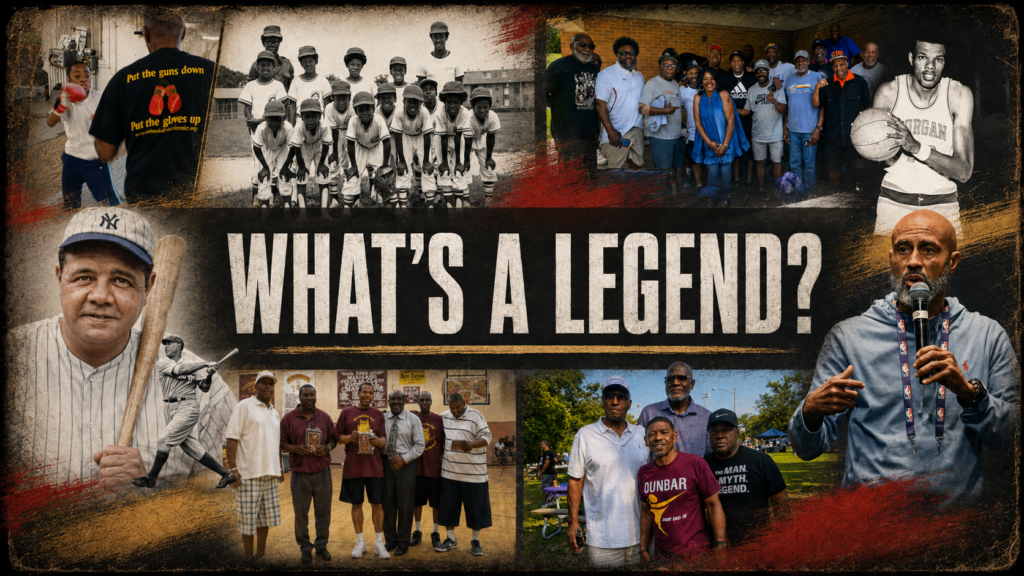
What is a legend?
Who comes to mind when you hear that word?
What did that person accomplish?
What did they have to overcome?
What did they give back to the neighborhood when the lights went down?
Why must this city guarantee that their name is never forgotten?
Tell us the names.
Tell us the stories.
Tell us why.
Welcome to Legends of Baltimore: More Than a Game.
Let’s write our history together.