
(BALTIMORE – November 29, 2026) – For generations, American history, as told predominantly through European eyes, has painted a picture of Christopher Columbus arriving in a hemisphere populated by so-called savages. The underlying narrative was that civilization began with the arrival of the European.
Nothing could be further from the truth.
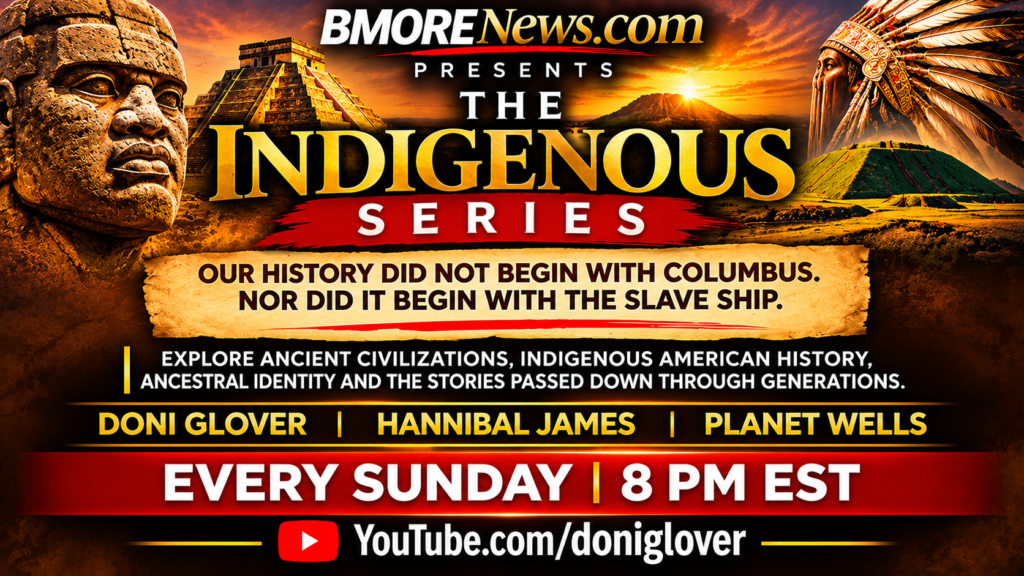
Consider the Maya, the Inca, the Aztec, the Olmec, and the Mississippian civilizations. Consider their monumental architecture, agricultural systems, astronomical knowledge, and extensive trade networks.
Consider Cahokia, near present-day St. Louis, where an enormous Indigenous urban center flourished centuries before Columbus. Monks Mound alone stands approximately 100 feet tall. Thousands of Indigenous earthworks and mounds have been documented across North America.
Consider the pyramids of Mexico and Central America and their astronomical alignments. What similarities exist between these structures and those found in Africa? What can those similarities tell us, and what questions remain unanswered?
Within the Indigenous research community, some advance theories connecting ancient Egypt to America, comparing the Mississippi River to the Nile and even suggesting that America was the biblical Garden of Eden. These theories remain unproven, but they are part of the broader conversation we have been exploring.
And then there is something much closer to home: the testimony of our own families.
How many Black Americans grew up hearing their grandmothers, great-grandmothers, and great-grandfathers tell them that they were Indian?
Why have we been so quick to dismiss their testimony?
We know what the Dawes Commission did. We have sworn testimony documenting how physical appearance influenced racial classification. We know what Walter Ashby Plecker did in Virginia, deliberately reclassifying Indigenous families as colored.
These are not conspiracy theories. These are documented chapters of American history.
So when someone tells me that their grandmother said they were Indian, I am not going to automatically dismiss them because a government document says otherwise. I want to know more about that family, its history, its community, and the circumstances under which those records were created.
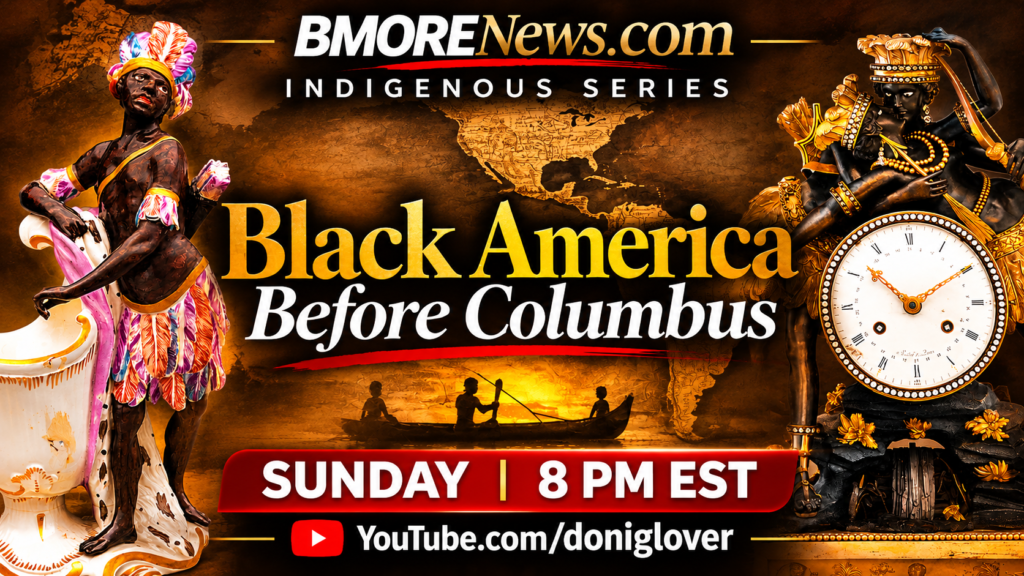
And when I see an eighteenth-century German sculptor named Franz Konrad Linck depicting America as a Black-skinned Indigenous figure, I want to know what inspired him.
The European account of American history cannot be the only account we are willing to entertain.
It is time we started listening to our elders, examining original historical documents and taking seriously the oral histories passed down through Black American families.
Our ancestors deserve at least that much.
America had a history before Columbus.
And Black American history deserves to be examined beyond the confines of the slave ship.
TUNE IN TONITE AT 8 PM EST FOR THE INDIGENOUS SERIES HOSTED BY DONI GLOVER