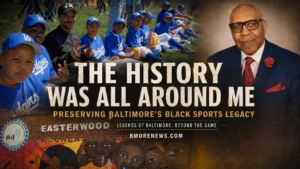




From Operation CHAMP and Easterwood Recreation Center to Cloverdale, the Legends Tournament and the Brunson League, BMORENews presents “Legends of Baltimore: Beyond the Game.”
(BALTIMORE – August 5, 2026) – For much of my life, I did not understand the depth and significance of Baltimore’s Black basketball history.
At 61 years old, I have spent all but two years of my life in Baltimore. Sports have always been a part of my journey. I played baseball, basketball and football. I wrestled, boxed, lifted weights, ran cross-country, swam and studied martial arts.
I was not the greatest basketball player—not by far—but I played the game. I knew some of the famous names. I knew about Dunbar. I knew Baltimore had produced extraordinary talent.
Still, I had no idea how deep the roots extended.
I did not fully understand the network that helped produce the players: the recreation centers, playgrounds, coaches, referees, neighborhood leagues, swimming pools, track clubs, summer programs, parents and community leaders.
I did not appreciate how closely connected all of it was—or how many lives, families and neighborhoods were shaped by it.
The history was all around me.
In many ways, it was a part of me.
I simply did not yet understand what I was seeing.
Over the past few years, Gregory Branch’s Legends Tournament, Timmy Greene’s 1 Baltimore Cookout and the people they brought into my life have opened my eyes.
They led me to Cloverdale, Dr. Warren Hayman and Earl “Rocky” Garner. They led me to Mr. William Wells and Al Leslie. They also led me back through my own memories—to Operation CHAMP, Easterwood Recreation Center and the people who helped save our lives.
The more I learn, the more I recognize that Baltimore’s Black basketball history was never only about basketball.
It was about community.
It was about accountability.
It was about survival.
It was always Beyond the Game.
Cleve Brister and Operation CHAMP
One name that resonates throughout these stories—especially among people who truly understand Baltimore’s recreation and basketball history—is Cleveland “Cleve” Brister.
That name reaches back to one of my earliest childhood memories.
In 1968, I was 3 years old, living near Patterson Park Avenue and Lanvale Street in East Baltimore. Dr. Martin Luther King Jr. had been assassinated, and Black people across the country responded with grief, anger and resistance.
Baltimore was in turmoil.
I remember soldiers from the National Guard standing in front of my father’s business. I remember tanks traveling along North Avenue. I remember glass being placed along the wall of the Suburban Soda Company to prevent people from climbing over it and breaking into the facility.
Some people may wonder how a 3-year-old could remember such things.
But some images never leave you.
I also remember Operation CHAMP.
A large tractor-trailer would pull up on our corner. A side panel would rise, and a stage would emerge. Performers would entertain the community, and basketball hoops would be set up. For a few hours, the street became a recreation center.
To my young eyes, it was exciting.
Operation CHAMP had already begun operating before the 1968 uprising. But in the aftermath of Dr. King’s assassination, the value of bringing basketball, music and organized recreation directly into Baltimore’s Black neighborhoods became especially clear.
The program provided children with recreation and gave communities an opportunity to gather amid one of the most difficult periods in the city’s history.
I did not know Cleve Brister at the time.
I only knew what I saw.
Much later, I learned that Brister was the man responsible for Operation CHAMP—the program that created those childhood memories.
His name had been part of my story long before I knew the man behind it.
Brister went on to become a respected Baltimore City government manager with more than 30 years of experience planning and managing large public events. His leadership extended to the AFRAM Festival, the Sportsman Basketball League and other important parts of Baltimore’s recreational and cultural life.
His influence also reached Upton Boxing Center, where Coach Calvin Ford and Coach Kenny Ellis helped develop an environment that would eventually produce world champion Gervonta “Tank” Davis.
Cleve Brister’s work connects multiple generations of Baltimore history.
From mobile recreation units on neighborhood streets to basketball leagues, boxing gyms and major cultural events, his career demonstrates what recreation leadership can mean to a city.
Easterwood and James Mosher Helped Save Our Lives
My recreation center was Easterwood Recreation Center in West Baltimore.
Easterwood helped save our lives.
That is not an exaggeration.
The recreation center gave us structure. It gave us activities. It gave us adults who knew our names, watched our development and expected something from us.
Eula Mae Williams, Ralph Durant and Marion Flood were three of the people who helped run Easterwood Recreation Center.
Their names deserve to be remembered.
Ralph Durant was an athlete and track star who led the Ed Waters Track Club. Along with Williams and Flood, he helped make Easterwood part of a larger recreation system that extended beyond one building and one sport.
At Easterwood, we could play basketball and baseball. We could lift weights and study martial arts. We could go to Carver to swim and play basketball. We could also go swimming at Coppin State.
The recreation centers and facilities were connected.
The adults running them understood that their responsibility extended far beyond keeping children occupied for a few hours.
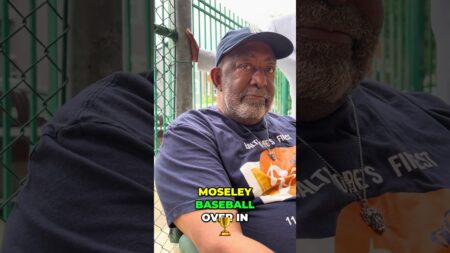
Then there was James Mosher Baseball.
From roughly the ages of 8 to 14, Easterwood and James Mosher became two of the most formative institutions in my life.
Founded in 1960, James Mosher is widely recognized as the oldest continuously operating African American youth baseball league in the country.
Let that sit with you.
The oldest continuously operating Black youth baseball league in America was right here in West Baltimore—and I was blessed to be part of it.
James Mosher gave us more than uniforms, practices and games. It gave us discipline, teamwork, competition and another group of adults invested in our development.
Easterwood and James Mosher reinforced one another.
One exposed us to multiple sports and activities. The other gave us a sustained baseball tradition in which we could develop, compete and belong.
Together, they gave us somewhere to go.
They gave us people to answer to.
They gave us something meaningful to represent.
West Baltimore took recreation seriously.
The programs were organized. The adults knew the children, their families and the neighborhoods they came from.
Recreation was an institution.
I won several trophies growing up. Some were for baseball. I represented Easterwood in citywide weightlifting competitions, including a tournament at Chick Webb Recreation Center in East Baltimore, where I won a trophy.
I also won a trophy in bumper pool.
Those trophies may not have made headlines, but they meant something to me.
They told a young boy that he could compete.
They gave me confidence.
They gave me a sense of accomplishment.
They showed me there was a world beyond the immediate pressures of the neighborhood.
Basketball was part of that system, but it was never the entire system. There was baseball, track and field, swimming, weightlifting, martial arts and other activities that allowed young people to discover their abilities.
Easterwood and James Mosher gave us structure, belonging and adults who paid attention.
That is why I say they helped save our lives.
The People Who Were the Glue
John “Poochie” Murdoch represents another essential part of this history.
People such as Murdoch were the glue.
We talk about Timmy Greene being the glue that helped keep Dunbar’s national championship family connected. Murdoch provided that same kind of connection within the community.
He connected the parents to the students.
Many parents were working, raising families and dealing with the pressures of everyday life. They could not always check on every assignment, practice or school day.
But if you were going to play for Murdoch’s team, he was going to know your mother.
He was going to know your teacher.
He was going to know whether you went to school.
He was going to know whether you were handling your responsibilities.
That is what we mean when we say it was more than basketball.
The adults did not simply want to know whether a child could dribble, shoot or defend. They wanted to know whether that child was attending school, respecting his mother and making progress.
A place on the team came with accountability.
That accountability worked because the coach, family, school and neighborhood were connected.
It was a community network long before anybody started using phrases such as “wraparound services.”
Our people were already doing the work.
Gregory Branch and the Legends Tournament
My education in Baltimore basketball history deepened through Gregory Branch’s Legends Tournament at the Dome.
The tournament was more than a collection of games.
It was a living archive.
Everywhere I turned, someone would point toward another man and ask, “Do you know who that is?”
Sometimes I did.
Too often, I did not.
These were men whose names carried enormous weight within Baltimore basketball circles. Some had been high school stars. Some played in college or professionally. Some became coaches, mentors, educators, officials and community leaders.
Others never received the attention their talent or service deserved.
Yet they continued to show up.
They showed up for the tournament. They showed up for one another. They showed up for Baltimore’s young people.
Gregory Branch’s Legends Tournament reintroduced me to a part of my own city.
It helped me understand that Baltimore’s basketball history cannot be measured solely by the number of players who reached the NBA.
The full story includes the people who organized the teams, coached the children, officiated the games, opened the recreation centers, maintained the traditions and kept the community connected.
It includes the people who made sure there was always another generation coming behind them.
Timmy Greene and 1 Baltimore
Then came Timmy Greene’s 1 Baltimore Cookout.
Once again, I found myself surrounded by history.
The gathering demonstrated that relationships formed through Baltimore basketball did not disappear when the final buzzer sounded.
Players, coaches, classmates, families and friends remained connected decades later.
The games may have brought them together, but the relationships endured beyond the game.
The cookout opened another door.
It led me deeper into the story of Cloverdale, one of the sacred grounds of Baltimore basketball.
It connected me with Dr. Warren Hayman, whose knowledge helped me understand Cloverdale’s place in the city’s athletic and cultural history.
It led me to Earl “Rocky” Garner and others carrying stories that cannot always be found in newspapers, record books or online archives.
These men are living sources.
They remember who played, who coached, who organized the games and who stood along the sidelines. They remember the personalities, rivalries and unforgettable moments that shaped Baltimore basketball culture.
Every interview opens another door.
Every name leads to several more names.
Every story reveals how much more there is to learn.
Corin “Tiny” Adams and Baltimore’s Women
Baltimore’s basketball history does not belong only to men.
Corin “Tiny” Adams is part of that history.
Tiny came from Brooklyn and became one of the greatest scorers in Morgan State University basketball history. Playing guard for the Lady Bears from 2006 to 2010, she finished with 2,058 points—making her Morgan State’s all-time leading scorer in either the men’s or women’s program.
Her achievements deserve a permanent place in the story of Baltimore basketball.
Dr. Warren Hayman helped me understand the significance of her accomplishments and asked us to honor her with a Joe Manns Black Wall Street Award.
We did.
Recognizing Tiny reinforced another responsibility of this series: Baltimore’s women cannot be treated as an afterthought.
They played.
They competed.
They set records.
They inspired young girls who needed to see that the court belonged to them, too.
Their stories must be preserved alongside those of the men.
Tiny’s journey is another reminder that Baltimore basketball history reaches across neighborhoods, generations and gender.
There are more women whose names we need to learn.
There are more records that need to be documented.
There are more legends who deserve their flowers.
Sitting With Mr. William Wells
I recently had an opportunity to sit one-on-one with Mr. William Wells.
Coach Wells spent 28 seasons leading the boys’ basketball program at St. Frances Academy. He won more than 500 games, captured six Baltimore Catholic League tournament championships and guided the Panthers to four appearances in the prestigious Alhambra Catholic Invitational Tournament.
But his true legacy cannot be contained in a win-loss record.
Coach Wells helped shape young men.
He taught them that basketball was a tool—not an identity and certainly not a guarantee.
His message was simple and profound:
“Don’t let basketball use you. Use basketball.”
That is Beyond the Game.
The victories matter. The championships matter. The statistics matter.
But what happened to those young men after the cheering stopped matters even more.
Who became a teacher?
Who became a coach?
Who became a father, mentor, business owner or community servant?
Who stumbled?
Who recovered?
Who returned to help the next generation?
Those are the stories I want to tell.
The Honor of Interviewing Al Leslie
I also had the honor of interviewing hometown legend Al Leslie.
Leslie grew up around Druid Hill Avenue and Laurens Street. He attended Booker T. Washington Middle School before receiving an A Better Chance scholarship to attend McDonogh School.
From there, he became one of the greatest basketball players in Bucknell University history.
Leslie scored 1,973 career points without the benefit of a three-point line. He started the final 105 games of his college career and scored in double figures in all but 11 of them.
He once scored a school-record 45 points against American University.
His mother, Beverly Henry, attended only one of his games at Bucknell.
It was that game.
Leslie’s No. 22 jersey was retired by Bucknell, and the Indiana Pacers selected him in the second round of the 1981 NBA Draft.
Yet some of the most important parts of his story happened after basketball.
Leslie spoke honestly about disappointment, addiction, recovery, family and the challenge of rebuilding his life when the NBA dream did not unfold as expected.
He also spoke lovingly about his wife, Debbie Turner, whom he credits with bringing out the best in him.
When Leslie read the finished article, he told me, “I loved it.”
Those three words warmed my soul.
They told me he felt seen—not merely as a former basketball player, but as a whole man.
That is Beyond the Game.
From the Brunson League to 180 Men
The history is still being written.
When I watch the high-level players competing in the Brunson League, I am reminded that Baltimore remains a basketball town.
When I think about the interview we conducted a few months ago with Big Les and Mert—James Pugh—I think about the 180 men participating in their league.
That is not merely 180 basketball players.
That is 180 lives.
It is 180 families, 180 personal journeys and 180 opportunities for structure, brotherhood, accountability and growth.
The court brings them together, but the impact travels home with them.
That is why these leagues matter.
They give men a place to compete, connect and belong. They create relationships across neighborhoods and generations.
They continue a Baltimore tradition much older than any single team or tournament.
Gert Scott and the People Who Encourage the Work
This series is also being strengthened by people who understand why the work matters.
Gert Scott has become one of the kindest new supporters of our efforts.
She is an inspiration.
Her encouragement reminds me that preserving this history is not a solitary mission. Every person who shares a name, identifies someone in an old photograph, corrects a detail or encourages us to keep going becomes part of the process.
History is not preserved by one person alone.
It is preserved by a community that decides its stories matter.
People such as Gert Scott help provide the encouragement needed to continue digging, listening and learning.
That support matters more than people may realize.
I Am Still Learning
The more I learn, the more I realize how much I did not know.
That realization could be embarrassing.
Instead, I find it humbling.
Journalism is not about pretending to know everything. It is about being curious enough to ask another question, humble enough to accept a correction and responsible enough to preserve what you learn.
I am grateful to Cleve Brister, Eula Mae Williams, Ralph Durant, Marion Flood, John “Poochie” Murdoch, Gregory Branch, Timmy Greene, Corin “Tiny” Adams, Dr. Warren Hayman, Earl “Rocky” Garner, Mr. William Wells, Al Leslie and the many others whose work has shaped this history.
Some I have met.
Some I remember from childhood.
Some I am only now learning to appreciate.
Together, they show that Baltimore’s Black basketball history is not a footnote.
It is not merely a list of NBA players.
It is a multigenerational story of segregation, resistance, recreation, education, discipline, competition, mentorship, survival and love.
It lives in Operation CHAMP.
It lives at Easterwood Recreation Center.
It lives at Cloverdale and the Dome.
It lives at Chick Webb, Carver and Coppin State.
It lives in the Brunson League and in neighborhood programs serving hundreds of men.
It lives in the old recreation centers, playgrounds, gymnasiums and swimming pools.
It lives in the stories told at tournaments, cookouts, barbershops and family gatherings.
Most importantly, it lives in the people who are still here to tell it.
Special Thanks
This work would not be possible without people willing to open doors, share memories and connect us with the legends.
Special thanks go to Derrick Jones, Dwayne “Kosher” Wood and Keith Goodie.
Their support, knowledge and willingness to participate have helped move this series forward.
They understand that this is not merely nostalgia.
It is preservation.
It is giving people their flowers while they are still here to receive them.
It is creating a record that Baltimore’s children and grandchildren can inherit.
One Legend at a Time
That is why BMORENews is presenting Legends of Baltimore: Beyond the Game.
Basketball may have opened the door, but this series is about something much larger.
This is an effort to document Baltimore’s Black sports and recreation history through the people who created, protected and sustained it.
We will tell these stories one legend at a time.
Sometimes, we may tell the stories of two or three legends at once because their lives and contributions cannot be separated.
We will celebrate the great players, but not every legend carried a basketball.
Some carried baseball bats, boxing gloves, track spikes or swimming gear. Some lifted weights, studied martial arts or competed in neighborhood recreation centers where children could discover abilities they did not know they possessed.
Some never wore a uniform at all.
They were the coaches, recreation leaders, referees, organizers, parents, mentors, educators and community builders who created the opportunities.
They opened the gymnasiums.
They organized the leagues.
They transported the children.
They knew the mothers, teachers and neighborhoods.
They made sure young people attended school and handled their responsibilities before stepping onto a court or field.
We will document the victories.
We will also examine the losses—and what those losses taught.
We will honor legends whose names are already known while introducing readers to people they should have known all along.
I do not pretend to have the entire story.
I am still learning.
I was not the greatest athlete, but I can make a solid effort to help preserve this notable history—one that has impacted lives, communities and households across Baltimore.
More than anything, I hope our children can learn something from these stories.
I hope they learn that the adults who came before them built institutions out of necessity.
I hope they understand that sports can open doors, but character determines what happens after they walk through them.
I hope they see that a coach who knows their mother, their teacher and whether they attended school is not being intrusive.
That coach is investing in their future.
Baltimore produced these legends.
Baltimore deserves to know them.
And BMORENews intends to preserve their stories—one legend at a time.
Welcome to Legends of Baltimore: Beyond the Game.