

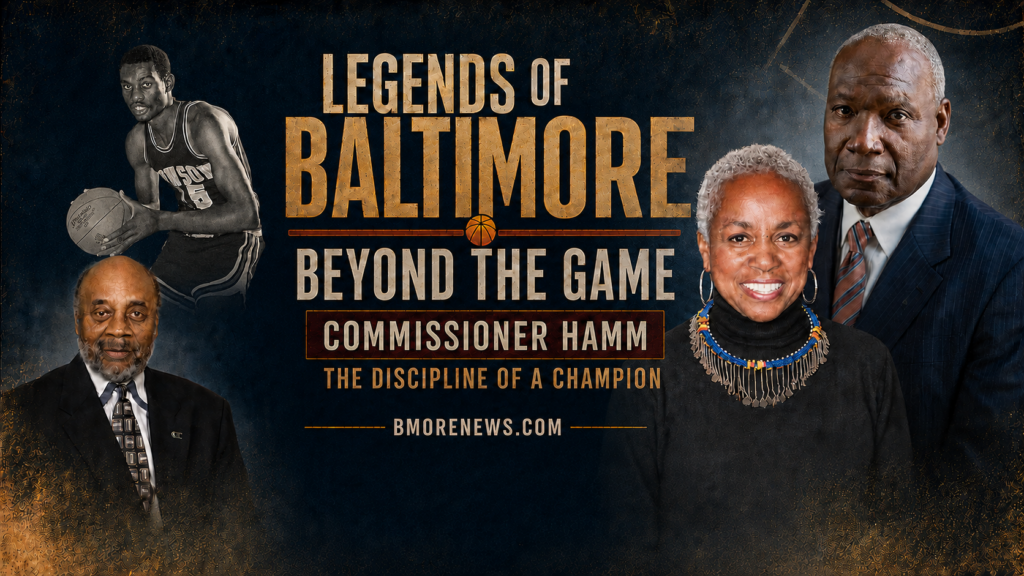
From three buses out of Cherry Hill to undefeated seasons at City College, a national championship and leadership of the Baltimore Police Department, Leonard Hamm’s life demonstrates what basketball can build.
(CHERRY HILL, BALTIMORE – August 6, 2026) – I have known Commissioner Hamm and covered him in the news for years. I met him when he was Baltimore’s police commissioner, and that is how I have known him ever since.
But I had no idea about the basketball player.
No idea.
Here is another man I have known for years, only to discover that there was an entire chapter of his life that I knew nothing about.
That keeps happening as I dig deeper into Baltimore’s basketball history.
I have known Dr. Warren Hayman since I was 18 years old. For years, I simply knew him as Julia’s daddy. I had no idea about his history on the basketball court.
Then there was the late James “Winky” Camphor. Winky and I used to go at it. I knew him and his wife, Miss Peaches, as the ideal Coppin State couple. To me, they were the king and queen of every Coppin event. They were Mr. and Mrs. Coppin. Whether that designation was official or unofficial, I do not know. But whenever Coppin State gathered, there they were—hands down, bar none, no question.
What I did not know was that Winky Camphor was one of Coppin basketball’s originals.
He played four seasons for Coppin from 1948 through 1951. He once scored 50 points against Cheyney in 1950, an achievement Coppin recognizes as its unofficial single-game scoring record. He earned both his bachelor’s and master’s degrees from Coppin and was inducted into the Coppin State Athletics Hall of Fame in 2013.
This was not simply a man who faithfully attended Coppin events. Winky Camphor helped build the tradition that everyone else came to celebrate. I had known Mr. and Mrs. Coppin for years, yet I had no idea I was going back and forth with one of the original Eagles and one of the institution’s basketball legends.
And then there is Brother Rasoul.
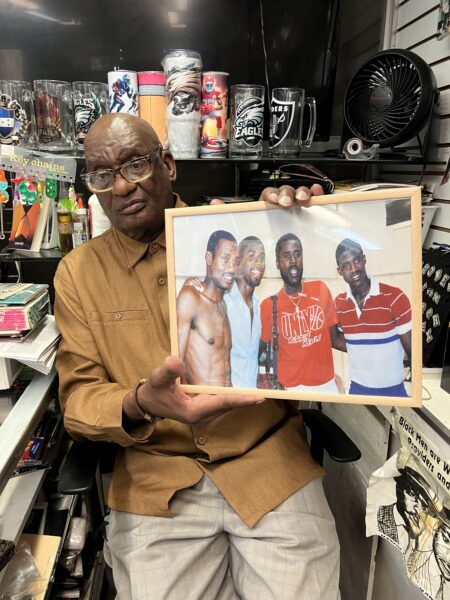
For years, I knew Brother Rasoul from Lexington Market. I knew him as the man selling bean pies and The Final Call. I respected the man standing in front of me, but I did not know the basketball giant standing inside him.
Brother Rasoul was formerly known as Pat McKinley.
That name carries enormous weight in Baltimore basketball. Pat McKinley played at City College before becoming one of the greatest players in Towson basketball history. From 1973 through 1977, he was a four-year starter at center. He finished his college career with 1,832 points, 1,421 rebounds and 229 blocked shots. He once pulled down 30 rebounds in a game and blocked nine shots in another—both school records.
As a senior, McKinley helped lead Towson to a 27-3 record and the No. 1 ranking in NCAA Division II. He was a first-team All-American, a three-time first-team All-Mason-Dixon Conference selection, the 1977 conference tournament’s Most Valuable Player and Towson’s Male Athlete of the Year. The Washington Bullets selected him in the eighth round of the 1977 NBA Draft. Towson inducted him into its Athletics Hall of Fame in 1993.
And the Bullets did more than draft him.
McKinley went to training camp and made people take notice. In a September 28, 1977, Washington Post profile, sportswriter Paul Attner described him as a long-shot rookie who was still surviving roster cuts while competing at forward, one of Washington’s deepest positions.
McKinley had arrived at Towson on a partial scholarship after playing at City College, where he was not even considered the best player on his team. By the time he left Towson, however, he was regarded as the best college basketball player in the Baltimore area.
At 6-foot-7 and about 200 pounds, McKinley used his speed, leaping ability, hustle and shot-blocking to compensate for his slender frame. Bullets General Manager Bob Ferry called him the quickest forward the team had ever brought to training camp. McKinley had also impressed the organization during Baltimore’s Urban Coalition League. He was playing summer basketball in Venezuela when he learned that Washington had drafted him.
The odds were long, but Brother Rasoul had already made a career out of defeating long odds. He did not merely have his name called in the NBA Draft. He put on a Washington Bullets uniform, entered a professional training camp and proved—to the organization and to himself—that he could compete at that level.
Brother Rasoul is also recognized within Baltimore’s basketball family as a BNBL Hall of Famer.
All those years, I thought I knew Brother Rasoul because I had seen him selling bean pies and The Final Call. I had no idea I was speaking to a City College great, a Towson All-American, an NBA draft pick and one of the most accomplished rebounders in Towson history.
Who knew?
Apparently, plenty of people knew. I simply was not one of them.
That is why this story has to be told.
The late Cleveland “Cleve” Brister understood that, too. Through Operation CHAMP, the Sportsman Basketball League and decades of work in Baltimore recreation, Cleve helped create opportunities for generations of young people. He had also begun gathering pieces of this history before he ran out of time. His name belongs in this story because preserving Baltimore basketball’s legacy also means honoring the people who recognized its importance and did the work before us.
You cannot tell the history of Baltimore basketball without acknowledging the thousands of people who came through the BNBL, Project Survival, Cloverdale, the Dome and countless other leagues, courts, recreation centers and tournaments that became institutions in this city.
Yet their history has never been discussed broadly enough.
Baltimore is a basketball town. The deeper I go into this history, the more I understand that the game touches everything.
Where doesn’t it touch?
It reaches into our neighborhoods, schools, housing projects, police department, courtrooms, businesses, churches and political institutions. It produced professional athletes, but it also produced police commissioners, lawyers, doctors, educators, entrepreneurs, public servants and community leaders.
Through it all, there is a camaraderie that has survived generations.
You can see it at 1 Baltimore. You can hear it when the old players begin calling names and comparing teams. You can feel it in the stories about the coaches, recreation centers and neighborhood courts that helped raise generations of Baltimore children.
I thank God that I even received a BNBL jersey and got to feel like I was part of that fraternity. I made it one time. I got the gray, 13-and-under jersey.
It remains one of the proudest moments of my athletic life.
Now, all these years later, I am learning that people I have known most of my life were part of something much larger than I understood.
Commissioner Hamm is another one.
Before he led the Baltimore Police Department, Commissioner Hamm was a champion—a fundamentally sound forward from Cherry Hill who did the dirty work, scored when needed, never lost a game at City College and later helped Textile win a national championship.
And somehow, after knowing Commissioner Hamm for years, I never knew any of it.
Until now.
Commissioner Hamm has a modest way of describing an extraordinary life.
“I occupied the seat,” he said of serving as Baltimore’s police commissioner.
But that answer does not begin to explain Commissioner Hamm.
You cannot spend a lifetime winning championships, rise from Cherry Hill to lead the Baltimore Police Department and then say you merely occupied a seat. Commissioner did not simply occupy seats. He earned his way into rooms that a young Black boy from Cherry Hill could scarcely have imagined—and he carried the discipline that basketball gave him into every one of them.
Before there was Commissioner Hamm, there was a boy who did not expect to live beyond 25.
“I grew up in Cherry Hill,” Commissioner said. “I didn’t think I was going to make it past 25 years of age, and I ended up being a police commissioner because of basketball at City.”
That is not just a basketball story. It is a Baltimore story.
A Different Road Out of Cherry Hill
Commissioner was the second-oldest of seven children. His mother and father remained together, raising five boys and two girls in a three-bedroom home. His parents had one bedroom, his two sisters shared another and the five boys shared the third.
The family was not especially religious, Commissioner recalled, but structure, decency and right from wrong were firmly established.
“My mother wanted me to be decent,” he said. “That’s all she said: ‘I want you to be decent.’ I wanted to be better. I wanted to be different. I didn’t want to be like everybody else.”
Commissioner was intelligent and serious about learning. He excelled in mathematics, English, science and mechanical drawing. He did not want to memorize lessons simply long enough to pass a test. He wanted to understand them. When school failed to give him the Black history he wanted, he used his library card and studied it for himself.
At Cherry Hill Junior High School No. 180, a Black teacher named Geraldine Francois spoke words that Commissioner had never heard directed toward him.
“Leonard, you’re smart. You are smart.”
Francois, his homeroom and mathematics teacher, became one of several people whom Commissioner now believes God deliberately placed along his path.
The grown men on the Cherry Hill basketball courts also recognized something in him. They began choosing Commissioner for their games when he was only 12. Afterward, when the men went for beer or liquor, they warned the youngster away.
“No. You don’t do this,” they told him. “You’re special.”
They taught him the game, but they also guarded his future.
Falling in Love With City
Commissioner knew by the eighth grade that he wanted to attend Baltimore City College.
The revelation came at the annual City-Poly football game at Memorial Stadium. When Commissioner entered the stadium, he instinctively turned left instead of right. On that side were the City students and supporters.
He heard the roar, watched how the young men carried themselves and fell in love with the spirit of City College.
Another encounter soon made the dream tangible.
During the summer before ninth grade, Commissioner was walking to his girlfriend’s house in dress clothes when he spotted an unfamiliar young man working out on a basketball court. Commissioner could tell from the way the man dribbled and moved that he was a serious player.
“I’ve got to play him,” Commissioner remembered thinking.
Still wearing his dress clothes, Commissioner challenged him. They played one-on-one for two or three hours, until darkness stopped them.
The other player finally asked which high school Commissioner attended.
“I don’t go to high school,” Commissioner answered. “I’m in junior high school.”
The player was Billy Rose, a member of City’s varsity team.
“Come to City,” Rose told him. “You made the team.”
Rose told the City coaches about the gifted youngster from Cherry Hill. By the time Commissioner arrived, they were already looking for him.
Getting there required commitment. Commissioner caught three buses, beginning around 6 o’clock in the morning, to travel from Cherry Hill to City College. Then came practices demanding a level of discipline that stayed with him for the rest of his life.
Commissioner describes himself as a fundamentally sound player rather than the flashy type. He even believes he might not have made the great Dunbar teams of that period because his style did not fit their style.
At City, however, Jerry “Fips” Phillips saw what Commissioner could become and helped develop him.
Commissioner remembers Phillips not merely as a coach but as a man whose loyalty to his players lasted for life. Years later, when Phillips was living in Florida and was roughly 82 years old, he drove all the way to Baltimore to attend a cookout with the men he had coached.
The lesson was unmistakable: the bond ran in both directions.
“I Don’t Know What Losing Is”
Commissioner played forward and did the work that winning demanded. According to longtime Baltimore basketball figure Timmy Greene, Commissioner defended, rebounded, handled the physical assignments and could score.
He was not simply along for the ride. He was a vital part of it.
At City College, Commissioner played on undefeated championship teams in 1965-66 and 1966-67. City defeated Dunbar and then St. Joe in consecutive championship seasons.
“At City College, I never lost a game,” Commissioner said. “We were undefeated two years in a row. I never lost.”
His winning continued in college. In 1970, Commissioner was part of the Philadelphia College of Textiles and Science team—widely known as Textile—that won the NCAA College Division national championship. The institution later became Philadelphia University and merged with Thomas Jefferson University in 2017.
“I’m winning championships my entire life, man,” Commissioner said. “I don’t know what losing is.”
Then, almost in the next breath, he returned to his natural modesty and characterized even becoming police commissioner as occupying a seat.
No, sir.
Commissioner’s story is not about occupying a seat. It is about developing the discipline to reach that seat, the character to carry its responsibilities and the humility to remember that leadership is temporary even when its impact can be permanent.
From Champion to Commissioner
The traits that carried Commissioner from Cherry Hill to City College were the same ones that carried him into public service: preparation, composure, self-control and an unwillingness to follow the crowd.
Arguably the King and Queen of Baltimore
You cannot properly tell the story of Commissioner Hamm without giving significant recognition to his wife, Rose Backus Davis.
Together, Commissioner Hamm and Rose Backus Davis are arguably the king and queen of Baltimore.
Rose did not merely stand beside a prominent man. She built a formidable record of leadership and service of her own. As principal of the historic Frederick Douglass High School, she carried responsibility for one of the most important educational institutions in Black Baltimore. Commissioner Hamm led the Baltimore Police Department. Rose led Douglass. Both accepted the responsibility of leading institutions that matter deeply to this city.
They are also united by something larger than their professional titles: their love for Baltimore. Commissioner Hamm and Rose are steadfast proponents of supporting and preserving Black businesses and Black institutions. They understand that these institutions are more than buildings, organizations or places to spend money. They carry our history, employ our people, educate our children and help hold our communities together.
That commitment is evident in where they go, what they support and how consistently they show up for Baltimore. Their example reminds us that leadership is not only about the position one holds. It is also about what one protects, where one invests and what one helps preserve for the next generation.
That is Commissioner Hamm and Rose Backus Davis—arguably the king and queen of Baltimore—whose lives reflect service, partnership and an abiding love for Black Baltimore.
Dunbar legend Timmy Greene said Commissioner Hamm’s presence remains important because his wisdom reaches far beyond basketball. Greene is a co-founder of 1 Baltimore, an organization featuring former sports legends who come together annually to give each other their flowers, laugh about old times, and celebrate life.
“He knows a lot of things that we haven’t experienced,” Greene said. “He made a mark on the court, but he also made a mark being a Black commissioner in a city like Baltimore, coming from Cherry Hill. You’re not going to find that in a lot of cities.”
Greene also remembers Commissioner repeatedly reminding the men involved with 1 Baltimore not to allow anyone to take them out of their comfort zone. Commissioner’s temperament is steady and mild-mannered. Greene said he has rarely seen him allow circumstances or personalities to pull him away from that center.
That is discipline in another uniform.
Commissioner’s involvement also helps explain something important about 1 Baltimore. Although outsiders may view the organization as centered on Dunbar or East Baltimore, City College men were part of its foundation.
Commissioner Hamm, Al Robinson and Jimmy Conyers were at the table from the beginning. According to Greene, it was Conyers—a West Baltimore native and City graduate—who first raised the idea that helped give birth to the effort.
That breadth is the point. The organization is not the property of one school, neighborhood or side of town. It reflects a basketball fraternity that stretches across Baltimore.
“That’s the beauty of this thing,” Greene said.
The People Behind the Legends
Commissioner Hamm’s story helps reveal the larger truth emerging from these interviews with Baltimore basketball legends. Behind nearly every accomplished player was at least one person who saw more in him than he could yet see in himself.
For Commissioner, there was Geraldine Francois telling him he was smart. There were grown men in Cherry Hill allowing a 12-year-old to compete while steering him away from their vices. There was Billy Rose discovering him on a neighborhood court. There was Jerry Phillips helping turn his fundamentals and determination into championship basketball.
Commissioner says he did not realize at the time that he was a star or that his example was influencing other people. He was simply working, learning and trying to become better.
That humility is admirable, but it should not be allowed to erase the magnitude of the achievement.
Commissioner Hamm came from a crowded three-bedroom home in Cherry Hill. He caught three buses to pursue an education and a basketball dream at City College. He never lost a high school game. He became a national champion. He rose through the Baltimore Police Department and eventually became its commissioner.
He continues to offer his wisdom to 1 Baltimore and to a generation working to preserve the city’s basketball legacy.
Basketball did more than teach Commissioner how to win games. It taught him how to order his life.
And his life is evidence of what Baltimore basketball has produced—not merely athletes, but commissioners, lawyers, educators, entrepreneurs, mentors and community leaders.
The projects were never only about drugs and despair. The recreation centers were never merely buildings. The courts were classrooms. The coaches and older players were teachers. The game opened doors, established standards and changed the direction of lives.
Commissioner Hamm is one of those lives.
He may insist that he only occupied the seat.
History should record that he did considerably more.
Commissioner Hamm: The Discipline of a Champion.