

The Mayor for Life used government contracts, development opportunities and political power to build Washington, D.C.’s Black business class.
(BALTIMORE – July 20, 2026) – Invariably, when I meet people from Washington, D.C., and the conversation turns to Marion Barry, I hear some version of the same statement:
“Marion Barry gave me my first job.”
I have heard it repeatedly from Washingtonians of different ages and backgrounds. To me, that is one of the most revealing measures of the man’s legacy. Long before “workforce development” became fashionable political language, Marion Barry understood that a young person’s first job could change the trajectory of an entire life.
His Summer Youth Employment Program opened that door for more than 100,000 young Washingtonians over the years. Future Prince George’s County Executive Rushern Baker was reportedly among those who received an early job through Barry’s program.
But Marion Barry did not stop at creating workers. He helped create owners.
He understood something that too many political leaders still fail to grasp: Black political power is incomplete unless it produces Black economic power.
From Less Than 5 Percent to Approximately 40 Percent
When Barry became mayor of Washington in 1979, Black residents made up the majority of the city’s population, yet minority-owned businesses received less than 5 percent of District government contracting and procurement dollars.
That disparity was not the result of Black businesses lacking talent, discipline or ambition. Black contractors had been systematically excluded from the relationships, financing, bonding capacity and government experience required to compete for major public contracts.
Barry set out to change that.
His administration aggressively implemented the District’s minority-contracting program, requiring government agencies and companies doing business with the city to include minority-owned firms. He used the purchasing power of the District government to open industries that had historically been closed to Black entrepreneurs.
By 1985, the city was awarding approximately $185 million annually to minority-owned businesses. By 1989, hundreds of minority firms were receiving approximately 40 percent of District contract dollars—about $233 million that year.
Barry later said minority participation reached 47 percent.
Whether the precise peak was 40, 45 or 47 percent, the transformation is undeniable. Marion Barry moved minority contracting from the margins of District government into the center of its economic-development strategy.
He Was Interested in Ownership
Barry did not limit his vision to construction jobs or small subcontracts. His administration opened opportunities in real estate, municipal bonds, law, accounting, consulting, supplies and other professional services.
He pressured developers seeking to do business with Washington to include Black firms and Black equity partners. He expected financial institutions and Wall Street companies benefiting from District business to place Black professionals in meaningful positions.
He was not satisfied with Black people simply working on a project. He wanted Black people owning part of the project, providing its professional services and participating in the decisions that determined where the money went.
A job can produce income. Ownership can produce assets, equity, employment, influence and generational wealth.
Marion Barry understood the difference.
Economist Dr. Julianne Malveaux credited Barry’s Minority Business Opportunity Commission and his efforts in contracting, supplies and the bond business with expanding Washington’s Black middle class and helping create “dozens of Black millionaires.”
There is no official list identifying every millionaire Barry’s policies helped produce. Nevertheless, the contracting figures demonstrate how it happened: hundreds of millions of dollars that previously bypassed Black businesses began flowing through Black-owned companies.
Those companies could hire workers, purchase equipment, establish credit, increase their bonding capacity, acquire property and compete for progressively larger opportunities.
Barry did not hand anyone a million dollars. He opened markets in which Black entrepreneurs could earn it.
From Bob Johnson to Don Peebles
Robert L. Johnson, the founder of Black Entertainment Television, is frequently cited when discussing Barry’s economic legacy.
Barry’s administration awarded Johnson a significant District cable opportunity and later facilitated access to the land on which BET established its Washington headquarters. Johnson went on to build BET into a media empire and, after selling the company to Viacom, became America’s first Black billionaire.
Barry did not create Johnson’s vision, business instincts or determination. What he did was use public authority to help open a door that the traditional marketplace was unlikely to open for a young Black media entrepreneur.
Real estate developer R. Donahue Peebles offers another example.
Barry appointed the young Peebles to the District’s real-estate tax appeals board in 1983 and later elevated him to chairman. Peebles gained valuable experience and credibility in Washington real estate. A Peebles-led partnership subsequently developed a commercial office building on Martin Luther King Jr. Avenue in Anacostia through a public-private partnership with the District.
Completed in 1989, it became his first major commercial development. Peebles went on to build a nationally prominent real-estate enterprise.
Again, Barry provided the opportunity. The entrepreneur did the work.
That was the model: recognize talent, provide access to a meaningful opportunity and allow Black entrepreneurs to establish a track record.
I Had the Opportunity to Meet the Mayor for Life
I had the privilege of meeting Mayor for Life Marion Barry thanks to my late friend Terry Hairston, a Morehouse brother.
I called Marion Barry, and he answered his phone. More importantly, he agreed to meet with me.
I will never forget that.
Here was a genuine American political legend—a civil-rights veteran, former chairman of the Student Nonviolent Coordinating Committee, four-term mayor of the nation’s capital and one of the most recognizable Black political leaders in the country—and he made time to meet with me.
There was absolutely nothing I could do to illuminate Marion Barry more than he had already illuminated himself. Nor was that my goal. I simply wanted to interview the man because I knew he was authentic. I believed he would give me the real deal.
He was a truth speaker, and genuine truth speakers are rare.
Truly great people reveal their character through their treatment of people who can do nothing for them. Marion Barry did not need anything from me. Yet he answered his phone, met with me and respected my work as a journalist.
For that, I remain deeply grateful.
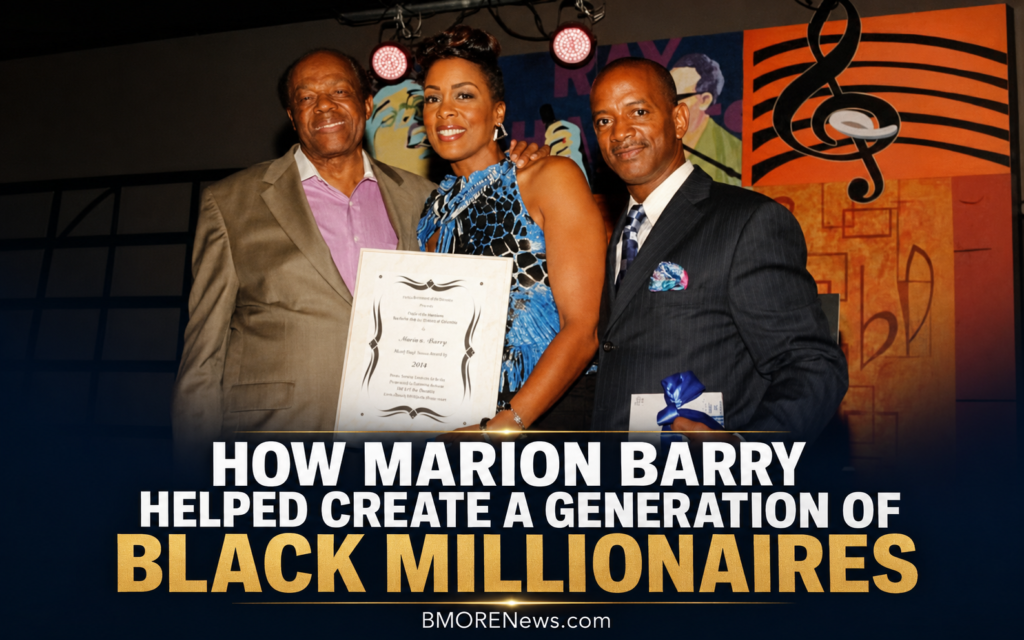
I am also grateful to Micheline Bowman—a Morgan State alumna from gorgeous Prince George’s County—who helped me honor the Mayor for Life with a Joe Manns Black Wall Street Award approximately one year before his passing.
We were able to give him his flowers while he could still receive them.
A Legacy to Be Replicated
Marion Barry’s record was not without controversy. There were legitimate concerns about oversight, political favoritism and whether too many contracts became concentrated among a relatively small circle of firms.
Those weaknesses should be studied honestly. But they should not be used to erase the central achievement.
Before Barry, Black residents controlled Washington politically but remained largely excluded from the city’s major commercial opportunities. He used the power of government to begin closing that gap.
He did not merely announce that Washington supported Black businesses. He attached dollars, contracts, land, development opportunities and institutional authority to that commitment.
He understood that a minority-business directory is not an economic-development program. Certification alone does not create wealth. A networking reception is not a contract. A proclamation does not increase bonding capacity. A press conference does not create equity.
Businesses prosper when they receive opportunities, capital, technical support, contracts and access to markets.
That is what Marion Barry attempted to provide.
His model offers a lesson for every majority-Black city in America. We should be able to measure:
- How many Black businesses receive their first government contract
- How many graduate from subcontractors to prime contractors
- How many increase their revenue and workforce
- How many acquire commercial property
- How many develop the capacity to compete outside government
- How many become million-dollar companies
- How many produce genuine generational wealth
The goal cannot be to recycle opportunities among the same handful of politically connected businesses. The goal must be to continually enlarge the circle of capable Black-owned firms.
Marion Barry’s legacy is not simply that he helped make Black people millionaires. It is that he understood government had a responsibility to dismantle the barriers preventing qualified Black entrepreneurs from participating in the marketplace.
He gave young people their first jobs. He gave Black professionals access to leadership. He gave Black companies contracts. He gave entrepreneurs opportunities to become owners.
And when a journalist from Baltimore called him seeking the real story, he answered the phone.
Mayor for Life Marion Barry’s legacy in Black business deserves to be revered, respected and replicated across this country.