


(SOUTHEAST, D.C. – July 8, 2026) – Every day, the world’s attention turns to Washington.
Television cameras point toward the White House, the U.S. Capitol, the Supreme Court, and the monuments that symbolize American power. Presidents make speeches. Congress debates legislation. Diplomats negotiate. Decisions made in Washington ripple across the globe.
Yet on a recent summer morning, some of the most important work in the nation’s capital wasn’t taking place inside one of those marble buildings.
It was happening on a sidewalk in Southeast D.C.
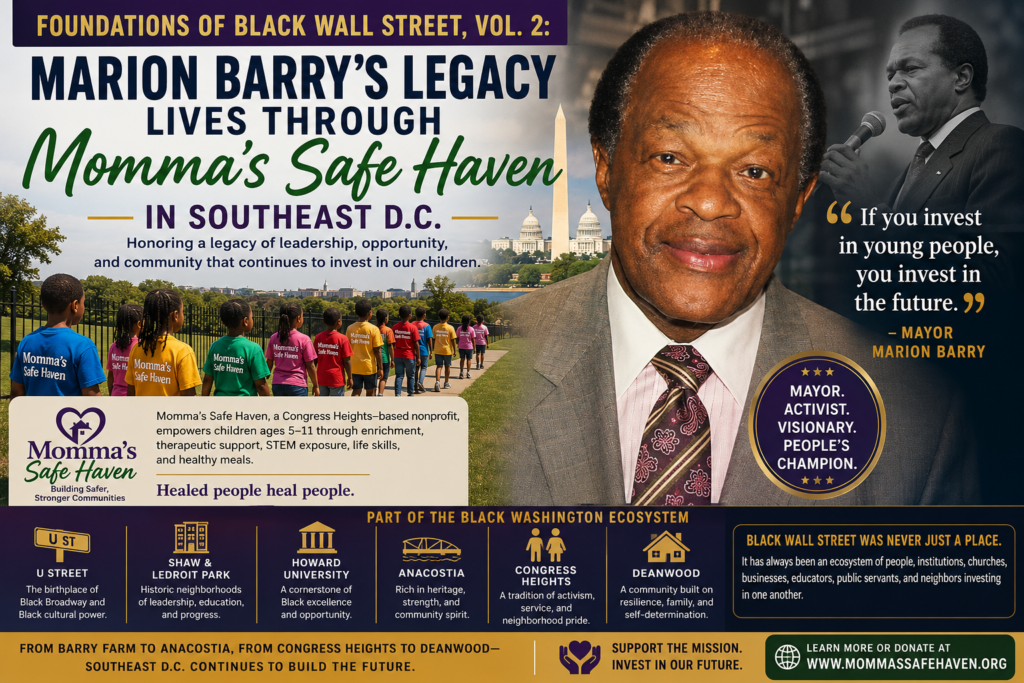
A line of beautiful Black children walked two by two toward a neighborhood park, laughing, talking, and breathing in the summer air. They weren’t simply taking a walk. They were participating in a carefully planned nature experience led by Momma’s Safe Haven, a Benning Park-based nonprofit that has quietly invested in the children of Southeast Washington for more than a decade.
The walk is intentional.
The children are paired together in a buddy system. They learn responsibility, teamwork, awareness, and confidence while experiencing their own neighborhood through a different lens. For many of them, who live in public housing communities east of the Anacostia River, the walk represents something far greater than recreation.
It represents care.
It represents structure.
It represents hope.
On July 14, Momma’s Safe Haven will celebrate eleven years as a tax-exempt nonprofit, although founder and executive director Beverly F. Smith says the ministry itself began even before that official designation.
“Eleven years,” she said. “Praise God.”
Today, the organization serves children ages 5 through 11 through a summer enrichment program that emphasizes reading, writing, arithmetic, therapeutic support, STEM exposure, healthy meals, outdoor activities, and personal development. Through a partnership with DC Central Kitchen, children receive breakfast and lunch, while the organization’s broader programming provides breakfast, lunch, and dinner to approximately thirty youth and adults.
“If it weren’t for programs like yours, they might not otherwise have something to do,” I told Smith.
“Oh, yeah,” she replied. “Definitely won’t have nothing to do.”
But keeping children occupied is only part of the mission.
“The main thing also is those healthy meals,” she said. “Age-appropriate activities that are future-focused, preparing them for what’s to come. And also making sure they’re being seen.
“Just like what you’re doing now. Just give me a call and say, ‘Hey, I see you.’ That’s what a lot of our youth need. Somebody to really speak to them, look them in the eye, hear them, and respond—not to chastise them—but to let them know they’re on the journey.”
More Than a Neighborhood
For many Washingtonians, Southeast D.C. isn’t simply a place on the map. For generations of families, it has been the heart of their Washington—a place where communities have fought, struggled, organized, worshipped, celebrated, and raised children together.
East of the Anacostia River, Wards 7 and 8 have long been defined not only by challenge, but by resilience, self-reliance, neighborhood pride, and an unwavering commitment to one another.
This is a community where churches, neighborhood organizations, small businesses, entrepreneurs, educators, public servants, and everyday residents have built institutions that sustained families through periods of prosperity and neglect alike. For many, self-reliance wasn’t simply a virtue—it was a necessity.
Southeast Washington, D.C.—particularly the historic Black neighborhoods east of the Anacostia River—has long been one of the enduring foundations of Black life in the District. Together with the historic Northwest communities of U Street and Shaw—known collectively as “Black Broadway”—LeDroit Park, Howard University, and neighborhoods such as Anacostia, Congress Heights, and Deanwood, Southeast has helped shape a broader ecosystem that has produced generations of Black leadership, entrepreneurship, political power, civic engagement, and community service in the nation’s capital.
Black Wall Street was never just a place.
It has always been an ecosystem.
People.
Churches.
Schools.
Businesses.
Entrepreneurs.
Public servants.
Neighborhood organizations.
Families investing in one another.
Momma’s Safe Haven stands squarely in that tradition.
Marion Barry’s Washington
It is impossible to tell the story of modern Black Washington without telling the story of Marion Barry.
Long before becoming Washington’s four-term mayor, Barry was one of the original architects of the modern Civil Rights Movement, serving as the first national chairman of the Student Nonviolent Coordinating Committee. Later, as mayor, he helped build one of the nation’s largest Black middle classes, expanded contracting opportunities for Black-owned businesses, strengthened Black political leadership, and created the Summer Youth Employment Program that introduced generations of young Washingtonians to the dignity of work.
Smith remembers that program personally.
As a ninth-grade student in Southeast Washington, she was attending a school assembly when Barry unexpectedly appeared.
He asked students who wanted summer jobs to raise their hands.
Smith hesitated.
“I was so mad,” she recalled with a laugh. “I’ve always loved to work.”
Seeing several students who had missed the opportunity, Barry immediately called for one of the city’s fifteen-passenger vans.
“He got in the van with us himself,” Smith said. “He took us downtown to make sure we got signed up.”
That moment stayed with her.
Years later, after becoming an author herself, she shared the stage with Barry at a community event. The two planned a joint book signing before his passing.
“It was an honor,” she said. “He was my councilmember. My mayor.”
Today, Smith is doing for another generation what Barry once did for her.
She is investing in children.
Healed People Heal People
When asked why she has devoted her life to serving young people, Smith answered without hesitation.
“Healed people heal people.”
Her own story explains why.
She grew up as the eighth of nine children in a single-parent household in Southeast D.C. during the crack cocaine era. She remembers going to the corner store with a dollar for french fries. She remembers washing clothes by hand. She remembers hardship.
She also remembers love.
“It was a house full of love,” she said. “I grew up around a lot of strong women.”
Those experiences shaped her philosophy.
“You can’t give what you don’t have, and you can’t teach what you don’t know.”
She continues to educate herself so she can pour knowledge into children, helping them avoid many of the hardships she experienced growing up.
Carrying the Legacy Forward
Momma’s Safe Haven operates today largely through volunteers and community support.
“This is an all-hands-on-deck situation,” Smith said.
Donations help fund educational programming, meals, supplies, staffing, and opportunities that allow children to experience the kind of summer every child deserves.
This isn’t charity.
It’s community investment.
It’s legacy.
It’s Black Wall Street in practice.
Just as Philip A. Payton Jr. helped lay the foundation for modern Harlem, Marion Barry helped build modern Black Washington—not simply through politics, but by investing in people.
That investment continues today through leaders like Beverly F. Smith and organizations like Momma’s Safe Haven.
As a young reporter building BMORENews.com, I had the privilege of covering Marion Barry on several occasions. I remember calling him, and he answered.
Think about that.
One of the most recognizable political figures in America took the phone calls of a young Black publisher trying to build a media company.
That mattered.
Years later, thanks to Micheline Bowman, we had the privilege of presenting Marion Barry with the Joe Manns Black Wall Street Award about a year before his passing.
To stand beside him was to stand beside history.
Barry understood something that sounds almost too simple:
Take care of the people.
That was the mathematics.
It still is.
Today, when Beverly F. Smith leads children through Southeast D.C., teaching them, feeding them, encouraging them, and reminding them that they matter, Marion Barry’s legacy continues to walk those same streets.
Two by two.
One child at a time.
To learn more or support the work of Momma’s Safe Haven, visit www.mommassafehaven.org.