

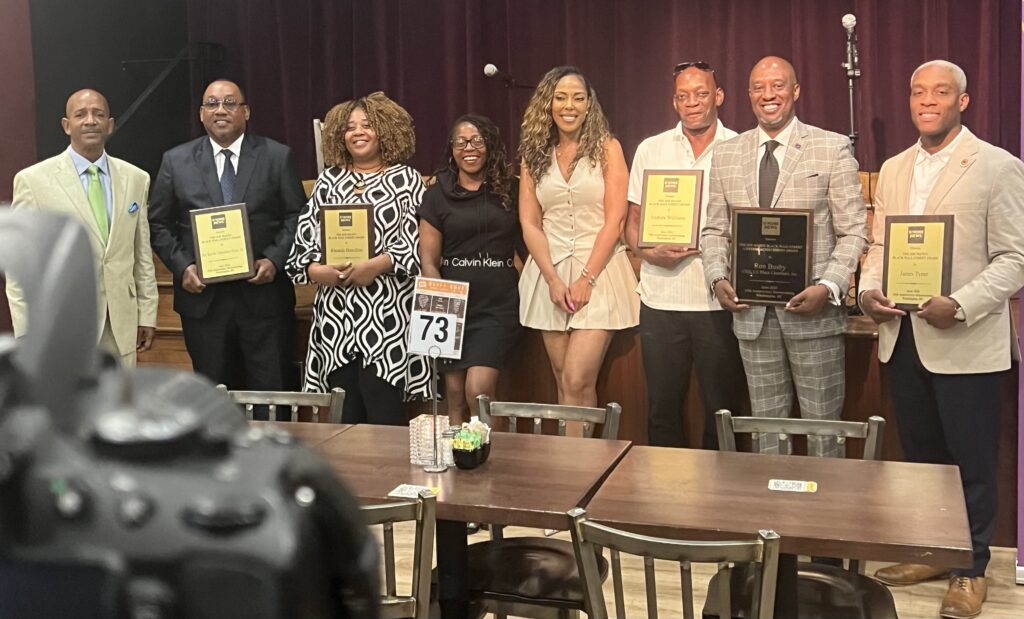
(SOUTHEAST DC – June 17, 2026) – Ron Busby is from Oakland, and, of course, I’m from Baltimore. We agreed, as we sat in Busboys & Poets in Southeast, DC, that Southeast has that certain je ne sais quoi. That pop. That “you know you’re in the Black community” kind of vibe — especially having traveled places where our numbers aren’t as strong.
When I travel, I want to see my people. Brooklyn. Southeast DC. Southwest Atlanta. I love to go and see the vibe I know so well. I assure you some music will be coming out of some window, and the smell of scrumptious food is coming from another spot.
As I stood outside on Martin Luther King, Jr. near Marion Barry Avenue, I paused to simply peep the evening flow. People were simply living. A couple of young kids dashed to a store, laughing. A man sat on his front porch and enjoyed the peace.
I love DC. It’s always a refreshing ride. Memories galore. Anacostia Park, back in the day. Howard University, the Mecca. The White House. And yes, I’m thinking of a different president. Mayor for Life; his remembrance is so strong in DC. I so admire how Washingtonians adore this man. “He gave me my first job.”
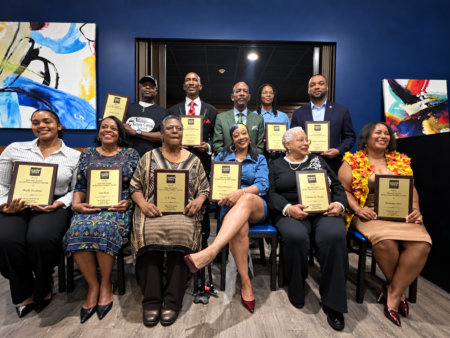
Our event tonight was quaint. Many thanks to Sharif Small for stopping by. Attendees got a chance to get to know each other. The Joe Manns Black Wall Street Awards are always a treat, but this event afforded individuals the opportunity to really blend. We had a great mix of people: a pastor, a banker, the president of a development firm, a community housing advocate extraordinaire, and a man who helped my sister from another mister since she was a youngster in Southeast.
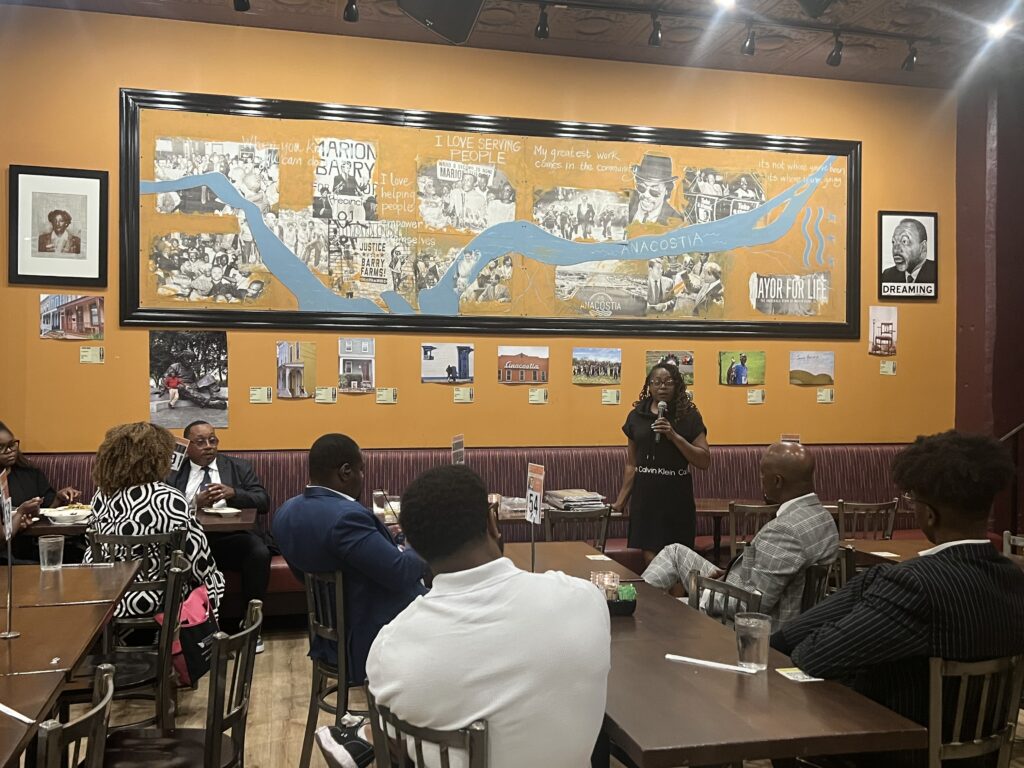
BEVERLY SMITH: THE ONE WHO KEEPS SHOWING UP
That would be Beverly Smith, CEO of Momma’s Safe Haven — an entity known to save young lives on a regular basis. She’s been doing the work for years, relentlessly. Bev brings hope to the community where she has spent much of her life. She has traveled the world, written books and movies, and is always on that journey toward inner growth. She is our Black Wall Street DC commander. She has single-handedly facilitated several Joe Manns Black Wall Street Awards in Southeast, and Washingtonians have been recognized because of Bev, and we are grateful.
Beverly tells the story of how it all started for her — and it goes back to radio, not real estate. She’d actually gone to WPB Radio to sit down with Jackie Griffin, the mother of former Washington Redskins quarterback Robert Griffin III, who at the time was co-hosting a show called “R3 Solutions” aimed at helping entrepreneurs. Jackie wasn’t able to make it that day. Beverly ended up on the air anyway — on my show instead — and the two of us have been connected ever since.
“You know what? It’s in line with us being rich in self-employment, and I do know people in DC deserve to be honored,” Beverly said. That conviction is what led to the first Black Wall Street ceremony in Southeast, back in June 2015, at Benning Park — ten individuals, organizations, and businesses honored that day, the seed of what’s grown into the Joe Manns Black Wall Street Awards’ deep roots in this neighborhood.
“Doni is really great for making sure that we not just walk away with honoring people, which is important, which is huge,” she added. “I’m giving people their flowers while they can smell them. But not only that — to educate us.”
DANIELLE SCOTT AND THE BUILDERS FROM BLACKROCK
Also in the room: Danielle Scott, a phenomenal part of the BMORENews family and a former Black Wall Street honoree herself. Danielle has supported our efforts ever since our first encounter last year, and we’ve since collaborated on several small projects. The goal is simply to help each other.
This time, Danielle came with a nomination of her own. She’d been asked for names of people who’ve made a real difference in her business and her path forward, and two came to mind immediately — both with Blackrock Development Management, a Black-owned firm making strides across the DMV. James Tyner showed up to accept; his partner, Bernard Stephens, couldn’t be there.
“They’re always reaching back and pulling forward small and minority-owned businesses to assist them in their journey going forward,” Danielle said of the two men. “Especially now, in an economy where over [a significant number of] Black women have lost their jobs and been displaced, they are making certain that they are making those voices heard, and also pulling us forward so we have a space in this changing world.”
James Tyner took the moment with the kind of humility that tends to land harder than polish. Born and raised in Detroit, he came up through a tougher upbringing before college steered him toward construction instead of his father’s path into engineering. He’s a Tennessee State graduate. These last several years brought him into the DMV — seven years in Baltimore living near Patterson Park, then on to Prince George’s County — and along the way, he and Stephens worked their way up through the ranks at major regional builders, including HESS Construction, before deciding three years ago to build something of their own: Blackrock Development Management.
“We wanted to be in a position where we could hand it back — go talk to new firms, talk to the businesses who may not have had opportunities on some jobs,” Tyner said. “If we get an opportunity, you get an opportunity. That’s as simple as this.”
He admitted he’d never heard of Black Wall Street until Danielle invited him and he did his own research. “I’m honored and pleasured to be here,” he said. “I feel like the artist when they get awarded at the BET Awards. That’s nice — but when you get an award from your own people, it’s a lot better.”
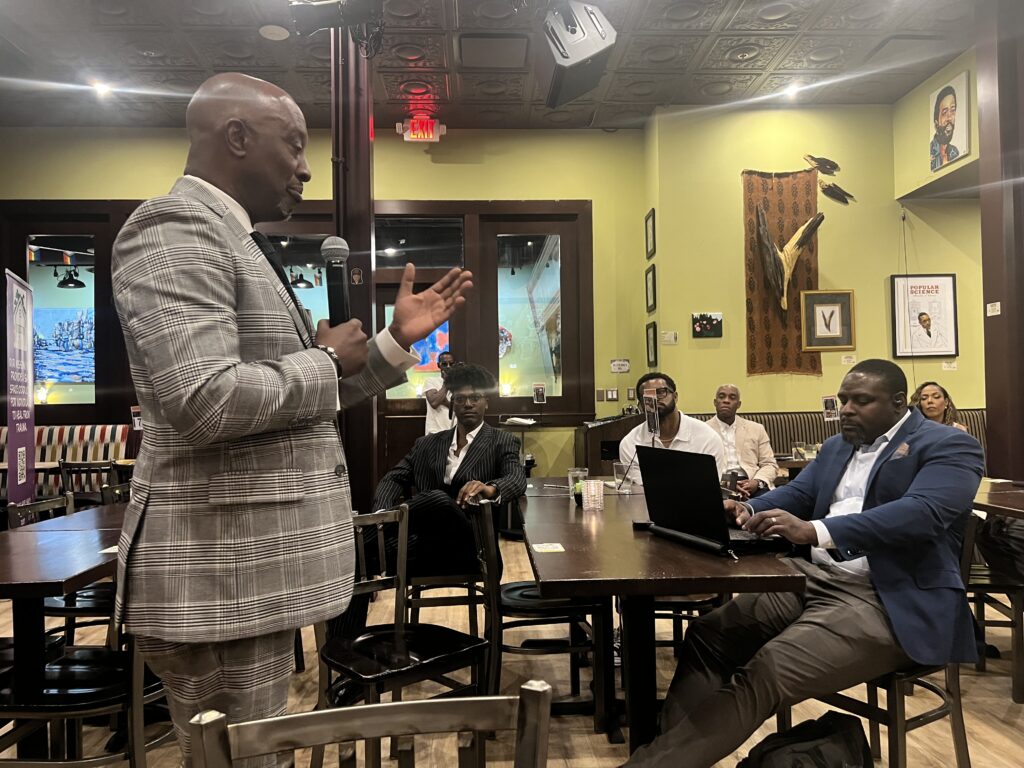
RON BUSBY: BLACK, NOT MINORITY
We tried to set the table pretty well for our very special guest, a big brother — Ron Busby, CEO of the U.S. Black Chambers. This brother is a classy businessman who never stops pushing the envelope for our economic and business empowerment as a people. He knows all too well our trillions in annual spending power and how that ranks among the largest economies on earth. Now, imagine if we actually had a Gross Domestic Product as well. I see massive potential, personally. Can you imagine if we harnessed but five percent of that — of our own money? My God, man.
Ron and I have known each other since 2009, the year he moved to Washington from Phoenix, Arizona — by way of Oakland, California, where he grew up. A mutual friend, the late Michael Graham, made the introduction. “He said, ‘Hey, man, you should meet this young guy,'” Ron told the room. “It was an immediate attraction and friendship.”
He talked about his people the way a man talks about people who built him. His mother was a minister and an educator, a graduate of Florida A&M who went on to graduate school at Clark Atlanta University. His father owned a business and was a member of the Black Panther Party. “I know my Lord and Savior, Jesus Christ,” Ron said. “And I had a father.”
Then he told the story that brought him to Washington in the first place — a double-decker bus tour with his son, not long after Barack Obama’s inauguration, snow still on the ground. He looked at the license plates. *Taxation Without Representation.* “I said, that’s a Black thing. We pay taxes. We vote. We pay tithes and offerings. But we had nobody representing us here in Washington, DC, as it related to Black business,” he said. “We had great organizations representing homeownership, early childhood development, criminal justice reform. But nobody was talking about Black-owned business.”
That’s the gap that built the U.S. Black Chambers. Ron didn’t mince words about the language used to describe that gap, either.
“All of the programs that were created for us were created under the auspices of the name ‘minority.’ I ain’t no minority. I don’t see any minorities in this room. I see Black people,” he said. “But the programs that were created for us were created for minorities.”
He laid out why that distinction matters in dollars. The federal government spends roughly a trillion dollars a year on products and services, a large share of which goes out to contractors. Early in the Obama administration, the goal for minority-firm procurement sat at five percent — and the administration exceeded it. By his second term, Ron said, the community was still applauding a goal that, in his view, kept the data too blurry to mean much. It took a moment years later — when Michael Bloomberg came through Tulsa, Oklahoma, the birthplace of Black Wall Street, to unveil his Greenwood Initiative during his 2020 presidential run — for Ron and others to push for the numbers to be broken out by race instead of lumped under “minority.”
“For the first time in this country’s history, we heard disaggregated numbers,” he said. Of the federal government’s MBE — minority business enterprise — spend, Busby broke it down like this: the Asian community received 1.8 percent, the Latino community 1.7 percent, and Black-owned businesses just 1.5 percent. The rest of that MBE bucket went to white women.
“It is not an attack on DEI,” Ron said. “It’s an attack on you and I. No other community is receiving the types of challenges that we are. We’ve got to fight back for Black-owned issues, not minority issues.”
He had a word for the Black women in the room, too, on the question of double inclusion under both racial and gender programs. “It don’t work like that. There’s only one check, and that check is Black,” he said. “We’ve got to increase the bucket for Black folks.”
When he started the U.S. Black Chambers in 2009, there were six chambers of commerce around the country. Today, USBC has grown into a network of more than 145 Black chambers and business organizations across 42 states, representing approximately 326,000 Black-owned businesses — one of the largest coordinated voices for Black enterprise in America. Nationally, USBC points to an estimated 1.9 million Black-owned businesses, employing more than 921,000 people and generating over $137 billion in annual revenue. It’s the kind of growth that doesn’t happen from a five percent goal alone — it happens from people like Ron Busby refusing to let the data hide behind a word that was never built to describe us in the first place.
_____________________________________________________________________________________
*Doni Glover is the founder and publisher of BMORENews.com, now in its 24th year of covering Black Baltimore, and the founder of the Joe Manns Black Wall Street Awards, now in its 15th year. He is also the host of the Emmy-nominated Doni Glover podcast and The Doni Glover Show on WMAR-TV 2.*