

From Eastern Shore crab pickers and Baltimore ship caulkers to Raymond Haysbert, Otis Warren, and my mother’s three rules
By Doni Glover | BMORENews.com
(BALTIMORE — Labor Day 2026) — America. North America, specifically. The East Coast. The Mid-Atlantic. More specifically, travel up the Chesapeake Bay, and you will find a city of firsts.
It is the place many of us call home.
New York City has pizza. Philadelphia has cheesesteaks. Baltimore has crab cakes loaded with jumbo lump, lightly breaded, with a dash of yellow mustard and two crackers on the side.
Mmph. Watch your mouf!
I can smell a skillet with about five of them cooking right now. The aroma lights up the block. Somebody’s momma is in that kitchen burning it up.
That is Baltimore.
Like New Orleans, Baltimore has its own distinct flavor, and much of it can be found in Big Momma’s cookbook. These crab cakes have delighted world leaders and everyday Joes. Everybody loves them—unless they are allergic.
But crab cakes are only the beginning.
The Chesapeake Set Our Table
When I think about Thanksgiving, I remember my mother’s oyster dressing. Lillie Juanita Glover could make it just right, and my father loved it.
That dish carried the Chesapeake directly to our family table.
Then there were the steamed crabs—and I am not talking about ordinary crabs. I am talking about jumbo crabs straight off Maryland’s Eastern Shore. They were the biggest crabs I have ever eaten. You did not need a dozen. You only needed two.
Two of those giants, properly steamed and seasoned, could handle the whole assignment.
Baltimore’s seafood vocabulary runs deep: oysters and clams on the half shell, crabmeat cocktails, shrimp cocktails, clams casino, oysters Rockefeller, oyster shooters, Maryland crab soup, and cream of crab soup made with a proper roux.
This food is more than a menu. It tells a story about the water that sustained Maryland families and powered a regional economy. It connects Baltimore to the Eastern Shore, where documented Black life reaches deep into Maryland’s colonial period—before Baltimore developed into the major urban center we recognize today.
Frederick Douglass and Harriet Tubman came out of that Eastern Shore world. Black farmers, sailors, watermen, cooks, laborers, merchants, and entrepreneurs worked the land and the Chesapeake. They created families and communities, pursued freedom, and resisted slavery.
And Black women picked the crabmeat.
The Black Women Behind the Crabmeat
Long before today’s Eastern Shore seafood industry came to rely heavily on immigrant workers from Latin America and Asia, Black women were doing the exacting work of picking crabmeat in packing houses along the Chesapeake.
I know specifically about Tilghman Island and Talbot County. I saw the photographs and artwork when I worked at Harrison’s Pier 5—top-rated, by the way. Those images showed Black women whose hands helped turn the Chesapeake’s catch into the crabmeat served in restaurants and homes throughout the region.
They picked through shell and cartilage, separated the grades of meat, and filled container after container. It was repetitive, skilled labor performed for wages that rarely reflected its value.
Black involvement in Talbot County’s seafood industry extended beyond picking. Black-owned enterprises included the Coulbourne and Jewett Seafood Packing Company in St. Michaels, which operated from 1902 until 1962, and the Bellevue Seafood Company. Black people worked the water, manufactured equipment, processed and packed the catch, and helped create the food culture now marketed as quintessentially Maryland.
Across the Eastern Shore, Black women also fought for the recognition of the value of their labor. In 1938, approximately 600 crab pickers—predominantly Black women—walked out of Crisfield’s packing houses after employers attempted to cut their pay. They endured intimidation and violence during a five-week strike, but they prevailed: their prior wage was restored, and their union was recognized.
In 2024, Maryland finally installed a historical marker honoring them.
So, when somebody enjoys a Maryland crab cake, they should remember the hands behind the crabmeat.
The Chesapeake did not feed Baltimore by itself.
Black women helped feed Baltimore.
Connolly’s and the Old Waterfront
For generations, one place where Baltimore gathered over the Chesapeake’s bounty was Connolly’s Seafood Restaurant.
Connolly’s stood at 701–705 East Pratt Street at the head of Pier 5. The complex included a restaurant, an oyster house, an office, a warehouse, and boats docked beside it. The Connolly family operated the business for five generations. It became a Baltimore institution before closing in 1991, after the city terminated its lease. The building was demolished the following year.
Connolly’s was not a Black-owned restaurant, and I do not mention it to suggest otherwise. I mention it because it was a beloved Baltimore landmark—a shared gathering place on the waterfront that many of us remember with affection.
Segregation was real. Discrimination was real. Black people were excluded from businesses, neighborhoods, schools, jobs, and political power. But there were also occasions and spaces where ordinary Black and white Baltimoreans came together.
The old state fair could do it. Orioles baseball at Memorial Stadium could do it. Places like Connolly’s could sometimes do it.
I do not remember people constantly fighting. I remember people gathering.
That, too, is part of Baltimore’s story.
From the Oyster House to the Union Hall
The same harbor that delivered oysters, crabs, clams, and fish was filled with vessels that had to be built, repaired, and made seaworthy. That work required highly skilled ship caulkers, many of whom were Black Baltimoreans.
No account of Baltimore’s waterfront is complete without Isaac Myers.
After the Civil War, white workers attempted to drive Black caulkers from the trade. Myers and his fellow workers did not quietly accept exclusion. They pooled resources and created their own opportunity.
In 1866, Black craftsmen established the Chesapeake Marine Railway and Dry Dock Company, a cooperative shipyard that employed hundreds. In 1868, Myers became president of the Colored Caulkers’ Trade Union Society of Baltimore. The following year, he helped establish the Colored National Labor Union and became its first president.
Frederick Douglass succeeded Myers as president of the national organization in 1872.
That distinction matters: Douglass did not serve as president of Baltimore’s caulkers’ union. He succeeded Myers at the helm of the national labor organization that grew from this larger movement.
Decades before A. Philip Randolph and the Brotherhood of Sleeping Car Porters, Black workers were organizing collectively for fair wages, dignity, power, and control over their labor. Baltimore did not merely participate in Black labor history.
Black Baltimore helped build one of its earliest national models.
Frederick Douglass Refused to Be Broken
Frederick Douglass was brilliant.
Born into slavery on Maryland’s Eastern Shore, he was sent to Baltimore, where the seeds of his literacy and freedom were planted. He later told his story in Narrative of the Life of Frederick Douglass, an American Slave, one of the most consequential autobiographies ever published.
As a teenager, Douglass was sent to Edward Covey, a brutal man known as a “nigger-breaker”—someone enslavers used to crush the resistance and humanity out of other human beings.
Covey beat Douglass repeatedly until Douglass finally fought back. Their confrontation lasted nearly two hours. Covey never whipped him again.
Douglass did not literally break Covey’s back. But let us put it in plain Baltimore terms: Mr. Covey went looking to break Frederick Douglass and discovered that if anybody was getting broken that day, it was him.
The fight rekindled Douglass’s sense of manhood and became a turning point on his road to freedom. He escaped slavery, became one of the world’s greatest writers and orators, challenged America’s conscience, and later carried his leadership into the national Black labor movement.
Harriet Tubman: From Maryland to the World
And then there is Harriet Tubman.
Baltimore is increasingly called Tubman City, and rightly so. Tubman was born Araminta Ross on Maryland’s Eastern Shore. As an enslaved adolescent, she was struck in the head by a two-pound metal weight an overseer had thrown at another enslaved person. The injury nearly killed her and caused lifelong headaches, seizures or sleeping spells, and powerful visionary experiences.
Yet nothing stopped her.
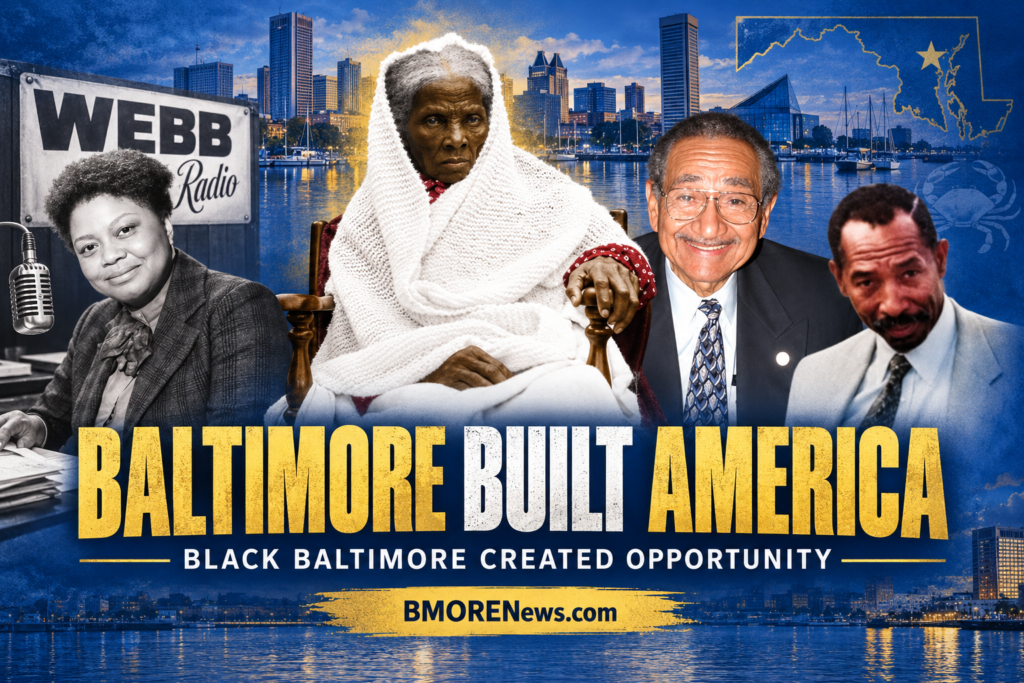
Tubman escaped slavery and repeatedly returned to Maryland to guide other enslaved people to freedom. Her work carried her through a network stretching along the East Coast and into Canada. During the Civil War, she served the Union as a nurse, scout, spy, and leader.
I was in New Orleans and saw a school named after Harriet Tubman. Think about that: a woman born into slavery here in Maryland left a legacy honored all the way down in Louisiana.
We sometimes impose our 21st-century understanding of distance and travel upon people who lived in the 1800s. But people traveled then. News traveled. Ideas traveled. Freedom networks traveled.
Harriet Tubman was from here.
Maryland helped give America Harriet Tubman.
Black Baltimore Built Businesses—and Businesspeople
The waterfront demonstrates a pattern found throughout Baltimore’s Black history. When conventional doors were closed, Black Baltimoreans created their own companies, organizations, and routes to opportunity.
Henry G. Parks Jr. built Parks Sausage into a nationally recognized company. Its advertising slogan—“More Parks Sausages, Mom, please”—entered American popular culture. In 1969, Parks became the first Black-owned company to have its stock traded publicly on a major American exchange.
But the Parks story cannot be told without Raymond V. Haysbert Sr.
Parks recruited Haysbert to Baltimore in 1952. A Wilberforce University-trained accountant and Tuskegee Airman, Haysbert rose from accountant and office manager to president and CEO. Under his leadership, Parks Sausage became one of America’s largest Black-owned businesses.
In 1980, Haysbert organized an employee purchase that returned Parks to private ownership. He drew upon his own credit while structuring the deal so employees could gain a stake in the company.
Raymond Haysbert did not merely employ workers. He gave workers an opportunity to become owners.
The EDGE Center Came First
Mr. Haysbert did not hoard what he knew.
Before the Greater Baltimore Black Chamber of Commerce—and long before the Greater Baltimore Urban League opened the entrepreneurship center that now bears his name—there was the EDGE Center.
I learned about the EDGE Center while working at Empower Baltimore during the Baltimore Empowerment Zone. The center participated in that larger economic development effort, but its purpose was straightforward: to teach entrepreneurship and give everyday people access to practical business knowledge.
Mr. Haysbert understood that telling people to start businesses was not enough. They needed instruction, technical assistance, contacts, and access to information that had traditionally circulated behind closed doors.
Mr. Haysbert and his assistant, Wanda, helped many of us acquire skills, make connections, and learn things we otherwise might never have been taught.
He later helped establish the Presidents’ Roundtable, which brought Black business leaders together, and became a founder and longtime chairman of the Greater Baltimore Black Chamber of Commerce. He taught at more than a dozen colleges and universities. When the Greater Baltimore Urban League needed to rebuild its finances and public standing, Haysbert chaired its board and helped restore corporate support.
Forum Caterers, the family enterprise he founded after Parks Sausage, became the first advertiser on BMORENews.com.
Entrepreneurs remember the first person who paid them. We remember the people who believed in the vision before everybody else could see it.
For BMORENews, that person was Raymond V. Haysbert Sr.
An 80-Year-Old Tuskegee Airman Listening to Jay-Z
Ray Haysbert was my friend and, above all, he was a teacher.
I remember this man, around 80 years old, showing me how to transfer contact information between mobile devices—what we called the “zap” feature. Here was a Tuskegee Airman, born in 1920, teaching a younger entrepreneur how to use emerging technology.
And while he was doing it, Mr. Haysbert was listening to Jay-Z’s “Big Pimpin’.”
That was Ray Haysbert.
He could discuss corporate finance, entrepreneurship, politics, civil rights, and technology while keeping an ear on what a younger generation was listening to. He was not trapped inside his accomplishments. He remained curious. Because he kept learning, he could keep teaching.
On top of all that, Raymond Haysbert was a Republican in a city where Democrats outnumbered Republicans roughly nine to one—and he never apologized to anybody for it.
I loved that about him.
He did not allow anyone else to define his politics, his Blackness, or his commitment to Baltimore. He supported Black political advancement across party lines, serving as campaign treasurer for Harry A. Cole, Maryland’s first Black state senator; chairing Clarence “Du” Burns’s 1987 mayoral campaign; and later supporting Carl Stokes’s mayoral candidacy.
Mr. Haysbert was nobody’s political property.
Today, the Greater Baltimore Black Chamber is led by Devin Xavier Jackson. Devin brings his own leadership and vision, but he does not stand alone. He stands on broad shoulders.
Raymond Haysbert built businesses, but his greater contribution was building businesspeople.
My Mother’s Three Rules
Before I understood redlining, restrictive covenants, blockbusting, segregation ordinances, or the politics of real estate, my mother had already taught me the most important lesson about land.
In the early 1950s, Lily Juanita Glover became one of the first Black homeowners on Moreland Avenue. When she moved there, the neighborhood opposite Easterwood Park was still majority white.
My mother had three rules for her children:
Number one: At 18, you are leaving.
Number two: Do not bring any babies into this house in the meantime.
Number three: Own your house.
Those rules were direct. There was no committee meeting, no extended negotiation, and very little room for interpretation.
My mother batted four for four.
All four of her children became homeowners.
That accomplishment means more when placed against Baltimore’s history. My mother purchased a home in a city that had pioneered legal residential segregation. She moved her Black family into a majority-white community during an era when banks, real-estate brokers, neighborhood associations, and public policy still worked to control where Black people could live.
She did not use terms such as “intergenerational wealth” or “racial wealth gap.” She simply said:
Own your house.
Black Communities Were Already Here
My mother’s story belongs to a much older Black Baltimore tradition.
Long before P. David Bramble and MCB Real Estate became household names, Otis Warren was clocking land.
Before the Warrens, there was Grandison Hoe.
Grandison Hoe, a formerly enslaved farmer, acquired land in what is now North Baltimore during the antebellum period. His children built homes there, helping establish the foundation of Hoes Heights.
Hoes Heights sits between Hampden and Roland Park—two communities rarely associated with old Black Baltimore. Yet Black families were farming, owning land, building homes, and raising children there before some of Baltimore’s best-known white neighborhoods took their modern form.
Hoes Heights was not an exception.
Morgan Park developed around Morgan State and became home to Black professors and professionals. Wilson Park began to develop in 1917 through the work of Harry O. Wilson Sr., a Black businessman and banker who acquired land so that Black families could build homes.
Cross Keys also had a Black community long before the upscale planned development carrying that name appeared. Black families lived along Falls Road, many connected to the Jones Falls Valley’s mills and industries. Much of the old community was later condemned and demolished.
These are the things they do not tell us.
The conventional story makes Baltimore’s racial geography appear natural and inevitable: white people always lived here, and Black people always lived over there.
That is not what happened.
Black families owned land and built communities throughout the region. Then government, real-estate interests, neighborhood associations, lenders, and developers drew harder lines around them.
Ashbie Hawkins and George McMechen Crossed the Color Line
If we name Mayor J. Barry Mahool, we must first name W. Ashbie Hawkins and George W.F. McMechen.
Hawkins was one of Baltimore’s first Black lawyers. He attended the University of Maryland School of Law but was expelled when the institution resegregated. He completed his legal education at Howard University and returned to Baltimore to practice law.
His law partner, George W.F. McMechen, was Morgan’s first graduate and a graduate of Yale Law School. The two men were also family: Hawkins was married to McMechen’s sister, Ada.
In 1910, Hawkins purchased a house at 1834 McCulloh Street on a block then occupied primarily by white residents. McMechen leased the house and moved his family into it.
That simple act—a Black family moving into a home it could afford—caused a white political panic.
The house was attacked. Windows were broken, and a brick was thrown through a third-floor skylight. White residents organized and demanded that City Hall protect the neighborhood’s racial boundaries.
Under Mayor J. Barry Mahool, Baltimore responded with the country’s first citywide attempt to separate Black and white residents by law. Beginning in 1910, the city enacted a series of residential-segregation ordinances restricting Black residents from moving onto majority-white blocks and white residents from moving onto majority-Black blocks.
On its face, that language appeared to treat both races equally. Hawkins and McMechen understood the trick.
White Baltimore had access to a broad housing market, capital, lenders, developers, and newly constructed neighborhoods. Black Baltimore had been restricted to overcrowded areas and denied the resources required to build sufficient housing. A supposedly equal prohibition would lock Black families inside inequality.
Hawkins, McMechen, and attorney Warner T. McGuinn fought the ordinances in court. Each time they defeated one version, city officials attempted to rewrite it. Their victories contributed to the legal foundation for the national fight that culminated in the U.S. Supreme Court’s 1917 decision in Buchanan v. Warley, which invalidated racial zoning laws.
Mahool used government power to codify segregation.
Hawkins and McMechen used the law to fight back.
Otis Warren Changed the Skyline
Otis Warren Jr. followed his father, Otis Warren Sr., into real estate. The elder Warren acquired properties for Black families during an era when segregation restricted where they could live, but Baltimore’s real-estate establishment initially denied him membership.
The son eventually broke through the door that had been closed to his father.
In 1976, Otis Warren Jr. was named Realtor of the Year. In 1982, he became the first Black president of the Greater Baltimore Board of Realtors.
But Otis Warren did not stop at selling property. He developed it.
He built the Dickey Hill Forest apartment community, developed affordable housing, expanded homeownership around Walbrook Junction, opened opportunities for Black real-estate professionals, and mentored developers who followed him.
His signature achievement rose at the intersection of Howard and Baltimore streets. After purchasing the site in 1989, Warren developed the 11-story, approximately 250,000-square-foot City Crescent Building, becoming the first Black developer to construct a major office building in downtown Baltimore.
Black people had laid bricks, framed houses, cleaned offices, maintained buildings, and performed the labor that built Baltimore. Otis Warren crossed another line.
He did not merely occupy space downtown.
He developed it.
Today, P. David Bramble leads development on a scale earlier Black Baltimore builders were systematically denied, including the reimagining of Harborplace. Bramble did not emerge from nowhere. He stands in a tradition of Black people who understood that land is more than real estate.
Land is shelter.
Land is wealth.
Land is inheritance.
Land is memory.
Land is power.
She Batted Four for Four
Baltimore’s officials once tried to draw a color line around this city.
Ashbie Hawkins and George McMechen challenged it.
Grandison Hoe, Harry Wilson, the Morgan Park families, and generations of Black Baltimoreans acquired land despite it.
Otis Warren changed the skyline. P. David Bramble carries the work forward today.
And in the early 1950s, Lily Juanita Glover purchased her home on Moreland Avenue in a majority-white community opposite Easterwood Park.
She gave her children three rules. The last one carried all of this history forward:
Own your house.
She batted four for four.
The Chesapeake fed us. Black women picked the crabmeat. Black caulkers kept the ships afloat and organized labor. Black entrepreneurs built companies and taught others how to build. Black families acquired property and created communities before Baltimore attempted to fence them in.
That is the Baltimore too many people never learn.
We are more than crab cakes, crime statistics, vacant houses, and television dramas.
We are the descendants of people who fed a region, built a port, organized workers, challenged segregation, owned the land, and created opportunity where none was offered.
Baltimore helped build America.
And Black Baltimore helped determine what America could become.