

(BALTIMORE – July 4, 2026) – America turns 250 today.
The Ledger at 250
That is not a small thing. Empires rise and fall in less time. Constitutions get rewritten. Borders get redrawn. And yet here we are in 2026, still arguing under the same flag, still building on the same foundation, still calling ourselves one country.
I have spent my life covering this country from a particular vantage point—Baltimore, Maryland, a city that has given America more than it has ever been credited for and has taken more punishment than it ever deserved. From that vantage point, I want to offer a different kind of birthday toast. Not a parade. Not fireworks. A ledger.
Because if America is being honest with itself at 250, it has to reckon with a hard truth: this country did not become great in spite of Black America. It became great, in no small part, because of Black America—because of people who were told no and built anyway, told wait and moved anyway, told stay in your place and reached for the stars anyway.
Black history is American history. Not a separate wing of the museum. Not a special-interest unit taught in February and forgotten in March. American history.
It’s 250 years of this country as a so-called, formally recognized nation, in a world full of nations. Yet today, as we look at 1600 Pennsylvania Avenue, I can’t help but feel a deep, unsettling weight. We are witnessing unprecedented attacks on civil liberties, on race issues, and on basic civil rights. The clock has turned back so far in just a couple of years. It is hard to celebrate this anniversary cleanly given the aggressive ICE attacks, the systemic targeting of immigrants, and the ongoing tragedy of citizens shot dead in our streets. Under this current climate, the old rules are shattered. It’s no longer just Black people being hunted down; with this administration, all’s fair. The cruelty is democratized. What has this country become 250 years later?
Long before there was an America, there were Indigenous nations. They were here centuries before European colonists arrived, before a Declaration of Independence, before a Constitution, and before the United States claimed this land as its own. Today, the descendants of those original colonists have turned into citizens who aggressively tell new arrivals that they cannot be immigrants. The historical amnesia is staggering.
America has always wrestled with the tension between its ideals and its reality. Our founding documents speak of liberty and equality, yet our history tells a far more complicated story. Progress has never been automatic. Every generation has had to fight to make the nation live up to its promises. So, on this 250th anniversary, celebration alone doesn’t feel sufficient. Reflection is required. Accountability is required. And perhaps the most important question of all is this: Two hundred and fifty years later, what kind of nation do we want to become?
1776 and the Unfinished Promise
The Declaration of Independence made a promise it did not keep. “All men are created equal” was written by men who owned other men. That contradiction did not resolve itself. It had to be fought for, generation after generation, by people who took the promise more seriously than the men who wrote it.
America is richer because of people who refused to accept the world as they found it.
-
I think of John Brown, a white man willing to die fighting slavery, because moral clarity has never belonged to one race alone.
-
I think of Nat Turner and Denmark Vesey, who answered bondage with rebellion, because there comes a point when waiting on justice becomes its own kind of injustice.
-
I think of Harriet Tubman, who could have stayed free once she crossed over and went back—again and again—because freedom that leaves others behind was never freedom to her.
-
I think of Frederick Douglass, who taught himself to read in a country that made it illegal, and then out-argued the men who wrote those laws.
-
And I think of William Still, the Father of the Underground Railroad, who earned that title through his tireless documentation and coordination, turning an underground network into an organized machine to ensure the stories of the enslaved survived to be told.
These were not people asking America for a favor. They were people holding America to its own word. They looked at the foundational text of this country and demanded its fulfillment, establishing a tradition of radical patriotism that remains the true engine of American democracy. Without them, the phrases penned in Philadelphia would have remained dead letters, hypocritical platitudes meant only for a land-owning elite. By forcing America to look into the mirror of its own sins, they saved the nation from its worst impulses.
The Inventors and the Visionaries
There is a version of American history in which the Black story ends with struggle. That version is incomplete and lazy. Alongside the fight for freedom ran a parallel current—invention, ingenuity, and the sheer refusal to accept limitations.
-
I think of Frederick McKinley Jones, whose refrigeration technology transformed food distribution around the world, ensuring produce could travel across state lines without spoiling.
-
I think of Alexander Miles, whose improvements to elevator doors made buildings safer for everyone who steps into one today.
-
I think of Sarah Boone, who patented an improved ironing board, a precision contribution that made everyday life easier for countless families.
-
I think of Dr. Daniel Hale Williams, who performed one of the earliest successful operations on the human heart and pericardium, expanding the boundaries of modern medicine.
-
I think of Ronald E. McNair, who reached for the stars and ultimately gave his life in service to America’s space program aboard the Challenger in 1986.
-
And I think of the Black Panthers, whose free breakfast programs reminded America that feeding hungry children is an act of patriotism, years before the federal government established a national school breakfast program on the same principle.
They didn’t just make Black history. They made America better.
This legacy of intellectual and physical mastery is central to understanding the modern world. When we look at the structural framework of global commerce, medical advancement, and urban infrastructure, the fingerprints of Black brilliance are indelible. These creators did not operate in a vacuum of encouragement; they worked in laboratories, workshops, and operating rooms that frequently questioned their right to exist. Yet, their contributions elevated the standard of living for every single human being who enjoys the fruits of modern civilization.
Black Wall Street and the Business of Freedom
I have spent fifteen years now honoring builders through the Joe Manns Black Wall Street Awards, and if there is one thing that season after season confirms, it is this: entrepreneurship has always been one of the most powerful expressions of freedom available to Black America.
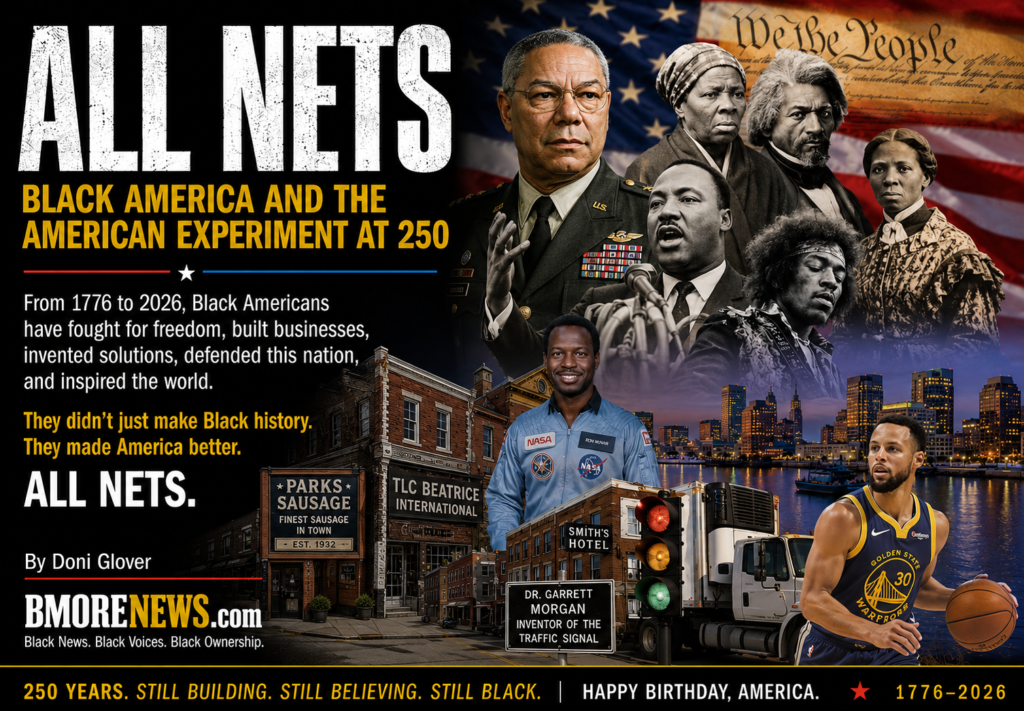
I think about the entrepreneurs, too. Parks Sausage, built into a household name from a Baltimore kitchen table. TLC Beatrice, once the largest Black-owned business in the country. Tom Smith, Maryland’s great Black hotelier. Little Willie Adams, who understood that capital—not just courage—was the missing ingredient in the fight for equality. These were men and women who built businesses when doors were closed, banks said no, and opportunity was rationed out in portions too small to live on.
And I would be doing this history a disservice if I did not mention Parren J. Mitchell. A World War II veteran, the first Black congressman from Maryland, and the founder of the minority business enterprise movement at the federal level. Mitchell understood something that too many civil rights conversations still miss: representation without economic opportunity is only half a victory. He bridged the fight for civil rights with the fight for Black entrepreneurship better than almost anyone in American political history.
Despite every obstacle placed in our path, Black Americans have continued to create, invent, build, lead, teach, heal, and inspire. As we say in basketball, we’re like Steph Curry from anywhere on the court.
All nets.
Economic self-determination is the bedrock of lasting freedom. The stories of Parks Sausage or Little Willie Adams are not merely tales of commercial success; they are strategies of survival and resistance. When you build your own financial institutions, your own production lines, and your own retail footprints, you decrease your dependency on systems designed to see you fail. This is the core philosophy that drives our work at BMORENews. We recognize that the ability to generate wealth, hire within our communities, and fund our own movements is the ultimate guarantor of our civil liberties.
The Witness: A Lifetime in Baltimore
I have watched tanks roll down North Avenue. I remember the smoke and the heavy armor filling the streets after the unrest of 1968, when the collective pain of a people boiled over after the assassination of Dr. King. I remember the failed rescue mission in the Iranian desert during the hostage crisis, a moment that shook the nation’s confidence. I remember exactly where I was on September 11, 2001, watching the world alter its course in a single morning.
I have covered presidents and mayors across sixty-plus White House visits and twenty-four years of BMORENews. I have raised children, and now grandchildren, in a city that the rest of the country loves to write off—and that I have spent my entire adult life refusing to let anyone write off in front of me.
In my lifetime, I have watched cultural titans and local heroes redefine excellence. I have watched Muhammad Ali inspire the world with his principles and his fists, Mike Tyson dominate boxing with raw fury, and Baltimore’s own Tank Davis continue that fierce championship tradition right before our eyes.
We have come a mighty long way. I have lived long enough to see America elect its first Black president, Barack Obama. I have lived to see Maryland elect its first Black governor, Wes Moore. I have lived to see Baltimore led by its first elected Black mayor, and Baltimore County led by its first Black county executive. I have lived to see West North Avenue finally receive the structural investment and development it deserved decades ago. We have pushed through the mud, broken down barriers, and built monuments where there were once ruins. To God be the glory.
What we carry from those who came before us is the conviction that you don’t wait for permission to build. You document. You coordinate. You organize. You open the business the bank told you not to open. You run for the office, they said, wasn’t yours to claim. And when the country falls short of its own promise, you don’t leave. You hold it accountable, and you stay.
The Soul of America and the Global Stage
Dr. Martin Luther King Jr. once observed:
“We have learned to fly the air like birds and swim the sea like fish, but we have not learned the simple art of living together as brothers.”
Nearly sixty years after his transition, those words remain painfully relevant. Today, in 2026, we have artificial intelligence capable of transforming entire industries and solving problems once thought impossible. We communicate instantly across oceans. We possess more wealth, more agricultural capacity, and more technological power than any civilization before us. Yet too often we remain poor in compassion, poor in understanding, and poor in our willingness to simply live together. If humanity can harness these advanced tools with wisdom, no child should go to bed hungry on this planet. No family should be condemned to starvation because of politics, geography, or corporate neglect.
It was Jimi Hendrix who famously said at Woodstock:
“When the power of love overcomes the love of power, the world will know peace.”
Whether spoken exactly that way or remembered through the years, the sentiment remains an absolute truth.
If the United States is, in fact, the most powerful nation on Earth—if we truly believe we are history’s greatest democracy—then we must rise to the responsibility of acting like a world leader in every sense of the word. Leadership is not measured only by military strength or economic coercion. It is measured by wisdom. By restraint. By integrity. By the ability to bring people together rather than drive them apart.
We cannot afford to flirt with nuclear destruction. We cannot afford unnecessary wars or imperialistic conflicts that leave generations scarred across the globe. Force will sometimes be necessary, but it should never be our first instinct. Real leadership exhausts all avenues of diplomacy and honest negotiation before resorting to violence.
The world is watching us. Not only the great powers like China, Russia, and Iran, but also the smaller, vulnerable nations that often bear the greatest consequences of decisions made by the world’s largest empires. Real leadership begins close to home. It begins with strong, mutually respectful relationships with our immediate neighbors—Canada and Mexico. It includes finding a more constructive, humane path with Cuba. Respecting our neighbors strengthens our moral standing around the world. A real leader is not a bully.
America has long described itself as a nation shaped by Judeo-Christian values. If that is so, then Christ’s teachings ought to matter—not merely in our Sunday pulpits but in our public policy and international affairs. Loving our neighbor cannot stop at people who look like us or share our language. Welcoming the stranger cannot depend upon which side of an arbitrary border that stranger was born. Compassion cannot be selective, and power without compassion is nothing more than brute domination.
Faith and the Uniform
None of this happened without faith. Black America did not survive slavery, Jim Crow, redlining, and mass incarceration on willpower alone. It survived on belief.
Belief, as Dr. King reminded us, that “the arc of the moral universe is long, but it bends toward justice.” Belief that a preacher from Georgia could stand on the steps of the Lincoln Memorial and give an entire nation a vocabulary for its own conscience. Belief that a Black guitarist from Seattle could take the national anthem, run it through distortion and feedback in front of half a million people, and hand it back to America sounding like a radical question the country still had to answer. Faith has never been passive; it has been a rigorous political and spiritual strategy.
It is the same moral clarity carried by Black veterans who fought for a country that did not always fight for them. I think of the Tuskegee Airmen flying hazardous combat missions over Europe while being denied service at lunch counters in the very states they were defending. I think of the soldiers of Vietnam returning home to a country deeply divided about the war, and, for Black veterans, still fundamentally divided about their humanity. Parren Mitchell himself wore this country’s uniform before he ever wore a congressional pin.
There is a profound, almost supernatural kind of patriotism required to defend a country that has not yet decided to fully claim you. That is not blind loyalty. That is a deep, unshakeable belief that the foundational promise is worth fighting for, even when the nation itself refuses to keep it.
A Prayer for the Next 250 Years
So on this 250th birthday, my prayer is not for a perfect country. This country has never been perfect, and pretending otherwise dishonors everyone who bled, marched, and organized to make it better.
My prayer is for a country honest enough to remember who built it—all of it, from the indigenous lands to the sweat of the enslaved, to the brilliance of the immigrant laborers. My prayer is for a country that keeps its promises a little faster than it has in the past. My prayer is for the next generation of Fredericks, Sarahs, Ronalds, and Parrens, still out there right now, still being told no, still building anyway.
We must remember the ordinary Americans, the activists, and the fallen who forced us to look at our flaws—from the streets where George Floyd and Freddie Gray lost their lives, to the modern organizers fighting for judicial reform. They remind us that the work of democracy is gritty, exhausting, and unceasing.
Around 1972, standing in an alley off East North Avenue right here in Baltimore, I asked my father a question. I was just a boy trying to make sense of a world that felt hostile and split down the middle.
“Daddy, do you hate white people?”
He stopped what he was doing and looked at me with an intensity I can still feel today.
“No,” he said clearly. “I don’t hate anybody. I hate what some people do, but I don’t hate anybody.”
I’ve carried those words for more than fifty years. They became my compass through the storms of covering politics, witnessing racial strife, and navigating the systemic hurdles placed in front of Black businesses. On America’s 250th birthday, that remains my deepest prayer for this nation. Children are not born hating. Learning to hate is a learned affliction. It is like carrying poison in your pocket; sooner or later, it spills and burns the one carrying it.
If we are to survive another 250 years, we must purge the poison. We must choose the power of love over the love of power. We must continue to create, invent, build, lead, teach, heal, and inspire without asking for permission from those who wish to hold us back.
Happy Birthday, America.
We’re still here, out on the court, hitting from anywhere.
All nets.
___________________________________
Doni Glover is the founder and publisher of BMORENews.com, now in its 24th year of covering Black Baltimore, and the founder of the Joe Manns Black Wall Street Awards, now in its 15th year. He is also the host of the Emmy-nominated Doni Glover podcast and The Doni Glover Show on WMAR-TV 2.