

(BALTIMORE – June 22, 2026) – On Saturday, I walked with my wife and our four small children to the AFRAM Festival at Druid Hill Park. Living close by, we wanted to soak up the sights and be among people we know for the 50th Anniversary of one of the largest free celebrations of Black culture on the East Coast. My wife suggested we go to let the kids run and play with our friend’s kids in the children’s area while we listened to some of the artists on stage. When we arrived, it was a beautiful sight: Black folks as far as I could see—bold, beautiful, audacious, and unapologetically themselves.
I ran into friends, family, and community members I hadn’t seen in years. I saw my 4th grade school teacher. I also saw thousands of young people moving through the park in groups of 20, 50, even 60 strong—little tribes and villages of their own moving in unison like snakes through the crowd. In nearly every large group I passed, there was at least one friendly face who greeted me and politely introduced me to friends as “Mr. Maybin.” I even recognized and reconnected with countless students and mentees I’d crossed paths with over the years.
That said, as an educator and mentor in the school system, there were elements that put me on alert. More ski masks and Nike tech fleece and hoodies in 90° weather than I’m usually comfortable with. Groups of youth posturing toughness, a practiced veneer of invulnerability that most Black boys learn to perform as early as we learn how to speak. Young people drifting, looking for connection, intimacy, pleasure—seeking safe spaces to belong. And in how they presented themselves, what I noticed most was the desire for joy, almost as if our kids have been taught they don’t deserve it.
I ran into a family member working security who gave me an unfiltered take when I asked him how the day was going: “Do you want my honest opinion?” he asked. I said yes. He told me the morning had been calm—good vibes, small crowds—but that things changed around 4 p.m. “The youth woke up,” he said. “We had fights on the basketball courts; we shut that down. Then moving through the park—fighting, smoking, drinking. It’s been a mess.” He answered a call on his walkie-talkie and had to go. He disappeared into the crowd.
After we continued walking through the festival, I saw some of those same elements, myself: scuffles, wandering groups, the tension that comes when large numbers of teenagers are left to self-organize. Still, nothing I witnessed felt existentially dangerous to my family; it felt more like an overcrowded family reunion in a house that was way too small—loud, chaotic, overwhelming for toddlers, but not inherently violent or criminal.
After the day’s incidents, Mayor Brandon Scott and the Baltimore Police Department announced age restrictions for the rest of AFRAM: anyone under 18 must be accompanied by a parent, guardian, or responsible adult. The announcement urged parents to comply to ensure minors are properly supervised.
My first concern with that policy is practical: enforcing an age-restriction on a park the size of Druid Hill is unrealistic. The larger problem is moral and political: the restriction casts a wide net of suspicion and criminality over an entire generation of Black youth without addressing the root causes of the crowding, the mischief, or the festival’s lack of thoughtful planning and programming for youth. In short, it punishes all for the actions of a few.
Online, I’ve seen elders in our community respond in ways that mirror the worst elders of my childhood—quick to criminalize, quick to blame. They talk about our kids as if they’re animals, incapable of peace or love. That rhetoric erases important context. Our young people are the children of the village we created: they live with the same systemic forces we did and some that we didn’t. If you are alarmed by their presence, it reveals more about your fear than it does about them.
Yes, there were fights—crowds breed conflict everywhere, and the youth are not exempt. But we don’t respond to post-game riots or rowdy adult crowds by sweeping bans on entire age groups or cultural demographics. We shouldn’t treat our own children differently because they are Black. Visibility of Black teenagers on Juneteenth weekend should provoke pride, not panic. Our youth need to be seen. That’s half the battle of reclaiming and reshaping our community narrative.
A lot of the judgment directed at these kids is extremely hypocritical. Many of the elders calling for stricter rules grew up as latchkey kids themselves. The tough-on-crime policies some supported in the 1980s and ’90s—responses to the crack epidemic—ended up ushering in over-policing and mass incarceration that devastated our communities. The impulse to call for more punitive measures now is a cycle that harms our children and ourselves.
The tough on crime policies that many elders in the Black community called for in the 80s and 90s impacted those same elders brutally when the police started over policing their communities, kicking their doors in, looking for their sons and grandsons to lock them up behind iron cages and feed a system of mass incarceration that’s still eating our babies whole today.
If we’re serious about safety and healthy community life, we need solutions that engage youth rather than banish them. A few practical, immediate ideas:
- From village leader Olu Butterfly, “Employ paid ‘village guardians’—non-police grassroots youth workers who provide supervision, guidance, and de-escalation at large events.” They are not law enforcement but credible community messengers who can intervene early to keep our youth safe and call police only when necessary.
- Partner with established youth organizations—Safe Streets, We Our Us, Baltimore Community Mediation Center, TENDEA Family, I Am Mentality, The Nolita Project, B-360, local arts groups—and give them visible roles in planning and on the ground. These organizations already do the daily work of engaging teens.
- Program youth-centered activations in the afternoon and evening: supervised pickup basketball, tournaments, field games, interactive art, dance and drumming clusters among the crowd, and rides or family attractions that aren’t just vendors or food trucks. Provide age-appropriate zones with responsible adult supervision for older teens to hang out, talk, and be seen.
- Improve signage, maps, and logistics so families and attendees can easily find stages, kids areas, and exits. That’s a simple fix that shows thoughtful planning.
- Enforce vendor rules and crack down on unpermitted alcohol sales to minors. Hustles happen, but enabling minors to drink should not be tolerated.
- Create a platform that facilitates safe travel for our youth at events that end after 9 pm.
When the festival lacked the visible representation from our pillar institutions—Safe Streets, We Our Us, community arts groups, mediation centers—the only default authority becomes the police. That’s a problem. Our village leaders are far better equipped to defuse fights, redirect energy, and connect with youth the way police can’t . The City should fund and lean on these credible messengers for these large scale events.
And this is most definitely possible. In many ways we already do it. The Mayor’s Office of Neighborhood Safety and Engagement (MONSE) has summer violence prevention workers that patrol events, mostly downtown and Fells Point. They provide conflict resolution, violence, mediation, and positive redirection for youth in those spaces. If the City cared enough to prioritize it, it’s definitely doable.
We must also reckon with media narratives that amplify fear. Misleading reporting about Black youth and crime inflames public panic and provides cover for more restrictive policies. Young people move in numbers because there is safety in those numbers and belonging in groups at that age. That’s normal. Gangs become appealing when alternatives for meaningful connection and purpose are scarce.
Black youth are powerful. The issue is not their energy—it’s the lack of clear pipelines for that energy to be channeled productively. And as Black people living in marginalized communities, in our rush for order, we too often sacrifice their freedom and ours. Policies aimed at policing youth will affect entire communities.
We are the village. We built the environment our children inherit. As my sister Mia Smith says often, “Our youth expose the cracks in society; they don’t create them.” And we can’t continue to blame Black youth for poor city planning, design, and anti-Black fear. Even when that fear comes from other Black people. When they feel excluded or banned from the spaces, all it does is fuel their innate desire to rebel against these unjust ideas and show up anyway with the same rebellious spirit that we exhibited ourselves as children. We cannot abdicate responsibility by hiding behind calls for exclusion. Instead, we must imagine and fund better systems—interventions that keep kids seen, supervised, and celebrated.
If you want to keep kids safe at festivals, don’t ban them. Invite them in, put trusted adults who love and respect them in clear and visible roles, create supervised spaces and programming, and remove the easy avenues for alcohol and bad actors/ predators to exploit them.
When children are embraced by the village, they don’t burn it down to feel its warmth.
_____________________________________________
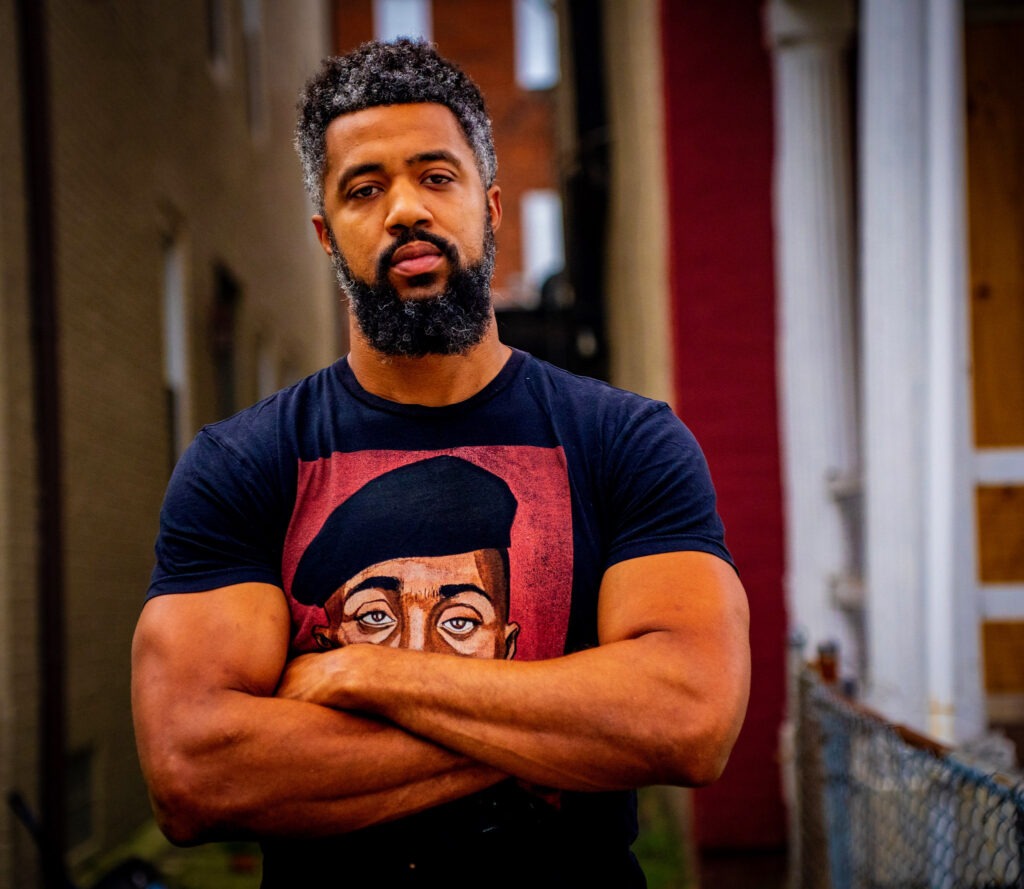
Aaron Maybin is a Baltimore native, former NFL linebacker, and the 11th overall pick in the 2009 NFL Draft. After five years in the league, he walked away from professional football to pursue a career as an artist, activist, author, educator, and community organizer. He now dedicates his time to Baltimore City students in classrooms, community centers, parks, and playgrounds. In January 2018, Maybin used social media to expose freezing conditions at Matthew A. Henson Elementary School, where classroom temperatures dropped below 40 degrees and children sat in heavy winter coats with icicles on the windows. His viral posts sparked national attention, forced Baltimore City Public Schools to temporarily shut down buildings, and prompted emergency action from local and state officials.