


A business-school assignment sent me around the world examining artificial intelligence, quantum computing, semiconductors, and data centers. It brought me home convinced that Maryland—and the University of Maryland—can help America build a smarter, more inclusive, and environmentally responsible technological future.
(COLLEGE PARK, MD – September 19, 2026) – It began as a homework assignment.
In Leading with a Strategic Mindset at the University of Maryland’s Robert H. Smith School of Business, Professor Paulo Prochno assigned the Harvard Business School case Building Innovation at VINCI. The case examines how a massive, decentralized global corporation encourages innovation and converts new ideas into business results.
I started where a student should: What does this company do? How is it organized? How does it turn strategy into action?
Then I discovered that VINCI is not simply a company associated with highways, airports, bridges, and traditional construction. Through VINCI Energies and related operations, it participates in the highly specialized systems that make modern data centers possible: electrical distribution, cooling, cabling, telecommunications, and other critical infrastructure.
Suddenly, I was no longer studying only organizational innovation.
I was examining the physical machinery behind artificial intelligence.
One question led to another. How much electricity do these facilities consume? How much water do they require? What happens to the land surrounding them? Who pays for the transmission lines, substations, and backup-power systems? How many permanent jobs remain after construction? Who owns the technology? Who receives the profits?
Most important: Who benefits?
When Homework Becomes a Journey
This intellectual journey did not begin with me alone.
My classmate Rod Carroll first introduced me to quantum computing. At the time, I could not have known where that conversation would lead. Later, when my research took me to Spain and I discovered that the country had connected its artificial-intelligence ambitions to a national quantum strategy, I became hungry for more.
Rod had planted a question that became increasingly valuable as my field of vision expanded.
That is one of the best things happening in my doctoral education. My professors and classmates keep serious questions in the air. The classroom becomes a laboratory, and an assignment can become an investigation.
For me, that investigation also became content and business strategy. I am a student, but I am also a journalist, broadcaster, and entrepreneur. What I learn doesn’t stay in a classroom. It shapes the questions I ask on the air, the stories BMORENews.com publishes, and the decisions I make about the future of my own business.
The assignment became content. The content became inquiry. The inquiry became a larger business and public-policy question.
What kind of artificial-intelligence economy are we building?
The World Is Not Waiting for America
My digital journey moved through France, Britain, Spain, Germany, Finland, Canada, Taiwan, and the United Arab Emirates. It eventually forced me to confront the country we cannot leave out of any serious discussion about technological leadership: China.
The United States still possesses enormous advantages. It has leading technology companies, world-class research universities, deep capital markets, major cloud-computing platforms and an extraordinary concentration of scientific and engineering talent.
Talent exists all over the world, but it gathers where laboratories, investment, institutions and opportunity reinforce one another. Silicon Valley did not become Silicon Valley by accident.
Yet America’s financial advantage should not make us comfortable.
As documented in the Stanford University 2026 AI Index Report, China is challenging the United States across several dimensions of artificial-intelligence development, research and deployment.
The competition encompasses three connected technological fronts.
The first is artificial intelligence: the models, data, computing capacity, talent and real-world applications that will influence nearly every industry.
The second is semiconductors: the advanced chips required to train and operate powerful AI systems.
The third is quantum technology: an emerging frontier involving computing, communications, sensing, cryptography, medicine, materials and national security.
This struggle is not merely about which country produces the most impressive chatbot.
It is about who controls the computing power, chips, networks, scientific talent, manufacturing capacity and technical standards that will shape the next generation of the world economy.
The United States has tried to slow China’s progress through export controls that restrict access to advanced AI chips and semiconductor-manufacturing technology. China, in turn, is investing heavily in domestic alternatives and attempting to reduce its dependence on American and allied technology.
National-security concerns are real. Artificial intelligence, advanced semiconductors and quantum technology can affect weapons, intelligence gathering, cybersecurity, communications and economic power. No responsible American leader can ignore the possibility that another nation could gain a decisive strategic advantage.
But competition creates its own danger.
A country can become so consumed with winning that it stops asking what victory costs.
The AI Race Depends on the World
The popular story describes artificial intelligence as a contest between the United States and China. The actual supply chain tells a far more complicated story.
American companies design many of the world’s leading AI chips and create much of the software that runs them. But those chips depend on a global network of expertise and production.
Taiwan Semiconductor Manufacturing Company, better known as TSMC, manufactures many of the most advanced chips designed by American companies.
Then there is ASML in the Netherlands.
ASML does not manufacture semiconductor wafers. It builds the enormously sophisticated lithography machines used to print microscopic circuit patterns onto silicon wafers. Its extreme-ultraviolet lithography systems are indispensable to producing the most advanced semiconductors.
Those machines, in turn, depend on specialized optics, lasers, materials and components developed across several countries, including Germany and Japan.
The world’s most powerful technology is not actually the product of one country.
It is the product of accumulated scientific knowledge, international education, global supply chains, public research, private investment and cooperation among people who may never meet one another.
That raises an uncomfortable question.
If this technology was created through worldwide cooperation and globally shared knowledge, is it wise to treat its future solely as a winner-take-all national competition?
That does not mean America should hand sensitive military technology to China. It does not mean ignoring cybersecurity, intellectual-property theft, surveillance, or human-rights concerns. It does mean recognizing that no country is technologically self-sufficient—and that humanity cannot allow competition to destroy the cooperation upon which technological progress itself depends.
We are fighting over who will control a technology that none of us created alone.
How intelligent is that?
Quantum Is the Next Frontier
Quantum computing has become another front in this global struggle, but we must discuss it carefully.
Quantum computers are not simply faster versions of the laptops and servers we use today. They operate according to different physical principles and may eventually solve certain specialized problems that are extremely difficult for conventional computers.
Potential applications include materials discovery, pharmaceutical research, logistics, sensing, cryptography and scientific simulation. Quantum communications could also affect the security of governments, banks, militaries and critical infrastructure.
Much of the technology remains experimental. It is too early to know which approaches will become commercially practical or how quickly.
But nations are not waiting for certainty.
The United States, China, the European Union, Spain, Britain, Canada, Japan, and other countries are investing in quantum research, talent, and infrastructure because they understand that leadership in an emerging technology is often established before the commercial market becomes obvious.
Spain particularly caught my attention.
Its National Quantum Technologies Strategy commits approximately €808 million—about $926 million—through 2030. Spain is not trying to outspend the United States or China dollar for dollar. It is attempting to coordinate government, universities, researchers, and industry around carefully selected areas of national strength.
That is strategy.
Spain is asking: If we cannot spend what America spends, how can we organize what we have to create the greatest public value?
America has the advantage of scale. Spain may be demonstrating the advantage of focus.
OpenAI Is Not the Same as Open-Source AI
My research also forced me to distinguish between OpenAI and open-source artificial intelligence.
OpenAI is a private American company. Its name should not be confused with the broader concept of open-source technology. Many of the most powerful commercial AI models are proprietary systems. The public may use them, but the underlying training data, software, model architecture, or decision-making processes may not be fully available for outside examination.
Even the term “open source” requires care. Some AI systems are more accurately described as “open weight” because developers release the model’s numerical parameters but not necessarily all the training data, software or methods used to create it.
Still, open and open-weight AI have helped spread technological capacity beyond a handful of wealthy corporations.
Researchers, universities, small businesses and developing countries can take an existing model, adapt it to local languages, test it, improve it and use it without building everything from the ground up. Open models can encourage innovation, competition and independent scrutiny. They can give nations with fewer resources an entry point into the AI economy.
Spain’s ALIA initiative is important for this reason. It is designed as public AI infrastructure serving Spanish and the country’s co-official languages. France’s Mistral AI has also supported influential open-weight models. Chinese companies and research groups have released models that developers worldwide can study and adapt.
Open systems are not without risks. They can be misused, manipulated, or deployed without adequate safeguards. But a world in which only a few corporations control the most powerful models presents serious risks of its own.
Who gets to experiment? Who gets to audit the systems? Who gets to build a business? Whose language is represented? Whose history is remembered? Whose values are embedded?
Open technology has helped spread knowledge worldwide. The challenge is to preserve that capacity for shared innovation without becoming careless about safety.
The Robert H. Smith School Is Part of This Story
This international journey ultimately returned me to the Robert H. Smith School of Business.
I am not studying these developments inside a technological vacuum. I am surrounded by people examining how artificial intelligence changes organizations, markets, decisions, and society.
Balaji Padmanabhan, my professor and director of Smith’s Center for Artificial Intelligence in Business, is a leading scholar in artificial intelligence, analytics, and data-driven decision-making. His work connects technical capability to the practical questions businesses, governments, and communities face.
My adviser, Tejwansh “Tej” Singh Anand, brings deep expertise in artificial intelligence, data science, blockchain and digital transformation. His experience reminds me that emerging technology must ultimately translate into organizational decisions, useful products, and measurable value.
Dean Prabhudev Konana is an accomplished information-systems scholar who has emphasized technology-enabled education, innovation and business impact. Faculty members including Jui Ramaprasad and Siva Viswanathan further demonstrate the depth of Smith’s work in information systems, digital platforms and the societal consequences of technology.
This is not simply name-dropping.
It explains why my questions keep expanding.
A business school should not teach students merely how to profit from artificial intelligence. It should help us determine how businesses can use technology responsibly, how leaders should weigh competing interests, and how innovation can serve people without destroying the resources people depend on.
Smith describes business impact as the effort to maximize value while positively affecting society and the planet. The AI and data-center debate is precisely where that principle must be tested.
What happens when shareholder value collides with environmental survival?
What happens when national competition collides with global cooperation?
What happens when technological capability collides with moral responsibility?
What Other Countries Are Teaching Us
Spain is not the only country offering lessons.
Finland treated public AI literacy as national infrastructure through the free Elements of AI course developed by the University of Helsinki and Reaktor. Instead of restricting AI knowledge to engineers and technology companies, Finland helped ordinary citizens understand the technology.
France is investing in domestic computing capacity, nuclear-powered infrastructure and companies such as Mistral AI. Its strategy connects artificial intelligence to technological sovereignty, although its expanding infrastructure must still be examined for environmental consequences.
Britain has attempted to combine AI investment with advanced safety research and model evaluation.
Canada demonstrates the importance of publicly supported scientific research—and the danger that a country can help create world-changing ideas while watching the largest commercial benefits migrate elsewhere.
Taiwan shows how specialized manufacturing expertise can make a relatively small place indispensable to the global economy.
The United Arab Emirates demonstrates what concentrated capital, government coordination and rapid adoption can accomplish, while also raising questions about political centralization, transparency and public participation.
China demonstrates the power of long-term industrial policy, state coordination and deployment at scale. It also raises profound concerns involving surveillance, censorship, individual rights and government power.
None of these countries offers a perfect model. None should be romanticized.
But America should be humble enough to study them.
Leadership does not mean refusing to learn.
America Builds the Infrastructure—but Who Benefits?
The United States has announced AI infrastructure ambitions on a scale the world has never seen. The private-sector Stargate project was introduced as an initiative that could invest up to $500 billion over four years.
France announced more than €109 billion—approximately $125 billion—in prospective AI investment. The European Union presented a goal of mobilizing €200 billion—approximately $229 billion.
These are commitments and investment targets, not necessarily money already spent. Nevertheless, they reveal the enormous scale of the race.
But spending is not strategy.
Construction is not automatically progress.
Corporate profit is not necessarily public benefit.
If America builds much of the world’s AI infrastructure, consumes enormous amounts of electricity and water, surrenders land, expands transmission systems, subsidizes private facilities and leaves households paying higher utility costs, what does the public receive in return?
If the profits and ownership remain concentrated among a handful of companies and investors, can we honestly call that national progress?
A billion-dollar data center may require enormous public infrastructure while creating relatively few permanent jobs once construction is complete. Economic-development announcements should therefore reveal more than the size of the private investment.
The public deserves to know:
- How much electricity will the facility require?
- How much water will it consume?
- Who will pay for grid upgrades?
- How many permanent jobs will it create?
- How much will the company receive in tax incentives?
- Will residential customers face higher utility bills?
- What backup power will be used?
- What emissions, noise, and environmental effects will surrounding communities experience?
- What binding benefits will the public receive?
Those questions should be answered before construction begins—not after the concrete is poured.
Competition Cannot Outweigh Reality
I understand why America wants to be first.
We want the strongest companies, the smartest scientists, and the military and strategic advantage. We do not want another country controlling technologies that could determine the future of defense, medicine, finance, communications, and industry.
But at some point, competition can outweigh reality.
We can become so focused on beating China that we fail to notice what the race is doing to our own communities. We can become so impressed by the intelligence of the machines that we stop examining the wisdom of the people deploying them.
China and the United States compete for leadership, but both nations occupy the same planet.
The atmosphere does not recognize national borders. Neither does climate change. Water depletion, rising temperatures, pollution, and environmental destruction will not spare the country with the most powerful computer.
If both countries “win” the AI race while destabilizing the climate, humanity loses.
We cannot ignore that truth.
The environmental question is not an argument against technology. It demands better technology, better engineering, and better leadership.
Can we share computing resources instead of endlessly duplicating them? Can data centers be built where electrical and water systems can sustain them? Can cooling systems reuse water? Can waste heat be captured? Can renewable and low-carbon power be added without shifting costs to households? Can smaller, more efficient models accomplish tasks that do not require enormous computing systems?
Environmental limits should not be treated as obstacles to innovation.
They should become requirements for innovation.
The Road Leads Back to Maryland
After traveling intellectually around the world, I landed back home.
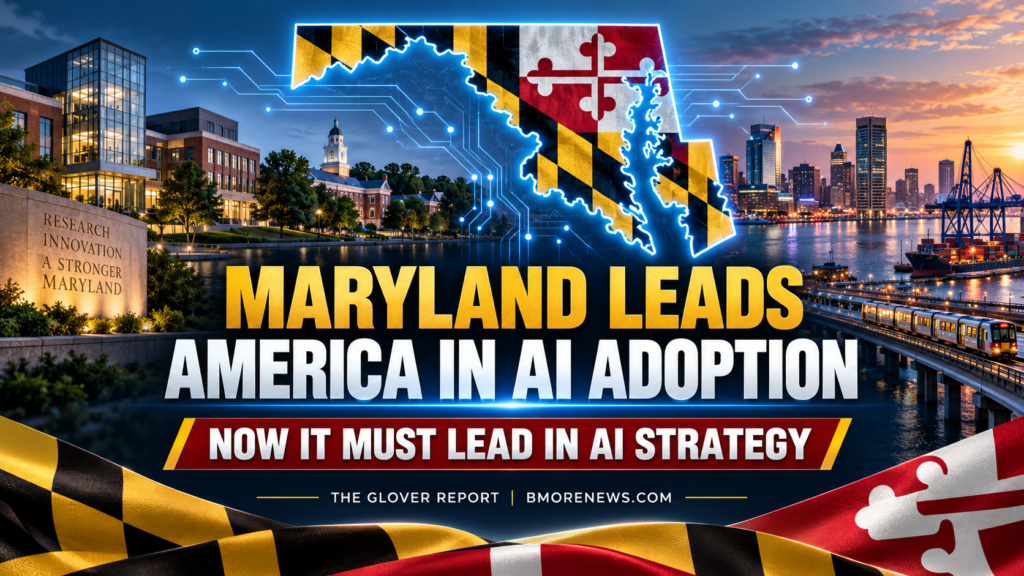
Microsoft’s 2026 United States AI Diffusion Report estimated that 36.3% of Maryland’s working-age population used generative AI, placing Maryland first among the 50 states. The District of Columbia ranked higher, but Maryland led the states. The national estimate was approximately 31%.
My home state—and the state where I proudly attend the University of Maryland—is at the forefront of public AI adoption.
That is a major news story. It is also an enormous responsibility.
Maryland should not settle for being the state where the most people use AI. Maryland should set out to become the East Coast center for responsible AI education, commercialization, governance, and public benefit.
We already possess many of the necessary ingredients.
Maryland has the University System of Maryland, Johns Hopkins University, Morgan State University, Coppin State University, Bowie State University, the University of Maryland Medical System and other educational and medical institutions.
We have federal agencies, research laboratories, cybersecurity expertise, defense institutions, biotechnology companies, and a highly educated workforce.
We have BWI Thurgood Marshall Airport, the Port of Baltimore, Interstate 95, MARC service, and Amtrak’s Northeast Corridor connecting us to Washington, Philadelphia, New York, and Boston.
Baltimore is also the birthplace of the Baltimore and Ohio Railroad, America’s first common-carrier railroad. Transportation and technological change are not new to us. Connecting people, markets and ideas is embedded in Maryland’s history.
Our location between Washington’s public power and the Northeast’s financial and commercial power gives Maryland a strategic position few states can match.
The question is whether we recognize it—and whether we organize it.
Maryland’s Black Technology Ecosystem Is Already Here
We must also stop discussing Maryland’s technology future as though Black people are waiting outside the door.
The ecosystem already exists.
I have covered Dr. Tyrone “Doc T” Taborn, publisher, chairman, and CEO of Career Communications Group, whose work has spent decades connecting Black students and professionals to science, engineering, and technology. His AiNEXTGEN conference and recognition program help convene people thinking about artificial intelligence, innovation, and the future.
I have covered Delali Dzirasa, founder and CEO of Baltimore-based Fearless, who has demonstrated that a Black-owned technology company can grow from Baltimore, compete for major contracts and build software intended to serve people.
I have covered LaKisha Greenwade, founder and CEO of Wearable Tech Ventures, whose work connects wearable technology, entrepreneurship, health innovation, and inclusive ecosystem building.
I have covered BC3 Technologies, a Baltimore-based, minority-owned medical-technology company developing an FDA-cleared spray designed to control severe bleeding during emergencies.
These are not side stories.
They are evidence.
They prove that Maryland already has Black technologists, founders, scientists, conveners, investors, and communicators contributing to the innovation economy. The task is not to “introduce” Black Maryland to technology. The task is to connect, finance, scale and recognize the people already doing the work—and prepare many more to join them.
Maryland’s AI strategy cannot be written solely inside corporate boardrooms, government offices or university laboratories.
Entrepreneurs must be present.
Black businesses must be present.
Public-school educators must be present.
Students must be present.
Parents, labor leaders, environmental advocates and community organizations must be present.
The people who will live with the consequences must have a voice in the decisions.
Public Education Must Be the Front Door
If Maryland leads the country in public AI adoption, then public education must become the front door to Maryland’s AI strategy.
Our children should not be trained merely to consume AI products created somewhere else. They should learn to understand, question, build, repair, audit, and improve the systems.
That education cannot begin only when a student reaches college.
Maryland should introduce age-appropriate AI literacy throughout its public schools. Students should learn what AI can do, where it fails, how bias enters a system, how it collects personal information, and why human judgment still matters.
They should also see the larger infrastructure behind the screen.
Some students will become software developers and data scientists. Others can become electricians, engineers, cybersecurity specialists, semiconductor technicians, cooling-system experts, robotics professionals, quantum researchers, ethicists, policymakers, journalists, or entrepreneurs.
The AI economy will require far more than people who know how to type prompts into a chatbot.
Imagine Baltimore students moving through a connected pathway from elementary and secondary schools to Coppin, Morgan, UMBC, the University of Maryland, community colleges, apprenticeships, and local technology companies.
Imagine young people from West Baltimore helping design the systems operating in their own communities.
Imagine public-school teachers receiving the training and computing access necessary to prepare students for jobs that are only beginning to exist.
Imagine Black-owned businesses receiving technical assistance and shared computing access so they can use AI to improve marketing, logistics, accounting, healthcare, manufacturing, and customer service.
That would be public adoption with a public purpose.
Without that connection to education and ownership, a high adoption rate may simply mean Marylanders are excellent customers for technology owned somewhere else.
I want us to be more than customers.
I want us to be builders.
A Charge to Governor Wes Moore and Maryland’s Leadership
Governor Wes Moore has spoken repeatedly about leaving no one behind. Artificial intelligence will test that promise.
Maryland needs a coordinated strategy that joins economic development, public education, higher education, environmental protection, workforce preparation, transportation, energy planning, and community participation.
The governor should consider convening a Maryland AI and Quantum Leadership Council that includes universities, public school systems, community colleges, technology companies, Black-owned businesses, organized labor, environmental experts, students, and community representatives.
Its purpose should not be to produce another report that sits on a shelf.
It should establish measurable goals:
- Universal AI literacy for Maryland students and educators.
- Shared public-interest computing capacity for universities, schools, researchers and small businesses.
- Clear environmental standards for data centers.
- Transparent reporting of electricity, water, emissions and public subsidies.
- Binding protections preventing households from subsidizing private infrastructure.
- Apprenticeships and career pathways tied to actual jobs.
- Procurement opportunities for Maryland-based and Black-owned technology companies.
- Public participation before major infrastructure decisions are finalized.
- Stronger connections among AI, cybersecurity, biotechnology, medical innovation, semiconductors and quantum research.
- A statewide strategy to turn public adoption into business formation, employment, and community wealth.
Maryland has already begun confronting the infrastructure question. The General Assembly’s Utility RELIEF Act established stronger protections intended to prevent households and small businesses from automatically absorbing costs created by large electrical users, including data centers. It also created a large-load registry requiring the disclosure of certain information to state regulators.
That is progress, but it is not the end of the debate.
Maryland must still determine how much project-level information the public receives before facilities are approved. Questions remain about water, land, backup generators, emissions, noise, tax incentives, permanent employment, and cumulative environmental effects.
Maryland should not simply attempt to duplicate Virginia’s Data Center Alley.
We should build something smarter.
The University of Maryland Can Lead the Way
The University of Maryland is uniquely positioned to become the intellectual and institutional center of this effort.
The university already brings together computer science, engineering, quantum research, business, public policy, education, medicine, journalism, and the social sciences. The Robert H. Smith School of Business can help translate scientific breakthroughs into organizations, ventures, policies and sustainable business models.
That translation is essential.
Scientists may develop the technology. Engineers may build it. But business and government leaders decide how to finance, commercialize, regulate, scale, and distribute it.
Those decisions determine who benefits.
The Smith School could help convene a Maryland AI and Quantum Business Summit bringing together researchers, students, policymakers, investors, public-school educators, entrepreneurs, environmental advocates and community leaders.
It could examine how Maryland commercializes quantum discoveries without losing the companies and jobs to other states.
It could help small and Black-owned businesses incorporate AI without surrendering their data or becoming dependent on systems they do not understand.
It could develop new measures of technological success that include public access, environmental performance, workforce diversity and community benefit—not just revenue and investment.
And it could help establish Maryland as a national model for decision-making at the intersection of technology, business and humanity.
The University of Maryland should not simply participate in America’s AI future.
It should help define what a responsible AI future looks like.
Maryland Can Lead a Different Kind of Race
America must begin fighting as though it is behind.
That does not mean surrendering leadership. It means abandoning the complacency that often accompanies it.
A challenger asks harder questions.
Can we accomplish more with fewer facilities?
Can universities, governments and smaller businesses share computing resources?
Can public subsidies require public access and measurable community benefits?
Can environmental limits stimulate more efficient engineering?
Can we measure success by the number of residents and businesses empowered—not merely by dollars invested, chips purchased or megawatts consumed?
Maryland now has an opportunity to answer those questions before someone else answers them for us.
We do not have to choose between technological leadership and environmental responsibility.
We do not have to choose between national security and public accountability.
We do not have to choose between innovation and inclusion.
Those false choices come from unimaginative leadership.
Our goal should not be merely to build more data centers. It should be to build an ecosystem that creates knowledge, businesses, jobs, medicine, public value and opportunity—while protecting the land, water, energy system and people who make that progress possible.
This is where Governor Wes Moore can lead.
This is where Maryland’s General Assembly can lead.
This is where our public-school educators can lead.
This is where Dr. Tyrone Taborn, Delali Dzirasa, LaKisha Greenwade, BC3 Technologies, and Maryland’s broader community of innovators can help lead.
This is where the University of Maryland and the Robert H. Smith School of Business can lead.
And this is where the children of Baltimore—if we educate, include and invest in them—can lead.
Dr. Martin Luther King Jr. warned in “Remaining Awake Through a Great Revolution” that humanity’s scientific and technological genius had made the world a neighborhood, but our moral and ethical commitment had not yet made it a brotherhood.
“We must all learn to live together as brothers—or we will all perish together as fools.”
That warning is not the end of this story.
It is our assignment.
Maryland leads America in public AI adoption. Now Maryland must lead the conversation about what artificial intelligence is for, who gets to build it, who benefits from it, and what we are willing—or unwilling—to sacrifice in its name.
Let Maryland become the place where technical intelligence meets moral intelligence.
Let the University of Maryland become the place where science, business, education and public responsibility meet.
Let Baltimore’s children see themselves not at the bottom of another technological economy, but at its center—as researchers, builders, owners and decision-makers.
Let us prove that technological leadership does not require environmental blindness, public exclusion or the surrender of our common humanity.
America may be racing China.
But Maryland can lead a more important race: the race to ensure that artificial intelligence makes human life better without making our planet unlivable.
That is the leadership I hope to see.
That is the future Maryland should build.
And that is a future worth fighting for.
Currency note: Euro-to-dollar conversions are approximate and use the European Central Bank reference rate of €1 to $1.146 on September 18, 2026.
__________________________________
Key Sources
- Microsoft U.S. AI Diffusion Report
- Stanford University AI Index Report
- Spain’s National Quantum Technologies Strategy
- ASML on Semiconductor Lithography
- Smith School Center for AI in Business
- Maryland’s Utility RELIEF Act
- The King Institute: “Remaining Awake Through a Great Revolution”