



(BALTIMORE – August 13, 2026) – Whenever I think about baseball’s relationship with Black and Latino communities, Roberto Clemente comes to mind.
Clemente was more than a magnificent right fielder. He was more than 3,000 hits, 12 Gold Gloves, four batting championships, two World Series championships, and a cannon for an arm.
He was a proud Afro-Puerto Rican who came to the United States and encountered many of the same racial barriers faced by Black Americans. He was insulted because of his skin color. His intelligence was underestimated because he spoke English with an accent. Sportswriters sometimes quoted him in broken English, reinforcing stereotypes instead of respecting the thoughtful, dignified man standing before them.
But Clemente never allowed America to define him.
Puerto Rico had already developed him.
Before Clemente became a Pittsburgh Pirate, he had been shaped by Puerto Rico’s baseball culture—one built through neighborhood competition, organized leagues, experienced mentors, and generations of exchange between Caribbean players and Black American ballplayers.
Clemente played winter baseball for the Cangrejeros de Santurce. One of the men who helped guide him was Pancho Coimbre, a Puerto Rican baseball great who had played for the New York Cubans in the Negro Leagues and later became a scout for the Pittsburgh Pirates.
During the winter of 1954–55, a young Clemente shared the Santurce outfield with Willie Mays. Together, they helped one of the most celebrated teams in Caribbean baseball history win both the Puerto Rican Winter League championship and the Caribbean Series.
Think about that: Willie Mays and Roberto Clemente playing in the same outfield—not in New York, Pittsburgh or another Major League city, but in Puerto Rico.
That was the international baseball world, created in part by segregation. Black American players traveled to Puerto Rico, Cuba, Mexico, Venezuela, Panama and the Dominican Republic. Caribbean and Latin American players came north and strengthened the Negro Leagues.
They played together, learned from one another and expanded the game across borders—even while white-controlled Major League Baseball denied many of them equal opportunity.
Clemente ultimately became one of baseball’s greatest humanitarians. He died on December 31, 1972, when a plane carrying relief supplies to earthquake victims in Nicaragua crashed shortly after leaving Puerto Rico. Clemente personally accompanied the shipment because he feared that previous supplies had not reached the people who needed them.
That was Roberto Clemente: greatness accompanied by responsibility.
His life presents a moral question for baseball today.
How can a sport celebrate Clemente’s humanitarian legacy, profit from generations of Black and Latino talent and invest extensively in developing players abroad while so many baseball fields and youth programs in Black America struggle for resources?
There is nothing wrong with investing in baseball internationally. Clemente’s story demonstrates the beauty of the game as it crosses borders. Latino and Caribbean children deserve every opportunity they receive.
But charity starts at home.
In the process of expanding the game worldwide, America failed to develop baseball talent equitably at home.
We missed.
We swung and missed.
The question now is whether Major League Baseball—and the Baltimore Orioles—will step back into the batter’s box and correct it.
Baseball Was Once Part of the Neighborhood
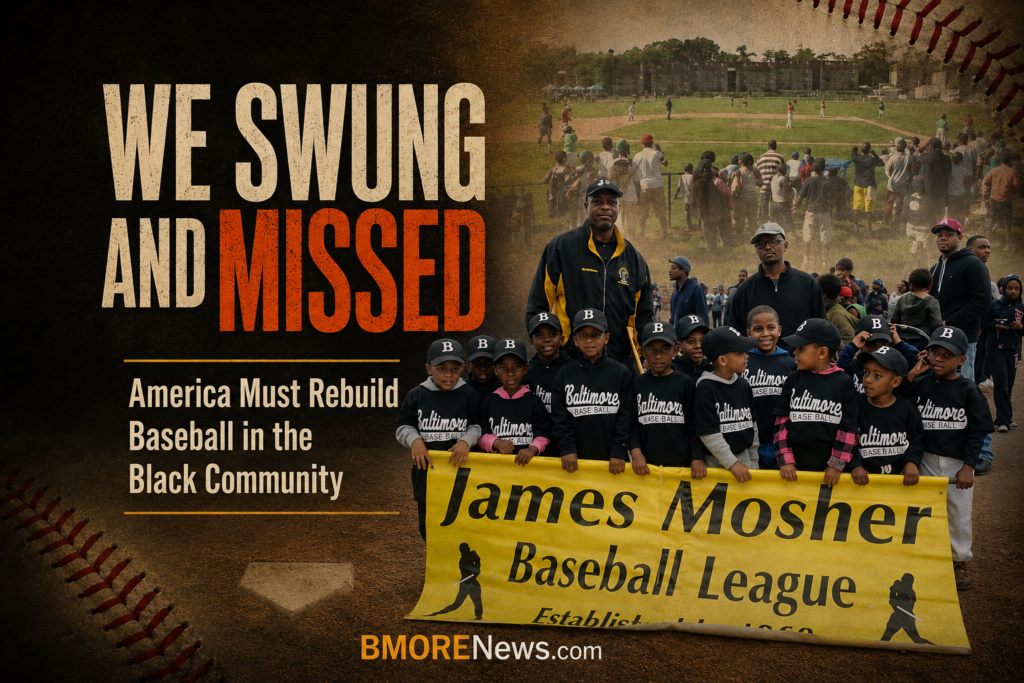
I grew up playing baseball at James Mosher, which was established in 1960 and is recognized as the oldest continuously operating African American youth baseball league in the United States.
Baseball was not some distant professional product we watched on television. It was part of our neighborhood culture. Children played, parents watched, coaches taught, and older players showed younger players how the game was supposed to be played.
You did not need a private hitting instructor to learn how to swing a bat. You did not need thousands of dollars to be recognized as an athlete. You went to the neighborhood field, competed and proved yourself.
James Mosher gave us something constructive to do. Baseball taught discipline, teamwork, patience and preparation. It connected generations and created lifelong friendships.
Donnell Anderson summarized that history in response to my previous column (Reclaiming the Sandlot: The $400 Bat, the Missing Roar and Why the Orioles Must Reconnect with Black Baltimore):
“Baseball was a big deal when I was a kid around my way.”
It certainly was around my way, too.
Rodney Walker suggested that basketball and football eventually supplanted baseball in many Black communities. That is undoubtedly part of the story. Children naturally gravitate toward the sports they see celebrated and made accessible around them.
Football commands attention every fall. Basketball has a particularly deep cultural connection to Baltimore. A child can pick up a basketball, find a hoop, and begin playing with relatively little equipment.
But that raises another question: Why did baseball lose its place?
Did Black children simply wake up one morning and decide they no longer liked baseball? Or did the community infrastructure surrounding the game weaken while the pathway to elite competition became increasingly expensive?
Talent Must Be Cultivated
Athletic talent does not develop by accident.
East Baltimore has traditionally produced extraordinary basketball talent because the game was embedded in the community. Children had access to recreation centers, playgrounds, coaches, older players, and constant competition.
Young players could watch the best athletes in the neighborhood and then step onto the same court to test themselves. The culture identified talent, challenged it and sharpened it.
Kenya has become internationally renowned for producing long-distance runners because generations of talent have been identified, cultivated and surrounded by a culture that understands how to develop it.
America must approach baseball with that same intentionality.
If we want the best baseball players, we must build an accessible system that finds and develops talent wherever it exists—not merely among families that can afford travel teams, private instruction and costly showcases.
Talent is everywhere.
Opportunity is not.
A child in Sandtown may possess the hand-eye coordination of a great hitter. A young pitcher in Cherry Hill may have a remarkable arm. A catcher in East Baltimore may understand the game instinctively.
But natural ability cannot reach its full potential without fields, equipment, instruction, repetition, competition and exposure.
That is how East Baltimore has developed basketball talent. That is how Kenya has developed generations of world-class distance runners. And that is how America must develop baseball talent—through a deliberate system accessible to every child with the ability, discipline and desire to play.
Baseball cannot continue waiting for families to buy their way into its development pipeline.
The game must return to the neighborhoods, identify the talent and invest in it.
Black Players Helped Build the International Game
There is a historical debt that Major League Baseball rarely discusses when addressing the decline of Black participation in the game.
Because segregation barred Black players from the American and National leagues, many of the greatest Negro League players spent their offseasons—and sometimes significant portions of their careers—playing in Cuba, the Dominican Republic, Puerto Rico, Venezuela, Mexico and Panama.
Cuba was among the earliest and most important destinations. Black American players traveled there before the Negro National League was established in 1920.
John Henry “Pop” Lloyd, Oscar Charleston, Josh Gibson and Satchel Paige were among the stars who competed in the Cuban League. They played alongside and against exceptional Cuban players, including the legendary Martín Dihigo.
Racism and colorism did not disappear when Black American players crossed the border. But many found greater freedom, recognition and respect abroad than they received in their own country.
The Dominican Republic emerged as another major destination. In 1937, dictator Rafael Trujillo recruited a collection of Negro League stars—including Paige, Gibson and James “Cool Papa” Bell—to play for Ciudad Trujillo. Trujillo used baseball as political propaganda, assembling a powerhouse team to demonstrate his authority and prestige.
Mexico also attracted leading Black players. During the 1940s, businessman Jorge Pasquel aggressively recruited stars from the Negro Leagues—and attempted to recruit players from white Major League Baseball—by offering salaries and opportunities unavailable to many Black players in the United States.
Puerto Rico and Venezuela developed strong winter leagues that became important destinations for Negro League players. Some competed there for years, extended their careers, and became celebrated figures within the local baseball culture.
Gibson became a legend in Puerto Rico, where he managed and played for Santurce. During the 1941–42 winter season, he hit .480 with 13 home runs and was recognized as the league’s top player.
These men did more than collect paychecks during the winter.
They shared techniques, strategy, discipline and knowledge. Some became managers, coaches and informal instructors. Local players and organizations absorbed what these seasoned professionals brought to the field.
But the exchange was never one-sided.
Latin American and Caribbean players also traveled north to compete in the Negro Leagues. Dihigo, José Méndez, Cristóbal Torriente and many others became essential figures in Black baseball.
Dihigo’s extraordinary career stretched across the United States, Cuba, Mexico and Venezuela, making him one of international baseball’s most revered figures.
It was a genuine cross-pollination of talent, culture and baseball intelligence.
Black American players helped elevate the game throughout Latin America and the Caribbean. Latin American and Caribbean players, in turn, strengthened the Negro Leagues. They competed together because the color line imposed by white Major League Baseball created a separate international baseball world.
Somewhere in the process of expanding the game abroad, however, baseball failed to develop the game at home.
Charity starts at home—and we missed.
We swung and missed.
This is not an argument against investing in Latino or Caribbean players. Those young athletes deserve every opportunity they receive. It is an argument that Major League Baseball should demonstrate the same commitment to cultivating Black children in Baltimore, Philadelphia, Detroit, Chicago, Atlanta and communities across America.
Baseball built academies, scouting networks and development pipelines beyond our borders while too many diamonds in Black America deteriorated, neighborhood leagues disappeared and talented children were priced out of the game.
The descendants of the community that helped carry baseball across international borders were left without a comparable pipeline in their own neighborhoods.
The Cost Goes Far Beyond a $400 Bat
My previous column used the $400 bat as a symbol of how youth baseball has become commercialized and inaccessible to many working-class families.
But the bat is only the beginning.
A serious youth player may face expenses for:
- Team registration
- Tournament fees
- Travel and hotels
- Private instruction
- Showcase participation
- Uniforms
- Cleats and gloves
- Aluminum and wooden bats
- Strength and conditioning
- Transportation to practices and games
Robert Scott, a Baltimore native who has coached youth baseball in Atlanta for approximately 18 years, offered valuable insight following the column. He has coached in the RBI environment and at higher levels of competitive youth baseball.
Scott explained that a $400 aluminum bat may perform at its best for only a season. At the higher levels, players may also need multiple wooden bats, some costing approximately $100 each.
He also made an essential point: Baseball is not the only expensive youth sport. Club soccer, lacrosse, volleyball, swimming, basketball and football can also price working-class families out of elite competition.
Baseball’s problem, however, is compounded by the shrinking number of neighborhood leagues and accessible diamonds.
When the local infrastructure disappears, families are pushed toward an expensive private system.
Playing the Game Is Not the Same as Entering the Pipeline
Reginald Johnson recalled Baltimore’s RBI league, part of Major League Baseball’s Reviving Baseball in Inner Cities initiative.
RBI was founded in 1989, and Major League Baseball assumed its administration in 1991. The program continues today, and the Orioles have supported participating teams.
That support should be acknowledged.
But we must ask a harder question: Does the RBI give Black children access to the same developmental and recruitment pipeline as players from affluent families?
Scott’s assessment was blunt. The RBI environment in which he coached could not compare with the elite development system surrounding organizations such as Perfect Game.
That distinction matters.
It is one thing to give a child an opportunity to play baseball.
It is another thing to position that child for recruitment.
At the highest levels of youth baseball, organizations such as Perfect Game host tournaments, showcases, and player evaluation events. College coaches and professional scouts examine performance, statistics and physical measurements against elite competition.
Families that can afford that system receive greater access and visibility.
Families that cannot afford it risk being left behind, regardless of how much talent their children possess.
Free registration may get a child onto a neighborhood team. It does not automatically pay for the travel, instruction, technology and exposure that increasingly determine how far that child can go.
Baseball has confused participation with development.
They are not the same.
Where Are the Orioles?
Some will produce a list of Orioles programs, camps, donations and sponsored teams.
But the existence of a program on paper does not necessarily create a meaningful presence in a neighborhood.
I can only speak about what I have seen.
I grew up playing baseball at James Mosher. I know what that field has meant to generations of children in West Baltimore.
Yet the Orioles have not maintained the kind of consistent, visible presence at James Mosher that I believe Baltimore’s hometown baseball franchise should have.
The first time I personally remember seeing Major League Baseball come to James Mosher was during the Freddie Gray unrest in 2015.
To be clear, that was Major League Baseball—not the Baltimore Orioles.
That distinction matters, but the larger question remains: Where has the sustained Orioles presence been?
A visit during a moment of national crisis is not the same as a lasting relationship with the community.
An occasional clinic is not a development system.
A photograph with children is not a pipeline to college baseball or the major leagues.
The real measure is whether children can see the program, access it, and grow through it.
How many Black Baltimore children have entered an Orioles-supported program and advanced into elite travel baseball?
How many have received showcase sponsorships?
How many have been connected directly with college recruiters?
How many have earned baseball scholarships?
How many have reached professional baseball?
Those are the numbers that matter.
America Invests Elsewhere
Ed Nottingham raised perhaps the most important issue in the discussion.
He possesses firsthand knowledge of elite youth baseball. His youngest son plays baseball at the University of Georgia, and his family traveled through the demanding showcase circuit—including Perfect Game, LakePoint, WWBA, East Coast Pro and the Area Code Games.
Nottingham’s concern is not simply that elite baseball costs money. His larger question concerns where Major League Baseball chooses to make substantial developmental investments.
Major League organizations have invested heavily in overseas academies, scouting networks and player-development facilities. Those investments have helped produce generations of exceptional international players.
There is nothing wrong with discovering and developing talented children in the Dominican Republic, Puerto Rico, Venezuela, Mexico or anywhere else.
But why has comparable infrastructure not been established throughout Black America?
Why can’t Baltimore have a first-class baseball academy designed to discover and develop children from Sandtown-Winchester, Upton, Park Heights, Cherry Hill, East Baltimore and every other community in the city?
Why should a gifted Baltimore child need thousands of dollars and a family capable of traveling around the country to receive the training and exposure that could change that child’s life?
Build the Academy in Baltimore
Nottingham offered a solution worthy of serious public discussion: Baltimore should establish a permanent Major League Baseball youth development facility on vacant city land.
This should not be another temporary clinic or ceremonial community appearance.
It should be a year-round institution jointly supported by the Baltimore Orioles, Major League Baseball, Baltimore City, philanthropic organizations and corporate partners.
The academy should include:
- Regulation baseball fields
- Indoor batting and pitching facilities
- Professional year-round instruction
- Strength, conditioning and injury-prevention programs
- Pitching and hitting technology
- Player measurements and performance analytics
- Academic tutoring and college preparation
- Transportation for children throughout Baltimore
- Equipment for families who cannot afford it
- Sponsored travel and showcase participation
- Direct relationships with college coaches and professional scouts
Baltimore has former professional, college and high-level amateur players who understand the game and understand our children.
They should be hired—not merely invited to make ceremonial appearances—to coach, mentor and develop the next generation.
This city does not lack baseball knowledge.
It lacks a coordinated commitment to apply that knowledge.
Come Back to James Mosher
James Mosher should be part of that investment.
For generations, it has been more than a baseball league and a collection of fields. It has been a community institution. It has produced competitors, leaders and lifelong friendships. It has given children a place to belong.
The Orioles should establish a consistent presence there—not because a camera crew is coming and not because Baltimore is experiencing a crisis, but because James Mosher represents the roots of Black baseball in this city.
Come during the offseason.
Come when registration begins.
Come to practices and games.
Bring players, coaches, and scouts.
Help restore and maintain the fields.
Sponsor the equipment.
Support the coaches and community leaders already doing the work.
Stay long enough for the children to know your names—and for you to know theirs.
Step Back Into the Batter’s Box
This is not about attacking the Baltimore Orioles.
It is about challenging our hometown Major League Baseball franchise to become a transformative force in the city it represents.
Baseball did not disappear from Black communities because Black children suddenly lost the ability to play. Neighborhood infrastructure weakened. Recreation programs declined. The elite pipeline became increasingly expensive. Institutional investment failed to close the gap.
We know how athletic greatness is developed.
East Baltimore has demonstrated it through basketball.
Kenya has demonstrated it through long-distance running.
Puerto Rico demonstrated it through Roberto Clemente.
Talent must be recognized, surrounded, challenged, trained, and given a genuine path forward.
America must develop baseball talent with the same intentionality—and that system must be accessible to all.
Roberto Clemente understood that greatness creates responsibility. Baseball continues to celebrate his name by presenting its annual award for character, community involvement, and humanitarian service.
Now the sport must embrace the responsibility that comes with his legacy.
Black ballplayers helped carry baseball across borders. They strengthened leagues throughout Latin America and the Caribbean while being denied equal opportunity at home.
In expanding the game internationally, baseball failed to make an equally serious investment in many of the Black American communities that helped build it.
Charity starts at home.
We missed.
We swung and missed.
But the game is not over.
Baltimore has the land. We have the history. We have the coaches. We have the knowledge. Most importantly, we have children whose potential has yet to be discovered.
Baltimore does not need another photo opportunity.
It needs fields, coaches, equipment, transportation, analytics, academic support, and a direct road from the neighborhood diamond to college and professional baseball.
Baltimore needs a genuine baseball pipeline.
And James Mosher would be a mighty good place to start.