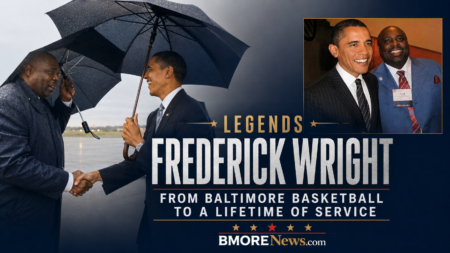



The Baltimore basketball standout survived addiction, gunfire, and the prospect of prison—then devoted his second chance to helping young people see one for themselves.
(BALTIMORE – September 2, 2026) – I have to thank Dwayne “Kosher” Wood for the bounce pass.
My reintroduction to Baltimore basketball history took root at the Dome, where I covered Greg Branch’s Tally Ho Foundation Legends Tournament year after year. That is where I met Kosher and became connected to a brotherhood of men – and women legends like the Great Gert Scott – who carry this city’s basketball history in their bones.
I knew Keith Goodie from my Dunbar days, but the Legends games allowed me to know him—and so many others—on a deeper level. The tournament has become an important event for Baltimore City and BMORENews.com, and we try to be there every time.
Then Kosher called me about another legend.
He told me there was a Lake Clifton Laker living in Iowa whose story I needed to hear: Rodney “Pop” Wright, the brother of fellow Baltimore legend Frederick Wright.
So I called Pop.
What began as a conversation about basketball became a testimony about survival, redemption, faith, and what it truly means to be a legend.
From One Win to a Baltimore Basketball Powerhouse
Pop said he started for Lake Clifton from his freshman year through his senior year and led the Lakers in scoring each season, averaging roughly 20 points per game during that span.
But his story is not simply about points. It is about transformation.
Pop remembers Lake Clifton going 1–18 in 1973. By 1975, the Lakers had become one of the finest teams in Baltimore. A published ranking of the city’s greatest public-school basketball teams lists the 1975 Lakers at 24–2, winners of the MSA A championship and the city championship, ranked No. 1 by The Baltimore Sun, and No. 12 nationally.
How did a struggling program become a powerhouse so quickly?
“I would say the players,” Pop told me. “We just had a great group.”
He remembered Tim Burroughs as a relentless forward whose energy resembled Dennis Rodman’s. Kevin Graham, the brother of Maryland great Ernie Graham, was a force at power forward. Robert Brown anchored the middle and, in Pop’s estimation, may have been the best player on the entire team.
The Lakers had something unusual for a high-school team in that era: size without sacrificing skill. Pop described two guards around 6-foot-4 who could handle the ball and shoot, the Graham brothers standing roughly 6-foot-7 and 6-foot-8, and a center around 6-foot-7.
“We really had the equivalent of a college team,” he said.
According to Pop, Lake Clifton won 32 consecutive MSA games during a two-year stretch. The record was remarkable, but what happened after Lake Clifton may have been even more significant.
Four Division I Starters From One Baltimore Team
Pop points with pride to four members of that Lake Clifton era who became starters at major Division I programs: Ernie Graham at the University of Maryland, Lance Hill at the University of Kansas, Arnold “Clyde” Gaines at the University of Wisconsin, and Pop at Drake University.
That achievement must be understood in the context of the time.
Pop remembers major college recruiters largely bypassing Baltimore’s inner-city public schools—City, Dunbar, Lake Clifton, and others—while focusing more heavily on Catholic and private-school programs. Baltimore had the talent. It did not always receive the exposure.
Those four players helped prove what was already here.
Pop took his talent to Drake University in Des Moines, Iowa. Drake’s official records list the 6-foot-4 Baltimore native on its 1978–79 and 1980–81 rosters. He finished his Drake career with 1,283 points and was later selected to the university’s 1980s men’s basketball all-decade team.
Long before Pop arrived, Drake had reached the 1969 Final Four at Cole Field House in College Park. That national run put the university on his radar. Years later, Iowa would become more than the place where he played college basketball.
It would become the place where he rebuilt his life.
The Coaches Who Built the Foundation
Pop’s basketball education began well before Lake Clifton.
He traced his organized playing days to 1969 and the Yankee Rebels, a team based in the Harford Road area. He remembered playing under Henry “Sarge” Powell and competing against the Madison Square Rockets coached by Agabel Lee, one of East Baltimore’s early coaching pioneers.
Pop placed Lee in a lineage that included JoJo Parks, Charlie Moore, Leon Howard, Woody Williams, William Wells, and Bob Wade. These were not merely men who taught young players how to run an offense or defend the paint. They taught discipline, responsibility, survival, and life.
He also credited Hurl Bates and the Urban Coalition Summer Pro Basketball League, which brought professional players to Dunbar during the summer and gave Baltimore talent exposure that the traditional college recruiting pipeline too often denied.
“All of these guys were my coaches,” Pop said. “We won championships together, and they all taught me a lot about life itself.”
Basketball, Drugs, and the Choices Baltimore Presented
Then our conversation went deeper.
Pop spoke candidly about the world in which he came of age. For many boys in his neighborhood, he said, the visible paths to success appeared painfully narrow.
“Either you were going to be a drug dealer or a professional guy in sports,” he recalled. “We wasn’t thinking business.”
The 1972 film Super Fly, he said, helped make the drug dealer appear stylish, powerful, and successful. That image collided with the reality of Baltimore neighborhoods already being damaged by heroin and by the trauma surrounding veterans returning from Vietnam.
The men with money, clothes, cars, and neighborhood status were often connected to the drug trade. For a child watching from the corner, the message could be seductive—and deadly.
Pop does not tell that part of the story from a distance. He lived it.
“Rodney ‘Pop’ Wright did,” he said, making it clear that he would expose his own past without telling anyone else’s story for them.
He became addicted to heroin and crack cocaine. He called himself “notorious.” His basketball gifts had taken him out of Baltimore, but addiction followed him.
In 1985, near Harford Road and 25th Street, Pop said he was shot twice in the back during a robbery attempt. The wounds left him with a colostomy bag and a body he had to put back together.
He left Baltimore, but he had not yet escaped the drugs.
The Moment in the Hole
Pop’s turning point came after he was caught attempting to rob Drake Bank—the bank associated with the university where he had once been a basketball star.
He said he was facing the possibility of 67 years in prison. While confined in the Polk County Jail, authorities placed him in isolation for several days.
There, stripped of the applause, the basketball reputation, the street identity, and every excuse, Pop got down on his knees.
“I really got a chance to pray to Christ,” he told me. “If I get the opportunity to get out of this, my Father, my Lord, I will never turn back.”
July 27, 1986, was the last day Rodney “Pop” Wright used drugs or alcohol.
On July 27, 2026, he celebrated 41 years clean and sober.
That is the championship no scoreboard could measure.
The Promise Became the POP Program
Pop did not treat his second chance as something meant only for him.
He built the Positive Outreach Program—better known as the POP Program—and dedicated his life to reaching young people before drugs, violence, hopelessness, or incarceration could claim them.
Pop estimates that his presentations have reached more than 850,000 young people in person.
The program grew from an unexpected place: a car dealership. Pop became the top Honda salesman in Iowa, and he did so well that the dealership owner allowed him to take December off to volunteer in schools. One month of service grew into a mission that has lasted for decades.
Pop also used his connections to help other people start over. He brought his brother Fred to the Midwest and introduced him to the Urban League. He estimates that he helped 15 to 20 relatives and approximately 50 other adults relocate or get back on their feet.
“Disciples should teach disciples to teach disciples,” he said. “Whatever I have learned in life, I try to pass it on to others, especially the youth.”
That is the heart of the Legends series.
Being the baddest player on the court does not, by itself, make somebody a legend. Statistics may make you accomplished. Championships may make you celebrated. But a legend gives something back.
Pop Wright gave his life back.
When Men Stand Up
Pop believes education remains one of the most important protections for Baltimore’s children. If a child reaches third grade without learning to read proficiently, he warned, that child’s future can begin narrowing before the child is old enough to understand what is happening.
I have long heard it said even more bluntly: if a Baltimore child has not learned to read by age eight or the third grade, somebody is already planning a prison cell for him. The wording is harsh, and prison projections are more complicated than that saying suggests. But its warning is real. Academic failure is not an isolated classroom problem. It can become the first in a chain of limited options, street exposure, contact with the criminal-justice system, and incarceration.
But education alone is not enough. Young people must also see adults living the lessons they preach.
“When men stand up, you know what boys will do?” Pop asked.
I expected him to say they would stand up, too.
“Sit down and listen,” he answered.
That line stayed with me.
Pop has spent 41 years making sure his conduct matches his message. Young people have never seen him take a drink. They have never seen him high. They have never seen him use his recovery as a performance while living another way behind closed doors.
“You not only got to say it,” he told me. “More so, you got to do it.”
Take Somebody With You
When I asked what advice he would give a Baltimore student leaving home for college, Pop did not talk first about scoring, grades, playing time, or even adjusting to a predominantly White institution.
He talked about opening the door for somebody else.
If a university wants your talent, he said, ask whether there might also be an opportunity for your cousin to find work, your aunt to relocate, or someone else in your family to experience a different environment.
“Don’t stop there,” Pop said. “Ask the school, ‘Can my cousin come out here and get a job? Can my aunt work?’”
He has watched a change of scenery change lives. Baltimore can place a child in survival mode so early and so completely that the child struggles to imagine another way of living.
Pop estimated that three out of every four Baltimore children have witnessed a shooting or been close to one before reaching sixth grade. It is not a verified statistic; it is the judgment of a man comparing the violence of the Baltimore he knew with the relative quiet of Des Moines. The larger truth behind his observation is undeniable: too many Baltimore children carry trauma long before adulthood.
When people in Iowa watched The Wire, Pop said, some reacted as though they were looking at a developing nation. They could not imagine that American children were navigating that kind of environment every day.
Yet Pop does not view Baltimore children as broken. He views them as battle-tested, capable, and full of possibility.
But talent cannot be the entire preparation. A young person—particularly a young Black man leaving the inner city for a college campus—needs academic skills, mentors, cultural awareness, mental-health support, and people who can help him understand an unfamiliar institution before a problem becomes a crisis. Getting through the door is access. Learning how to navigate, adapt, and thrive once inside is another form of access altogether.
“Sometimes you’re so caught up in Baltimore that you really can’t see what else it is in life,” he said.
Then he delivered the line that captures both the burden and the promise of this city:
“If you can make it in Baltimore, you can make it anywhere. You could basically be a king or a queen in other areas.”
What Covering These Legends Is Teaching Me
The longer I cover Baltimore’s basketball legends, the clearer it becomes that I am not merely documenting old games.
Each interview opens another window into the social and economic conditions from which these players emerged. We talk about box scores, championships, playgrounds, and college scholarships. But underneath those memories are drugs, crime, struggling schools, traumatized families, limited employment, mass incarceration, and the landmines awaiting a young Black boy who has not been given the tools to read, reason, and imagine a future.
Let me say it plainly. People in the community know exactly how it happens because we have seen it. Growing up in the inner city, I saw it. We all saw it.
East Side, West Side, Uptown, Downtown, Cherry Hill, and the County—we have all known the star player. He is the one everybody recognizes. People call his name when he enters the gym. Adults speak about his future. Girls notice him. Coaches pursue him. The neighborhood begins imagining where his talent might take him.
The star player gets a lot of attention. I sometimes compare it to the attention received by a really pretty girl. Everybody notices her. Everybody wants to speak to her. Everybody may want something from her. If her head is not on straight—or if nobody has prepared her to understand all that attention—it can become confusing.
The same can happen to the star basketball player. He may be young, celebrated, and surrounded by people telling him how great he is without anyone helping him understand what is actually happening around him. Attention can look like love. Access can look like friendship. People attracted to the talent can appear committed to the person. Before long, a young man can become caught up.
I am not saying that is what happened to Pop Wright. I am describing what I have witnessed in the streets time and time again, just as many other people have witnessed it.
We know what can happen when the games stop, the crowds disappear, and the athlete is no longer playing. We know how often drugs have diminished some of the greatest basketball careers we ever witnessed. This is not only a Baltimore story; it has happened to athletes across the country. But Baltimore has its own stories—stories the people in our neighborhoods know even when they never become part of the official record.
And it is not confined to sports. Success can disorient anybody. A teacher, CEO, architect, entrepreneur, entertainer, or elected official can reach a new level and then fall. It may be self-sabotage, inadequate preparation, untreated trauma, addiction, or simply an inability to perform under unfamiliar demands. Whatever the reason, human beings sometimes stumble when life takes them somewhere their talent reached before the rest of them was ready.
That is why our responsibility cannot end at celebrating the gift. We have to prepare the person carrying it.
Our careers do not end when we stop dribbling a basketball. Our lives do not stop when the cheering stops. The question becomes: What are we going to do afterward?
Pop Wright is a quintessential example of what we can do after the last game—and after the last high. Imagine being accustomed to winning, being recognized, and being the star, only to discover that life no longer responds to you that way. Sometimes life hits you. Sometimes you fall. The greater question is whether you can get back up, reclaim your life, rediscover your purpose, and use what remains to help somebody else.
These were not nameless people standing somewhere outside the history. They were gifted players whose names once filled gyms, school hallways, neighborhood conversations, and newspaper sports pages. Their talent made them heroes, but it did not make them immune to addiction—or to the same pressure, pain, temptation, and human vulnerability surrounding everyone else.
We cannot tell the history honestly if we preserve only the highlights while erasing what happened to some of the men after the cheering stopped. At the same time, Pop chose to tell his own story. We will not use his honesty to expose men who have not chosen to tell theirs. But we also will not sanitize the environment in which this generation played, lived, struggled, and, in too many cases, suffered.
Baltimore was known as a heroin town—a dope town—long before crack cocaine devastated American cities in the 1980s and 1990s. Pop came of age amid heroin, the mythology popular culture built around drug dealers, and the instability surrounding a generation of soldiers returning from Vietnam, some of whom came home carrying addiction and trauma. A decade later, crack would tear through many of the same neighborhoods.
Inside all of that, basketball remained one common, constructive thing.
The court offered structure. It offered coaches. It offered brotherhood, discipline, travel, recognition, and, for a gifted few, a route to higher education. The game could not remove every danger awaiting a young man, but it could place adults around him, expectations before him, and another possibility within view.
Still, we should not romanticize the playground. In Baltimore, the basketball court was part of the street. Around the game, a young player might encounter people smoking marijuana, drinking alcohol, selling drugs, using powder cocaine, injecting cocaine, or injecting heroin. Some adults had lived inside those cycles for years. The young athlete had to learn how to move through that environment—how to recognize danger, resist pressure, stay focused, and decide whom to trust.


Sometimes his talent protected him. Neighborhood figures might steer him away from trouble because everybody knew the young man could play. Coaches, older players, and community elders might keep an eye on him. But being protected from certain dangers is not the same as being prepared to understand them. Protection may last only as long as the protector is present—or as long as the ball keeps bouncing.
Then the athlete leaves Baltimore.
He may arrive on a college campus larger, wealthier, Whiter, and less familiar than any institution he has ever entered. Suddenly, the people who knew his family are gone. The neighborhood rules he understood no longer apply. He may be confronting academic pressure, loneliness, culture shock, newfound freedom, relationships, money, substances, public expectations, and the fear of losing the very talent that brought him there.
If he struggles, that does not automatically mean Baltimore ruined him. It means he is human. Moving from one environment into another requires adjustment, and even a strong young person can stumble when the demands change faster than his support system can respond.
This is where mental health has to become part of the basketball conversation. We prepare athletes to run plays, lift weights, study film, and perform under pressure. We must also prepare them to recognize anxiety, depression, isolation, trauma, addiction, and emotional overload. They need to know how to ask for help without believing they have surrendered their toughness or jeopardized their place on the team.
That is why Pop’s story reaches far beyond basketball. He experienced nearly every force that could consume a young Black man: academic and economic limitation, the drug culture, gun violence, addiction, and incarceration. Basketball opened a door, but basketball alone could not save him. Ultimately, faith, accountability, treatment, education, mentorship, opportunity, and service helped him build another life.
The pretty version of basketball history concentrates on the athletes who reached the NBA, became famous, and found glory beneath the brightest lights. Those stories deserve to be celebrated. But the NBA is not the only victorious ending to a basketball life.
For Pop, basketball led somewhere different. It carried him beyond Baltimore, exposed him to another world, and eventually gave him a platform that enabled him to reach hundreds of thousands of young people. His road included addiction, violence, humiliation, and a jail cell. But it also led to recovery, purpose, service, and 41 years of keeping a promise to God.
That path is as rewarding as an NBA career—and, measured by the lives he has touched, perhaps even more so. This is the story of Rodney “Pop” Wright and how he came to give back. That is what makes him a legend.
The scale of American incarceration gives that journey an even deeper meaning. The familiar claim that the United States has 5% of the world’s population but 25% of its prisoners is now outdated. Current figures put the United States at roughly 4% of the world’s population and about 16% of the world’s known prison population—still a staggering imbalance. The latest comprehensive U.S. Justice Department tables report that Black people comprised 33% of people serving sentences longer than one year in state prisons and 32% in federal prisons at the end of 2023.
Those numbers are not an abstraction in Baltimore. They represent boys, fathers, brothers, teammates, and unrealized possibilities.
Pop’s insistence on education is therefore not a slogan. Neither is his call for role models. Our young people need preparation before opportunity arrives, mentors while they are navigating it, and access that extends beyond admission to the knowledge and relationships required to remain, adapt, and succeed. A scholarship, a uniform, and a dormitory key do not mean the adjustment is complete. The institution and the family must care about the whole student, not merely the athlete who can help win games.
Maybe basketball made education accessible for Pop. Maybe education gave his basketball somewhere to take him. Either way, the game became a bridge. The obligation now is to make sure our children can cross that bridge—and that somebody is waiting on the other side to guide them.
That is where these Legends stories have to go. Each one must do more than preserve a name. Each one must push the envelope, expose another layer of Baltimore history, and leave the next generation with something it can use.
His Verse
At the end of these Legends conversations, I ask for a verse—a line that captures the life, the lessons, and the legacy.
Pop did not hesitate.
“Be an example and be a role model, and do it by your actions,” he said. “Your actions speak louder than words.”
Rodney “Pop” Wright was a champion at Lake Clifton. He became a Division I basketball player at Drake. He scored more than 1,200 college points and helped establish a path for Baltimore players who came behind him.
But his greatest victory did not happen beneath arena lights.
It happened alone in a jail cell, on his knees, when he asked God for another chance—and decided that if he received one, he would spend it helping others.
Forty years later, the promise is still being kept.
That is more than basketball.
That is a legend.
Rodney “Pop” Wright is expected to participate in Lake Clifton’s 50th-anniversary celebration on November 14, 2026. BMORENews.com will provide additional coverage as details become available.
Public sources consulted
- Drake University Athletics: Pop Wright roster profile
- Drake University Athletics: 1980–81 men’s basketball roster
- Drake University Athletics: Former players named to all-decade teams
- Baltimore Sports and Life: Top 100 Baltimore City public-school basketball teams
- Bureau of Justice Statistics: Prisoners in 2023—Statistical Tables
- World Prison Brief: World prison population estimates
- U.S. Census Bureau: U.S. and World Population Clock