The 55th Eastern Regional Conference brought more than a sea of red to Baltimore. It brought economic, cultural, social, historical, and political power.
(BALTIMORE – August 30, 2026) – Downtown Baltimore was painted red this weekend.
Thousands of members of Delta Sigma Theta Sorority, Incorporated descended on the city for the organization’s 55th Eastern Regional Conference, held August 27–30, 2026, at the Baltimore Convention Center and Hilton Baltimore Inner Harbor.
I had the opportunity to cover the conference and witness its impact firsthand.
Before entering the main ballroom, I stopped to see Dr. Frances “Toni” Draper, publisher of the AFRO-American Newspapers. Dr. Draper graciously introduced me to Dr. Jermaine Dawson, the new CEO of Baltimore City Public Schools. Chrissy Thornton, president and CEO of Associated Black Charities, was there; Baltimore County Executive Democratic nominee Julian Jones was, too.
Once I entered the ballroom, however, the magnitude of the conference became clear.
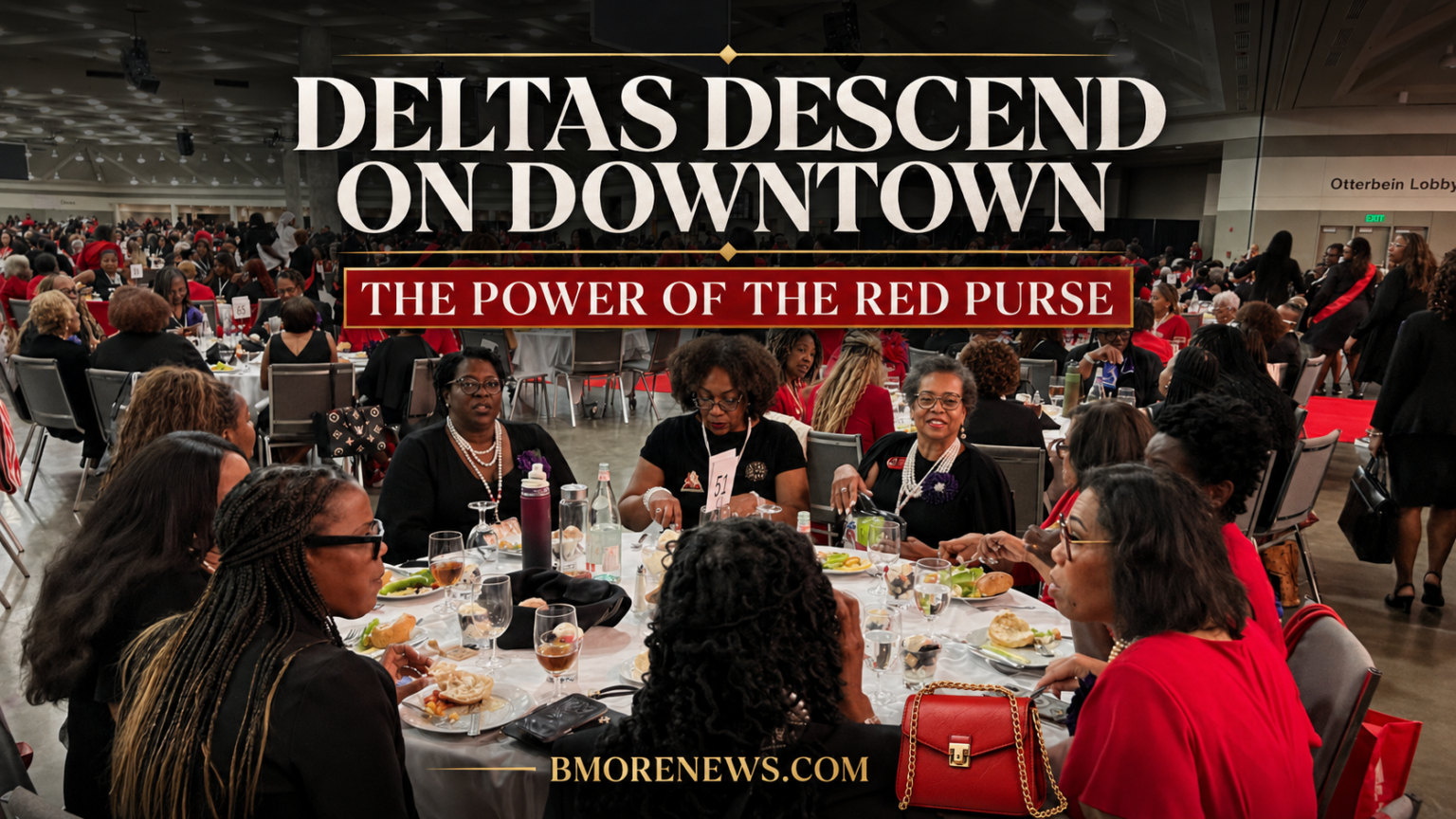
There were thousands of Deltas inside the Baltimore Convention Center. I cannot give you an exact number, but I can tell you what I saw: a convention center full of Black women.
And they were wearing red.
Oh, yes. They had on red.
It was an ocean of educated, articulate, conscientious, and accomplished Black women. I saw executives, entrepreneurs, educators, doctors, attorneys, elected officials, judges, homeowners, voters, mothers, mentors, and community leaders.
I saw women who earn money, manage money, invest money, and influence how money moves throughout America.
In other words, I saw power.
The Power Behind the Red Purse
Black America commands approximately $2 trillion in annual buying power. That is not a minor market or a niche demographic. That is an economic force capable of sustaining businesses, shaping industries, electing leaders, and transforming communities.
And within that market, the Black woman is essential.
The Black woman is not simply a consumer. She is increasingly the business owner, the corporate executive, the professional, the investor, and the entrepreneur. She determines or helps determine how household dollars are spent, where children are educated, which businesses receive support, and which political candidates earn the family’s trust.
So, when I looked across that convention center, I did not merely see thousands of conference attendees.
I saw thousands of decision-makers.
America may see the red dresses. Corporate America had better recognize the red purse. Politicians had better recognize the red vote. And everyone had better recognize the Black women carrying all three.
Standing on the Shoulders of Giants
This kind of Black female power did not suddenly appear in Baltimore in 2026.
Deltas have always been leaders.
The women who gathered downtown stand on the shoulders of Black women who confronted segregation, built institutions, challenged political systems, educated generations, and refused to surrender their dignity.
I think of Cicely Tyson portraying Miss Jane Pittman, walking toward that “whites only” water fountain after a lifetime of oppression. They could deny her access, but they could not erase her humanity. Through her work, Tyson showed America the pain, strength, beauty, and endurance of Black women.
I think of Dr. Betty Shabazz.
She was inside the Audubon Ballroom on February 21, 1965, when Malcolm X was assassinated. She was pregnant with their twin daughters and had four young daughters with her. Imagine the trauma of witnessing your husband murdered in front of you and your children.
Yet she continued.
Betty Shabazz raised six daughters while building her own life as an educator, administrator, and advocate. She carried her family through unimaginable grief without allowing that tragedy to become the end of their story.
That is strength.
I think of Fannie Lou Hamer, who dared to demand the right to vote in Mississippi.
They beat her like a man.
They put their hands on her as if she were a man. While she was being held in a Mississippi jail, officers ordered other prisoners to beat her with a blackjack. The beating left her with permanent injuries.
But they could not crush her spirit.
They could not silence her voice.
They could not stop her from helping to organize the Mississippi Freedom Democratic Party and challenging an all-white delegation at the 1964 Democratic National Convention.
Fannie Lou Hamer told America that she was “sick and tired of being sick and tired.” That declaration still resonates because Black women are still expected to endure pain, carry families, save institutions, and hold communities together—often without receiving the protection or recognition they deserve.
I think of Mary McLeod Bethune.
In 1904, Bethune founded the Daytona Educational and Industrial Training School for Negro Girls with faith, vision, and reportedly $1.50. That school eventually became Bethune-Cookman University.
She understood something profound: When you educate a Black girl, you do more than educate one person. You strengthen a family, build a community, and alter the future of a people.
Bethune did not wait for somebody else to build the institution Black girls needed. She built it herself.
I think of Shirley Chisholm—“unbought and unbossed.”
In 1968, she became the first Black woman elected to the United States Congress. In 1972, she became the first Black person to seek the presidential nomination of a major American political party and the first woman to seek the Democratic nomination.
She did not wait for America to decide that a Black woman belonged in the race for the White House. She stepped forward and made America confront the possibility.
And I think of Dr. Dorothy Height, one of the queens of the modern civil-rights movement.
Dr. Height served as the 10th national president of Delta Sigma Theta and led the National Council of Negro Women for four decades. She advised presidents, worked alongside some of the most prominent leaders of the civil-rights movement, and fought to ensure that Black women were not written out of a movement they helped lead.
When we remember the March on Washington, we remember the men who spoke from the podium. Dr. Height also reminds us to remember the Black women who organized, strategized, mobilized, and made the movement possible—even when they were denied the microphone.
These women did not simply enter rooms.
They changed the balance of power inside those rooms—and, when necessary, built rooms of their own.
More Than a Convention
That history is why the 55th Eastern Regional Conference represented more than a gathering of sorority members.
The Eastern Region extends across Connecticut, Delaware, Maryland, Massachusetts, New Hampshire, New Jersey, New York, Pennsylvania, Rhode Island, Washington, D.C., the Arabian Gulf, Germany, the United Kingdom, the U.S. Virgin Islands, Southern Africa, and West Africa.
These women brought their history, education, professional networks, businesses, political influence, and purchasing power to Baltimore.
I saw them throughout downtown. I saw them near the Inner Harbor, but I also saw them around Lexington Market. That mattered to me because it demonstrated that the conference’s economic activity was extending beyond the most obvious businesses surrounding the convention center.
The Deltas stayed in our hotels. They ate in our restaurants. They shopped in our stores. They used our transportation services, supported hospitality workers, and brought tremendous energy to downtown Baltimore.
How much did they spend?
I do not know. As of this writing, neither Visit Baltimore nor convention officials have released a final attendance count or an economic-impact figure for this particular conference.
But I know they spent something.
More importantly, I saw the impact with my own eyes.
Their presence touched hotel workers, restaurant servers, drivers, retailers, small-business owners, and other people who depend on a vibrant downtown economy.
Major conventions matter to Baltimore. They generate hotel stays, restaurant traffic, retail purchases, transportation revenue, and tax dollars. They introduce visitors to the city, and, when Baltimore does its job properly, those visitors return.
The Deltas demonstrated why Baltimore must remain capable of attracting major conventions—and why our businesses must be prepared to welcome and serve the Black consumer.
A Multiplicity of Power
Maryland Gov. Wes Moore served as keynote speaker for the conference’s Social Action Luncheon. I had hoped to see him, but the program was running later than my schedule allowed. My own show had not started, the day was getting away from me, and I had to bounce.
Still, I understood why the governor made it his business to be there.
He was not simply addressing a sorority.
He was standing before an extraordinary concentration of economic, political, cultural, professional, social, and historical power.
These women vote.
They organize.
They contribute to campaigns.
They lead companies.
They teach our children.
They run institutions.
They own homes.
They start businesses.
They serve communities.
They influence families, and they move money.
The conference also reflected Delta Sigma Theta’s commitment to service. Before its official opening, members held the Impact Day Nurture Nest Initiative at Coppin State University, providing support and resources to Baltimore-area mothers and families.
That is another form of economic impact—resources intentionally directed toward people who need them.