

(BALTIMORE – September 25, 2026) – Let me start with the people who have concerns, because their concerns deserve to be heard first.
Attorney Tonya Bana and Reservoir Hill community leader Carson Ward have said out loud what many in West Baltimore are thinking. They want affordable housing at Reservoir Square, the $170 million mixed-use development MCB Real Estate is building along the 600 to 850 blocks of West North Avenue. They want to know it will be made available. They want to know it will be built.
They have every right to that position. We need affordable housing. We absolutely need affordable housing.
Part of that concern comes from what used to be there. Before the cranes, there were apartments and the stores that served them. That stretch came to be known as “Murder Mall.” One murder is too many. I don’t know how many happened there, but it did not earn that nickname for nothing. So when something new rises on that ground, people want to know who it is really for.
That is a fair question. And no one asks it more sharply than someone who used to live there.
“It Just Wasn’t Meant for Us to Come Back”
Yolanda Pulley is executive director of People Empowered By the Struggle (PEBS). Before the bulldozers, she lived in Madison Park, the apartment complex on that stretch of West North Avenue, and she fought for the people who lived there. I asked her what she thinks when she rides past the new development.
“The first thing I thought about was the people who could not get in,” she told me. She says the new homes start at around $390,000. “That’s crazy.”
Pulley says the earlier development team told former residents they would have the first option to come back and rent. “That’s the only reason why they signed,” she said. Some of those families had lived there practically their whole lives and raised their children there. They wanted something better, and they wanted to be part of it.
She remembers what worked. From that corner, you could get north, south, east, or west in 10 minutes by car. It sat on a major bus route. You could catch a hack within two minutes. The shopping center had a supermarket, a barbershop, and a music store. Schools were close. “We had basically our whole little community going on within that shopping center,” she said.
She also remembers what didn’t work. Pulley says residents first tried to cooperate with the property’s owner, then fought her when conditions didn’t improve, and crime kept getting worse. Then it became personal. Her 16-year-old brother-in-law was killed there over a dice game. “I was done,” she said.
So she carries mixed feelings, a love-hate relationship with North Avenue. The neighborhood had political weight, too. Barbara Robinson, Nick Mosby and Marilyn Mosby all came out of that community. Activists like Rick Glen-Allen fought for Reservoir Hill, while Pulley fought for Madison Park.
“I ride past there every time, and I just want to shed a tear,” she said, “because it used to be affordable housing.”
I asked whether she blames David Bramble. Her answer surprised me.
“No, I can’t blame him,” she said. She believes he was trying to do what he thought was best for a neighborhood he considers his own, and that it has made things better for the people who live there now, who are mostly homeowners. But with brownstones nearby selling for around $700,000, she said, “It just wasn’t meant for us to come back.”
Both things can be true. Something better was built, and many of the people who endured the worst of that corner will not be the ones who live in it. That tension is at the heart of this story, and to understand it honestly, we need the history.
You Can’t Transform What You Don’t Understand
I say this emphatically: you can’t transform anything, including West North Avenue, without understanding its history. That is true anywhere in the world. You have to take the time to understand the people, the culture, what happened to them, the good, the bad, and the indifferent.
Before the Civil War, Baltimore had the largest free Black population of any city in America. With that came the Negro Dilemma: what to do with all of these Black people.
In 1910, they answered it. George W.F. McMechen, a Yale-trained Black attorney, moved into 1834 McCulloh Street, a house connected to his law partner, W. Ashbie Hawkins, on a block that had been white. White neighbors revolted, and Mayor J. Barry Mahool signed a residential segregation ordinance, the first of its kind in the nation, making it illegal for Black families to move onto majority-white blocks. Mahool and his allies argued openly that Black residents should be walled off in their own neighborhoods. Hawkins spent years fighting those ordinances in court. The U.S. Supreme Court struck down that type of law in 1917, but Baltimore simply found other tools: restrictive covenants, redlining, blockbusting, and neighborhood “improvement” associations.
I was taught that up until the 1950s, Black people in this city were not supposed to live west of Fulton Avenue or north of North Avenue. That is how segregation worked in America. Call it what it was: apartheid.
And yet we built anyway. Grandison Hoe founded Hoes Heights. Black families built Wilson Park and Morgan Park. Those were three Black communities north of North Avenue, established by people who refused to be contained.
Dr. Lawrence T. Brown gave us the language for what came after in his book, The Black Butterfly. Picture a map of Baltimore: the Black neighborhoods spread east and west like a butterfly’s wings, and the white neighborhoods run down the middle like an L. Brown shows how policy, not accident, created that shape, and how money flowed to the L while the butterfly was starved.
My own family lived it. My grandmother had a ground rent. It is the most despicable thing that can be done to a homeowner. You buy the house, but someone else owns the land beneath it, and if you fall behind on that small payment, you can lose everything. Those were the kinds of tactics used against Baltimore homeowners.
Then came the bulldozers. The “Highway to Nowhere” cut through West Baltimore in the 1970s and wiped out hundreds of homes and the Black families in them, for a road that goes practically nowhere. Later, the high-rise public housing came down. On the East Side, Lafayette Courts and Flag House Courts. On the West Side, Murphy Homes and Lexington Terrace. Those were points of concentrated poverty, and concentrating poverty is never a good idea. That is how you manufacture a ghetto. But I’m sure it was painful for many families to leave, and a whole lot changed when they did.
We also cannot overlook decades of neglect and the flood of drugs. Crack cocaine did not grow on North Avenue. The Iran-Contra era showed us how poison found its way into our communities. We are not surprised. We know about Tulsa and Black Wall Street. We know about MOVE in Philadelphia. We know about the Black towns across this country, including 557 in Texas, that were self-sufficient until they came under attack. Some were burned to the ground.
We understand police brutality, mass incarceration, addiction, homelessness, unemployment, and domestic violence. So does every other community. We are no different. But the media has a way of painting us as the only ones with challenges. And when white families were building wealth through the GI Bill, Black veterans who served this country were largely shut out.
As much as we have given to this country, it is about damn time the Black community got some love.
North Avenue Is Personal
I have lived on East North Avenue. I have lived on West North Avenue. It is the backdrop of my early life.
My first memories are of East Baltimore, but much of my family, including Grandma, was West Baltimore. My mother, Lillie Juanita Glover, bought her first house at 1526 Moreland Avenue in the early 1950s, four blocks off North Avenue, in what was then a majority-white neighborhood. She was one of the first Black homeowners there. The daycare center near North Avenue and I-83 opened around 1970, and I was in its first graduating class. Mom’s union built it.
So I have traveled North Avenue my whole life. I understand change.
What I don’t understand is foolishness, and by that I mean anything that isn’t practical. Take the traffic on West North Avenue heading west. Why would anyone slow down people coming home from downtown and from work? A major thoroughfare has been squeezed into a single westbound lane. Buses don’t come every five minutes. It feels like a tax for living in West Baltimore. Somebody needs to explain that one.
Where the Momentum Came From
The $170 million bet did not start with MCB. It goes back at least 24 years.
In 2002, Robert Ehrlich and Michael S. Steele were elected, and Steele came to Coppin State and signed a memorandum of understanding with the Black community. That was a turning point. Coppin grew into a full-fledged university, expanding from Gwynns Falls toward Baker Street. Go Coppin! That happened because Black people thought for themselves.
Put a pin in that phrase: thinking for ourselves. If you keep doing the same thing and getting the same results, that is insanity. We did not go to college and learn all of these strategies, principles, and values not to bring them back home and apply them to our own lives.
No one gets elected statewide in Maryland without Black voters in Baltimore City, Prince George’s County and Northwest Baltimore County. We understand our political power. Now we need to translate that political power into economic power for our community.
That is exactly what is happening along West North Avenue. State Senator Antonio Hayes has been the connection, bringing roughly $71 million back from Annapolis and championing the West North Avenue Development Authority (WNADA). Its footprint runs from North Avenue and Mount Royal all the way to Walbrook Junction, and Chad Williams leads it. Lt. Gov. Boyd Rutherford also played a role earlier on. Gov. Wes Moore’s administration has invested as well, including the ENOUGH initiative grant that is bringing resources to Sandtown-Winchester and Harlem Park.
This is an ecosystem, and it is evolving.
What Is Actually Being Built
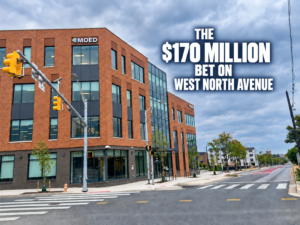
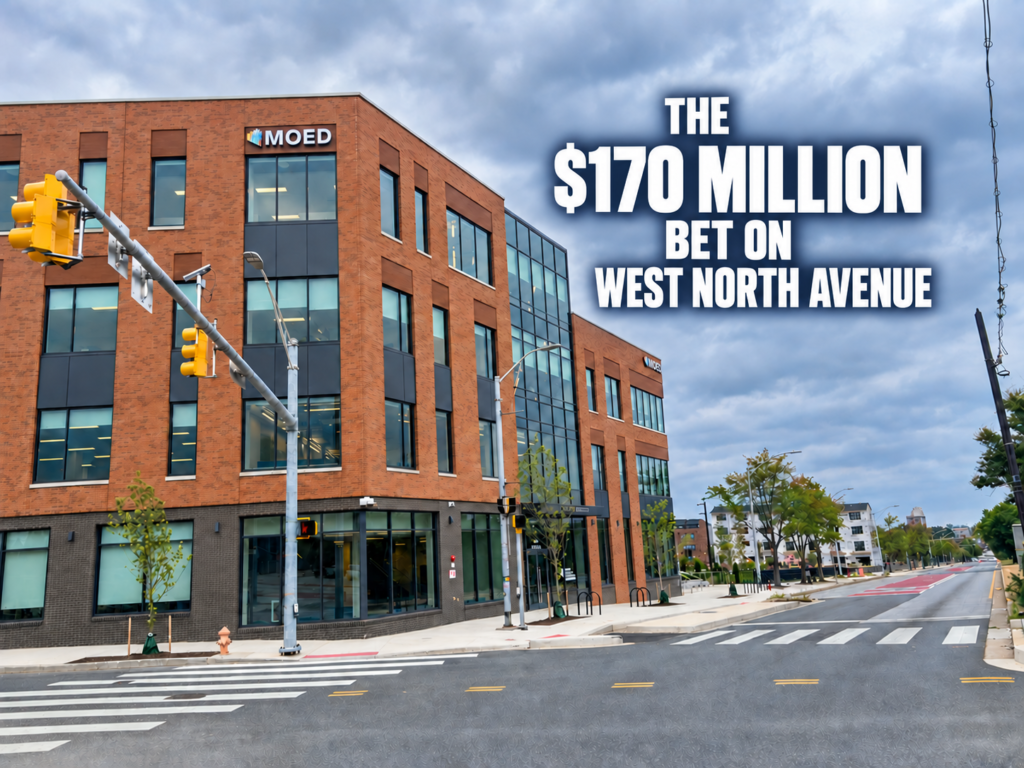
Here are the facts. Reservoir Square is an eight-acre, $170 million mixed-use development by MCB Real Estate, working with partners including Atapco Properties, MLR Partners, and Baltimore-based Blank Slate Development. WNADA was an early funder.
The plans include:
- New for-sale townhomes, with more than 75 homeowners already living there.
- A Streets Market grocery store of about 12,000 square feet, in a neighborhood where residents currently have just one grocery option within a mile, on the other side of North Avenue.
- A new four-story, 63,000-square-foot home for the Mayor’s Office of Employment Development, on the CityLink Gold route near Penn North, putting job services right where people need them.
The plan has changed along the way. MCB replaced a planned high-rise mixed-use building with more townhomes, saying the math didn’t work for anything else. The Reservoir Hill Association did not oppose the change, but its resident survey came back mixed. Those are the kinds of decisions the community should keep watching.
Scrutiny, and a Double Standard
David Bramble knew what he wanted. He wanted to build homes. He’s a developer. He lives off North Avenue, not far from this project. He is a product of City College, and he grew up in West Baltimore.
Some question him, and they should ask their questions. Is there affordability? Who gets the jobs and the contracts? Will longtime residents benefit or be priced out? Those questions should be asked of every developer.
But I have noticed something. The standard applied to him looks a lot like the standard I have seen applied to Julian Jones. When a white man is the county executive, when a white man is the developer, there seem to be almost no questions. When the county executive or the developer is a Black man, suddenly there are questions about everything.
I have known the Bramble family for nearly 30 years. I am only now getting to know David, but I know the tree he comes from. They are business people, and they love Baltimore. I cannot imagine him bringing anything but his best. And as a City College man, the last thing he wants is for somebody with Poly blood to have anything to talk trash about. I say that in jest.
So, Will Baltimore Be Affordable?
Will Baltimore be affordable in 25 years? Is it affordable now? One could argue Black people are being pushed out. One could argue Baltimore is the last East Coast city to gentrify. One could make a lot of claims.
Meanwhile, what are we going to do?
West Baltimore deserves something nice. The people who live closest to Reservoir Square will see it every day, and their opinions count far more than mine. We must respect those opinions, and I pray whatever tension exists gets worked out.
And here’s my advice: if you have an issue with someone, go see them. Write them a letter. Call them. That is what I do, and it tends to work.
That’s my two cents. The $170 million bet on West North Avenue is here. Now let’s make sure it pays off for the people who have been waiting the longest.