



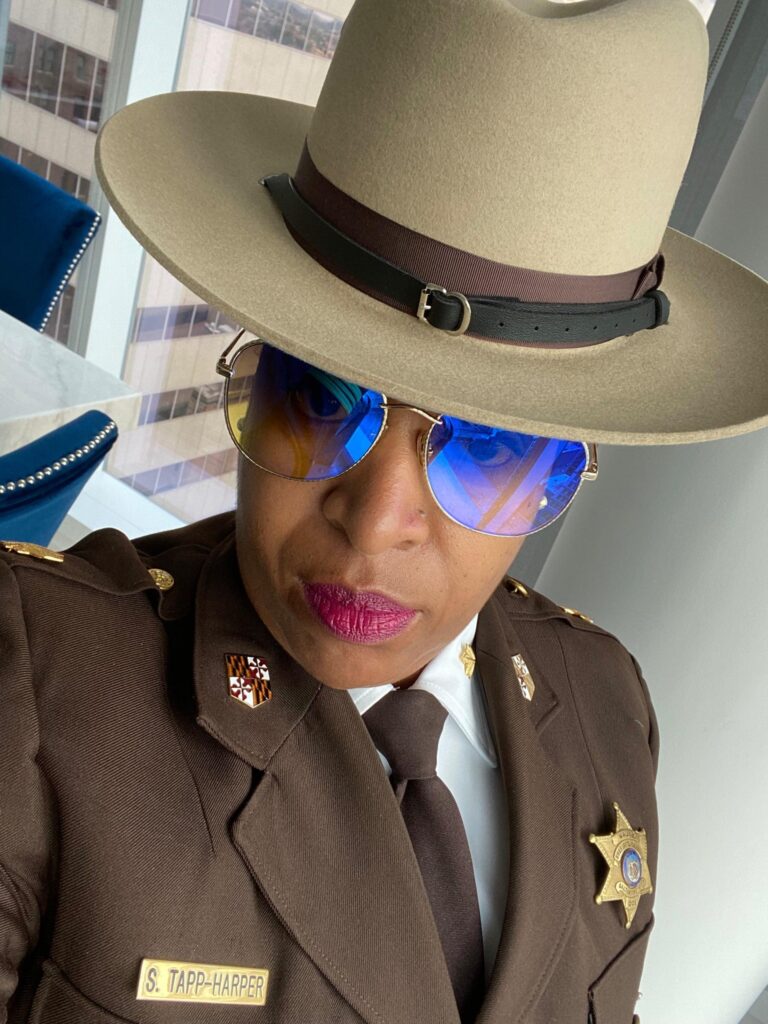
Dunbar High, Coppin State, Hopkins Alumna Brings Unmatched Law Enforcement Credentials to 2026 Race
(BALTIMORE – January 13, 2026) — In what promises to be one of the most closely watched local races in the 2026 primary election, Assistant Sheriff Sabrina Tapp-Harper has emerged as a formidable challenger for Baltimore City Sheriff, bringing three-and-a-half decades of law enforcement experience and a track record of breaking barriers in a traditionally male-dominated field.
Tapp-Harper, a Baltimore native who graduated from Dunbar High School before earning her Bachelor’s degree in Criminal Justice from Coppin State University and a Master’s in Applied Behavioral Science from Johns Hopkins University, represents a rare combination of deep community roots and institutional expertise.
A Career Built on Service and Innovation
Before joining the Baltimore City Sheriff’s Office in 2014, Tapp-Harper spent 26 years with the Baltimore City Police Department, rising through the ranks from cadet to Major. Her responsibilities included commanding the Special Investigation Section, overseeing sex offense and child abuse investigations, executive protection, and family crimes units.
In 2014, when the Sheriff’s Office created its Domestic Violence Unit, Tapp-Harper was tapped to lead the new division. She immediately implemented tactical approaches to address citywide protective orders, removing significant burden from the police department and bringing specialized expertise to a critical public safety issue.
Her work caught national attention. As an advocate for the Violence Against Women Act during the Obama Administration, Tapp-Harper was invited to the White House. She served as a research fellow with the International Association of Chiefs of Police in 2008 and served as Region Three President of the National Black Police Association until August 2025, presiding over 20 states and addressing discriminatory issues in the criminal justice system nationwide.
Historic Achievement and Institutional Knowledge
In September 2022, Tapp-Harper was promoted to Assistant Sheriff of Baltimore City, becoming the highest-ranking woman in the agency’s history. At the time, she emphasized her commitment to opening doors for others: “Although I’m the first, I will do everything in my power to ensure I’m not the last. That is really what career growth is about.”
Her ascension represented not just personal achievement but validation of decades spent understanding every facet of Baltimore’s law enforcement landscape — from patrol operations in five of the city’s nine police districts to internal affairs, education and training, and specialized investigative units.
A Vision Grounded in Community
Those who know Tapp-Harper describe her as someone who understands both the badge and the neighborhoods it serves. “Law enforcement is a calling,” she has said. “You don’t necessarily choose it. It kind of chooses you.”
Her approach to the work reflects her lived experience as a Black woman in law enforcement. “I take a no-nonsense approach to the issue of discrimination,” Tapp-Harper has stated. “I know how it feels to be marginalized and I’m not afraid to speak up.”
This combination of empathy and accountability could prove particularly relevant as Baltimore continues grappling with questions of police reform, community relations, and the role of the Sheriff’s Office in addressing quality-of-life issues like evictions — an area that has generated significant public debate during the current administration.
The Stakes for Baltimore
The Baltimore City Sheriff’s Office serves the courts, provides courthouse security, delivers legal paperwork including eviction notices, and has expanded its portfolio under the current administration. The office’s annual budget and operational decisions affect thousands of Baltimore residents, particularly those navigating the city’s housing crisis.
With the 2026 primary election set for June 23, Baltimore voters will have an opportunity to evaluate competing visions for the office’s future. Tapp-Harper’s candidacy presents a choice between continuity under current leadership and a return to institutional knowledge combined with fresh perspective.
Her credentials speak volumes: 34 years in law enforcement, national recognition for work on domestic violence prevention, graduate-level education in applied behavioral science, and proven leadership managing complex public safety challenges. She knows the Sheriff’s Office intimately, having worked there at the command level during a previous administration.
A Coppin Legacy
Tapp-Harper credits her alma mater with preparing her for the demands of leadership. She fondly recalls Coppin’s rigorous academic standards, including a four-hour exit writing examination required for graduation that “demanded the best, especially when it came to writing.”
That preparation has served her well through a career marked by increasing responsibility, national recognition, and a commitment to being “the conscience of the criminal justice system” — a phrase she uses to describe the mission of the National Black Police Association.
As the June 23, 2026 primary approaches, Tapp-Harper’s candidacy offers Baltimore voters a candidate whose resume reflects both historic achievement and practical experience managing the exact responsibilities of the office she seeks to lead.
The race will test whether experience, institutional knowledge, and a record of barrier-breaking accomplishment can overcome the advantages of incumbency in one of Baltimore’s most important local offices.
The Maryland primary election is scheduled for June 23, 2026. More information about candidate filing deadlines and voter registration is available at the Maryland State Board of Elections website.