


Baseball did not simply lose Black children. The game became too expensive for working-class families—and the Baltimore Orioles became disconnected from the city they call home.
(BALTIMORE – August 8, 2026) – A dear friend of mine and Morehouse brother is Robert “Robbie” Scott, the son of the late Pat Scott. Pat was the last surviving member of Baltimore’s famed Goon Squad, but he preferred to be remembered as an artist and a professor at Morgan State University.
At one point, Robbie was a Little League baseball coach. And boy, did I hear some stories about his experiences coaching.
But Robbie also educated me about some things I did not know about youth baseball. The long and short of it is this: Black children are not playing baseball like they did when we were coming up.
I am 61. Robbie is 63. We remember when baseball was everywhere. We remember when a child did not need a family investment portfolio to step into the batter’s box.
Today, Black children are disappearing from baseball.
People can attribute that decline to a litany of factors. They can say basketball became more popular. They can point to football. They can blame video games, changing neighborhoods, disappearing recreation programs or a lack of interest.
But I will say this plainly: Black families have been priced out of the game.
In 1981, Black American players accounted for 18.7% of Major League Baseball. On Opening Day in 2026, that number was only 6.8%. Yes, that was a slight improvement over 2024 and 2025, but it remains a staggering collapse from the baseball we knew.
The decline is real, historic, and impossible to dismiss.
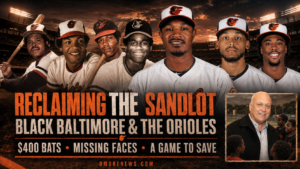
We Were Not Raised on $400 Bats
Unless I missed something, baseball used to be a relatively simple game.
Back in my day, you had a wooden bat or an aluminum bat. Somebody brought a ball. You brought your glove. If you did not have a bat, somebody else did. We shared equipment. We played in municipal leagues, recreation leagues, and neighborhood parks.
You did not need thousands of dollars to prove you could hit.
Today, high-end aluminum and composite youth bats can cost more than $400. And from what Robbie explained to me, these bats do not remain at peak performance forever. Their “pop” can decline with use, creating pressure on parents to replace an already expensive bat with the next model.
So, you are paying $400—or more—for one bat, and before long, somebody is telling you that your child needs another one to remain competitive.
Then come the cleats.
The glove.
The batting gloves.
The helmet.
The uniform.
The private instructor.
The tournament fees.
The hotel rooms.
The travel-ball registration.
The gas.
The meals on the road.
By the time the first pitch is thrown, a working-class family can be more than $1,000 into a season. At the elite travel-ball level, families can spend many thousands more.
That is not recreation.
That is an economic screening process.
In historically Black leagues—like Baltimore’s own James Mosher Baseball League, founded in 1960 and believed to be the oldest continuously operating Black youth baseball league in the country—the game was built around community access.
James Mosher gave generations of West Baltimore children a place to play, develop discipline, and learn how to become part of a team.
I know because I was one of those children.
I primarily played left field during my three years with the James Mosher Mets. In the 1976 championship game, I moved to center field because our regular center fielder was away.
We won that championship.
In my fourth and fifth years in the league, I was selected as an All-Star.
Baseball was part of my childhood because the community made room for me.
My father made sure I had what I needed. That is what fathers did. But he should not have been expected to spend $400 on one bat just to keep me competitive.
None of our parents should have faced that kind of manufactured pressure.
Baseball did not demand a four-figure investment from my family before allowing me to discover whether I could play. The community gave me an opportunity first.
Today, too many children are being financially screened out before anybody discovers what they can do.
This Is Bigger Than Black Baltimore
I look at this first through the lens of my own community because that is where I come from. I know what municipal baseball leagues and neighborhood recreation meant to Black children in Baltimore.
But this does not stop in Black neighborhoods.
There are poor white families in rural America staring at that same $400 price tag.
There are Latino families in urban communities staring at it.
There are Asian families in working-class neighborhoods staring at it.
There are immigrant families whose children may love baseball but whose parents cannot finance the machinery now surrounding it.
The youth sports industry has transformed a game once played on open sandlots into an exclusive, high-tech fashion show where performance is increasingly sold to the highest bidder.
Equipment companies market an advantage.
Travel programs market exposure.
Private coaches market access.
Tournament organizers market the possibility of being discovered.
Everybody gets paid except the family being bled dry.
And when a child swinging a $400 composite bat gets a base hit on a mishit ball because of the technology engineered into the barrel, the game is no longer testing only fundamentals.
It is also testing family income.
That is a problem.
The Wood Bat Challenge
It is time to break the gatekeeping.
Here is my proposal: The Wood Bat Challenge.
What if community leagues across America declared a simple rule?
If you cannot play with a wooden bat, you do not play in this league.
Mandating affordable, solid-wood bats would begin leveling the playing field overnight. Wood strips away the corporate status symbol and puts the focus back where it belongs: mechanics, hand-eye coordination, plate discipline, strength and hustle.
Wood does not lie.
A child who learns to hit with wood has to learn the sweet spot. That child has to develop proper mechanics. That child cannot depend as heavily on technology to compensate for a bad swing.
Wooden bats are not indestructible, but reasonably priced youth models are available for far less than the most expensive composite bats. A community league could outfit an entire team with shared wooden bats for roughly what two premium composite bats cost.
More importantly, Little League and USA Baseball rules already permit solid, one-piece wooden bats. We do not have to invent an entirely new game. We have to decide what kind of game we want to provide.
Do we want a game determined by skill and discipline?
Or do we want a game in which one child steps into the box with $400 worth of technology while another child’s mother is trying to decide whether she can afford groceries and registration fees?
Baseball was never supposed to belong exclusively to the wealthy.
It was supposed to belong to anybody with a glove, a ball and enough grit to step into the batter’s box.
“You Sure Do Get a Lot of Stuff”
I played James Mosher Baseball every year. When applications came out for the Junior Orioles package, there was a commercial featuring a little white boy who said, “You sure do get a lot of stuff.”
That line became a thing between my father and me.
My father repeated it all the time: “You sure do get a lot of stuff.”
I could not wait to go to Memorial Stadium and sit in the nosebleed section. It was not about getting close to the field. It was not about catching a foul ball.
It was about the experience.
That was Memorial Stadium.
That was the Baltimore Orioles I grew up with.
If you sat in the right-field nosebleed seats, you might look down and see Ken Singleton in right field or Lee May at first base.
Of course, that came after “The Boog.”
Boog Powell was legendary in his own right.
But in retrospect, I realize how much it meant to see Black ballplayers on that field. At the time, we did not necessarily stop and analyze it. We were children watching the Orioles. Those players were simply part of our team and part of our lives.
Ken Singleton.
Lee May.
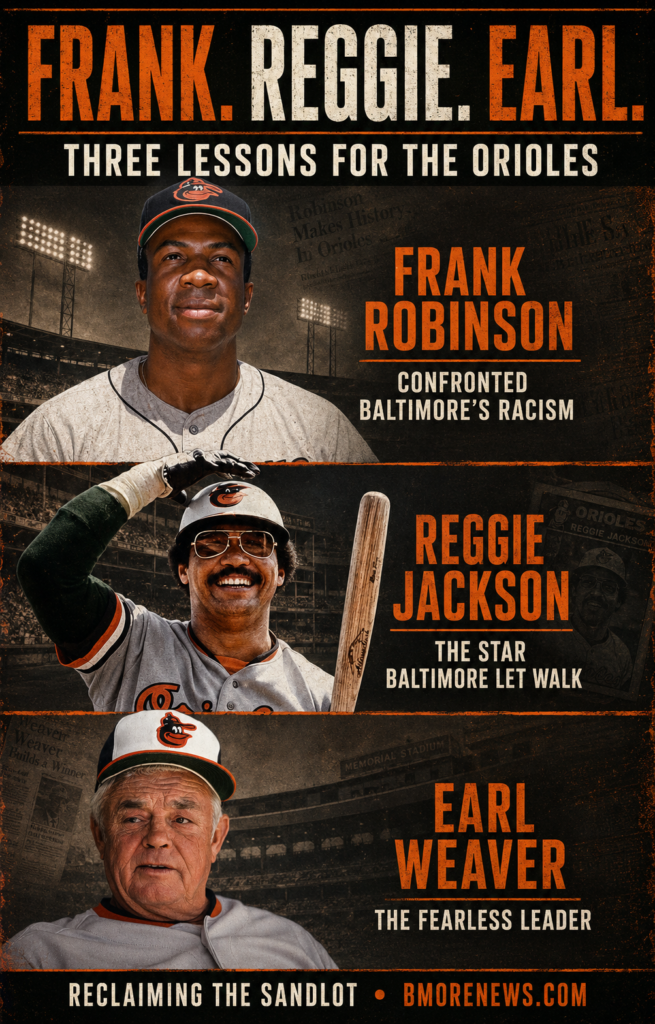
Frank Robinson.
Paul Blair.
Al Bumbry.
Elrod Hendricks.
Seeing Black players wearing Orioles uniforms told Black children something without anybody having to make a speech:
You belong in this game, too.
We saw ourselves on the field.
We saw Black excellence presented as a normal and essential part of Baltimore baseball.
That mattered.
I was a child, so I can speak only from my own perspective. But despite Baltimore’s deep history of racism and segregation, I do not remember any ruckus at Memorial Stadium. I do not remember disturbances between Black fans and white fans.
I remember people.
Black people and white people who loved baseball—the American game.
The Orioles brought us together.
But that game has been contaminated by corporate interests and by people who are simply stuck on stupid—people who fail to recognize that their greatest asset is their people.
When you ignore your people, you die.
You do not win.
Nobody talks about baseball in Black Baltimore the way we could be talking about it.
This Is What No One Is Willing to Say
The disappearance of Black American ballplayers did not merely change the racial composition of Major League Baseball.
It weakened the emotional connection between the Baltimore Orioles and Black Baltimore.
When Black children stopped seeing themselves on the field, baseball began disappearing from their imaginations.
When Black families stopped recognizing household names in the lineup, the Orioles began disappearing from their conversations.
And when the organization stopped coming consistently into Black neighborhoods, the relationship began to die.
That is not nostalgia.
That is cause and effect.
There was a time—and yes, I am reminiscing—when the Orioles had Al Bumbry in left field and Paul Blair in center field.
We had Frank Robinson.
We had Elrod Hendricks.
We had Ken Singleton.
We had Lee May, the home-run hitter who might strike out, but when he waved that bat, people watched. He brought fans to the game.
We also remember Mike Cuellar, the Cuban-born left-hander whose presence was part of a diverse Orioles team that felt connected to more of Baltimore.
Those names are more than names.
They are memories.
They are fathers and sons listening to games together. They are children arguing over batting averages. They are people sitting on porches with radios. They are the roar that came through the television when somebody hit one over the wall.
Those players gave Black Baltimore a reason to identify with the Orioles—not as a marketing demographic, but as part of the team’s living culture.
And then there was Adam Jones.
Adam Jones was the last Black Oriole who had that pop—that presence. He was not merely a player whose name appeared on the roster.
He was visible.
He was connected.
He was a five-time All-Star, a four-time Gold Glove winner and a Silver Slugger. He spent 11 seasons in Baltimore and became one of the defining faces of the franchise.
On July 20, 2010, First Lady Michelle Obama came to Camden Yards as part of her “Let’s Move!” campaign. Adam Jones stood on the field with her. He also participated in the youth baseball clinic connected to her visit.
Nobody will forget that.
Jones also worked with children through the Orioles’ Reviving Baseball in Inner Cities program, visited RBI league games and supported Boys and Girls Clubs, local schools and other Baltimore organizations.
That is what it means to become part of a city.
Adam Jones was not simply Black and playing baseball.
Black Baltimore knew him.
Cedric Mullins came closest after Jones. Mullins became an All-Star and Silver Slugger and recorded the first 30-home-run, 30-stolen-base season by an Oriole since the franchise moved to Baltimore.
He became only the third player in Orioles history to reach 100 home runs and 100 stolen bases, joining Brady Anderson and Paul Blair.
Then the Orioles traded him in 2025.
Since Adam Jones left after the 2018 season, Cedric Mullins is essentially the only Black American Oriole who became a sustained, recognizable face of the franchise.
The Orioles have employed other Black American players. Mychal Givens, Dillon Tate, DJ Stewart, Tim Beckham, Aaron Hicks, Tony Kemp, Jeremiah Jackson, Christian Franklin and others have worn the uniform during the past decade.
I will not erase those players or pretend they were not here.
As of August 2026, Jeremiah Jackson and Christian Franklin are Black American players on the Orioles’ active roster. Jackson has spoken publicly about Black baseball history and Jackie Robinson. Franklin made his major-league debut with Baltimore in August.
But that raises the real question:
How many Black people in Baltimore know their names?
Why haven’t the Orioles introduced them properly to Black Baltimore?
Where is the relationship?
Where is the promotion?
Where are the sustained community appearances?
Where is the effort to make these players—and the Black Orioles who follow them—visible faces of baseball in a majority-Black city?
Having Black players listed on a roster is not the same as building a connection with Black Baltimore.
Since Adam Jones, it has been dead and stinking.
This is a majority-Black town, and Adam Jones is the last Black face you gave us who became part of the city’s identity?
Really?
And you want to win?
That is why you are losing.
That is why you will never truly win over this city until you tap into Black Baltimore—not as a marketing category, not as a heritage-night audience, and not as a collection of children you bring downtown for photographs.
You have to make Black Baltimore part of the life of the Baltimore Orioles again.
And I say that with all due respect.
When the Orioles Moved Downtown
Something else happened long before David Rubenstein arrived.
When the Orioles left Memorial Stadium and moved downtown, the team became further disconnected from Baltimore’s neighborhoods.
Memorial Stadium was not merely a place where baseball games were played. It sat among communities. People walked there. Children saw the crowds coming. Families from different parts of Baltimore converged on 33rd Street.
We walked together from 33rd and Greenmount, right on up to the stadium.
The stadium was physically and culturally connected to the people.
Camden Yards is a beautiful ballpark. Nobody can deny that. It changed how America built baseball stadiums.
But something was lost when baseball was removed from the neighborhoods and placed inside a downtown tourism and entertainment strategy.
The team became something people traveled downtown to see instead of something embedded in the everyday life of Baltimore’s neighborhoods.
The Orioles went corporate.
Your biggest strength is your home.
When you make the harbor more attractive to tourists than to the people who live here, it dies. Downtown Baltimore has spent years learning that painful lesson.
You cannot build a city’s heartbeat around people who visit twice a year.
You have to make it relevant to the home team.
You have to customize the experience for the people who live here.
You have to make Black Baltimore feel that the Orioles belong to us, too.
Where Are the Orioles?
Compare the Orioles with the Baltimore Ravens.
It is nothing to see the Ravens at a community event. We see current Ravens. We see former Ravens. We see representatives of the organization.
The Ravens have made themselves part of Baltimore’s community life.
I live in West Baltimore, off Pennsylvania Avenue.
These children do not see the Baltimore Orioles.
Ever.
They do not see Orioles players walking into their recreation centers. They do not regularly see them visiting their schools. They do not see them standing around neighborhood baseball diamonds, talking with coaches and showing children how to hold a bat.
They do not see former Orioles maintaining a visible presence in the community.
But we see Ravens and former Ravens all the time.
Now, I will be fair.
The Orioles have community programs. They operate an RBI youth baseball initiative. They adopted Harlem Park Elementary/Middle School in 2024. They have supported fields, schools and charitable projects.
I am not saying the organization does absolutely nothing.
I am saying its presence is not felt.
Those are two different things.
A program listed on a website is not the same as a child seeing a major-league baseball player in his neighborhood.
A corporate donation is not the same as a player forming a relationship with a recreation center.
Inviting children downtown for one special event is not the same as repeatedly coming into the communities where those children live.
I remember C4 doing some outreach for the Orioles.
Typically, we hear him on WBAL Radio.
That is not the same as building an Orioles presence along Pennsylvania Avenue, North Avenue, Edmondson Avenue, Greenmount Avenue or throughout East and West Baltimore.
The Orioles cannot sit downtown and expect Black Baltimore to find its way back to baseball.
The Orioles have to come to Black Baltimore.
Come to James Mosher.
Come to Easterwood.
Come to Sandtown.
Come to Harlem Park—and not just one adopted school.
Come to Pennsylvania Avenue.
Bring Jeremiah Jackson.
Bring Christian Franklin.
Bring former Orioles.
Bring bats, gloves and tickets. Bring instructors. Bring scouts. Bring the Oriole Bird.
Most importantly, keep coming after the cameras leave.
That is how children develop a connection to a team.
That is how players become household names.
Giving Cal Ripken His Flowers
Let me say something else.
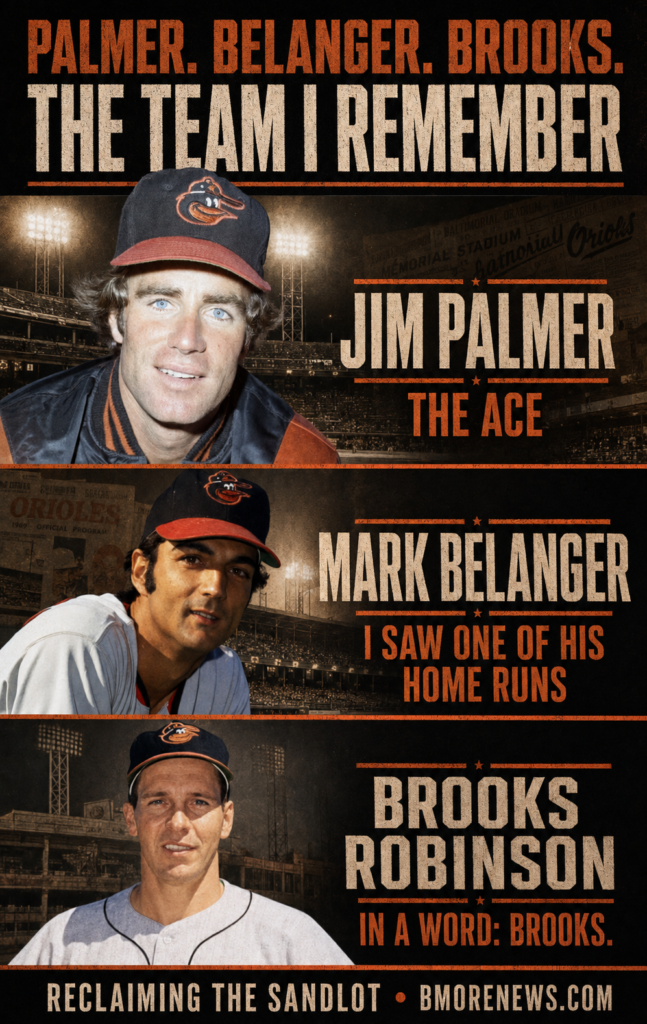
I grew up a Brooks Robinson fan.
The Human Vacuum Cleaner.
As a matter of fact, when I was a James Mosher All-Star, all of the All-Stars got an opportunity to go to Memorial Stadium and meet Brooks Robinson. We were even featured on Evening Magazine on Channel 13.
So, when Cal Ripken Jr. came along, I was already a Brooks Robinson man.
Call me a Baltimoron.
Call me stuck on stupid.
I accept it.
But I was a Brooks fan.
Honestly, I never really gave Cal a chance. Plus, his father was a coach with the Orioles, and I looked at that situation and thought, “How could he not make the team?”
Please forgive my youthful judgment.
Or don’t.
But I was a Brooks Robinson fan.
Having said that, I will tell you something else: Since Cal Ripken began his nonprofit outreach, that man has made a Herculean effort to give back to children.
I have seen his fingerprints from Harford County to Baltimore City. I have seen the fields. I have seen the programs. I have seen his impact on James Mosher Baseball.
The organization is the Cal Ripken, Sr. Foundation, which Cal and his brother Billy founded in 2001 to honor their father.
And this is not some little vanity foundation created so a famous athlete can take pictures and hold an annual gala.
The foundation has reached millions of children. It has built more than 125 Youth Development Parks across the country. It has created STEM centers, instructional leagues, mentorship programs and safe places for children to play.
Its first Youth Development Park was built on the former site of Memorial Stadium. Home plate was positioned where home plate sat when the Orioles played there.
Think about that.
Cal Ripken took the place where Baltimore once came together around baseball and put baseball back into the hands of children.
In 2017, the foundation partnered with BGE to build Eddie Murray Field for James Mosher Baseball in West Baltimore. That field gave the country’s oldest continuously operating Black youth baseball league a modern home with synthetic turf, bleachers and a scoreboard.
The foundation later connected Coppin State baseball players with James Mosher children for instruction and mentoring.
In June 2025, Cal Ripken returned to the former Memorial Stadium site and worked directly with James Mosher children as his foundation launched a national partnership with Major League Baseball’s Nike RBI program.
That is not symbolic giveback.
That is tangible giveback.
Of all the professional athletes whose work I have observed, Cal Ripken has quietly become the gold standard.
He is the king of giveback.
I say that as a Brooks Robinson man who never really gave Cal a fair chance when he was playing. I can admit when the evidence changes my judgment.
That man has given back tremendously—and impactfully.
So, Baltimore Orioles, you do not have to create the entire blueprint from scratch.
The blueprint is standing right in front of you.
Tap into Black Baltimore, and then magnify what Cal Ripken and the Cal Ripken, Sr. Foundation have already built.
Magnify James Mosher.
Magnify Eddie Murray Field.
Magnify the work at the former Memorial Stadium site.
Magnify the fields in Cherry Hill and throughout Baltimore.
Magnify the instructional leagues, the free equipment, the mentoring and the effort to remove the economic barriers keeping working-class children away from baseball.
Do not merely use Cal Ripken’s name to celebrate Orioles history.
Use his work to build the Orioles’ future.
Magnify it, Baltimore Orioles.
Magnify that.
My Challenge to David Rubenstein
Mr. Rubenstein, you did not create this disconnection.
You inherited it.
Your ownership group did not take control of the Orioles until 2024. The cultural distance between the Orioles and Black Baltimore developed over decades.
But now it belongs to you.
Make it your business to identify, develop, and retain at least three quality Black American ballplayers over the next three years—and make them visible faces of Baltimore baseball.
You already have Jeremiah Jackson and Christian Franklin.
Start with them.
Introduce them properly to Black Baltimore. Put them in our neighborhoods. Put them before our children. Give the city a chance to know their names, their stories, and their game.
Not honorary faces.
Not ceremonial faces.
Not players brought out during Black History Month and then returned to obscurity.
I mean visible, everyday representatives of the Baltimore Orioles—playing ball, appearing in West Baltimore, East Baltimore, and Cherry Hill, visiting recreation centers, showing up at James Mosher, speaking to children and reminding Black Baltimore that baseball still has a place for us.
Then build something behind them.
Sponsor community leagues.
Provide equipment.
Create a wooden-bat league.
Pay registration fees for children whose families cannot afford them.
Restore fields.
Hire coaches.
Bring Orioles players into neighborhoods consistently—not merely when cameras are rolling.
Build a direct pathway from Baltimore’s recreation leagues to serious instruction, high school competition, college baseball and the professional scouting system.
Let the Orioles become the organization that tears down baseball’s paywall in Baltimore.
Do that, and you will win.
I promise you.
You may not win the World Series overnight, but you will begin winning back the city.
You will build fans.
You will sell tickets.
You will create memories.
You will give Black children a reason to pick up a glove instead of assuming baseball belongs to somebody else.
The 600-Pound Gorilla
This is the 600-pound gorilla in the room.
All of these fancy, highly intelligent and well-skilled sportswriters, commentators, analysts, executives and consultants keep dancing around it.
They study launch angles.
They study payroll.
They study analytics.
They study attendance patterns, concession sales, parking, television ratings and corporate partnerships.
They have artificial intelligence, advanced data systems and a multibillion-dollar sports industry at their disposal.
Yet nobody seems willing to apply some goddamn common sense.
The Baltimore Orioles play in a Black city, but the team has lost its organic connection to Black Baltimore.
That is the problem staring everybody in the face.
And the institutional blindness is so Baltimore.
It is so 1910.
It is the spirit of the J. Barry Mahool segregation ordinance. It is redlining. It is the same old Baltimore habit of locking Black people out, ignoring our contribution and then acting confused when the institution begins to die.
Same thing.
Stuck on stupid.
If the Orioles want to become relevant to Baltimore again, they must become relevant to Black Baltimore.
And if America wants Black children—and working-class children of every race—to return to baseball, the game has to become affordable again.
Tear down the $400 paywall.
Put wooden bats back into children’s hands.
Put Black American ballplayers before Black Baltimore.
Bring the game home.
Real Recognizes Real
If you are afraid of your fans—if you are afraid of the people—then you will never win over Black Baltimore.
Baltimore, Black, white and otherwise, is an authentic city.
Real recognizes real in this city, as the young people say.
For real, for real.
Baltimore will also call out a phony.
You cannot afford to be anything but authentic with Baltimore because we see right through you.
You cannot manufacture a relationship with a commercial.
You cannot purchase authenticity with a sponsorship.
You cannot show up once, take pictures with Black children, and expect the community to believe you are committed.
You have to come among the people.
You have to listen to the people.
You have to keep showing up when there are no cameras, no press releases, and no immediate financial rewards.
That is the disconnect David Rubenstein inherited.
The question is whether he has the courage and common sense to repair it.