
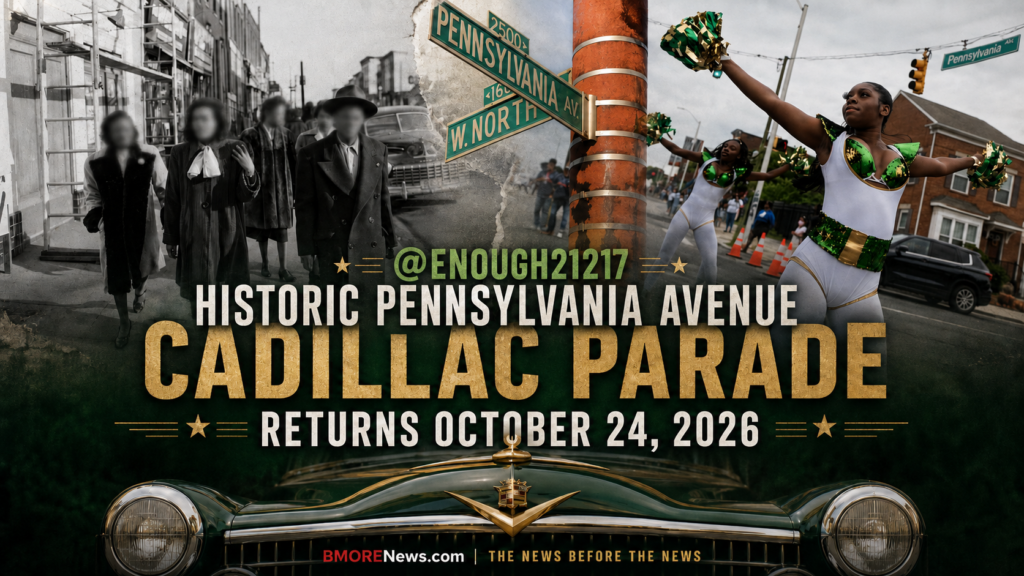
From the legendary Easter parades and Cadillac Club to the Royal Theatre, Sphinx Club, Lena Boone, Little Willie Adams, George and Stephanie Gilliam, and Baltimore’s phenomenal marching bands, Pennsylvania Avenue is calling its people home.
(BALTIMORE – August 18, 2026) – The sound of snare drums warming up.
Rat-a-tat-tat.
Then comes another snare. And another.
As you listen, you realize that there are multiple snare drummers playing the same rhythm—to the letter, to the T, not missing a beat.
Then come the bass drums.
Boom! Boom! Boom! Boom!
Rat-a-tat-tat!
Boom! Boom! Boom!
We know that sound in West Baltimore. We know it in East Baltimore. We know it in Cherry Hill and in neighborhoods all across the city.
It is the unmistakable sound of a Baltimore marching band.
The New Edition Legacy. The Baltimore GoGetters. The Baltimore Twilighters. And all of the other phenomenal marching bands, drumlines, dancers, drill teams, drum majors, instructors, parents, and volunteers who have carried this culture from one generation to the next.
Forgive us if we do not know every band’s name. This city is overflowing with talent. Every group that has practiced on a playground, a recreation center parking lot, a basketball court, or a neighborhood street deserves its props.
The bands show up in uniform.
The dancers dance.
The drum majors lead.
The drummers bring the thunder.
Everything is done with precision.
This is more than entertainment. Baltimore’s marching-band culture is a world unto itself. The people involved are serious about their work, uniforms, routines, reputations, and legacies.
And do not let there be a competition.
You think the Ravens are competitive?
Baltimore’s marching bands come to win.
Little girls grow into young women inside this culture. Young boys grow into men. Some begin as children and return years later as instructors, mentors, section leaders, and parents. The bands provide discipline, accountability, a sense of belonging, exercise, creativity, mentorship, and a place for young people to shine.
They also give Baltimore one of its most recognizable sounds.
On Saturday, October 24, 2026, we get to hear that sound on Pennsylvania Avenue one more time.
Rat-a-tat-tat!
Boom! Boom! Boom!
The Historic Pennsylvania Avenue Cadillac Parade is coming back through the ENOUGH@21217 initiative.
And let me be clear: We are not creating a new tradition.
We are bringing a great Baltimore tradition home.
Pennsylvania Avenue Was Black Baltimore’s Downtown
For generations, Pennsylvania Avenue was the cultural, commercial, political, and entertainment hub of Black Baltimore.
It was our downtown.
It was our Broadway.
It was our Hollywood.
It was our Harlem.
It was where Black Baltimore went to shop, eat, dance, conduct business, hear music, watch movies, attend shows, celebrate Easter, display its finest automobiles—and see and be seen.
Pennsylvania Avenue was alive day and night.
Black doctors, lawyers, real-estate brokers, educators, politicians, undertakers, journalists, musicians, nightclub owners, beauty professionals, shopkeepers, and entrepreneurs operated along the corridor and in the surrounding neighborhoods.
Churches, schools, social clubs, professional offices, restaurants, theaters, taverns, hotels, dress shops, barbershops, and beauty salons created a complete Black ecosystem.
This was not merely an entertainment strip.
Pennsylvania Avenue was one of the most important centers of Black economic and cultural life in America.
During the day, people shopped, worked, conducted business, visited professional offices, and gathered at the market. At night, the lights came on, the music started, and Pennsylvania Avenue transformed into one of the country’s premier Black entertainment districts.
The Avenue was a destination.
The Royal Theatre
The Royal Theatre stood at the center of that world.
It opened in 1922 as the Black-owned Douglass Theatre, presenting motion pictures, traveling comedy, Black vaudeville, live entertainment, and even occasional circus and animal acts. It was later renamed the Royal Theatre and became one of the premier stops on the Black entertainment circuit.
Its sister institutions included the Apollo Theatre in Harlem, the Howard Theatre in Washington, D.C., the Regal Theatre in Chicago, and the Earle Theatre in Philadelphia.
The biggest Black entertainers in America came through the Royal.
Louis Armstrong.
Duke Ellington.
Cab Calloway.
Pearl Bailey.
Sarah Vaughan.
Mahalia Jackson.
Ray Charles.
Nat King Cole.
Etta James.
James Brown.
The Temptations.
The Supremes.
And countless others.
Baltimore’s beloved Billie Holiday was connected to the Avenue. So were Cab Calloway, his sister Blanche Calloway, Eubie Blake, and the legendary drummer Chick Webb.
Sonny Til and the Orioles began harmonizing near Pennsylvania Avenue and Pitcher Street before helping to define the emerging sound of rhythm and blues.
When a performer took the stage at the Royal, the audience expected greatness.
This was not a passive crowd.
Black Baltimore knew talent. The people had standards. If you could win over the Royal Theatre audience, you had done something.
The Royal was part movie theater, part concert hall, part community institution, and part proving ground. It gave Black performers and Black audiences a magnificent space of their own at a time when Jim Crow barred them from many white establishments.
The Royal Theatre was demolished in 1971, but its spirit has never left Pennsylvania Avenue.
The Regent and the Other Movie Houses
The Royal was not the Avenue’s only major theater.
The Regent Theatre was originally built in 1916 and reconstructed in 1920 as a large vaudeville-style movie house. It reportedly seated as many as 2,200 people.
Think about that.
Thousands of Black Baltimoreans could gather under one roof to watch films and live performances in the heart of their own community.
The theaters gave Pennsylvania Avenue its star power, but the nightclubs, restaurants, taverns, and social clubs kept the corridor moving after the final curtain came down.
The Sphinx Club
Then there was the Sphinx Club.
Charles Phillip Tilghman founded the Sphinx Club in 1946 at 2107 Pennsylvania Avenue. It became one of the country’s earliest Black-owned nightclubs and one of Baltimore’s most exclusive gathering places.
The Sphinx was where doctors, lawyers, judges, politicians, business owners, entertainers, and community leaders mixed.
Anybody who was somebody passed through the Sphinx.
It became famous for its after-show gatherings, New Year’s Eve celebrations, Mardi Gras affairs, and elegant social atmosphere. Entertainers who had completed their performances at the Royal often made their way to the Sphinx.
Sam Cooke and Redd Foxx were among the prominent entertainers associated with the club. Limousines lined the street. Members dressed properly. The Sphinx was a place to see and be seen.
It remained open until 1992.
The building still stands, though the music and crowds that once filled it have long since disappeared.
But the history remains.
Club Casino, Gamby’s, The Ritz and More
The Sphinx Club was only one piece of the Pennsylvania Avenue nightlife ecosystem.
There was Club Casino, associated with William Lloyd “Little Willie” Adams, in the 1500 block of Pennsylvania Avenue.
There was Ike Dixon’s Comedy Club, remembered for its enormous bar shaped like the Pimlico Race Course.
There was Gamby’s.
The Ritz.
Club Tijuana.
The Bamboo Lounge.
The Closet Club.
The Red Fox.
The Avenue Bar.
Wendall’s Tavern.
The New Albert Dreamland.
Club Tijuana reportedly hosted jazz giants Miles Davis and John Coltrane. The Ritz was one of the Avenue’s significant early music venues. Gamby’s, Club Casino, the Comedy Club, and the Bamboo Lounge all contributed to a nightlife scene that attracted Black Baltimoreans and visitors from well beyond the city.
Even establishments that were not primarily music venues frequently featured a pianist, organist, singer, or small group.
Music was everywhere.
The Arch Social Club, still standing at Pennsylvania and North avenues, remains one of the last living links to that great Pennsylvania Avenue entertainment tradition.
These places did not operate in isolation.
They depended on one another.
The Royal and Regent attracted the crowds. The clubs kept people entertained after the shows. Restaurants fed them. Hotels accommodated visiting musicians and entertainers. Barbershops and beauty salons got people ready. Dress shops supplied the fashions. Photographers documented the moment.
Black-owned businesses circulated Black dollars through Black Baltimore.
Pennsylvania Avenue represented our natural ecosystem before anyone needed to give it a fancy name.
Easter Sunday on Pennsylvania Avenue
This was also the world that produced the great Pennsylvania Avenue Easter Parade.
During segregation, Baltimore effectively had two major Easter promenades.
White Baltimore paraded along Charles Street.
Black Baltimore stepped out on Pennsylvania Avenue.
And when Black Baltimore stepped out, we stepped out.
The ladies wore their finest dresses, gloves, shoes, and spectacular Easter hats. The men came sharp from head to toe. The children were polished, pressed, and dressed to make their grandparents proud.
Bands played.
Dignitaries appeared.
Confetti filled the air.
People gathered near Pennsylvania Avenue and Laurens Street and along the surrounding blocks. The sidewalks were full, and the Avenue remained alive with people socializing well into the evening.
There are photographs documenting it.
Historical images from the 1950s show Black Baltimoreans standing shoulder to shoulder in their Easter best. One picture shows what has been described as a fashion show breaking out in the middle of the annual Pennsylvania Avenue Easter Parade.
Pennsylvania Avenue was our runway.
The Easter Parade was about more than clothing. It was a public display of Black dignity, family, fashion, faith, community, and prosperity during an era when white Baltimore attempted to make Black people invisible.
We were not invisible.
We were beautiful.
We were organized.
We were accomplished.
And on Easter Sunday, Pennsylvania Avenue gave Black Baltimore the stage it deserved.
That Easter tradition appears to have lasted into the 1980s, with later attempts to revive it. Its memory lives in the photographs, family stories, newspaper archives, and recollections of those who experienced the Avenue in its prime.
The Cadillac Parade Begins
The Cadillac Parade emerged from that same culture of Black elegance, accomplishment, and unapologetic visibility.
The tradition dates to 1946 and is credited to Garnett “TV Tank” Budd. It was sponsored by the Cadillac Club, a loose association of Black men who owned Cadillacs and socialized at Pennsylvania Avenue’s nightclubs.
The parade became a rolling “Who’s Who” of Black Baltimore.
Community leaders, business owners, politicians, celebrities, entertainers, doctors, lawyers, families, and proud Cadillac owners traveled along the Avenue while the people lined the sidewalks.
The automobiles were magnificent.
Chrome shining.
Whitewall tires spotless.
Paint polished until it reflected the faces of the people watching.
Those Cadillacs were more than cars.
They represented achievement in a country that did everything possible to block Black advancement.
And the relationship between Black America and Cadillac has a deeper history than many people realize.
Black Purchasing Power and Cadillac’s Survival
During the Great Depression, the market for luxury automobiles collapsed.
Cadillac sales fell from more than 41,000 vehicles in 1928 to fewer than 7,000 in 1933. General Motors reportedly considered shutting down the Cadillac division or preserving only the name until economic conditions improved.
Yet Cadillac had a market that its own racist policies refused to recognize.
Nicholas Dreystadt, then responsible for Cadillac’s national service operations, noticed something while visiting dealerships around the country.
Black customers were bringing Cadillacs in for service—even though Cadillac dealers were not supposed to sell automobiles directly to Black people.
Affluent Black doctors, lawyers, entertainers, athletes, ministers, and business owners wanted Cadillacs badly enough that they paid white intermediaries hundreds of dollars to purchase the cars for them.
Think about that.
Black people had the money.
Black people wanted the product.
Yet racism forced them to pay a white person merely to stand between them and the dealership.
Dreystadt took that information to General Motors executives. His argument was as practical as it was revolutionary for the time: Why should white middlemen collect hundreds of dollars when Cadillac could sell directly to Black customers?
General Motors accepted the proposal and ended Cadillac’s discriminatory sales policy.
In 1934, Cadillac sales increased by approximately 70%. The division broke even, and Dreystadt was promoted to lead Cadillac.
To be historically precise, Black consumers were not the only reason Cadillac recovered. Dreystadt also reduced production costs, Cadillac adjusted its product line, and the American automobile industry benefited from the country’s gradual economic recovery.
But Black purchasing power mattered.
It mattered enough for Cadillac to abandon an openly discriminatory sales policy.
It mattered enough to help expand Cadillac’s market at a moment when the company desperately needed customers.
It helped establish a cultural relationship between Black America and Cadillac that endured for generations.
More Than a Status Symbol
That history gives the Historic Pennsylvania Avenue Cadillac Parade a meaning far greater than polished chrome, whitewall tires, tailfins, and beautiful automobiles.
The Cadillac represented arrival.
It represented the Black doctor, lawyer, musician, entrepreneur, athlete, minister, and business owner who succeeded in a country structured to prevent that success.
Driving a Cadillac was a public declaration:
You may refuse us rooms in your hotels.
You may deny us homes in your neighborhoods.
You may turn us away from your restaurants, stores, banks, and country clubs.
You may even refuse to sell us the automobile directly.
But you cannot make us invisible.
By the time Garnett “TV Tank” Budd conceived the Cadillac Parade on Pennsylvania Avenue in 1946, the automobile already carried this extraordinary history.
That same year, the Sphinx Club opened. Little Willie Adams was financing Black businesses and institutions. The Avenue was growing into one of the country’s leading Black entertainment and commercial districts.
The Cadillacs, the clubs, the theaters, the Easter fashions, and the parades were all parts of the same declaration.
Black Baltimore had culture.
Black Baltimore had style.
Black Baltimore had money.
Black Baltimore had power.
And Black Baltimore was going to be seen.
That is why this cannot be reduced to a car show.
The Historic Pennsylvania Avenue Cadillac Parade is a procession of Black resistance, economic achievement, cultural pride, and unapologetic visibility.
Those Cadillacs did not merely travel down Pennsylvania Avenue.
They told America that we had arrived.
Little Willie Adams
William Lloyd “Little Willie” Adams personified much of what Pennsylvania Avenue represented.
He came to Baltimore from North Carolina as a teenager in 1929 with little formal education and very little money. He worked in a factory, delivered newspapers, repaired bicycles, and operated a shoeshine parlor.
He eventually made his initial fortune through the numbers business. But that is not the full measure of the man.
At a time when conventional banks routinely refused to finance Black entrepreneurs, Little Willie Adams became a pioneering Black financier and venture capitalist.
He understood that political power and economic power went hand in hand.
He invested in real estate and helped finance Black-owned businesses. His interests included Adams Realty Brokers and Club Casino on Pennsylvania Avenue. He helped finance the Sphinx Club and invested in the Charm Centre, the upscale fashion establishment associated with his wife, educator, businesswoman, and political pioneer Victorine Quille Adams.
The Charm Centre gave Black women access to first-class clothing at a time when downtown department stores refused to serve them properly or allow them to try on garments.
Little Willie also helped finance the Parks Sausage Company, which became one of Baltimore’s most celebrated Black-owned businesses. His wider business interests included real estate, development, taverns, nightclubs, liquor stores, and other enterprises.
He supported civil-rights efforts, including the fight against racial discrimination at Baltimore’s municipal golf courses. He helped entrepreneurs, politicians, and community institutions, sometimes without attaching his name to the transaction.
Little Willie Adams understood the power of Black capital before the term “Black Wall Street” became popular again.
He was one.
Lena Boone
The late Lena Boone represented another indispensable part of Pennsylvania Avenue’s legacy: uncompromising community leadership.
Ms. Boone was instrumental in Upton and the surrounding community. She was a powerful presence who worked for years on behalf of the people and institutions of Pennsylvania Avenue.
She was iconic.
I can still see that stern look.
Ms. Boone did not play.
She loved her people. She loved her community. And it showed in the work.
Every community needs people who remember what it was, understand what it can become, and refuse to allow outsiders—or insiders—to dismiss its value.
Lena Boone was one of those people.
She helped keep residents, organizations, elected officials, business owners, and stakeholders focused on Upton and Pennsylvania Avenue. Her contribution was not about seeking applause. It was about protecting the community, maintaining standards, and ensuring that its people had a voice.
Little Willie Adams and Lena Boone served as parade marshals during the revival years going back to the late 1990s.
Their presence was significant.
Little Willie represented Black economic power, business development, and investment.
Lena Boone represented grassroots leadership, community accountability, and love for the neighborhood.
They were not selected merely because they were famous.
They represented what Pennsylvania Avenue stood for.
George and Stephanie Gilliam Revive the Parade
By the mid-1990s, George Gilliam revived the Historic Pennsylvania Avenue Cadillac Parade and helped carry the tradition into the early 2000s.
He did that work alongside his late wife, Stephanie Gilliam, through the Pennsylvania Avenue Redevelopment Collaborative and in partnership with people and organizations determined to keep the Avenue’s history alive.
George and Stephanie Gilliam deserve to be remembered for their relentless commitment to Pennsylvania Avenue.
They understood that revitalization required more than buildings.
A community needs memory.
It needs culture.
It needs traditions that reconnect the people with the place.
The parade helped bring energy to Pennsylvania Avenue that had not been seen in years. It placed the community’s history back in the street where residents could see it, hear it, touch it, and participate in it.
The Gilliam revival was connected to a broader effort to restore Pennsylvania Avenue’s cultural legacy, including work surrounding the Royal Theatre Monument and Billie Holiday’s presence on the corridor.
Alvin Brunson is another name that shall not be forgotten.
These men—and the women who worked beside them—committed significant portions of their lives to keeping Pennsylvania Avenue true blue in the hearts of the people.
They refused to let Baltimore forget.
More Than a One-Day Parade
The 2026 Historic Pennsylvania Avenue Cadillac Parade is being organized through ENOUGH@21217 as more than a single-day celebration.
It is an opportunity to reconnect neighborhoods throughout the 21217 ZIP code and across Baltimore.
Our communities share many of the same hopes for our children, families, businesses, and future. Yet residents and organizations do not always have enough opportunities to come together across neighborhood boundaries.
The parade gives us a reason to gather.
Young people and elders.
Longtime residents and new neighbors.
Community associations and churches.
Schools and businesses.
Nonprofits and public agencies.
Artists and performers.
Cadillac owners and marching bands.
Political leaders and everyday residents.
Everybody has a place.
Reconnecting communities through Pennsylvania Avenue can build relationships extending far beyond one Saturday morning. Those relationships can help neighborhoods share resources, support young people, address community challenges, strengthen local businesses, and create new economic opportunities.
This is not simply a parade passing through the community.
It is the community marching together.
How Residents Can Participate
Residents can volunteer with parade planning, outreach, setup, and day-of activities.
Individuals and families can march in the parade. Neighborhood associations, schools, churches, youth organizations, community groups, dance troupes, marching bands, drill teams, artists, and performers can register to participate.
People can also help spread the word to family members, former residents, classmates, church members, social organizations, and friends throughout Baltimore.
Most importantly, people can come out, line the Avenue, celebrate the participants, and support the businesses and organizations operating along the corridor.
Bring the children.
Let them hear the drums.
Let them see the Cadillacs.
Let them learn that Pennsylvania Avenue was—and remains—part of their inheritance.
Businesses, Organizations and Sponsors
Businesses and organizations can become parade sponsors and demonstrate their commitment to West Baltimore and the communities of the 21217 ZIP code.
They can enter a float, classic vehicle, team, organization, or community group in the parade.
Organizations can participate in the Community Connection Fair as vendors or resource partners. They can provide in-kind donations, volunteers, services, equipment, transportation, food, water, promotional support, or other resources.
Businesses along the corridor can offer special promotions and activities encouraging visitors to explore Pennsylvania Avenue and support local commerce.
Sponsorships are essential to making the Historic Pennsylvania Avenue Cadillac Parade safe, successful, accessible, and memorable.
Contributions will help support parade operations, logistics, public safety, youth participation, community outreach, neighborhood engagement, entertainment, and event programming.
Businesses, institutions, foundations, and community organizations interested in sponsorship are encouraged to request the Sponsorship Package and discuss partnership opportunities with the organizers.
October 24, 2026
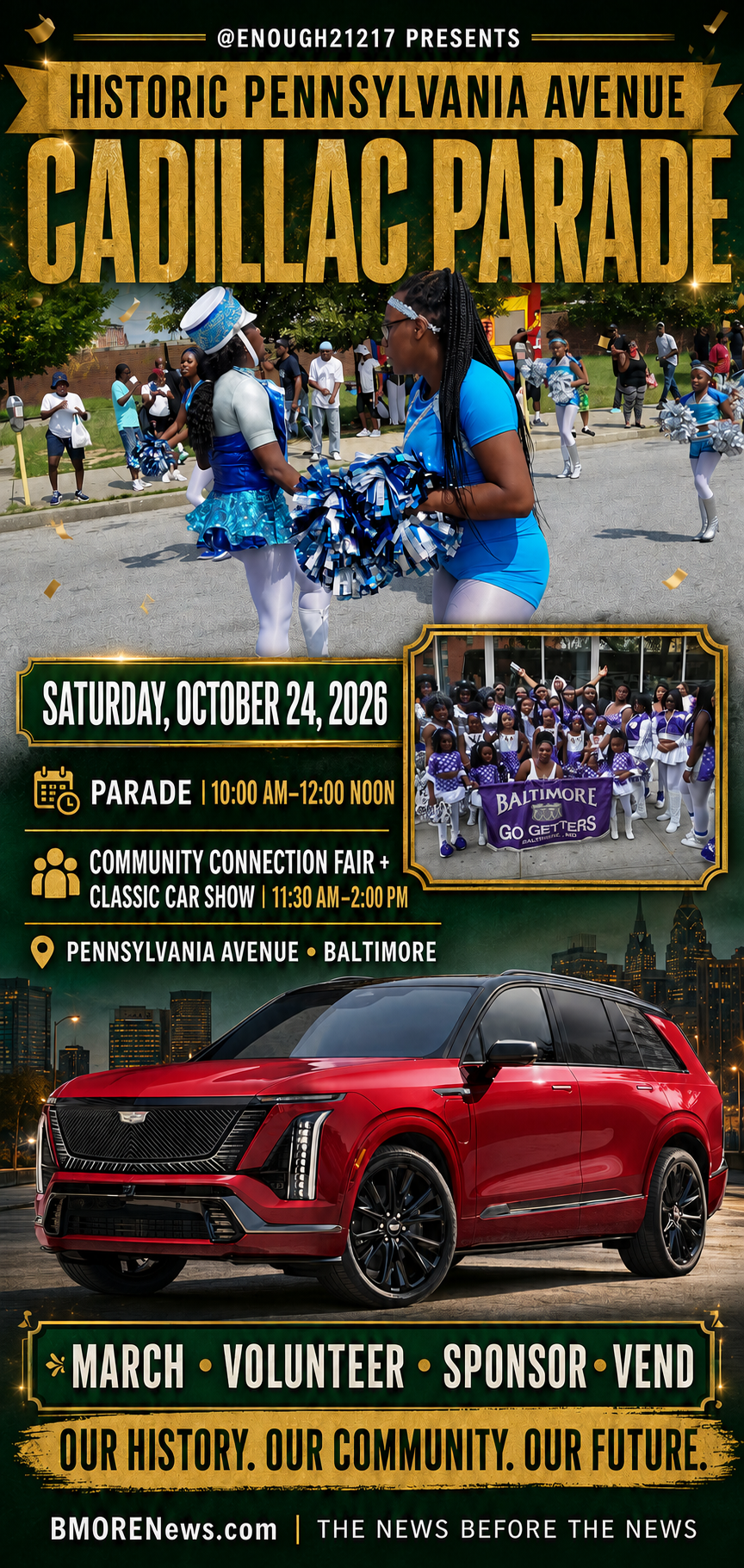
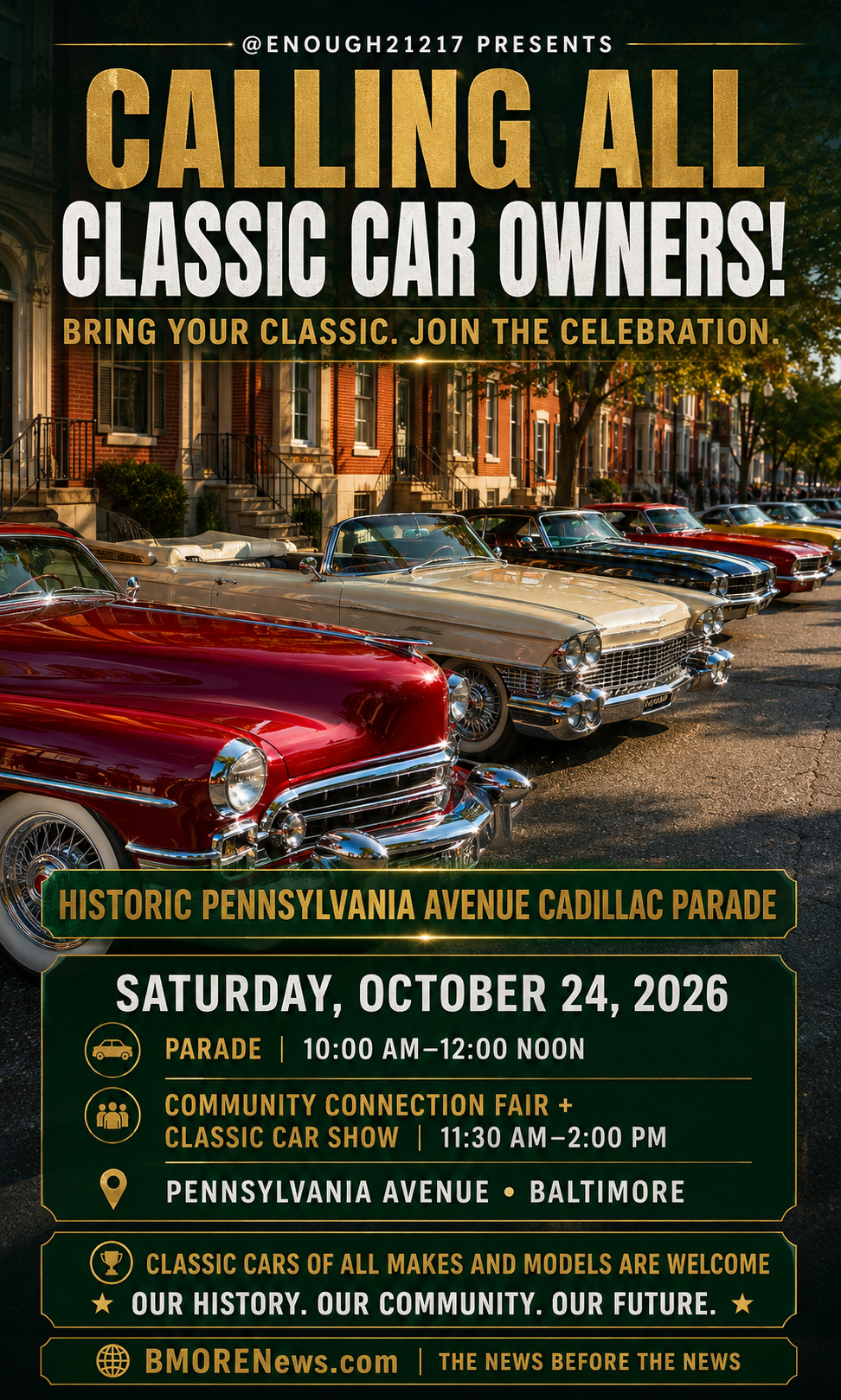
The Historic Pennsylvania Avenue Cadillac Parade will take place Saturday, October 24, 2026, from 9 to 11 a.m.
Immediately following the parade, the celebration will continue with a Community Connection Fair and Classic Car Show from 11:30 a.m. to 2 p.m.
The afternoon celebration will feature food trucks, vendors, community resources, music, entertainment, family activities, classic automobiles, and opportunities to connect with organizations serving West Baltimore neighborhoods.
The goal is simple but important: Use the history and legacy of Pennsylvania Avenue as a bridge between communities and generations.
Together, we can celebrate where Pennsylvania Avenue has been, strengthen the relationships that exist today, and help shape what comes next.
Pennsylvania Avenue Is Calling Us Home
So, come one, come all.
Bring the children.
Bring the elders.
Bring the churches.
Bring the schools.
Bring the neighborhoods.
Bring the businesses.
Bring the Cadillacs.
Bring the classic cars.
Bring the drumlines.
Bring the dancers.
Bring the memories.
Come stand on history.
Come celebrate the legacy of Pennsylvania Avenue.
Come remember the Easter parades and the fashions that transformed the Avenue into Black Baltimore’s runway.
Come remember the Royal Theatre, the Regent, the Sphinx, Club Casino, Gamby’s, The Ritz, Club Tijuana, the Comedy Club, the Bamboo Lounge, and all the places where Black Baltimore ate, danced, laughed, watched movies, conducted business, and made history.
Come remember Garnett “TV Tank” Budd.
Come remember Lena Boone.
Come remember Little Willie Adams.
Come remember George and Stephanie Gilliam.
Come remember Alvin Brunson and all the residents, merchants, musicians, organizers, and community leaders whose names may never appear on a monument but whose labor kept Pennsylvania Avenue alive.
When the New Edition Legacy, the Baltimore GoGetters, the Baltimore Twilighters, and Baltimore’s other phenomenal marching bands step onto Pennsylvania Avenue, they will be following generations.
They will be following the Easter paraders dressed in their finest.
They will be following the Cadillacs that rolled past the Royal.
They will be following the entertainers who lit up the stage and the entrepreneurs who kept Black dollars moving.
They will be following Lena Boone and Little Willie Adams.
They will be following George and Stephanie Gilliam.
And when those snare drums start talking and those bass drums answer, Baltimore will know exactly what time it is.
Rat-a-tat-tat!
Boom! Boom! Boom!
Rat-a-tat-tat!
Boom! Boom! Boom!
On October 24th, we are not merely putting a parade on Pennsylvania Avenue.
We are reclaiming one of our traditions.
We are restoring Pennsylvania Avenue to its rightful place at the center of Black Baltimore’s cultural memory.
We are bringing the people home.
Our History. Our Community. Our Future. Together, We Rise!
We get down with the get down.
For information about sponsorships, volunteering, vending, parade participation, or partnership opportunities, contact Alexandria Warrick Adams at 503-410-1882 or aadams@elev8baltimore.org.
.