


How Easterwood-Troy Brailey Park produced champions, protected generations and helped save our lives
(BALTIMORE – August 7, 2026) – When we got back from East Baltimore, I was about nine years old. I say “got back” because my mother had owned a house there the whole time—1526 Moreland Avenue, on a dead-end block facing Easterwood Park.
My mother, Lillie Juanita Glover, was one of the first Black homeowners on that block back in the early 1950s, when the neighborhood around Moreland and Baker was still predominantly white. One of her first instructions to me was simple: Don’t go around Warwick.
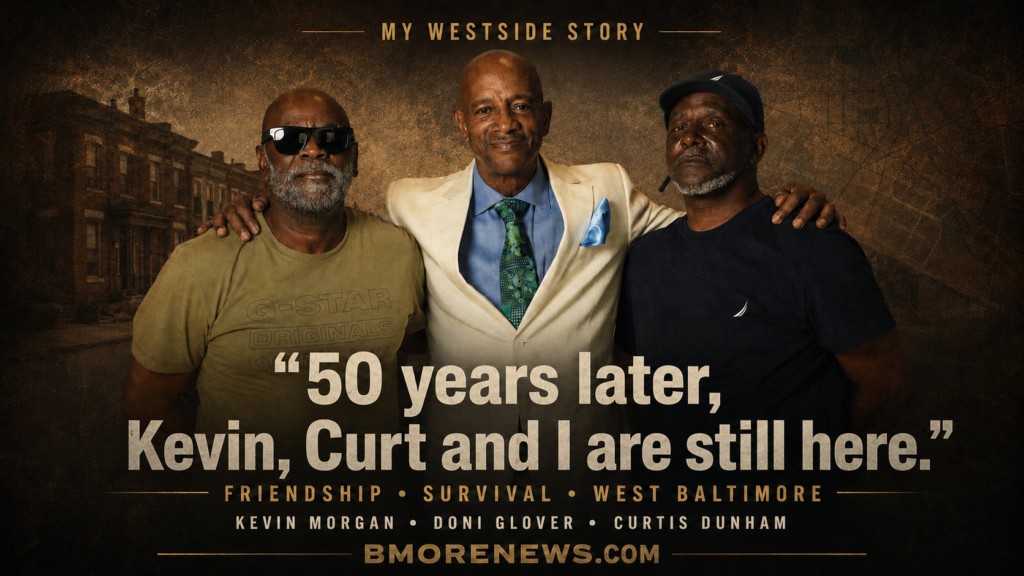
A block away, off Warwick and Baker, lived Kevin Morgan. We’re still friends to this day. Curtis Dunham lived farther up, in the 1700 block of Moreland Avenue.
I’m the youngest of the three of us. I’m 61; they’re both 62.
We all loved Easterwood Park. We loved our community. We took care of one another. We’ve lost some friends along the way—mutual friends who are dearly missed. Others still live right there or nearby.
We’re proud to be here. We’re glad to be here. One day at a time.
We’ve all had our flaws. We’ve all made our mistakes. But we’re still standing strong.
The History Beneath Our Feet
Easterwood Park and the West Baltimore neighborhood surrounding it carry more than a century of history. Within those few blocks is the story of Baltimore’s urban growth, residential architecture, changing racial demographics and grassroots community activism.
The park was established around 1911 as part of Baltimore’s early-20th-century expansion of public parks and recreational green spaces. The surrounding neighborhood—now recognized as part of the Coppin Heights/Easterwood Park Historic District—was developed primarily between 1890 and 1915.
Its streets were lined with two-story, porchfront brick rowhouses, many featuring second-story bay windows, Queen Anne-style accents, and small front lawns. Many of the houses were constructed by the Welsh Construction Company, owned by prominent Baltimore developer Ephraim Macht.
Before World War II, Easterwood was predominantly a white, working-to-middle-class neighborhood. That began to change following the war and continued through the 1950s as Black families moved into Easterwood and Coppin Heights. They helped establish this section of West Baltimore as an important center of middle-class Black homeownership.
My mother was part of that historic transition.
By the time my friends and I were growing up there, Easterwood Park had become much more than a patch of green space. It was a recreational and social center for neighborhood children and families. It hosted sports, community gatherings, and the everyday activities that helped hold a neighborhood together.
Like much of West Baltimore, however, Easterwood was eventually hit by industrial job losses, economic disinvestment, housing vacancies and aging infrastructure. The beautiful houses, porches, bushes and hedges remained, but the economic foundation supporting the community began to weaken.
The Maryland Historical Trust later surveyed the area and recognized it as the Coppin Heights/Easterwood Park Historic District, designated B-5224. Around 2014, portions of the historic residential grid near the park were cleared to accommodate Coppin State University’s South Campus expansion.

When Black Leadership Kept the Doors Open
Easterwood Recreation Center had already closed when the Omega Baltimore Foundation stepped forward.
In December 2011, the Baltimore City Board of Estimates awarded the foundation responsibility for managing and operating the center through a public-private partnership with Baltimore City Recreation and Parks. The final agreement was signed in 2012, and Easterwood reopened its doors.
The Omega Baltimore Foundation is affiliated with the Pi Omega Chapter of Omega Psi Phi Fraternity. The center operates under the leadership of Zanes Cypress, who continues to run Easterwood Recreation Center today.
Without the Omega Baltimore Foundation, Easterwood Rec might have remained closed.
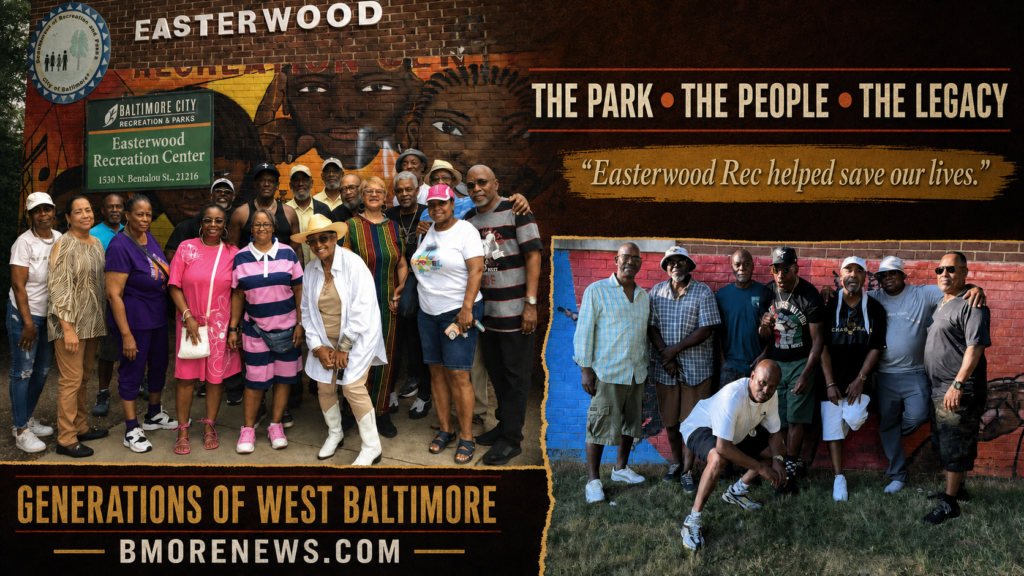
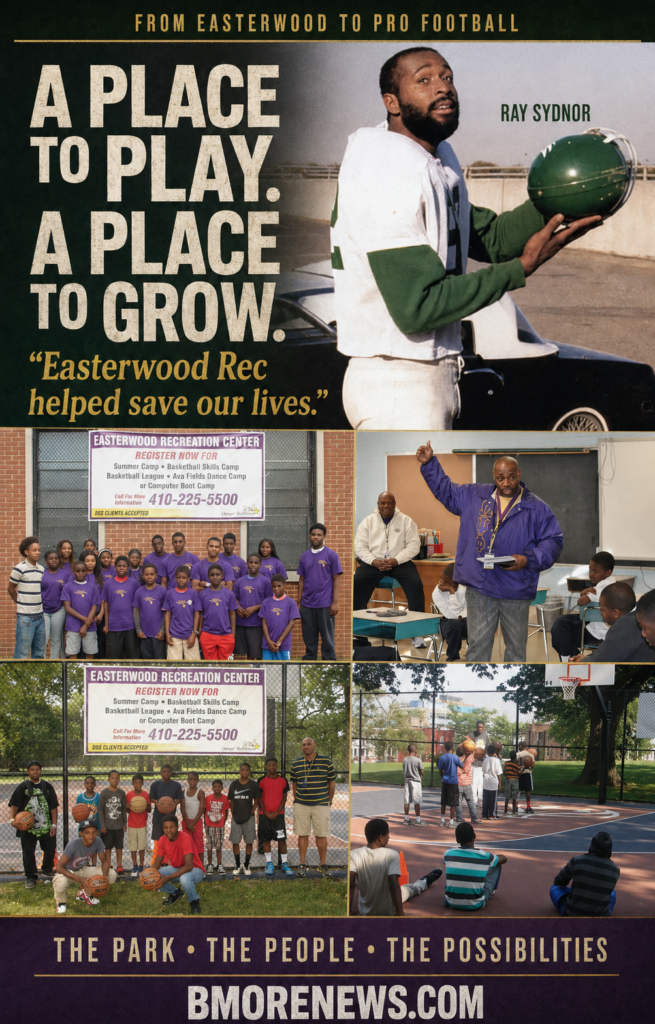
That matters because Easterwood Rec helped save our lives. It gave children a place to play, learn, compete, socialize, and remain connected to responsible adults.
Yet Easterwood was severely underfunded, especially considering all the money that has been sucked out of Black people and Black communities.
Easterwood Park should be dripping with resources.
I am glad, for instance, that the governor committed $118 million to a new Frederick Douglass High School. I’m glad that state Sen. Antonio Hayes has helped bring millions of dollars to West North Avenue.
We just need that about 10 more times.
When Investment Finally Came
Coppin State University was part of our community. They used to let us go swimming up there. We played basketball at Coppin.
The first significant state investment I remember coming into my old community came by way of a Republican named Bob Ehrlich.
One of my elders spoke to me about Ehrlich back when I was supporting him over Kathleen Kennedy Townsend. Mr. Hooks—God rest his soul—told me Bob Ehrlich was a “spear thrower for Newt Gingrich.”
That is exactly what Mr. Hooks called him.
But Ehrlich understood that if he was going to become governor of Maryland, he needed an untapped market. That market was Black people.
Consequently, there was a memorandum of understanding signed at Coppin involving Lt. Gov. candidate Michael Steele, Gubernatorial candidate Cong. Robert Ehrlich, and the Black community. I discuss it in my book, Black Blueprint: From Baltimore to Burkina Faso.
Long story short, Bob Ehrlich helped begin a new period of investment in Black Baltimore—in my neighborhood, in West Baltimore.
It took a Republican.
Too often, the Maryland Democratic Party has used Black people while providing too little return on our investment.
Very little.
Not enough.
Historic underfunding.
Maryland’s HBCUs endured generations of inequitable funding. That history cannot be erased merely because the state eventually reached a settlement.
And there would have been no Bob Ehrlich without Michael Steele.
Later, after eight years of Martin O’Malley, Republican Gov. Larry Hogan came into office and further invested in West North Avenue. Just as there would have been no Ehrlich without Steele, there would have been no Hogan without Lt. Gov. Boyd Rutherford.
Rutherford helped put together the West North Avenue Development Authority. Gov. Wes Moore—a Democrat, thank God—finally saw it not as robbery to invest $71 million in West North Avenue.
That is the kind of investment West Baltimore has long deserved.
We just need much more of it.
The Legends We Almost Forgot
When people talk about Baltimore sports legends, they usually begin with high school championships, college records and professional careers.
But before those accomplishments came the neighborhood recreation centers.
Before the uniforms, scholarships and television cameras, there were adults who opened gymnasiums, organized teams, drove children to meets and found ways to keep young people occupied.
At Easterwood, those adults included Eula Mae Williams and Ralph Durant.
Williams provided leadership and operated some of the best summer camps in the city. I never attended the camp. I lived across the street. Why would I attend when I could look out the window, see what was happening, and then go do what I wanted to do?
Of course, my mother usually had a list of tasks waiting for me.
Still, it was beautiful to watch. Every summer, the children would line up on Easterwood’s steps. They had somewhere to go, something constructive to do, and adults looking out for them.
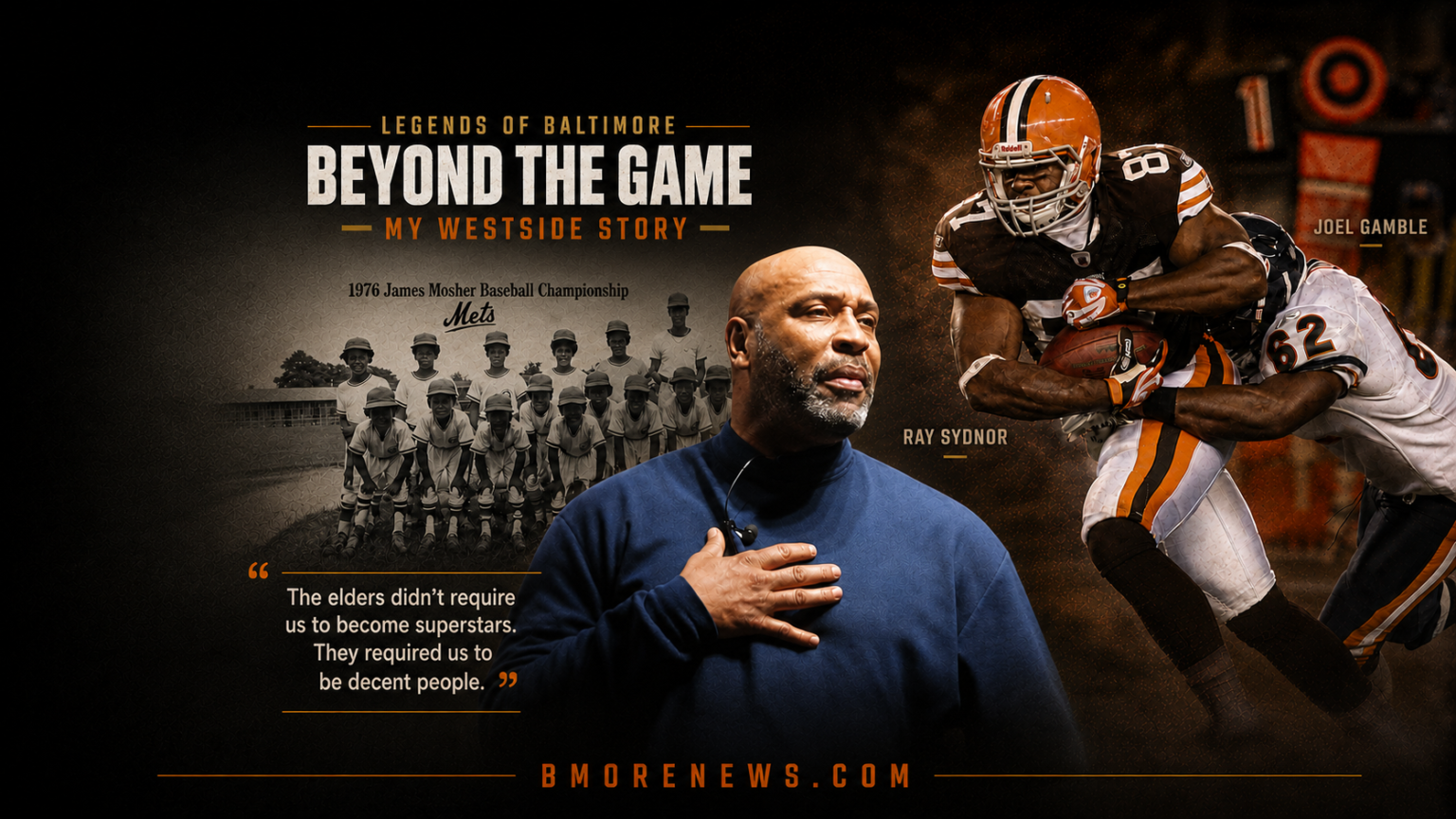
Ralph Durant was another Easterwood legend. A recreation leader and pioneering Baltimore track coach, Durant helped develop the youth track system that carried children from neighborhood recreation centers to competitions across the country.
One of those children was Cliff Wiley, Durant’s young neighbor on McKean Avenue.
Wiley originally thought he would become a baseball player. After striking out during a game at Easterwood, he learned about the neighborhood track program coached by Durant. Durant placed him on two relay teams during his first meet. Wiley came home with two trophies and fell in love with track.
He later became a 13-time All-American at the University of Kansas, an NCAA champion, a member of a world-record relay team, a Pan American Games gold medalist, the world’s top-ranked 400-meter runner and a qualifier for the 1980 United States Olympic team.
Durant’s legacy continues through the Ralph Durant Academy and the Ralph Durant Classic.
Then there was Raymond “Ray” Sydnor.
AFRO archives place a young Raymond Sydnor on Easterwood’s recreation track team in 1970 and 1971. Sydnor went on to play football and basketball at the University of Wisconsin. The Pittsburgh Steelers selected him in the third round of the 1980 NFL Draft, and he subsequently joined the Philadelphia Eagles.
Sydnor eventually returned to community work, using sports, mentoring and ministry to reach Baltimore children.
How many other stars came through Easterwood whose names I still don’t know?
That is one reason this Legends series exists. Baltimore’s history cannot consist only of the people whose records were preserved by schools, universities and professional leagues. We must also remember the neighborhood adults and recreation-center coaches who helped put those athletes on the road to success.
Joel Gamble Comes Home
Joel Gamble represents a younger generation of Easterwood legends.
Gamble grew up on Smallwood Street, one block from Carver and Easterwood. He attended Matthew A. Henson Elementary School, Falstaff Middle School and Carver Vocational-Technical High School, where he is a Hall of Famer.
Basketball was his first love, but he eventually transitioned to football.
After an injury limited him to three games during his senior year at Carver, many of his larger college opportunities disappeared. Shippensburg University offered him a chance.
“They chose me,” Gamble said.
At Shippensburg, Gamble developed into an all-conference tight end. During his sophomore season, he led the team in receptions and receiving yards. He later became affiliated with three NFL organizations: the Philadelphia Eagles, Cleveland Browns and Tennessee Titans.
But Gamble’s story did not end with professional football.
After retiring, he came home.
“My connection to Easterwood—that’s the neighborhood that I grew up in, the recreation or playground area that I used to play in growing up,” Gamble said.
In 2013, he partnered with Zanes Cypress to hold one of his organization’s first football camps at Easterwood.
“That kind of kicked off all of the community work that I do to this day,” Gamble said. “A lot of the programming that I’ve done over the years has been hosted at Easterwood, from the flag football leagues to different camps and things of that nature.”
Although his organization has expanded beyond the recreation center, Gamble said his partnership with Easterwood has continued since 2013.
Today, JG Community Youth Outreach provides athletic, academic and cultural programming for Baltimore children and families. Gamble also maintains partnerships with Matthew A. Henson Elementary and Carver, his alma mater.
For Gamble, reaching the NFL was not solely a personal accomplishment.
“It’s a blessing to be able to share that I played for three teams in the NFL,” he said. “I think the biggest, most impactful thing about that is it kind of shares some hope for the community that I come from.”
He believes God gave him an athletic platform so he could return home and bless other people.
“That’s the most impactful part,” Gamble said. “God gave me that opportunity to play in the league, but more so, I’ve been able to touch lives from that platform and be able to help people out.”
That is what it means to go beyond the game.
What Easterwood Gave Us
Gamble does not clearly remember the Easterwood Recreation Center building being open when he was a small child. He remembers the park itself as a place where neighborhood children could play football.
Later, he played basketball on Easterwood’s courts.
“They even had the lights out there at one point in time,” Gamble recalled. “That was definitely something that was helpful in our community, especially when you see all these signs around saying ‘No ball playing.’ That was the place that we could go as kids to actually play and be safe.”
That is the point.
Easterwood gave us somewhere to go.
It gave us baseball, basketball, track and field, flag football, martial arts and weightlifting. Sometimes, children even went roller-skating inside Easterwood Rec.
I never roller-skated there. I went to skating rinks. But for children who simply needed somewhere to skate, it was a beautiful thing.
The park also gave us the Easterwood Whatnauts and those unforgettable Sunday flag football games.
Cars would block the entire street. Wasn’t no getting up the block once the game started. That was the ball game. That was the Sunday highlight.
My mother made chicken sandwiches, and I went outside and sold them.
That was community.
The Best Discos in Baltimore
Easterwood had the best recreation-center discos in Baltimore.
Nobody had discos like ours.
Nobody.
Our joints were packed.
“One Nation Under a Groove.” Parliament. Funkadelic.
We danced, laughed, sweated and enjoyed being young. Those discos gave us music, culture and a place to gather.
And when Kurtis Blow came to Giovanchi’s, that was a highlight.
Kurtis Blow was one of hip-hop’s earliest national stars. For him to come into our world meant something. We did not have social media placing celebrities in the palms of our hands.
When somebody like Kurtis Blow showed up, that became part of the neighborhood’s collective memory.
The Stores, Streets and Sounds
Our story was also written through neighborhood businesses.
There was Whitey’s Store at Warwick and Baker.
There was Ben’s Bar at Westwood and Presbury.
We watched a Black-owned store at Warwick and Presbury get sold to Korean owners. We watched another Black-owned corner store at Presbury and Bentalou close. Another held on until the deaths of the family members who operated it.
Those stores represented more than convenience. They represented ownership, familiarity and the economic life of the community.
We watched that ownership change.
We would go to Jerry’s at Walbrook Junction and buy a $12 pair of Hush Puppies.
We went to Mondawmin Mall. Charlie Rudo sold more tennis shoes than anybody. Going to Mondawmin itself was an experience.
Then there were the Travis Winkey fashion shows.
Oh, my God.
Travis Winkey’s models would come down that runway:
Pose. Pose. Pose. Pose. Pose.
Those shows were a highlight.
Later, when we started making a little money, we could go to Mondawmin and buy a pair of Jordache. We could buy Calvin Klein or Gloria Vanderbilt. We could go to the record store and buy our favorite 45.
All of that was part of the world surrounding Easterwood Park.
What We Saw
Growing up, we saw many of the same things and many of the same people. We saw people going places, and we saw people going nowhere fast.
We also saw a police helicopter chasing a dirt bike crash in Easterwood Park.
Federal aviation records confirm that on Aug. 12, 1995, a Baltimore police helicopter was assisting in the pursuit of a suspect riding a dirt bike. The dirt bike entered Easterwood Park from Baker Street before the helicopter crashed.
That was the kind of thing we witnessed.
Those of us with active, responsible parents knew that if we went outside and did anything to discredit the family name, there would be consequences.
At the same time, young people are curious, adventurous and, yes, ignorant. We made mistakes like everybody else.
The real question was always: How fast can you correct that mistake and never make it again?
For our friends who are gone—Lord, we miss them. We miss the memories.
But again, we’re still here.
Three People Down
Perhaps the worst thing we witnessed happened on West North Avenue.
A man hit the number inside P&M Bar in the 2100 block. Another man shot him, took his winning lottery ticket and walked briskly down the street.
A police officer positioned in the North Avenue median shot the gunman, and the gunman shot the police officer.
In less than a minute, three people were down in front of us.
This happened along North Avenue between Pulaski Street and Smallwood Street. North and Pulaski was known as “Dodge City” because somebody once came through there with an Uzi and shot the area up.
Come to find out, the man who hit the number was my classmate’s stepfather.
That same classmate later lost his brother, Bill, at Warwick and Presbury. Bill was killed while trying to break up a fight.
The lesson is not necessarily that you should never try to break up a fight. The lesson is that you must pay careful attention to what you are doing, who you are dealing with, and who else may be coming to that fight.
You need peripheral vision. You need to understand whether anyone involved has a weapon—or a propensity for using one.
Before stepping into the middle of a confrontation, understand exactly what you are getting yourself into.
Trying to help can cost you your life.
The Drugs and the Game
We saw the crack epidemic. Before that, we saw heroin and cocaine and the grip they had on our community. We saw people who slung dope. We grew up around young kingpins—probably more of them in our community than in many other sections of Baltimore, for a litany of reasons.
The generation I grew up with was kind of like the NFL: The game kept getting faster.
People would go away to prison and return 10 or 20 years later, only to find that everything had changed. The players had changed. The game was essentially the same, but it was faster and run by a whole new crew.
The power structures shifted.
Who was in charge? Who made the decisions? Who set the bar?
A man who had been a kingpin 15 or 20 years earlier might be working a nine-to-five—if he was still alive.
We saw people with holes blown in their heads.
At the end of my block, I saw thick, dark blood oozing from a man’s head. I’ll never forget it. Even though my father was an undertaker and I had seen dead bodies before, this was different.
This was a freshly murdered body, face down, with blood still coming from a hole in his head.
We saw these things as children. Truth be told, they were traumatic.
My mother said, “Don’t go around Warwick.”
But I was an adventurous, disobedient soul. I had to go and see for myself.
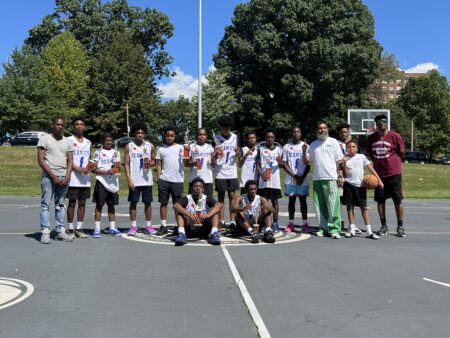
Sixty-one years later, Kevin, Curt and I are still here. Still living. We’re grandfathers now. We remember one another as little boys.
That is the beauty of this photo.
This is my Westside story.
Countless Stories
We’ve got countless stories—stories that lead to Odell’s, Giovanchi’s, and Paschal’s. Stories from our high school days.
Kevin and Curt’s zone school was Walbrook. I presumed, of course, that I wasn’t going to do any work if I went up to Walbrook. So, I ended up going across town—first to Poly and then to the mighty, mighty Dunbar.
Nonetheless, after growing up with these guys, I’m simply glad we’re still friends. I’m glad we can still hang out, enjoy one another’s company, and watch our families grow.
There were many who did not make it out of those streets. Many never learned the lesson.
Some are still out there.
As beautiful as our neighborhood was—and it was beautiful, with its bushes, hedges and porches—drugs utterly destroyed our way of life.
Drugs came by way of people. There was exploitation. There was heavy addiction.
And some of us played a role in it.

What I Remember, Too
I’ve told you about some of the ills. But let me tell you what else I remember: some of the most competitive baseball games of my life.
Hardball.
I would suit up and play catcher because I was James Mosher. That’s James Mosher Baseball, considered the oldest Black youth baseball league for children in the country.
East Baltimore had Lafayette Rec. We had James Mosher.
I rode the bench for three years. By nine or 10 years old, I was a powerhouse. The competition at James Mosher was fierce. Some of the best baseball players you could ever see came out of there.
We had a shortstop named Clerow “Junie” Myers. God rest his soul. Junie played short, but one day he was on the mound and threw the meanest changeup you could imagine coming from a 12-year-old.
Then there was Craig—tall, statuesque and mean on the mound. Craig played for the Cubs. You would step up to the plate against him and think, “I’m not even going to get a piece of this.”
But then you had the guys who challenged pitchers like that—the home-run hitters.
Howard Fields. Brian Easley. Kevin Davis. Eric Davis. Kenny Davis.
Man, those cats could poke it over the fence.
I hit the fence once. I got an inside-the-park hit once, too. But those were truly outstanding ballplayers I came up under.
By the time I got to Dunbar, baseball—pitching, throwing and hitting—was a given for me. I don’t know about anybody else, but for me, it was a given.
I admire the guys from East Baltimore who knew at eight or nine years old exactly which high school they were going to attend. A lot of them knew they wanted to go to Dunbar.
Here is what I knew: Even as a little boy, I knew I was going to college.
That much I knew.
High school, though? I had no idea.
Then one day, my best friend Marty’s older brother, Levi—God rest his soul—was standing outside. Marty and I were the same age and lived two doors apart. I had just dropped off my trash and was heading back when Levi stopped me.
“Hey, what high school are you going to?”
“I don’t know.”
“Go to Poly.”
“Okay.”
So, I applied to Baltimore Polytechnic Institute.
Poly waxed my hind parts academically.
But that, too, was part of growing up—and another piece of my Westside story.
The Crucible
There is a Bible passage I learned at The Lord’s Church under Bishop Kevia Fernando Elliott, my godbrother:
“Whosoever the Son has set free, ye shall be free indeed.”
Growing up in the inner city of Baltimore—east side or west side—puts you in a crucible. A fire is placed upon your life. That fire will either bring out the impurities and make you, or it will break you.
That is the beauty of this photo.
We made it.
We survived everything thrown at us, including mass incarceration.
We saw one homeboy go away for 42 years. He’s home now. We remember it as though it happened yesterday.
We know about the prison system. Many of us were able to dodge prison.
One guy couldn’t stay home. He kept going back. It’s called institutionalization. He had been locked up for so long as a child that he did not know how to function outside of prison.
I was no roughneck. Prison was simply one of the consequences that came with being in the streets. Of course, people who received long sentences typically did something to earn them.
Nonetheless, as beautiful as West Baltimore was, as beautiful as Easterwood Park was, and as beautiful as Rognel Heights was with its cobblestone streets, we witnessed the devastation drugs could cause.
So, this is a shout-out to everybody who came through the streets of Baltimore—to everybody who made it, who is still here, and who is doing the right thing.
Especially those who, like me, did some of the wrong things, too.
God allows U-turns.
If God says you’re free, then you’re free.