


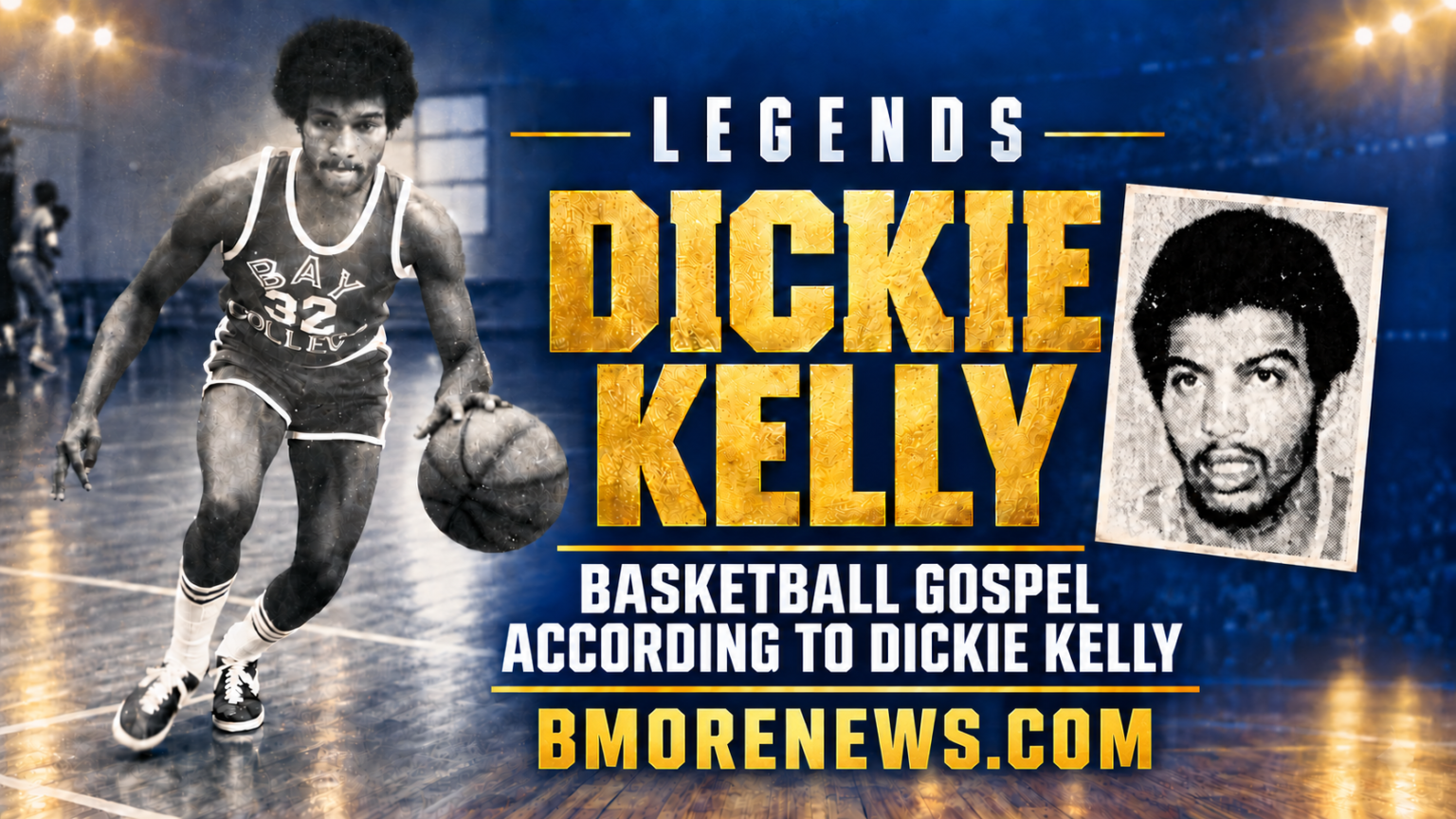
BASKETBALL GOSPEL ACCORDING TO DICKIE KELLY
The Dunbar great, playground scoring machine, and Baltimore Bullets draft pick remembers the long road from Turner Station to the edge of the NBA
(BALTIMORE – September 6, 2026) — Before there was Skip, there was Dickie.
That is not meant to diminish the greatness of Skip Wise, one of the most celebrated basketball players ever produced by Baltimore. It is a reminder that this city’s basketball history did not begin with the names most people remember.
Long before Skip electrified crowds at Dunbar High School, Dickie Kelly was already giving Baltimore basketball fans something to talk about.
Kelly was a playground legend, a Dunbar Poet, a scoring machine and a guard who once stood toe-to-toe with Earl “The Pearl” Monroe. He played at Bay College of Maryland, earned national junior-college recognition, and was selected by the Baltimore Bullets in the 1973 NBA Draft.
Yet when Kelly was asked what he wanted people to remember most, he did not begin with points, championships, or professional basketball.
“That I was a hard-working, God-fearing man,” Kelly said. “That’s all you got to say.”
Across the Bridge to Turner Station
James “Dickie” Kelly was born on February 7, 1948. He grew up in Sparrows Point, near Turner Station in Baltimore County, and began playing organized basketball at about age 7.
There was no youth basketball league in Sparrows Point, he recalled, so he crossed the bridge into Turner Station to play in a program run by a man known as Captain Smith.
“He had everything,” Kelly said. “He had baseball, basketball. I think he had football, too.”
Kelly’s mother gave him bus fare to reach the games. Instead, he often pocketed the money and walked across the bridge.
“I was saving that money she was giving me to catch the bus,” he said. “I just walked over the bridge.”
Sometimes he used a little of the savings to stop for a hot dog.
That resourcefulness would remain with him. Kelly learned early how to make his own way, negotiate for himself, and survive without constantly asking his family for money.
But the foundation of his game came from something simpler: hours of solitary practice.
“I had a basketball court where you had to have the winners,” he explained. “Sometimes I used to go up there, and if there was nobody playing, I used to act like somebody was playing me. I’m out there by myself, putting moves on myself. I’m trying to duck myself—but you can’t duck yourself.”
He would practice for hours after school, sometimes remaining on the court after dark and playing by the light of a nearby streetlamp.
“What made me good?” Kelly asked. “Me practicing by myself.”
Becoming a Dunbar Poet
Kelly eventually made his way to Baltimore’s legendary Dunbar High School, where William “Sugar” Cain coached the Poets.
Kelly believed he was ready to contribute before Cain was prepared to give him the opportunity. As a young player, he watched older players enter games ahead of him—even when he believed he was better.
“I thought I was supposed to be starting in the 10th grade,” Kelly recalled.
During one practice, Cain warned his starters not to let “this rookie” beat them.
Kelly never forgot it.
The following season, Dunbar struggled during the first half of a game. Cain finally turned to Kelly.
“He said, ‘Mr. Kelly, you’re starting the second half,’” Kelly remembered. “I said, ‘Yeah, I guess I am. We’re losing by 10.’”
With Kelly on the floor, Dunbar erased the deficit and won by 10.
That performance changed everything.
In 1965, Dunbar completed an undefeated 20-0 season and swept Carver in the Maryland Scholastic Association championship series. Historical accounts credit Kelly with scoring 18 points in the first championship game. In Game 2, played before nearly 4,600 people at the Baltimore Civic Center, he scored 23 points—including 11 consecutive points during a decisive third-quarter run.
The Poets won, 74-64, and secured another championship.
Kelly, who played only the second half of that season, was named second-team All-Metro. His impact went far beyond the number of games he played.
The court had finally confirmed what Kelly already believed: once he was given a real opportunity, he belonged among Baltimore’s best.
Timmy Greene Remembers
Long before “Mean” Timmy Greene helped Dunbar defeat nationally ranked DeMatha and claim its place in basketball history, he knew Dickie Kelly as one of the many talented players who came through Luzerne Playground.
Greene did not initially understand just how prominent Kelly was.
“I had known Dickie when he used to come around Luzerne Playground,” Greene recalled. “But I didn’t know who he was until they played Carver for the championship that year. My brother was on the junior varsity, and by me going out and watching the game, I said, ‘Damn, that’s the same guy who comes around the playground.’”
Luzerne attracted some of Baltimore’s best players. Greene remembers Gus Johnson and other established stars coming through, so seeing a talented player on that court was not unusual.
“I knew Dickie was good,” Greene said. “But I didn’t realize he was as prominent as he was because a lot of people used to come around Luzerne Playground.”
Watching Kelly play for Dunbar gave Greene a different appreciation for the guard he had previously known only from the neighborhood court.
“Can’t nobody say that Dickie Kelly doesn’t rank as one of the best to come out of Baltimore,” Greene said.
Greene later played with Kelly through Camp Concern. Kelly was supposed to be playing, Greene joked, but had also taken on coaching responsibilities. Their relationship gave Greene a view of Kelly across different stages of Baltimore basketball—from the playground and Dunbar to the adult leagues and community programs.
Most importantly, Greene supports the assessment passed along by Dwayne “Kosher” Wood: before Baltimore celebrated Skip Wise, Dickie Kelly had already established the standard.
“That’s not out of the way to say,” Greene said. “Before there was Skip, there was Dickie Kelly. When they had a chance to battle one another, they battled.”
For Greene, the comparison is not about taking anything away from Skip Wise. It is about making sure Kelly receives his rightful place in the lineage of Baltimore basketball.
Before Skip became a national phenomenon, the people around Luzerne Playground already knew what Dickie Kelly could do.
Facing Earl “The Pearl”
Kelly’s reputation eventually carried him beyond Baltimore.
He played in Philadelphia’s famed Sonny Hill League, where professional players, college stars, and elite playground players tested themselves against one another.
That is where Kelly encountered Earl Monroe.
Monroe, a Philadelphia legend who became a star for the Baltimore Bullets and New York Knicks, was known for his creativity, control, and improvisation. He later entered the Naismith Memorial Basketball Hall of Fame.
Kelly did not claim that he dominated Monroe. He put it another way.
“He didn’t do no more to me than I did to him,” Kelly said. “We broke out even.”
Then Kelly paused.
“But I think I had a little edge there.”
The matchup changed Kelly’s position within the league. After watching him compete against Monroe, Sonny Hill moved Kelly into the starting lineup.
“Right after that game, Sonny Hill said, ‘Kelly, you’re starting from there on,’” he recalled.
Kelly also took something from Monroe: the spin move.
“That’s the only move that I didn’t get when I was playing by myself,” Kelly said. “I had to learn that later in life. I got it from Earl Monroe.”

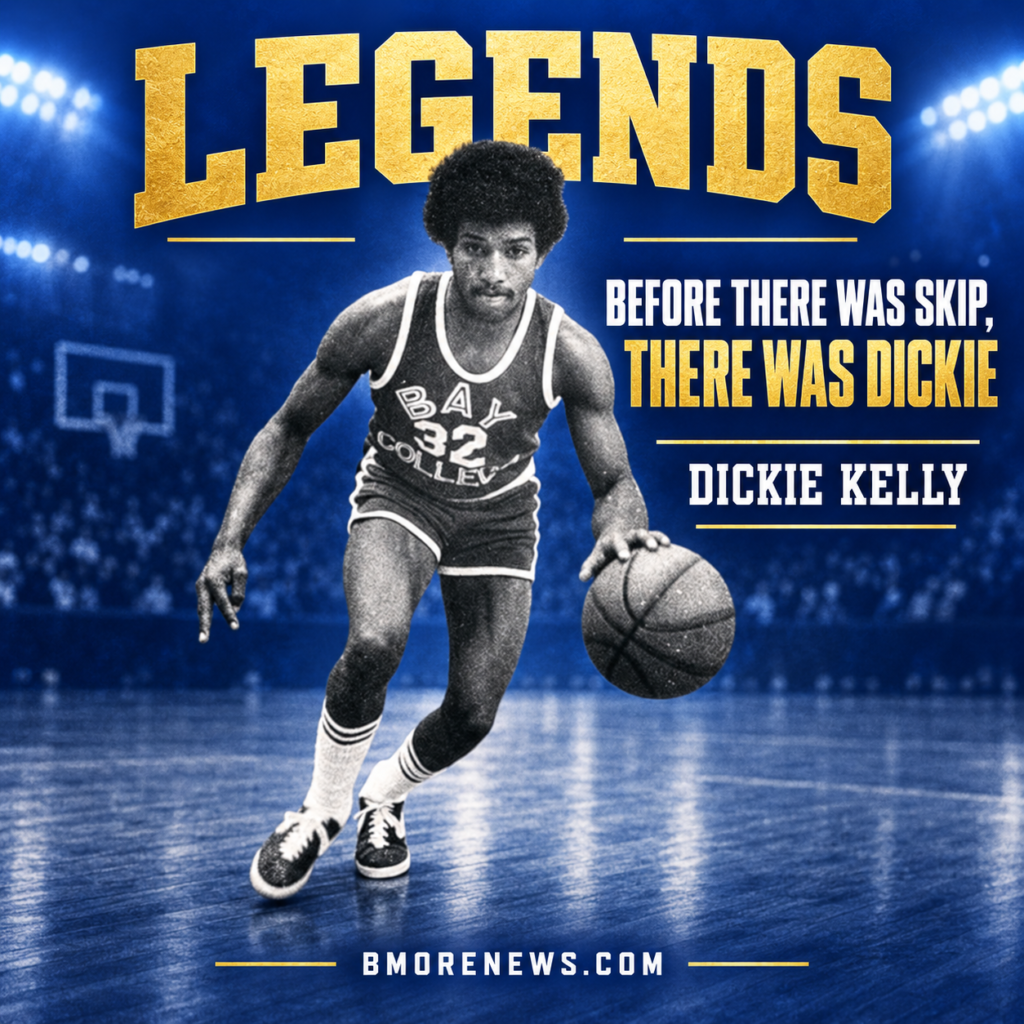
A Scoring Machine at Bay College
Kelly’s educational and basketball journey did not follow a straight line. He spent several years away from school before enrolling at Bay College of Maryland, a junior college.
Once he arrived, he made up for lost time.
Kelly recalls averaging about 40 points and 10 assists in his first season, and about 30 points in his second.
Whether the defense knew what was coming made little difference. Kelly could cross over, create separation, get to the basket, and hit the jumper if his defender backed away.
His performance earned him recognition on the 1972-73 junior-college All-America team.
Kelly also played for coach Paul Baker at Wheeling College in West Virginia. He remembers Baker helping him financially, providing him with his own room and treating him like a player whose value extended beyond the court.
Kelly said he learned to advocate for himself and make his own arrangements in an era when Black players did not always receive the opportunities, representation, or protection their talent warranted.
“How did you know to make deals for yourself?” I asked him.
“God, my man,” Kelly answered. “The Lord. I always prayed.”
Drafted by the Baltimore Bullets
Kelly’s reputation brought him to the attention of the Capital Bullets.
He recalls participating in a professional tryout under Gene Shue, the Bullets coach who had also coached Earl Monroe in Baltimore. Kelly said he survived until the final round of cuts and was offered an opportunity to appear in an exhibition game.
The historical record confirms that the Baltimore Bullets selected James “Dickie” Kelly in the 10th round of the 1973 NBA Draft with the 162nd overall pick.
He did not become an NBA star. His name is not one casual basketball fans are likely to find displayed alongside Monroe, Wes Unseld or Elvin Hayes.
But being drafted mattered.
A boy who once walked across a bridge to play in Turner Station had reached the doorstep of the NBA.
“Amongst the Elites”
In 2016, Baltimore writer Joseph Hall—known as “The Blackman Who Reads Aloud”—published a tribute titled Dickie Kelly, A Playground Legend, B’more’s Own, Bad to the Bone.
Hall has granted BMORENews.com permission to share his words in this Legends profile.
“Before that, folks on the eastside knew the score. Chasing after Dickie Kelly could really make you sore; defending against him, well, that was a hard chore.
“Man, Dickie Kelly was definitely the truth. He was always bound to blow scores off the roof. All of the statisticians kept all of the proof.
“Dickie Kelly was indeed among the elites. Watching Dickie crossover was such a treat. He’d bang that jumper, then pop—hit repeat. Give him a couple of inches and you were dead meat.
“Dickie with the pill—oh my, how sweet. Oh yes, Coach Butch McAdams, Dickie Kelly was indeed amongst the elites.”
Hall described Kelly as “one cool cat” whose exploits extended far beyond his days at Bay College.
That is how playground history survives. One witness tells another. One generation reminds the next. The names are carried forward by the people who were there.
More Than Basketball
Basketball was only part of Kelly’s life.
He worked for Camp Concern and later became a firefighter, serving for 21 years and earning a pension. His mother could see that the discipline he demonstrated on the basketball court had carried into adulthood.
“Every morning I got up, she knew I got up,” Kelly said. “She knew I went to work.”
His mother supported his basketball wholeheartedly, but she also expected him to work, handle his responsibilities, and become a man.
Kelly’s father worked at the steel mill in Sparrows Point and rarely attended his games. Kelly remembers some of his father’s coworkers telling him that he had a son who could really play.
Eventually, his father came to see him.
“He never came to a game,” Kelly recalled. “I didn’t know he knew I played.”
Unfortunately, Dunbar lost that night, ending a long winning streak. Kelly also became involved in a confrontation on the court.
His father did not say much about either occurrence. Still, his presence mattered.
Years later, the tenderness in Kelly’s voice when he spoke about his parents revealed another side of the fearless playground competitor. Behind the confidence, the sharp tongue, and the unapologetic storytelling was a son who wanted to make his mother and father proud.
The Legend Before the Legend
From time to time, I check in with my advisors. They keep me on point.
Dwayne “Kosher” Wood is one of them.
I trust Kosher’s judgment because he knows Baltimore’s history. Whenever I need direction, I can call him.
After interviewing Mr. Dickie Kelly, I told Kosher that Kelly was one of the most authentic and unapologetic people I had ever met. He is conscientious. He is aware of his surroundings, aware of the history, and aware of what it takes to become the best.
Kosher responded with a piece of Baltimore basketball truth.
Most everybody pays homage to Skip Wise, he said. But the people who know the real history understand that before there was a Skip, there was Dickie Kelly.
That statement captured the purpose of the BMORENews.com Legends series.
History is not merely a list of the most famous names. History belongs to the people who built the road—even when someone else became better known for traveling it.
Dickie Kelly practiced alone under a streetlight. He crossed the bridge into Turner Station. He fought for playing time at Dunbar. He helped the Poets win a championship. He matched moves with Earl Monroe. He became a junior-college All-American and was drafted by the Washington Bullets.
Then he went to work, served his community, and fulfilled his responsibilities.
Yet through all the basketball stories, the scoring numbers, the confrontations and the colorful language, Kelly reduced his life to one simple sentence:
“I was a hard-working, God-fearing man.”
Before there was Skip, there was Dickie.
And Dickie Kelly was bad to the bone.
Editor’s note: Portions of this profile are based on Doni Glover’s interviews with Dickie Kelly and Timmy Greene. Statistics and recollections attributed directly to Kelly reflect his account. Excerpts from Joseph Hall’s 2016 LinkedIn tribute are republished and lightly edited for clarity with Hall’s permission.