


(BALTIMORE – September 20, 2026) – A woman called me out on Facebook, and I will be honest: She pissed me off.
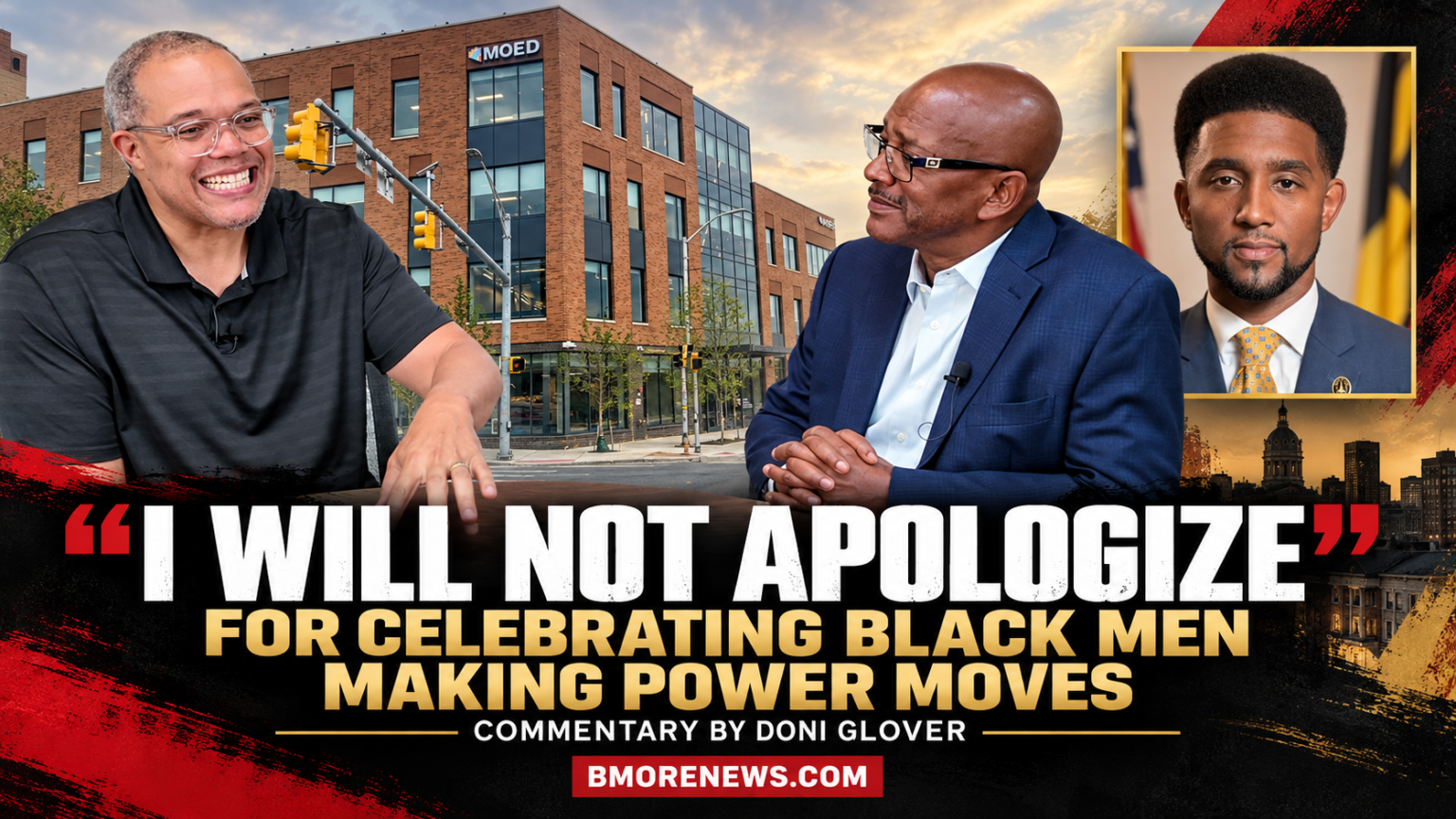
She challenged me over my support for David Bramble, the West Baltimore native and co-founder of MCB Real Estate whose company acquired Harborplace and is involved in major development along West North Avenue. She questioned why people conflate MCB’s interests with those of Baltimore’s Black residents. She pointed out that MCB is not an MBE. She questioned the relationship between Bramble and Mayor Brandon Scott. She even compared Bramble to Ronald Lipscomb.
Then she wrote, “Come on, Doni. You’re better than that.”
That got under my skin.
Why? Because she got my number.
I do have a soft spot for Black men from Baltimore who rise high enough to move money, land and power. I do want to see Black men make consequential moves. Considering the history of this city—and this country—I believe it is long overdue.
But there is more to my perspective than racial pride.
Around 1999, some 27 years ago, I began writing for The Baltimore Times. It is a Black newspaper that has served this city for more than four decades. When I was getting started, The Baltimore Times did something I will never forget: It allowed my website to appear with my byline.
That may sound small today. It was not small then.
Not every newspaper was willing to do that. Some wanted my writing. Some wanted my front-page stories. But The Baltimore Times allowed me to build my own platform while contributing to theirs. That act of generosity and vision mattered to the future of BMORENews.com.
For nearly 30 years, I have watched Peter and Joy Bramble serve Baltimore through that newspaper. They gave this majority-Black city another important media voice—one with its own style, priorities and commitment to positive community news. Anyone who has spent time with Joy knows how authentic she is and how deeply she cares about people.
That is the family history I carried with me when I began getting to know David Bramble.
Does that history affect the way I see him? Of course it does. I will not insult my readers by pretending otherwise. Journalism does not require us to be people without memories, relationships or perspective. It requires us to be honest about those things and still follow the facts.
So, yes, I want David Bramble to succeed. I know what his family has meant to Baltimore. I know he comes from West Baltimore. I know he lives near the same North Avenue that has endured disinvestment, violence, sirens, helicopters, vacant buildings and broken promises for generations.
I also know what has not happened there.
The daycare center near North Avenue and Interstate 83 was built around 1970. I know because I was part of its first graduating class. For most of my lifetime, virtually nothing transformative happened at that property or along large stretches of West North Avenue. Baltimore became accustomed to neglecting communities like ours and then explaining that neglect as though it were natural.
Now development is coming. The housing may be expensive. The developer intends to make money. Neither fact surprises me. Developers—Black, white or otherwise—develop property to make money.
The public question is not whether a developer earns a profit. The question is what the community receives in return.
Will longtime residents benefit? Will Black businesses participate? Will people from the surrounding neighborhoods get jobs, contracts and opportunities? Will development improve safety and quality of life? Will it build community wealth, or merely increase property values until existing residents can no longer afford to remain?
Those are legitimate questions, and David Bramble does not get a pass from me.
But let us clear away an irrelevant distraction. I never said MCB was an MBE. I never based my support on MBE certification. Someone else introduced that subject into the conversation.
As I have said before, the traditional MBE framework is not the center of my argument. A certification label does not automatically tell me whether Black businesses or Black communities will benefit. I care about measurable outcomes for my community. While I naturally prefer to see Black Americans included in ownership and decision-making, my ultimate goal is the best community we can build.
Precision matters, too. David Bramble did not personally “buy the Inner Harbor.” MCB Real Estate, the company he co-founded and leads, acquired Harborplace. Harborplace is not the entire Inner Harbor. I can state that more accurately without abandoning the larger significance of what is happening.
I also understand that deals get made.
Major developments do not appear because someone walks into City Hall, takes a number and completes a form. Developers, elected officials, lenders, lawyers, investors and community leaders meet, negotiate and assemble complicated projects. That happens in Baltimore and in every major city in America.
The existence of dealmaking is not proof of corruption. The appropriate questions are whether the process was lawful, whether it was transparent, what public resources were committed, what promises were made and whether those promises are kept.
Hold Mayor Brandon Scott accountable. Hold David Bramble accountable. Follow the money. Examine the financing. Monitor local hiring. Measure Black-business participation. Put every public commitment on the record.
That is journalism.
What is not journalism is treating two Black men making significant moves as inherently suspicious and then working backward to construct a case against them. Words such as “hooking up MCB,” comments about one Black man becoming richer and unsupported comparisons to disgraced figures do not sound like neutral demands for accountability. They sound like disdain.
And that raises an uncomfortable question: Would some people be more comfortable if the developer were white?
For generations, Baltimore’s most valuable land, contracts and development opportunities largely passed through hands that did not look like ours. Black residents were expected to watch other people make fortunes while our neighborhoods waited. Now, when a Black man from West Baltimore reaches a position where his company can help reshape major parts of the city, some people seem determined to explain why his Blackness should mean absolutely nothing.
It does not mean everything. But it does not mean nothing.
Representation alone will not rebuild a community. A Black face at the top does not guarantee Black workers, Black contractors, affordable housing or community wealth. But after generations of exclusion, there is nothing wrong with recognizing the importance of Black people gaining access to capital, ownership and decision-making power.
I can celebrate that progress and scrutinize the deal at the same time.
Those are not contradictory positions.
Harborplace had been deteriorating for years. The celebrated vision associated with James Rouse did not protect it from decline under subsequent ownership. MCB decided to take on a property that had become a public embarrassment in the symbolic heart of the city. That does not guarantee success. It does mean somebody accepted the challenge.
The same is true on West North Avenue. After decades of neglect, I am not going to greet every crane, construction crew and new building with automatic hostility. I am going to ask who benefits, who participates and whether the completed project strengthens the community.
And I am going to hope it succeeds.
Maybe that woman did get my number. She recognized that I am rooting for David Bramble. Now I have put my cards on the table.
I am rooting for a son of West Baltimore to succeed in West Baltimore. I am rooting for Black men to operate at the highest levels of business and government. I am rooting for development that brings genuine opportunity to communities that have waited far too long.
I will demand accountability, but I will not apologize for that hope.
You cannot please everyone. Nor should that be the goal.
People who say it cannot be done should not interrupt the people who are doing it.