

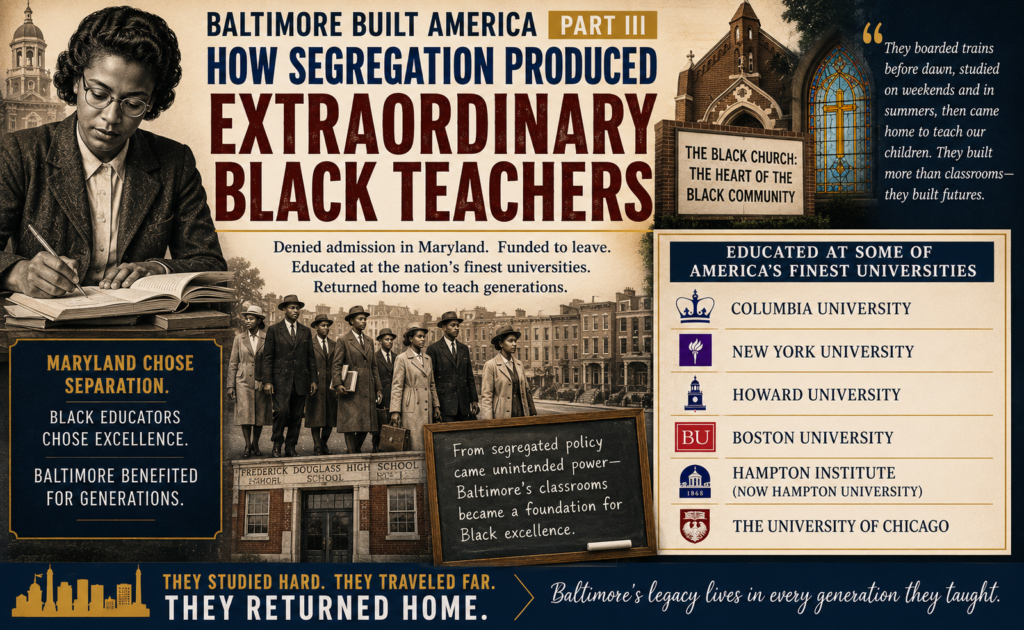
Baltimore Built America, Part III: How Segregation Produced Extraordinary Black Teachers
(BALTIMORE – July 11, 2026) – Every now and then, history surprises you.
Not because the facts have been hidden.
But because no one has ever connected them.
That happened during one of my many conversations with Baltimore historian Marco Merrick.
Marco and I had been discussing Baltimore’s remarkable legacy—its railroads, churches, civil rights pioneers, labor leaders, neighborhoods, educators, and institutions.
Then he said something that stopped me.
“If you were Black,” he said, “you couldn’t go to the University of Maryland.”
At first, I thought he was simply reminding me of Maryland’s long history of segregation.
Then he kept talking.
The State of Maryland, he explained, paid to send Black students—including many teachers—to graduate schools outside the state rather than admit them to its own universities.
I had never thought about it that way.
So I began researching.
The deeper I dug, the more I realized Marco had pointed me toward one of the great untold stories of Black Baltimore.
Maryland Paid Black Students to Leave
For much of the first half of the twentieth century, Maryland maintained segregated higher education.
Although Black Marylanders paid taxes that supported the University of Maryland, many graduate and professional programs remained closed to them.
One of the defining legal battles came in 1935 when Donald Gaines Murray, represented by a young Baltimore attorney named Thurgood Marshall, challenged the University of Maryland School of Law after being denied admission because he was Black.
Maryland’s highest court ruled in Murray’s favor in 1936.
The decision forced the law school to admit him.
But the state did not immediately dismantle segregation throughout its system of higher education.
Instead, lawmakers expanded another strategy.
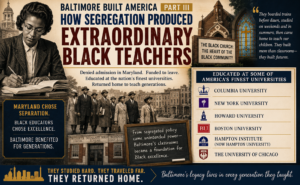
In 1937, Maryland established the Commission on Scholarships for Negroes, appropriating taxpayer dollars to send Black students to graduate and professional schools outside Maryland whenever comparable programs remained unavailable within the state.
Rather than integrate its universities, Maryland financed separation.
The message was unmistakable.
We’ll pay for you to leave before we’ll allow you to study beside white students in our own classrooms.
The Unintended Consequence
History often produces consequences no one anticipates.
Maryland intended to preserve segregation.
Instead, it helped create one of the most highly educated generations of Black teachers in America.
Unable to pursue graduate education in Maryland, many Black educators earned advanced degrees from some of the nation’s leading universities, including:
- Columbia University
- New York University
- Howard University
- Boston University
- Hampton Institute
- The University of Chicago
Some boarded trains before dawn on Saturday mornings.
Some attended classes during the summer.
Some spent weekends in New York or other cities, then returned to Baltimore in time to stand before their students Monday morning.
They endured segregation while pursuing academic excellence.
Then they came home.
They Returned to Teach Baltimore
This may be the most remarkable part of the story.
These educators did not earn prestigious degrees simply to improve their own careers.
They returned to Baltimore.
They became classroom teachers.
Department heads.
Principals.
Mentors.
Master educators.
They taught generations of Baltimore children.
Doctors.
Lawyers.
Ministers.
Scientists.
Entrepreneurs.
Teachers.
Civil rights leaders.
Public servants.
When people speak about Baltimore’s legendary Black schools, perhaps they should first speak about Baltimore’s legendary Black teachers.
My Father’s Education
As I researched this history, I found myself thinking about my father.
Donald Edward Glover, born in 1931, often told me that he and his classmates received a world-class education.
He wasn’t exaggerating.
He believed it.
My father graduated from Frederick Douglass High School, Baltimore’s first public high school established for African Americans.
Long before Dunbar High School became another pillar of Black academic excellence, Douglass educated generations of Baltimore’s Black leadership.
Growing up, I accepted my father’s confidence in his education without questioning it.
Today, I understand it differently.
If Maryland refused to admit many Black students into its graduate schools, yet financed advanced education at Columbia, NYU, Howard, Boston University, Hampton Institute, and the University of Chicago, then many of those educators returned to Baltimore carrying credentials from some of America’s finest universities.
They came home.
They taught my father.
Perhaps his confidence wasn’t nostalgia.
Perhaps it was simply the truth.
The Churches That Built Schools
The deeper Marco and I explored Baltimore’s history, another pattern became impossible to ignore.
Many of Maryland’s historic Black colleges were born inside Black churches.
Union Baptist Church played a foundational role in what became Bowie State University, originally established to educate Black teachers.
Sharp Street Memorial United Methodist Church gave birth to Centenary Biblical Institute, the institution that eventually became Morgan State University.
Bethel A.M.E. Church helped establish what became Coppin State University, continuing a long tradition of educational leadership within Baltimore’s African Methodist Episcopal community.
Even Baltimore journalism carries church roots.
Few people realize that The AFRO-American newspaper began in the basement of Sharon Baptist Church.
These stories reveal something larger.
The Black church was never simply a place of worship.
It was an incubator.
It produced colleges.
Newspapers.
Teachers.
Pastors.
Lawyers.
Journalists.
Civil rights leaders.
Entrepreneurs.
It produced institutions.
The Church That Raised Me
Researching these institutions forced me to reflect on my own childhood.
Much of my upbringing took place inside the very institutions I am now writing about.
As a young boy, I attended daycare at St. Mark’s Baptist Church.
Later, I participated in Boy Scouts through Union Baptist Church on Druid Hill Avenue and later through Perkins Square Baptist Church.
At the time, those experiences seemed perfectly ordinary.
Looking back, I realize they were extraordinary.
Union Baptist was far more than another church.
Through leaders such as Rev. Dr. Harvey Johnson and later Rev. Dr. Vernon N. Dobson, it became one of Baltimore’s great centers of faith, education, civil rights, and community leadership.
As a child, I didn’t fully appreciate what those walls had witnessed.
Today, I do.
My father made certain I understood Baltimore.
Not just the neighborhood where we lived.
Baltimore.
He introduced me to East Baltimore.
He exposed me to Sandtown-Winchester.
He took me around Druid Hill Avenue, where so much of Baltimore’s Black religious, educational, legal, and civil-rights history unfolded.
He never announced that he was teaching me history.
He simply made sure I experienced it.
Looking back, I now realize my education did not begin in a classroom.
It began at home.
It continued in churches.
Funeral homes.
Neighborhoods.
Community organizations.
And conversations with elders who understood that preserving history was every bit as important as making it.
The Center of Black Baltimore
Before integration, the Black church stood at the center of Black community life.
It was where people worshipped.
But it was also where jobs were found.
Scholarships were announced.
Political campaigns were organized.
Community meetings were held.
Civil rights strategies were developed.
Families celebrated weddings.
Families mourned loved ones.
My father’s career in funeral service reinforced that lesson.
As president of the Funeral Directors and Morticians Association of Maryland, he understood that relationships with pastors were not optional.
They were essential.
Churches and funeral homes stood among the strongest institutions in Black Baltimore.
Each served families during life’s most significant moments.
Then Came Integration
Integration was one of the greatest victories of the Civil Rights Movement.
It opened doors that generations had fought to unlock.
Black families moved into neighborhoods where they had previously been prohibited from living.
Opportunities expanded.
Communities evolved.
Churches changed.
Some congregations followed their members into Randallstown, Owings Mills, Columbia, and Baltimore County.
Others remained in neighborhoods whose populations changed dramatically.
Television.
Livestreaming.
Mega-churches.
Multiple campuses.
The Black church adapted.
It remains an essential institution.
But it no longer occupies the singular place at the center of Black community life that it once did during segregation.
That isn’t a criticism.
It’s history.
Marco’s Question
Before we ended one conversation, Marco raised another question.
What happened to those extraordinary Black teachers after desegregation?
The historical record confirms that Black educators began teaching in formerly white schools.
National scholarship documents that thousands of Black teachers and principals across America lost positions, leadership opportunities, or influence as school systems reorganized following Brown v. Board of Education.
Baltimore’s story deserves deeper investigation.
Did historically Black schools lose some of their most experienced educators?
Did they lose institutional memory?
How did those changes affect generations of students?
Those questions deserve careful research.
They deserve evidence.
And they deserve honest discussion.
Marco believes the answers may help explain part of Baltimore’s educational story.
Whether history ultimately confirms every aspect of that belief remains to be seen.
But his questions are important enough to ask.
History Is a Conversation
Marco often insists he isn’t a historian.
“I just love history,” he told me.
I smiled.
“That makes you a historian.”
He’s right about one thing.
History isn’t preserved only in archives.
It’s preserved in conversations.
In churches.
In classrooms.
In funeral homes.
In neighborhoods.
In family stories passed from one generation to the next.
Every conversation with Marco uncovers another chapter of Baltimore’s story.
Every memory of my father helps me better understand that story.
And every article I write in this series reminds me that I am not simply researching Black Baltimore.
In many ways, I am rediscovering the institutions that helped raise me.
___________________________________________________________________
Related Articles: