

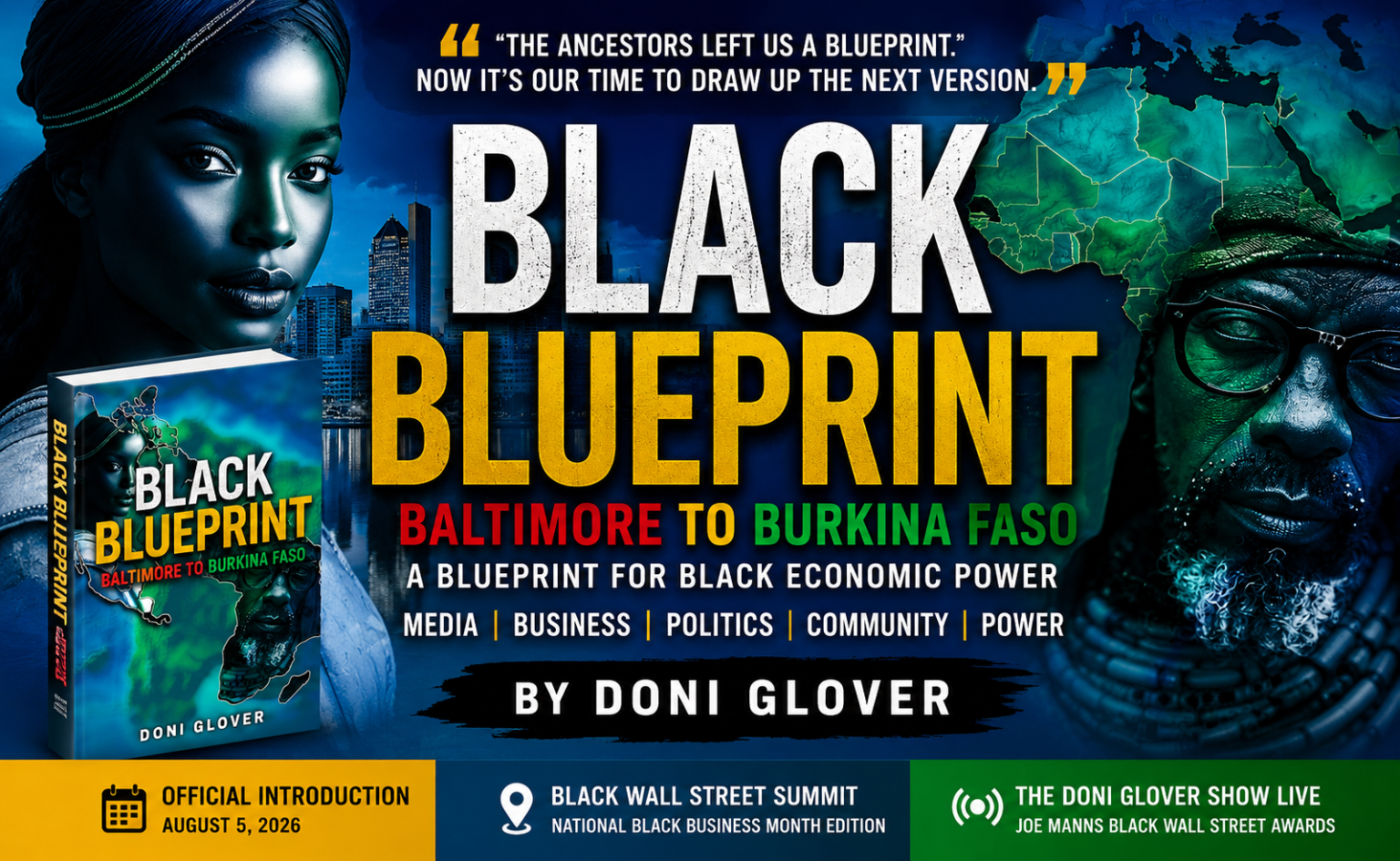
As the Black Wall Street Summit arrives on August 5, Doni Glover’s Black Blueprint: Baltimore to Burkina Faso finally gets the stage it deserves—and perhaps the moment it was written for.
(BALTIMORE – June 27, 2026) – “I was never meant to be a statistic. I was raised to be a solution.”
Those are the first words of Black Blueprint.
Every time I read them, I’m transported back to North Avenue.
Back to the crack epidemic.
Back to liquor stores on every corner.
Back to schools that struggled.
Back to friends who never made it out.
And back to my parents—Doc and Lillie Glover—who looked at everything happening around us and decided their son would become part of the solution instead of another statistic.
That decision changed my life.
It also became the foundation for this book.
Some Books Arrive Exactly When They’re Supposed To
I finished Black Blueprint months ago.
Truth be told, I didn’t promote it the way most authors would.
Life happened.
Election season consumed me.
BMORENews kept moving.
BlackUSA.News kept growing.
The Joe Manns Black Wall Street Awards continued honoring builders.
My doctoral research continued.
Another conference had to be organized.
Looking back, I don’t think the timing was right.
Now I do.
Because the Black Wall Street Summit isn’t simply another conference.
It’s the first time all of these ideas come together under one roof.
August 5 isn’t just another event on my calendar.
It’s the public introduction of an idea I’ve been building toward for more than twenty-five years.
This Book Isn’t About Me
People often ask whether Black Blueprint is my autobiography.
It isn’t.
Yes, you’ll read about my journey—from Sandtown to the White House.
You’ll read about Jordan.
Africa.
Politics.
Business.
Journalism.
The founding of BMORENews.
The Joe Manns Black Wall Street Awards.
Conversations with governors, entrepreneurs, community organizers, and world leaders.
But those stories aren’t the destination.
They’re the evidence.
The real subject of this book is one question:
How do Black communities build institutions that create lasting economic and political power?
For twenty-five years I’ve watched communities succeed.
I’ve also watched communities decline.
The difference almost always comes back to institutions.
Who owns the businesses?
Who controls the media?
Who develops the neighborhoods?
Who educates the children?
Who organizes the churches?
Who trains the next generation?
Who invests?
Who tells the story?
Those are the questions Black Blueprint attempts to answer.
The Summit Is the Book Come Alive
Look closely at the August 5 program.
You’ll discover every forum represents a chapter.
The Leadership Forum explores political leadership.
The Black Wealth Forum explores economic leadership.
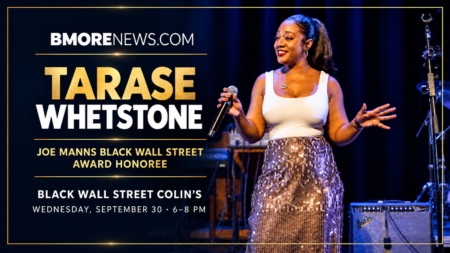
The Joe Manns Black Wall Street Awards celebrate institution builders.
Nothing about that happened by accident.
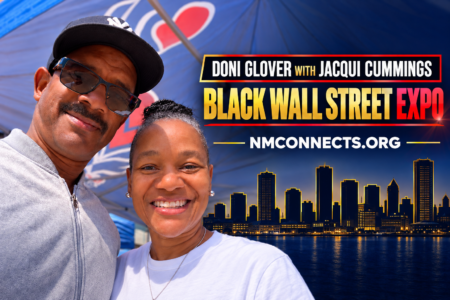
Jacqui Cummings isn’t simply a speaker.
She’s a chapter.
Her work building Black Wall Street on 25th demonstrates what ownership looks like when it becomes community development.
Renny Bass.
Kevin Scott.
Vennieth McCormick.
Each represents a different pathway toward Black wealth creation.
Together they answer a question our community has been asking for generations:
How do we build?
Then come Sabrina Tapp-Harper.
Arkia Wade.
Delegate Malcolm Ruff.
Their conversation isn’t about winning elections.
It’s about what happens after Election Day.
Because political power only matters if it produces better schools.
Safer neighborhoods.
Stronger businesses.
Greater opportunity.
Until then, elections are only the beginning.
Why This Book Matters
We’ve spent decades talking about civil rights.
We’ve spent decades talking about social justice.
We’ve spent decades talking about representation.
Those conversations matter.
But here’s what I’ve learned after twenty-five years covering Black America:
Political power without economic power is incomplete.
Economic power without institutions is temporary.
Institutions without leadership eventually collapse.
Everything is connected.
That’s the blueprint.
Government.
Business.
Faith.
Education.
Media.
Community organizations.
They aren’t separate conversations.
They’re one conversation.
The Chapter I Hope Everyone Reads
One of my favorite chapters is called The Power of Black Media Ownership.
It asks a simple question.
If we don’t support our own media…
Who will?
Roland Martin understood it.
Cathy Hughes understood it.
Oprah Winfrey understood it.
Dorothy Brunson understood it.
Ownership changes everything.
That’s why BMORENews is still here after twenty-four years.
Not because it was easy.
Because it was necessary.
Communities that don’t own their narrative eventually lose control of it.
Why August 5 Matters
This Summit isn’t simply about hearing good speakers.
It isn’t simply about honoring remarkable people.
It isn’t simply about buying another book.
It’s about connecting the dots.
Politics.
Business.
Education.
Media.
Faith.
Community.
Ownership.
For the first time, those ideas come together in one place.
That is what Black Blueprint has always been trying to say.
Leave With More Than Inspiration
On August 5, I hope people leave with more than photographs.
More than applause.
More than another business card.
I hope they leave asking bigger questions.
What institution am I building?
What legacy am I creating?
What will still be standing fifty years after I’m gone?
Because hope, by itself, has never changed a neighborhood.
Strategy has.
Ownership has.
Leadership has.
Institutions have.
History doesn’t write itself.
Somebody has to pick up the pen.
Somebody has to build the business.
Somebody has to invest.
Somebody has to organize.
Somebody has to tell the story.
On August 5, we gather to celebrate those who already are.
And to inspire those who will.
Bring a notebook.
Leave with a blueprint.
The Black Wall Street Summit: National Black Business Month Edition
Featuring The Doni Glover Show LIVE, the Joe Manns Black Wall Street Awards, and the introduction of Black Blueprint: Baltimore to Burkina Faso
Wednesday, August 5, 2026
6:00 p.m. – 8:00 p.m.
Justice Thurgood Marshall Amenity Center
1315 Division Street
Baltimore, Maryland 21217
Admission is free.
Books will be available for purchase and signing.