



(BALTIMORE – August 1, 2026) – For the uninitiated, Howard University made national headlines this week after unenrolling 502 incoming freshmen who had not satisfied the university’s financial requirements by its deadline.
Since then, more than 200 students have been reinstated following individual reviews. That still leaves hundreds of young people and their families facing uncertainty just weeks before the beginning of the fall semester.
Howard maintains that it repeatedly communicated its deadlines and financial requirements. Some affected families say the communication was confusing, their financial aid or outside scholarships had not been properly reflected, or they could not get timely answers from university officials.
Whatever side one takes, the controversy has raised a larger question: Can Black people have an honest conversation about accountability at an HBCU without someone treating the conversation as an attack on Black institutions?
I certainly hope so.
Race still matters in America. HBCUs were created because Black people were excluded from most of the nation’s colleges and universities. Many remain underfunded today, while operating with smaller endowments and fewer resources than their predominantly white counterparts.
Those facts are real. They must always be part of the conversation.
But acknowledging the historic mistreatment of HBCUs does not mean we cannot ask what an institution is doing with the money it receives. It does not mean we cannot examine graduation rates, student retention, administrative effectiveness, faculty working conditions, and the quality of the education students are receiving.
Those are not anti-HBCU questions.
Those are accountability questions.
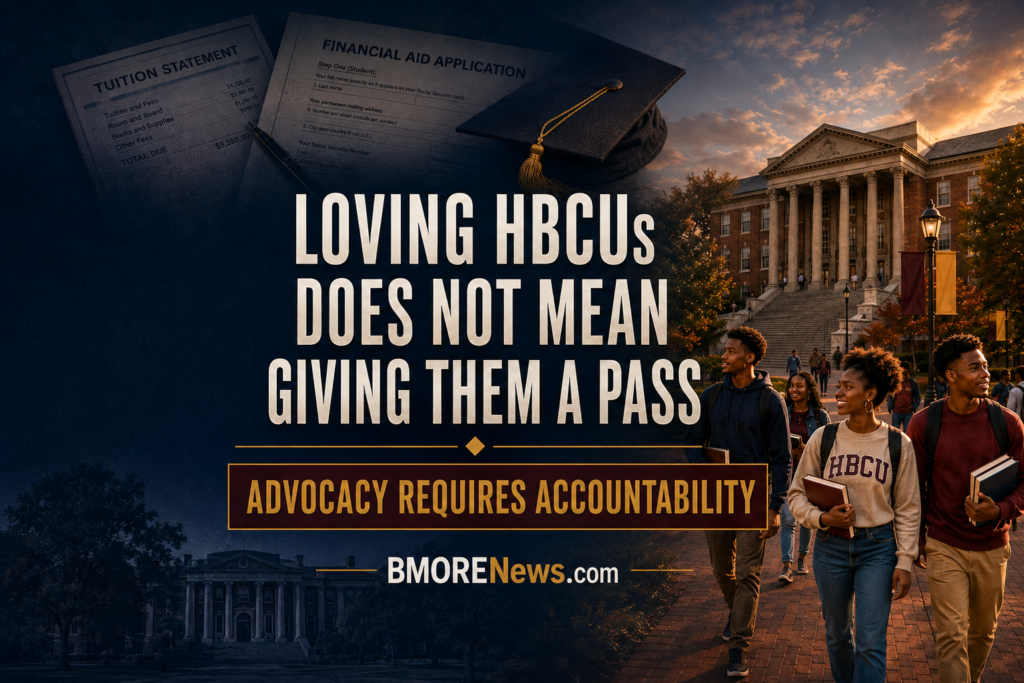
Advocacy Requires Accountability
I have consistently advocated for Black colleges. I have pushed the state of Maryland to honor its obligations to its historically Black institutions after generations of discriminatory funding and program duplication.
But supporting HBCUs does not require silence.
We should be able to ask:
What did you do with the money?
Are you being a good steward of your resources?
Are students receiving the education and support they were promised?
Are administrators communicating effectively with families?
Are students graduating—and how much debt are they carrying when they leave?
When a prospective student or parent asks about a school’s graduation rate, that is not disrespect. With the exorbitant cost of higher education today, it is due diligence.
Families have every right to ask what kind of return they can reasonably expect from an investment that may follow them financially for decades.
That standard should apply to every institution—Black, white or otherwise.
I Have Lived This Experience
My position does not come from hostility toward HBCUs. It comes from love, experience and investment.
I attended three HBCUs: Morehouse College, Coppin State University and Morgan State University.
Morehouse gave me the dream. Coppin helped me earn my bachelor’s degree. Morgan helped me climb higher academically.
I know firsthand the cultural power of an HBCU. I know what it means to enter an environment where Black excellence is not an exception. I know what it means to be surrounded by our history, our traditions, and professors who see potential in Black students that the rest of the world may overlook.
I also know what it means when the money runs out.
My mother begged, borrowed, and maybe even stole to help send me to Morehouse. Going there was one of the greatest experiences of my life. I met brothers from across the country. I met Coretta Scott King. I experienced a world that helped shape the man I would become. I walked where giants walked.
But after three semesters, I had to face the reality that I could not afford to remain there.
That experience is one reason I refuse to dismiss questions about tuition, financial aid and institutional responsibility. These are not abstract matters. These decisions can redirect a young person’s entire life.
Overworked and Underpaid Professors
Accountability must also include how institutions treat their professors.
In my experience, many HBCU professors are overworked and underpaid.
Overworked and underpaid.
Overworked and underpaid.
What happens when a professor is carrying an excessive teaching load, attempting to publish, advising students, serving on committees, and still struggling financially?
The students do not always receive everything that professor could otherwise give them.
Seasoned professors may hide the stress better than younger professors, but the stress is still there. It enters the classroom. It affects preparation, availability, research and the amount of individual attention students receive.
Predominantly white institutions frequently have larger endowments, better research support, lighter teaching loads and higher faculty salaries. That inequality must be acknowledged.
However, limited resources do not eliminate an institution’s responsibility to use what it has wisely. They make responsible stewardship even more important.
Philanthropy Is Not a Substitute for Transparency
We have witnessed extraordinary philanthropy directed toward HBCUs.
In 2019, Robert F. Smith famously announced that he would pay off the student-loan debt of Morehouse College’s graduating class. MacKenzie Scott and other major donors have given hundreds of millions of dollars to historically Black institutions. Alumni, churches, corporations, celebrities and ordinary Black families continue to contribute.
That generosity is beautiful.
But every large gift should be followed by a reasonable question: What measurable difference did it make for students?
Did it lower their financial burden?
Did it improve graduation and retention rates?
Did it strengthen academic programs?
Did it help recruit and retain faculty?
Did it modernize financial-aid and administrative systems?
We should not be afraid to follow the money merely because the recipient is a Black institution. Accountability protects the institution, the donor and, most importantly, the student.
My Question About UNCF
I will also say something that may make some people uncomfortable.
I have been around higher education since I was 18 years old, and I cannot personally recall meeting anyone who identified themselves to me as a United Negro College Fund scholarship recipient.
That does not mean UNCF has not helped students. Its 2025 annual report says 10,885 students received scholarships during that fiscal year, and the organization reports awarding more than $62 million in scholarships annually.
Those are substantial numbers.
But my personal experience raises a communications question: Where are those recipients? Are their stories being told loudly and consistently enough in our communities? Do prospective students know how to find and apply for these opportunities?
I am not accusing UNCF of doing nothing. I am saying that organizations collecting money in the name of Black students should welcome questions about who receives it, where it goes, and what outcomes it produces.
Transparency should never offend an organization that is doing the work.
Love Does Not Require Silence
When Black people raise these questions, the response cannot always be, “Why don’t you ask that about white institutions?”
People connected to predominantly white institutions should—and frequently do—hold those schools accountable. But I am speaking about Black institutions because I attended Black institutions, advocate for Black institutions, and care deeply about their survival.
Do not try to guilt me into silence.
I am Black, and I am asking about accountability.
I want HBCUs funded fairly. I want their professors paid properly. I want their facilities modernized. I want their endowments strengthened. I want students to arrive, thrive, graduate, and leave without a lifetime of crushing debt.
And because I want those institutions to survive, I will continue asking hard questions.
We cannot demand accountability from white America while treating accountability as betrayal when it reaches our own institutions.
HBCUs are too important to be placed beyond scrutiny.
They deserve our protection from discrimination. They deserve equitable public investment. They deserve our philanthropy, advocacy and respect.
But our students deserve transparency, competence and responsible stewardship, too.
Love does not require silence.
Real love demands accountability.