


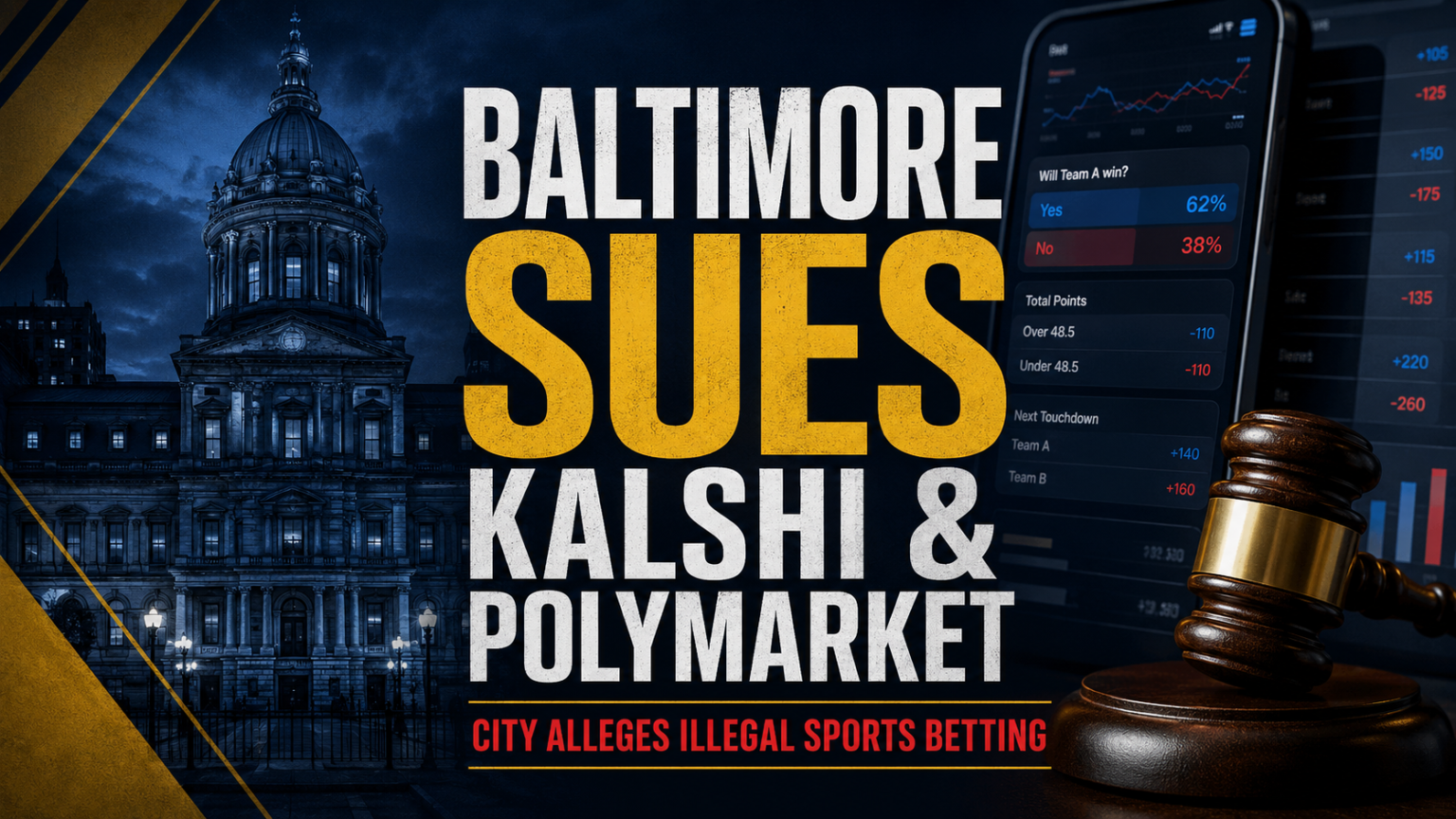
BALTIMORE, MD (August 13, 2026) – Today, Mayor Brandon M. Scott and the City Council of Baltimore filed lawsuits in the Circuit Court for Baltimore City against prediction market operators Kalshi and Polymarket and their affiliated companies. The lawsuits allege that the companies violated Baltimore’s Consumer Protection Ordinance (CPO) by operating illegal, unlicensed sports-betting platforms and misleading consumers about the legality and regulatory status of their products.
According to the complaints, Kalshi and Polymarket allow Baltimore residents to wager on game winners, point spreads, point totals, player statistics, and other propositions commonly offered by licensed sportsbooks. Although the companies describe these wagers as ‘event contracts’ or prediction-market trades, the complaints contend that they function as sports bets and constitute unlawful gambling under Maryland law.
“These companies are running sportsbooks without licenses and betting that a new label will put them above the law,” said Baltimore Mayor Brandon M. Scott. “It won’t. Baltimore will not let multibillion-dollar companies put profits over people and harm our communities through illegal gambling.”
The lawsuits allege that Kalshi and Polymarket offer sports wagering in Baltimore without the licenses required under Maryland law, allowing them to compete with regulated sportsbooks while avoiding the oversight, taxation, responsible-gambling requirements, and consumer protections imposed on licensed operators. According to the complaints, Kalshi and Polymarket offer many of the same wagers available through traditional online sportsbooks, including moneyline-style wagers, point spreads, totals, tournament outcomes, and player-performance propositions through a platform that closely resembles an online sportsbook.
“Kalshi and Polymarket cannot circumvent Baltimore’s consumer protections by repackaging gambling as something else or claiming federal regulation puts them beyond the reach of our laws,” said City Solicitor Ebony M. Thompson. “The City will continue to use its consumer protection authority to stop deceptive and unlawful conduct and hold companies accountable when they put our residents at risk.”
The lawsuits further allege that Kalshi and Polymarket market their platforms in ways that create a false or misleading impression that their offerings are lawful and appropriately regulated, while making gambling readily accessible to consumers. This conduct can expose vulnerable populations, including young adults and people with gambling addictions, to significant financial harm.
“Allowing prediction market companies to evade gambling laws would set a dangerous precedent far beyond Baltimore,” said DiCello Levitt Founding Partner Adam Levitt. “These companies cannot be permitted to use new terminology and new technology to operate outside the rules designed to protect consumers and communities.”
The City asserts claims for unfair, abusive, and deceptive trade practices under Baltimore’s Consumer Protection Ordinance and seeks civil penalties, injunctive relief, restitution for affected consumers, disgorgement of ill-gotten profits, and other relief authorized by law.
A copy of the Kalshi complaint is available here. A copy of the Polymarket complaint is available here.
The legal team in this matter is led by the Baltimore City Law Department’s Ebony M. Thompson, Sara Gross, and Thomas Webb and DiCello Levitt’s Adam Levitt, Dan Ferri, Joseph “JJ” Nelson, and Andrea Shang.