


The city has the institutions, talent and emerging leadership to become a world-class technology and business hub—but only if Baltimore improves efficiency, celebrates enterprise and moves Black businesses from participation to power
(BALTIMORE – September 16, 2026)—A decade ago, the operative term was “biotech.”
Today, researchers, entrepreneurs and investors are talking about algorithms, artificial intelligence, wearable technology and quantum computing. “Data centers” is the new topic du jour at the water fountain.
The language has changed because the economy is changing.
Baltimore has an opportunity to become a major technology and business hub. We already have many of the ingredients. The University of Maryland, the University of Maryland Medical System, and Johns Hopkins University are internationally respected anchor institutions. We have Morgan State University, Coppin State University, Loyola University Maryland, the University of Baltimore, and the Maryland Institute College of Art.
We have hospitals, researchers, laboratories, entrepreneurs, manufacturers, software developers, medical innovators, and one of the most strategically located ports on the East Coast. We are connected to BWI Marshall Airport, Washington, D.C., Fort Meade, and one of the nation’s largest concentrations of federal research and cybersecurity assets.
By golly, Baltimore is long overdue for a rejuvenation—a booster shot.
The innovation is already here
Consider BC3 Technologies.
BMORENews previously documented the Black family and Baltimore manufacturing legacy behind the company’s SEAL Hemostatic Wound Spray. Now, BC3 has announced that SEAL is available at 77 Army & Air Force Exchange Service locations in the United States and overseas.
That is not merely another press release about innovation.
That is a Baltimore company taking a patented, FDA-cleared medical product into brick-and-mortar retail. It means distribution, manufacturing, commercialization, and access to new customers, including military families in the United States and abroad.
That is what an emerging technology economy should produce: not just research papers and ribbon cuttings, but products that reach the marketplace.
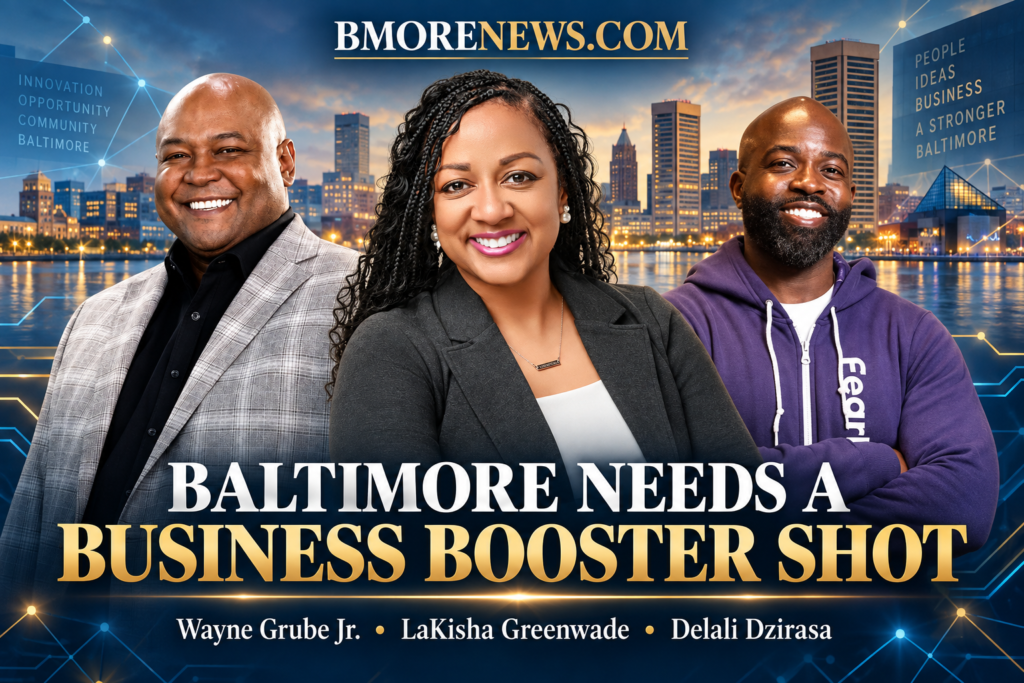
Then there is LaKisha Greenwade, founder and CEO of Wearable Tech Ventures. Greenwade has been building an ecosystem around wearable technology for approximately a decade. Her work connects artificial intelligence, engineering, health, sports, fashion, and entrepreneurship while creating opportunities for founders who have traditionally lacked access to capital and powerful networks.
Her organization aims to support 100 wearable-technology startups by 2030.
Fearless, founded by Delali Dzirasa, represents another part of the ecosystem. The Baltimore-based digital-services firm builds software and modernizes systems, including work for government clients. Fearless has demonstrated that a Black-founded technology company can grow from Baltimore while maintaining a visible commitment to the city.
Morgan State University has launched a bachelor’s degree in artificial intelligence. The University of Maryland is expanding its work in AI, commercialization, and quantum science. Researchers throughout the region are moving ideas from laboratories toward practical applications.
Baltimore’s emerging technology ecosystem is not confined to one field. It includes medical technology, software, artificial intelligence, data science, cybersecurity, wearable technology and quantum computing.
The question is whether Baltimore can connect those assets into a functioning business ecosystem.
A new presence at Baltimore Peninsula
In April, the University of Maryland’s Robert H. Smith School of Business opened a new Baltimore campus at Baltimore Peninsula, formerly known as Port Covington.
Located in Rye Street Market, the campus houses the Smith School’s Flex MBA program for working professionals. Its presence matters because technological innovation requires more than engineers and researchers. It also requires people who understand finance, management, marketing, operations, strategy, and commercialization.
Baltimore Peninsula was promoted as a transformative development. It received enormous public support and generated enormous expectations. The results have taken longer and emerged on a smaller scale than many Baltimoreans anticipated.
However, the arrival of the Smith School creates another opportunity. The campus can become more than a place where students attend classes and earn degrees. It can become a bridge connecting business education with Baltimore’s entrepreneurs, medical institutions, technology companies, and communities.
That is where the real value will be measured.
Does the campus help entrepreneurs build companies? Does it connect students with Baltimore businesses? Does it help researchers commercialize inventions? Does it contribute to new jobs, new investment and new enterprises?
A new institution in a major development is encouraging. But Baltimore must judge economic development by outcomes, not addresses.
Baltimore must confront its anti-business reputation
Baltimore already has business-development programs, permitting systems, economic-development agencies and committed public employees. This is not an argument that nothing exists or that no one is working.
It argues that our efficiency must improve if Baltimore intends to compete as a world-class city.
BMORENews recently examined three long-vacant houses next to my home in West Baltimore. The properties had sat vacant for more than two decades, survived a major fire in 2017, and were eventually sold at auction. Months after the sale, neighbors had seen cleared yards but no visible rehabilitation.
The story raised a larger question: Can Baltimore become a genuine one-stop shop for developers?
A veteran developer described the barriers small and midsized builders encounter—financing problems, title issues, acquisition delays, permits, inspections, utility coordination, skilled-contractor shortages and fragmented agency responsibilities.
Every delay costs money. Interest continues accumulating. Insurance must be paid. Materials become more expensive. Vandals can enter unsecured buildings. A project that initially made financial sense can become impossible.
Large, favored developers often receive coordinated attention, specially structured assistance and access to decision-makers. Baltimore must democratize that treatment.
Every qualified entrepreneur and developer should receive clear information, predictable timelines, and responsive service. They should not need a political sponsor to get an email answered or a routine decision made.
Baltimore needs city employees who are eager to serve, empowered to make decisions and committed to getting things done. Many dedicated employees are already working inside City government. The challenge is ensuring that the entire system supports coordination, accountability, and timely action.
A one-stop shop cannot be a slogan. It needs an accountable case manager who can coordinate acquisition, financing, permitting, inspections, utilities and occupancy. It needs transparent project tracking, response deadlines and the authority to resolve ordinary problems.
The standard is not whether a program exists.
The standard is whether people can use it efficiently, predictably and fairly.
Business must be celebrated
Baltimore needs a culture that celebrates business—all legitimate business.
Small business is not separate from big business. When small businesses win, big businesses win.
Successful small businesses create customers, stabilize commercial corridors and generate demand for accountants, lawyers, banks, insurance companies, suppliers, technology providers and construction firms. They employ residents, occupy vacant buildings and contribute to the tax base.
Large employers need strong neighborhoods, effective schools, safe streets, reliable services and a pipeline of talented workers. Small businesses help create that environment.
Baltimore cannot afford an economic-development culture in which entrepreneurs are automatically treated as though they are asking the city for a favor. They create jobs, assume risks, and invest capital. City government should protect the public interest while helping legitimate business activity move forward.
That does not mean eliminating accountability, inspections, or community standards. It means administering them competently.
Minority business is not necessarily Black business
In a majority-Black city, Baltimore must also be precise when discussing minority-business participation.
“Minority business enterprise” is an administrative category. It is not synonymous with Black business.
MBE figures can combine businesses owned by Black people, other racial and ethnic groups, and women, including white women. Therefore, a large MBE participation percentage does not automatically demonstrate that Black businesses received a proportionate share of contracts or dollars.
Federal contracting data illustrates the problem. In fiscal year 2020, Black-owned small businesses received only 1.67% of federal contract dollars eligible for small-business participation. Minority-owned small businesses collectively received 9.4%. Black-owned firms therefore captured less than 18% of the minority-owned contracting share.
Baltimore should measure more than certifications and participation goals.
How many Black businesses are receiving prime contracts? How many remain confined to subcontracting? How many are increasing their bonding capacity, purchasing equipment, hiring workers, and acquiring property? How many are developing the financial strength to compete independently?
Subcontracting is not inherently wrong. It can provide revenue, experience, and important relationships. But it cannot be the final destination of Baltimore’s Black-business strategy.
The goal must be to move Black businesses from participation to ownership, from subcontracting to prime contracting and from chasing opportunities to controlling assets and creating opportunities.
Many Black business owners in Baltimore are not sitting around waiting for an MBE contract. They are serving customers, finding markets, meeting payroll and doing their damn business.
Baltimore must recognize them as businesses—not merely as minority-program participants.
Leadership matters
This moment also presents a notable group of Black leaders occupying some of Baltimore’s most consequential institutions.
Dr. Jermaine Dawson began serving as CEO of Baltimore City Public Schools on July 1. After meeting him and learning he is a Morehouse man, I left optimistic. Morehouse teaches excellence, preparation, and responsibility. I like Dr. Dawson’s spirit, and I find his vision believable.
Education cannot be separated from economic development. Baltimore cannot become a world-class technology hub without preparing its children to participate in the industries being built around them.
Our students must be exposed to coding, artificial intelligence, engineering, entrepreneurship, quantum science, skilled trades, and financial literacy. They must see themselves not only as future employees but as inventors, researchers, executives and owners.
Otis Rolley is president and CEO of the Baltimore Development Corporation and is the first African American man to lead the city’s principal economic-development agency.
Mark Anthony Thomas leads the Greater Baltimore Committee, the region’s major business and civic organization.
Shelonda Stokes leads the Downtown Partnership of Baltimore and the Downtown Management Authority.
These names are becoming familiar. That is significant.
In a majority-Black city, Black leadership at major education, business and economic-development institutions should not be unusual. However, representation must be connected to measurable progress.
These leaders deserve recognition, support and accountability. Their success will not be measured solely by announcements, conferences or renderings. It will be measured by stronger schools, thriving businesses, occupied storefronts, completed projects, growing companies and opportunities reaching neighborhoods across Baltimore.
The gold standard
Marion Barry in Washington and Maynard Jackson in Atlanta remain the gold standard for using mayoral power to build Black business capacity.
They understood that public contracts could do more than purchase goods and services. Used well, they could help businesses gain experience, hire employees, buy equipment, and become major employers and prime contractors.
Rudy Giuliani represented a different lesson. I am not suggesting that Giuliani was good for Black business. His policing policies caused enormous harm in Black and Latino communities.
But his administration projected that New York City intended to compete for business. There was an urgency around improving the city’s overall business climate.
Baltimore needs both a pro-business culture and an intentional Black-business strategy.
Those ideas do not conflict.
A world-class city must welcome investment, encourage entrepreneurship and operate efficiently. A majority-Black city must also ensure that Black businesses have genuine opportunities to own, build, scale and lead.
Baltimore’s moment
I am optimistic about Baltimore.
Not blindly optimistic. Not satisfied with slogans. Not interested in confusing announcements with outcomes.
But optimistic.
The assets are here. The institutional anchors are here. The entrepreneurs are here. A new generation of leaders is in place. Companies such as BC3 Technologies, Fearless, and Wearable Tech Ventures demonstrate what Baltimore can produce.
Now we must connect the pieces.
Baltimore needs an education system aligned with the industries of the future. It needs anchor institutions that buy locally and build local capacity. It needs City Hall to improve efficiency and responsiveness. It needs economic-development organizations to serve neighborhood entrepreneurs with the same urgency they give major developers.
It needs Black businesses winning prime contracts, building assets and expanding nationally and internationally.
Baltimore does not need another slogan.
It needs a booster shot—a renewed belief that enterprise matters, education matters, efficiency matters, and Black economic power matters.
Business should be celebrated in Baltimore.
And Baltimore should become the city where ideas are developed, businesses are built, and everybody with the talent and discipline to contribute has a fair opportunity to get in the game.